Another Class – Lotsa Boats

Once more, a class by Shari Blaukopf, “Sketching Boats: Simple Solutions for a Complex Scene,” has changed my approach to subject matter in watercolor and other media. I think this class amazed me the most in how it affected my own painting. As Shari writes:

I love painting boats, but this course is not really about that. It’s about simplifying a complex scene. So, while boats and their reflections are our ostensible subject, I’ll be sharing my tips and techniques for making visual sense from any scene of complexity.

Complex scenes – other than landscapes – overwhelm me when it comes to painting. I just have no idea where to begin. Looking at a bazillion things cluttering up the subject matter and deciding what to do is sometimes so much that it is better to walk away and try something simpler. For me, buildings are often the culprit, and this means city scenes go unpainted. Certainly scenes of harbors and boats and marinas are even more complex as boats sit on the water and are all about the same height – masts being the main difference in a marina full of sailboats. However, this class broke it down quite nicely, and while I am not especially enamored with the results, I am really happy with what I learned from this class and the general success of the painting.
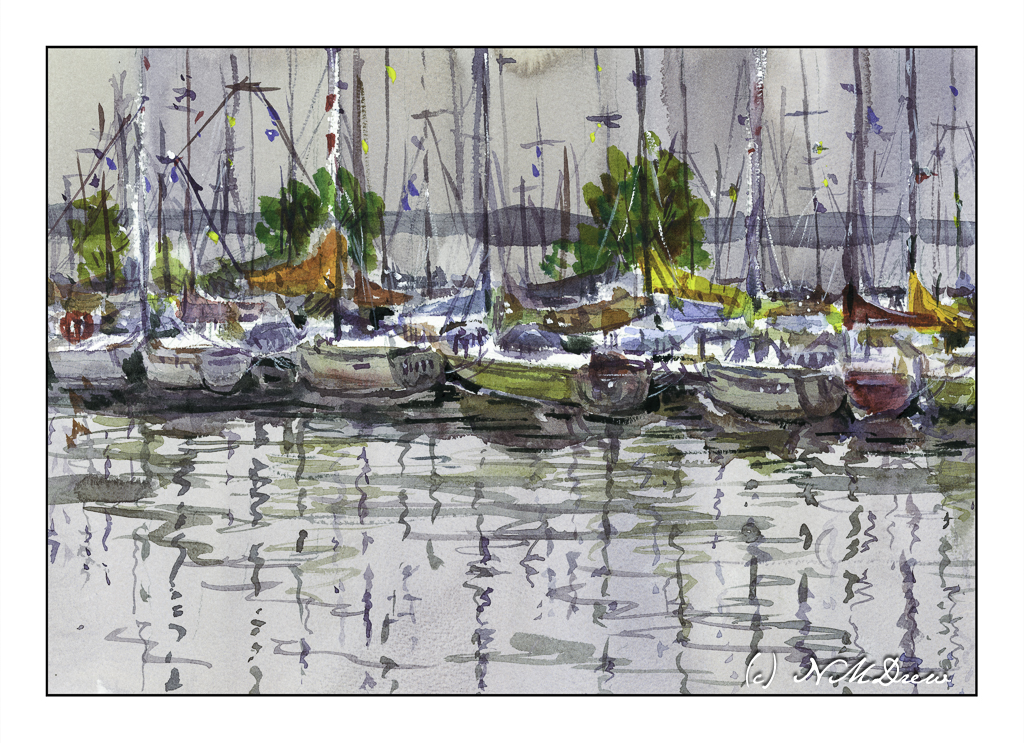
Essentially, the process is very logical and simple. The scene is drawn in pencil. The horizon line is determined, and then the drawing is begun. The boats, as they are the main subject, are drawn on an even level – they all are pulled up against a dock and the water is the surface. There are no hills or valleys. The boats closest to the viewer are drawn in detail, and the rest are suggested with shapes and lines, with their “oh, that’s a boat” qualities indicated when painted.

The sky and the forefront water first were painted along with the land in the distance behind the boats. Areas for larger masts, the white ones, are left unpainted. Then the detailed boats were generally limned in with color. Masts and reflections are indicated in this early period. From there, the painter works back toward the more distant boats and such. Eventually, details are added and final, tiny touches with color and white gouache complete the painting.

In summary: the simplest areas are completed first. The complex areas where detail counts is narrowed down to the first row of boats. Large to small. General to specific.

Writing this does absolutely no justice to Shari’s wonderful short course. I recommend it for watercolorists and any painter intimidated by complex scenes. Her breakdown of a complex scene is very simple – but I personally would never have thought about painting this way!

I was floored by my results – I did not expect to be able to do this painting at all.

Watercolor, short course by Shari Blaukopf, Arches Rough 140# paper, 10×14.
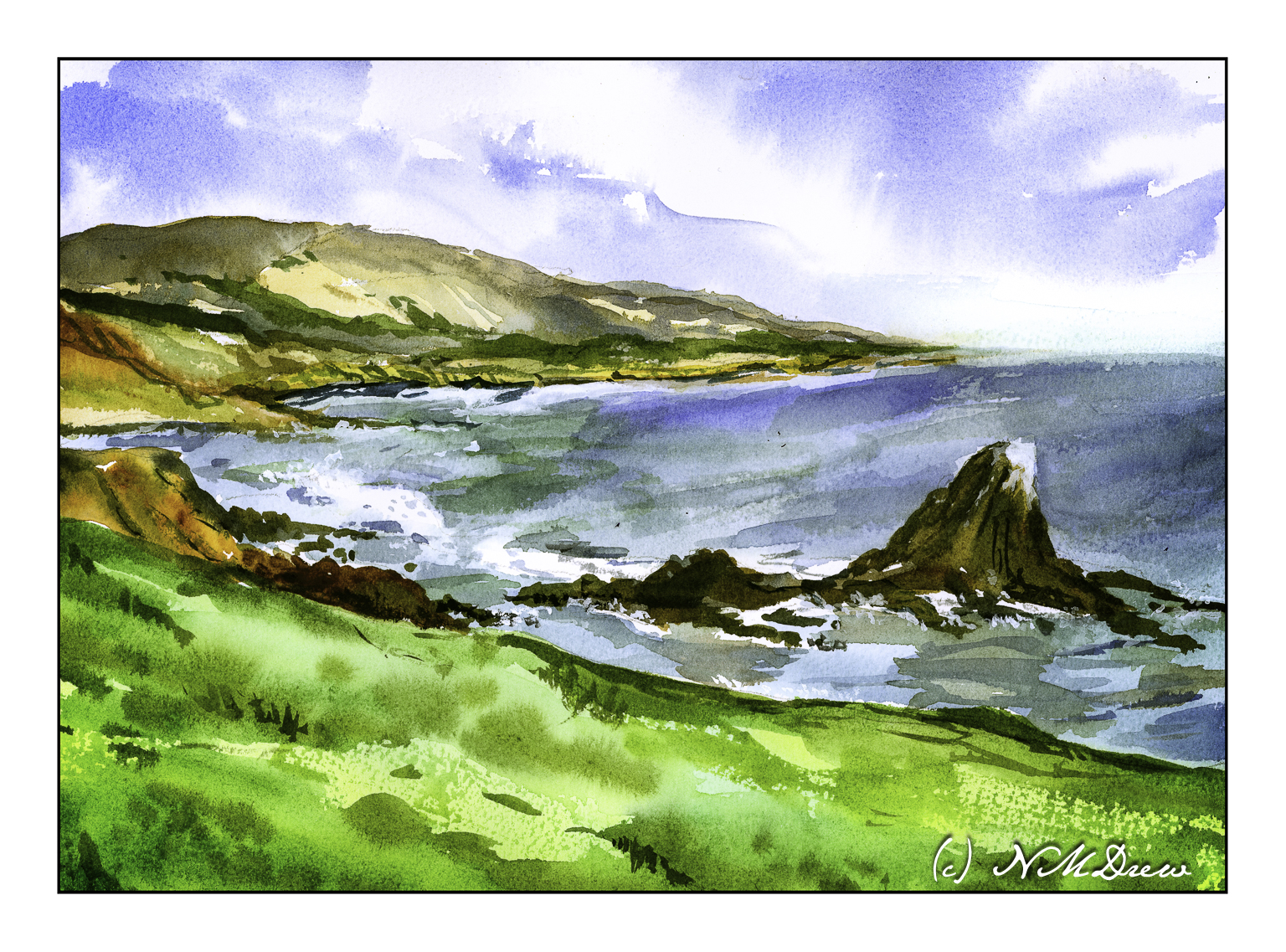
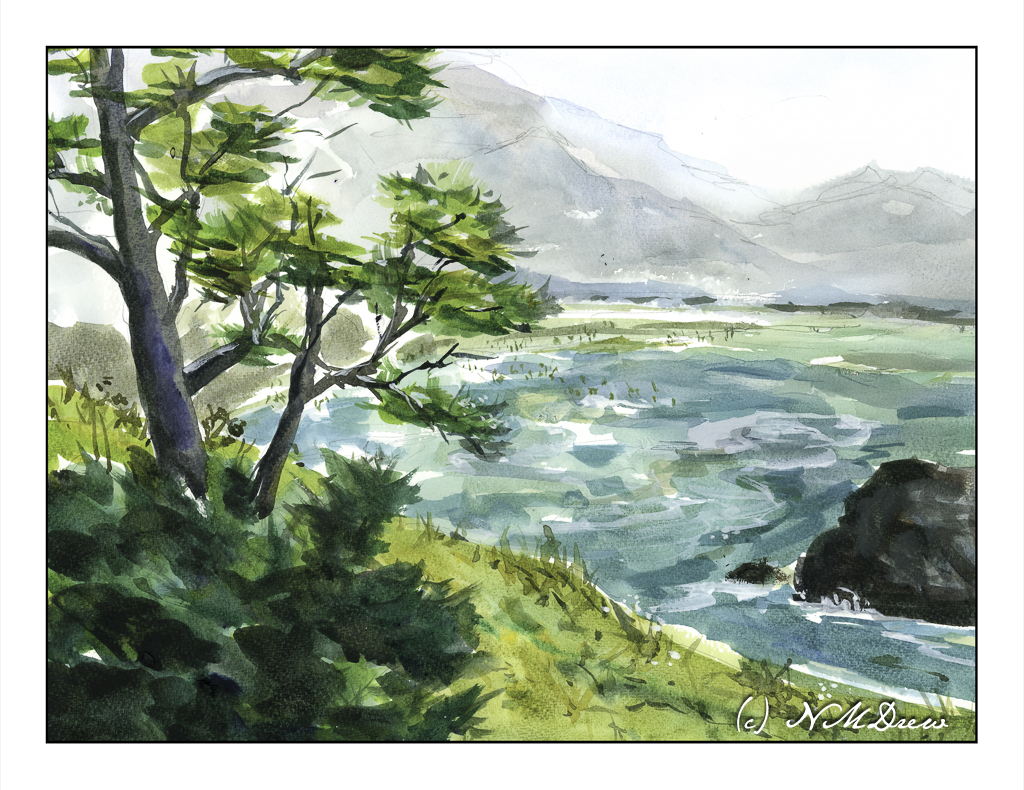
Pigeon Point

California has a wonderful number of coastal state parks. Pigeon Point is one of them. This park features a lighthouse, coastal cliffs, hiking trails – all the usual attractions. It is located south of San Francisco and worth the time to visit.

I tried to capture a bit of the wildness here with a sense of a windy day. Simplification of the foreground was a challenge. The first step was to lay down a very wet wash of yellow and green and letting them dry. From there, a bit of detail, using both dry brush and wet-into-rewetted paper.

The sky was laid in with clear water first, and from there the sky and clouds were given shape using mostly ultramarine blue in varying strengths. Once laid in, nothing was done.

The ocean was a bit tricky. There were multiple colors of blue and green and aqua. Sea foam and waves, too, added to the scene. The protruding rocks and boulders near and far add a bit of drama, and a bit of a problem! First I laid down a clear water puddle, avoiding the rocks in the foreground and the distant lands. From there, slow layering of colors, sometimes wet-in-wet, sometimes rewetting and adding color.

The distant coast was laid in with a number of simple washes, eventually building up contrast and shapes. The same was done with the rocks in the foreground, between the green slope and the horizon, but the washes were a bit darker. Once the foreground rocks were dry, increasingly less wet and more intense paints were done.

The final touches were to use titanium white gouache to get a sense of sea foam, hide a mistake or two, and complete details. I tried to work with a good sense of contrast that conveyed distance – in some ways it worked, and others it did not. This being watercolor, I think I finished in time!

Watercolors with some gouache, 11×14 Arches 140# rough paper.

Beach Day at Low Tide

After a busy several days, including the winding down of my summer painting classes, I needed to do some watercolor and landscape painting! Oil painting and portraiture require a lot of focus, but it is so restful to just think about colors and shapes, as I do in watercolors.

This painting is inspired by travels along the Oregon coastline. I tried to capture both the color of the sea as well as the mistiness of the distant mountains. The little dots representing a beach filled with people was a bit inspired because I needed to do something with some empty space in the middle. Nothing like being the god of your landscape, eh?

Watercolor, St. Cuthbert’s Mill Bockingford paper, 140# CP, 12×16.

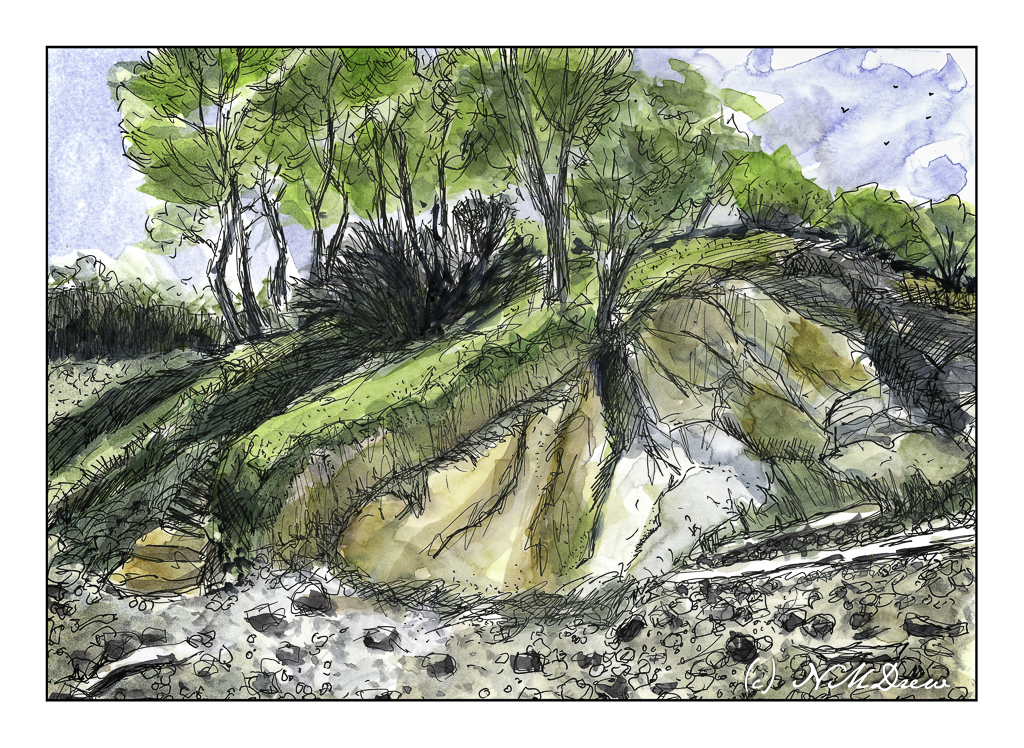
North Coast

Rocky coastlines are always fascinating because the first time I ever saw the ocean was along a wide, sandy beach with gentle waves. Not so here! You can see the debris – fallen trees stripped to bare logs, rocks, erosion. You can only imagine what it is like during a storm.

Years ago, we drove up the California coast, heading into Oregon and points north. It seems once you hit the central coast, about 100 miles from where we are, the coastline begins to change. Highway 1 leads into Big Sur, that fabled and beautiful land, and it is here you see rugged cliffs. Then, north of San Francisco, you move into the wide beach sands of Stinson Beach and move further along to the rugged Mendocino coast and then beyond. This picture is based on a photo I took there years ago – no idea where we were, but it was stunning.

Ink, watercolor, bristol paper.

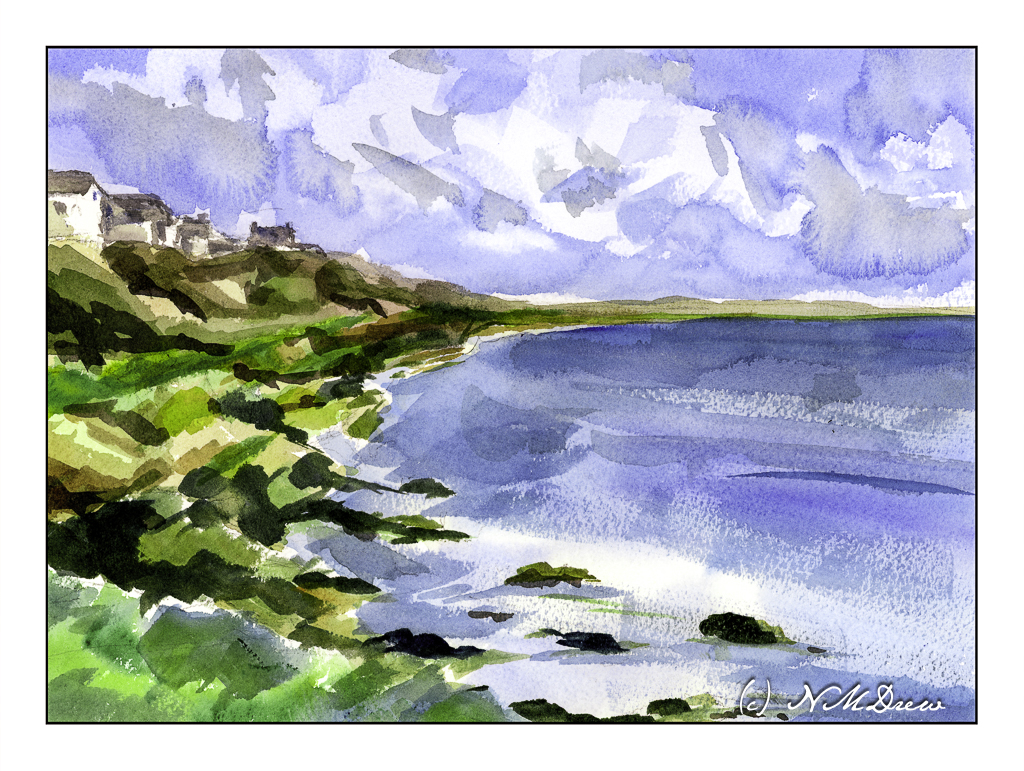
Cove

What can I say except this was one hell of a challenge! I wanted simplicity in the form of abstraction combined with atmospheric perspective. Well, the day is crisp and bright, a bit windy, and the light is harsh. Somewhere in there lays a bit of compromise.

The largest areas of the painting -sky, water – were laid in with very wet washes and allowed to dry.

The clouds were lifted out later and more blue, wet paint applied over the initial light wash. Shadows and shapes were created during this step.

The sea was a light wash with simple areas of white left behind in the foreground. Somehow the rest of it sort of happened using a large, flat brush. I find using flats really helps push the abstraction. The same can be said with the shoreline, using color to indicate plants, rocks, cliffs. The most “planned” part of the coastline were the houses and roofs. Dry brush with darker blues were applied with a wide 1″ brush to give the sea some dimension.

I had no idea how this painting would turn out. I like it for the simple fact I did achieve my desires for a simple, abstract painting which still has recognizable subject matter.

Wouldn’t it be great if we all liked everything we did? Maybe not – then we would probably never progress!