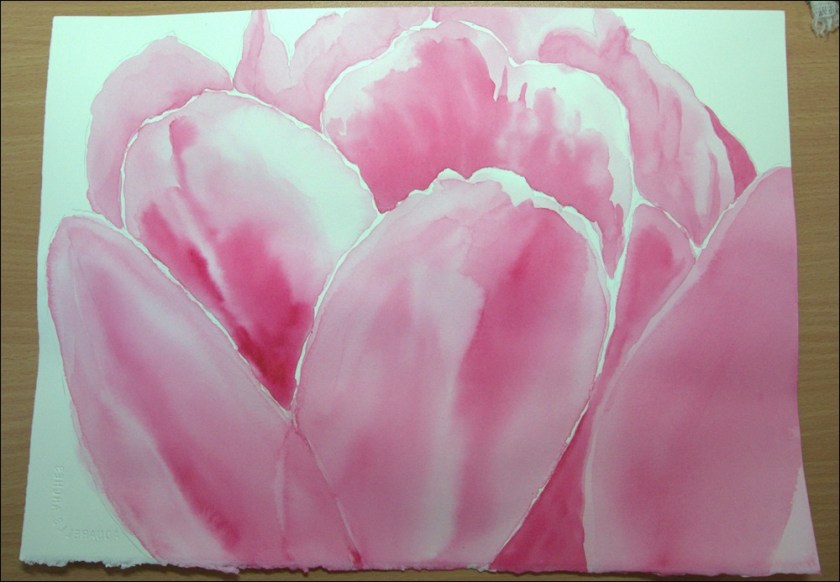
An Afternoon’s Painting Practice

I am an unabashed Charles Reid fan when it comes to instruction books and videos and style in watercolor.  I love his loose style and the way his colors flow in and out of each other without getting muddy.  Honestly, I am really a novice when it comes to watercolor painting – and mud is my usual result.  Somewhere in the past 6 months a part of me just quit worrying about what I produce, and this gave me the freedom from self-criticism (and condemnation) about what results I get.  I don’t care anymore, and this freedom is opening up doors which have been slammed shut by my unrealistic and unrelenting worrying.  It’s a great feeling!

Having a bunch of watercolors and supplies on hand, I dug out some water brushes and my traveling palette.  Out on the patio, with earphones on to listen to a spy novel, a bunch of paper towels and some water, I pulled out Reid’s book.  My watercolor pads came along with me, as did my coffee, water bottle, drawing pencils and who knows what else.  The verbal distractions of the audiobook keep me from getting too emotional about my practice pages.  I propped up Flower Painting in Watercolor and got to work, reading captions and color suggestions, drew some rough sketches from Reid’s exercises, and got to work.
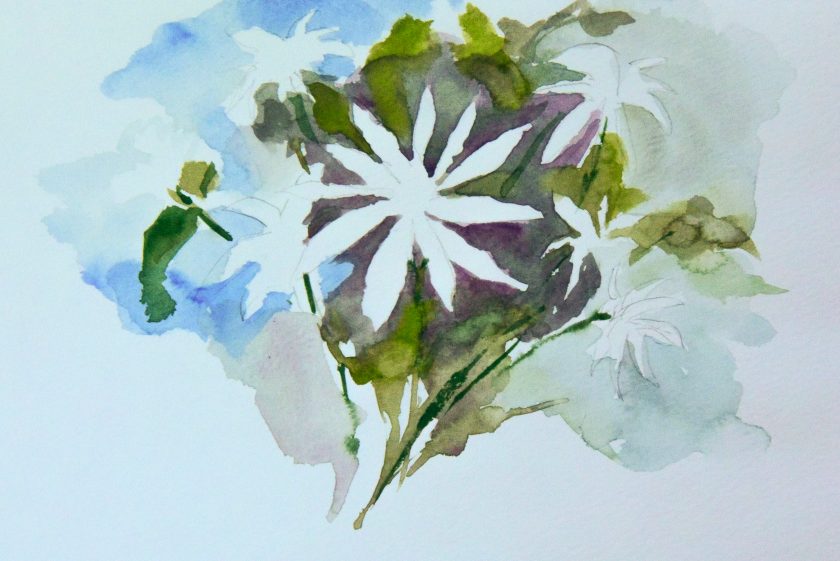
I think one of the hardest things to do is to leave white paper.  I just want to paint it all up.  And I also want to just keep going on – and this creates mud – without pause for paper to dry and paint to settle.  Rush, rush!

Well, I did succeed somewhat.  The crocuses above are one of Reid’s studies, and I was pretty pleased with it.  In reality, it doesn’t look half as good as the photo, but then it is on a piece of messy paper with scribbles on it and test swatches of color.
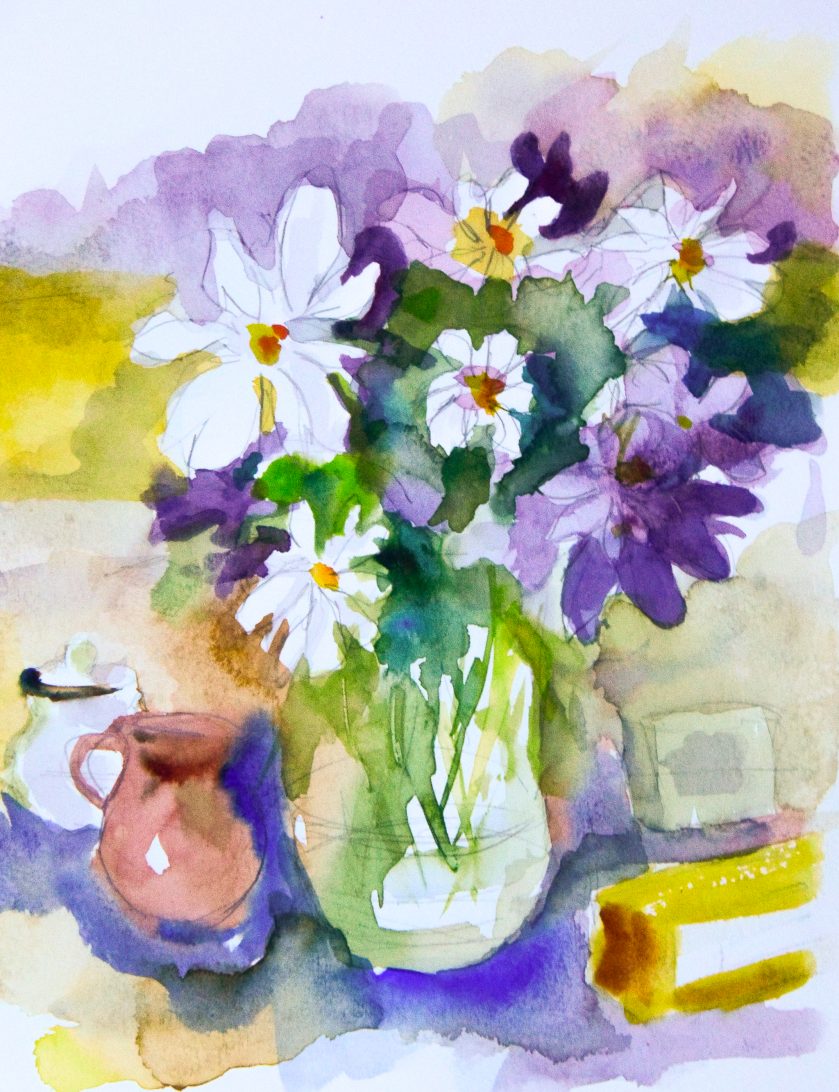
This was a quick study, more white space being left open.  I went back after I finished this study to use my pencil to add some shape to the white flowers.  I like lines – and it is a problem I find with my own sense of a “successful” painting – I need lines to define things.  Sometimes lines work – sometimes they don’t – but I do love the Renaissance ink studies I’ve seen, and lines have always held my eye.  Lines are expressive – but so are shapes of color.

Here, simply color shapes to imply a flower or a leaf.  My experience in sumi-e brush painting makes my understanding of controlling a brush – even an inexpensive water brush with nylon bristles – much easier.

One thing Reid pulls out is shapes without definition – just implication of form.  This is great practice for my line addiction!
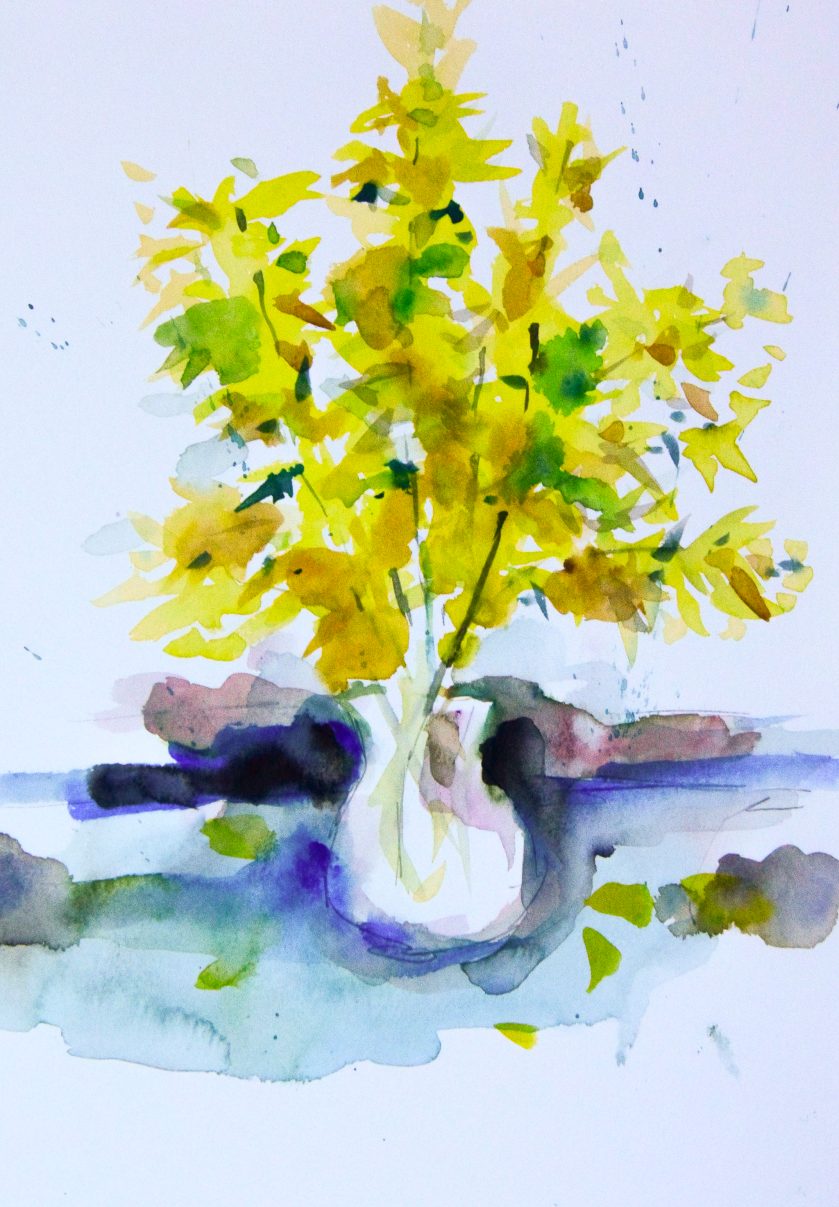
Another issue I find is contrast and value.  It’s hard for me to really get these right in a painting.  Reid mentions he makes his dark not super dark – not black – but installs a medium dark early on to establish value.  I struggle with this but with more practice I think I will get better at this.
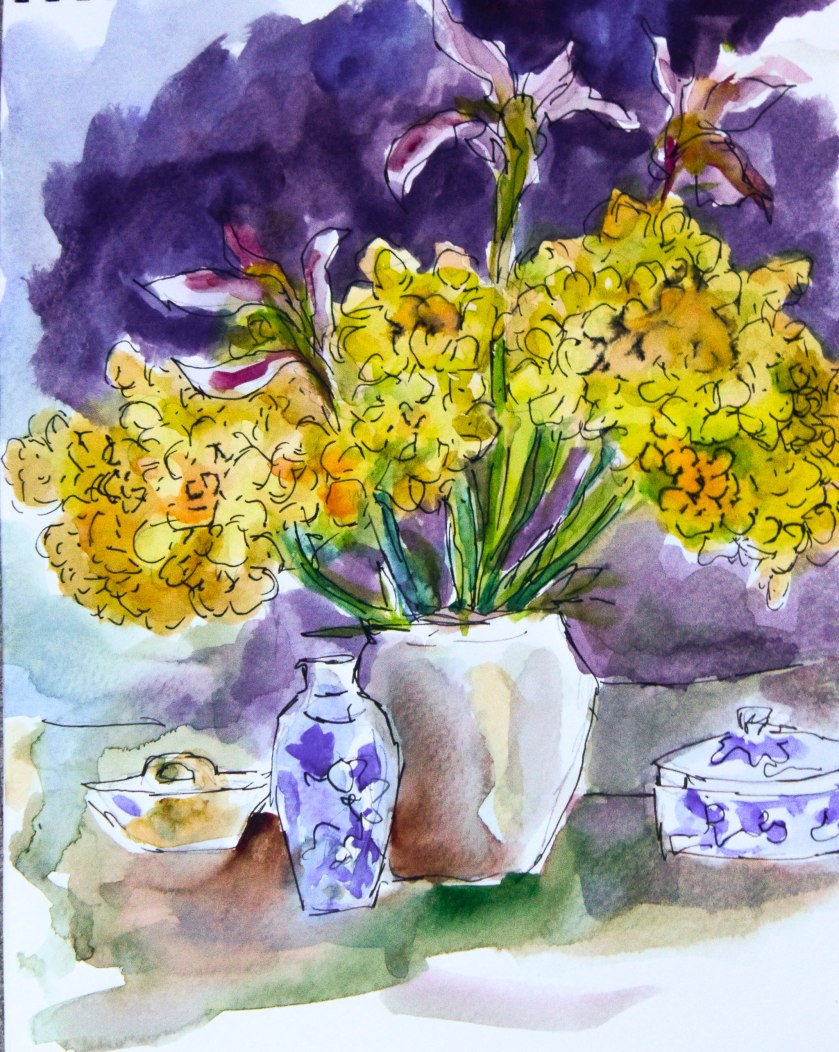
And here is the last one . . . not the best, but one which does have some good areas of contrast, and black lines from an India-ink pigmented pen.  Sketchy, painterly, and totally fun to do!

Quality paper is a must-have.  I have some tablets that I bought which I absolutely hate because of the texture and sizing in the paper.  However, I used them up and ordered more of the Canson’s Montval paper, in a spiral booklet form, 9×12 with 20 pages.  It’s a good working size – and it’s good paper, with a nice texture and sizing which doesn’t blotch up and look horrible.  It’s also very reasonably priced.  The Schmincke paint box may have Schmincke paints in them – or not.  My paint supplies include Schmincke, Winsor & Newton, Daniel Smith, Holbein, and M. Graham professional-grade watercolors.

I’m glad I sat down to paint – it’s such a wonderful feeling and one which gives me satisfaction.  Did I produce anything worthy of framing?  Not at all.  But working with my hands, seeing some success, is something which cannot be described – only experienced.  You know what I mean!  It’s like love!
Projects, or, Wonder Woman Does Not Live Here

3-365-corner-of-the-world-autumn-rain

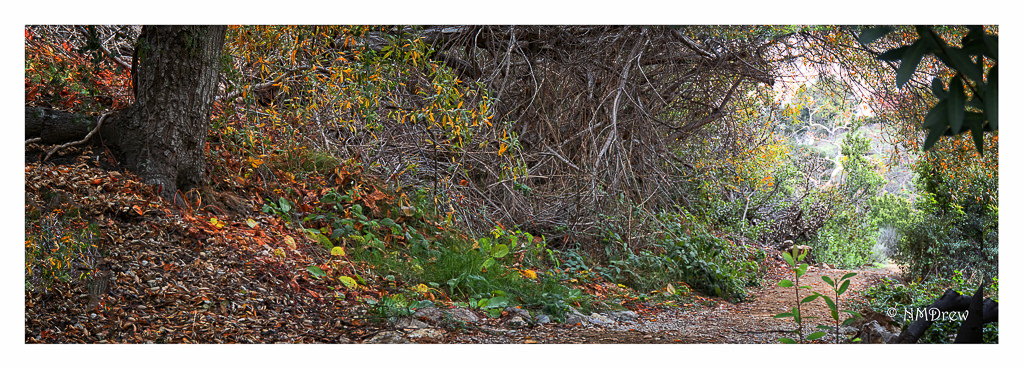
We have been enjoying rain for the past several weeks, and it shows.  Colors are more intense as the winter grasses emerge, the cold is shaking the leaves into color, and the subdued light intensifies the beauty of the trails nearby.  Of course, post-production helps, too.  I’ve enjoyed the weather – wind, rain, clouds, sunshine, cold.

The variety of weather has really helped, too, as this past week I’ve been dealing with dental problems and dental pain.  I didn’t know my teeth could be so annoying!!  However, things are calming down, and thank goodness for dental insurance, and good dentists.

Around here, there are a lot of things afoot, and not enough time to do them all.  I have been doing the following:

I thought I would be able to do it all, and still work my silly schedule, but it may be that I will need to scale back a bit.  I really want to do all these things, but find that an 11-hour day is so long that by the time I get home, I can just function.  This means eat dinner, do the dishes, and either fall asleep or watch a bit of TV, and then fall asleep.  How dull, eh?

What I am finding useful, though, is to actually schedule my creative time.   This means sit down and decide what I want to do on Friday, Saturday, and Sunday.  If I don’t, I get distracted, and other things just won’t happen.  And trust me, there are lots of things to distract me (besides aching teeth).  If I stay focused on my projects, I become a recluse and don’t get out of the house.  Friends and family help to keep me human, not a raving, obsessed something.

Looking Ahead to 2017

memories-of-last-spring

As I write, I am sitting down to lunch, looking at the total destruction and reconstruction of my studio.  Unlike those more fortunate, my studio is really a bedroom in the house that doesn’t even have a closet.  As a result, all storage is on shelves with plastic bins, all in the hope of keeping the dust to a minimum.  In addition to having shelves of cameras and lenses and other photography equipment in the studio, I also have my sewing supplies, a desk, a drafting table, two filing cabinets, two chairs, a computer, a printer, a scanner, and a couple of monitors.  The destruction of the studio is the cleaning out and throwing out of things, as well as reorganizing it to accommodate painting more readily.  Things are being moved around to make access to certain items more comfortable.

When I think about my focus on photography over the past several years, I am so glad I feel that I have mastered it to a degree that makes it comfortable, and gives a certain level of satisfaction.  Both digital and analog are areas where I feel a level of proficiency – I can take good pictures.  I know my cameras, I know my film, and can determine an exposure for a manual technique by looking at the light.  This is something that once learned is never lost – the knowledge may get a bit rusty without doing it, but it always comes back once being used again.

Photography, though, is not my first love in the visual arts.  Painting is always where I want to come home to roost.  The feel of a brush or pencil, the colors of paint or gradations of ink, the physical experience of painting and drawing:  all these combine for an experience that photography has never had.  I am not interested in painting realistic images – that’s what photography is for – but in the emotional expression or abstraction of whatever that painting provides.  Besides painting, I love woodblock printing, and sumi-e.  There is a sensual quality to working in these areas that, if I had a darkroom, I might find as satisfying.

With this focus on painting – mostly in watercolor, possibly in acrylic – I will need to revisit the skills I’ve lost over the past several years.  Because I tend to be rather fixated on painting in certain ways, I also hope that my sense of exploration and adventure will get piqued.  It’s easy to become formulaic in art, I think, but that doesn’t necessarily indicate a lack of focus.  Rather, being formulaic means a level of success in given techniques, but it may not open the door to that magical realm of creativity that leads to new insights and processes.  This is where I want to go.  I want to study botanical illustration because I am too splashy and undisciplined, but I also want to explore different ways of using colors, papers, paints, and pencils.  The process, ultimately, is the most important experience to me.  Whether or not I become an artistic celebrity is immaterial; it is the doing and being the art itself.

Tulip Painting – Day 1

Tulip 1


This past month has not been what I would have liked it to be. Instead of using my free time as I want to, I have had to use it for things that have to be done. The entire month of June seems to be that way. Sigh.

Today, though, I had time. Lots of it. Starting at 3 this afternoon, and going to 6, I got time to paint. (Yesterday, I did some baking.) The choice was to rummage through some of my paper in the paper portfolio, and see what I have. I have oodles of hot press 140# Arches, so I pulled out a sheet that was already cut, and went to work. Handling wet-into-wet and controlling color is today’s main goal. As I have also been watching some watercolor videos, I thought I would try to work with some of the information I observed, to see if I could remember it, as well as to see how well I could do.

Tulip 2

Subject matter is a pink tulip that has hints of yellow. The beginning task was to set down the first layer of washes, using WN Permanent Rose. Different layers of this color were used in increasing intensity to darken the areas. This took a lot of time. I applied clean water, and then worked in the paint as necessary, rotating the paper at times to have the color bleed, and at other times using a dry brush to pull out excess color. Other times, a damp brush was used to blur edges. I let the painting dry between sections.

After the pink was fairly well established, I pulled out some DS New Gamboge. Using clean water, I laid in a little wash in the areas of each of the petals. New Gamboge was blurred into the pinks, and edges softened using a large, dryish brush. Finally, around all of it, a combination of Phthalo blue and Hooker’s Green. Notice, I shaved off some of the tulip in the lower right corner, and probably will do more petal shaving with the next layer of color.

Tulip 4

So, that’s it for the day. Tomorrow more is planned to give the tulip more depth and dimension, and to do something with the background.

I’m rather pleased with it so far, but who knows what will happen tomorrow!

Practice, Practice, Practice!

I am continuing the varied steps from Birgit O’Connor’s excellent video.  Upon her recommendations for brushes, I ordered the DaVinci Cosmotop Mix B in size 30, and the Cosmotop Spin Mix F in 20 and 14.  The brushes I have been using have been either pure synthetics or pure Kolinsky sable, neither of which seems especially suited for the painting methods she demonstrates.  I also bought the Pebeo drawing gum, which is thinner and more manipulable than the Winsor Newton masking fluid.

Shapes, Pebeo, and Color Splatters

Above is the very first step in the current practice piece.  I laid out my masks, then used Winsor Newton’s masking fluid and a toothbrush and splattered resist all over.  This fluid is thick and drops in blobs, big and small.  Some will become pebbles and ocean glass by the end of the painting.  Then, using the toothbrush, splatters of color, to make the sand, were used.  My colors were combos of burnt sienna, ultramarine, umber, and yellow ochre.

Splattered Shapes

After letting everything dry, I removed the masks, splatters and all, and set them aside on a piece of typing paper.  (Maybe I will use them again!)  You can see what a mess there is!

No Shadows

The next step was quite long.  The shells, stones, pebbles, glass, and what is supposed to be seaweed, were painted.  O’Connor demonstrates some really cool techniques in her video, and the new brushes made all the difference in the world.  I am also getting some control, at last, in the shadings of the shells and stones.  In particular, I like the stone in the upper left corner, and the seaweed.

Shadows #1

As you can see, adding shadows to the painting give the illusion of depth.  If you look closely, though, you can see that the shadow in the upper left hand corner is very over worked, and the shadows vary in lightness and darkness.  This is because of a number of things.  I did not mix up enough watercolor wash for all the shadows.  This is very important to create a consistent hue.  Another thing is that these shadows are far more challenging that you might think – a single stroke is best.  The one in the upper left I revisited two or three times.  I think it might have been best done with a layer of water laid down first, as it is so large, and then working the shadow is as a wash, being careful to tilt and shift the paper so the shadow color is evenly distributed.

Shadows & Sand Ripples

The final step was adding the ripples in the sand.  These are fun to do, and remarkably easy.  And, they can really add to the overall composition of the picture, helping to move the eye in and out of the shapes.  Part of me thinks that I need one or two small ones moving from upper left to lower right between the upper left rock and the tip of the mussel shell, but I am not sure.  Below is the final painting, cropped to remove all the distractions of the in-progress pictures.

Final Impression

To sum it up, this has been a wonderful learning experience, and has renewed my confidence.  Yes, I am doing exercises, but exercises are necessary for mastery.  I will do a lot more because there is a lot to learn in these seemingly simple studies.  Again, O’Connor’s video is definitely a worthwhile purchase.