Above the Treeline – Mountain Peak & Snow

As always, I can never fail to but enthusiastically recommend the short watercolor courses by Shari Blaukopf! Her most recent one is called “Peaks and Valleys.” It is inspired by her trip into the Alps while teaching a class. Having lived near the Rocky Mountains in Colorado and driven through them many times, I found this course especially fun to do. Shari’s instruction is clear and to the point, but her lovely personality shows through to make the lessons personable and friendly.

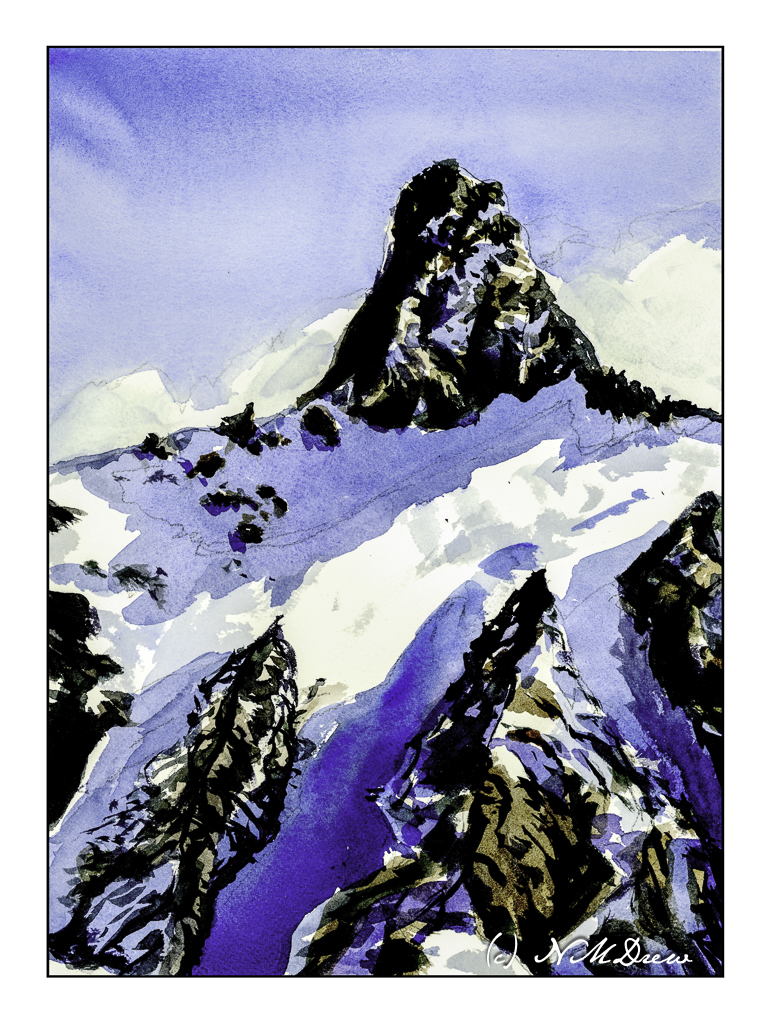
I am not going to show you the subject matter I have done so far in the course. Instead, I am going to show you what I learned to put into my own painting. My reference for this watercolor was a mountain peak photo found on Pixabay – the best resource for public domain, royalty free photos (and other things, too!).

Mont Blanc was the first mountain top study in this course. At 14,000 feet, it is way above the timberline, covered in snow, and nothing else than barren rock and clouds. At this elevation, the view across the Alps must have been amazing with ridges of more and more mountains before and beyond Mont Blanc itself. To paint it, essentially blues and browns were used in the class – cobalt, ultramarine, burnt sienna – with the addition of Payne’s grey, some organic viridian, and yellow ochre to neutralize of brighten the colors. Myself, for this painting, I stayed pretty much with these colors, but threw in some dioxazine purple as well.

It seems that the one most important lesson I fail to really retain when I watercolor is to be patient and think ahead on what I want to do. Taking a class such as this make me remember to plan ahead.

On the other hand much of my color mixing is automatic because I am familiar with how my colors look and blend, but my natural impatience is sorely tested. This is where 99% of my mishaps occur – rushing. With this painting, not so much because I started playing a game with myself – how will I plot my next step? I didn’t do a value study, but I want to try to do that more often. Here, the strong contrasts of light and dark, warm and cold, made the values and contrast easy to perceive.

I am rather pleased with this painting. It is cold and starkly beautiful, and that was the whole point of this painting.

Watercolor, Arches 140# CP, 9 x 12.

Estuary

Estuaries are important connections between rivers and fresh water to the sea. The land may be marshy, the water brackish, and adapt to the influx of waves and sea water and the outward movement of fresh water. Consequently, the estuary provides high levels of nutrients in both the water and the sediment, creating highly productive habitats. Plants, animals, birds, fish, and all sorts of life thrive in the estuaries.

Additionally, the estuaries form a protective barrier between land and sea, but with the loss of estuaries, the damage from the sea increases. A good example of this is in areas where hurricanes and other fierce storms sweep inland, causing great damage – estuaries can survive such storms and recover, but further inland where the land and water are not adapted for saltwater, valuable land may be lost.

Estuaries are found worldwide. In northern California, the Pescadero Marsh Natural Preserve is found near San Francisco, and offers a wonderful environment for hiking and observing birds and plants. Currently, many trails are closed, but the visit to Pescadero State Beach is beautiful, as are many of the beaches found the length of the coast of California.

And, if you didn’t know, all beaches are public in California, so even if someone’s house fronts the shoreline, the beach is there for all. There may be a couple of exceptions to this law, but by and large, no one can tell you that you cannot walk along the shore.

Watercolor, Arches Rough 140#, 12×16.

Beach Day at Low Tide

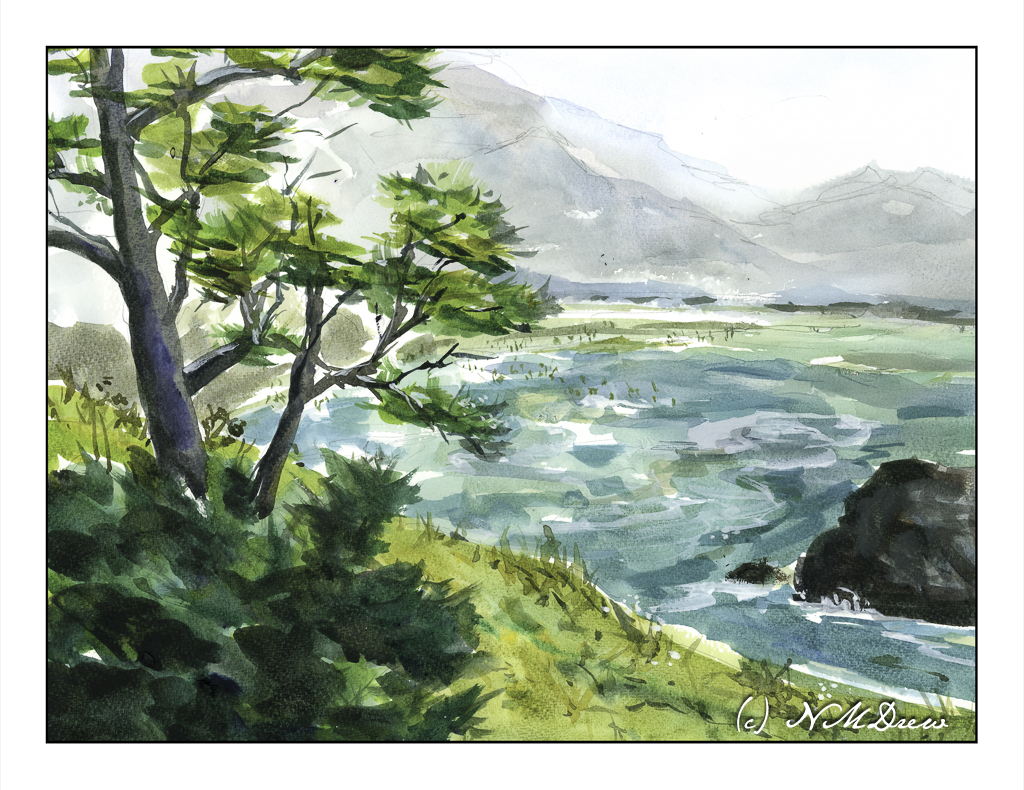
After a busy several days, including the winding down of my summer painting classes, I needed to do some watercolor and landscape painting! Oil painting and portraiture require a lot of focus, but it is so restful to just think about colors and shapes, as I do in watercolors.

This painting is inspired by travels along the Oregon coastline. I tried to capture both the color of the sea as well as the mistiness of the distant mountains. The little dots representing a beach filled with people was a bit inspired because I needed to do something with some empty space in the middle. Nothing like being the god of your landscape, eh?

Watercolor, St. Cuthbert’s Mill Bockingford paper, 140# CP, 12×16.

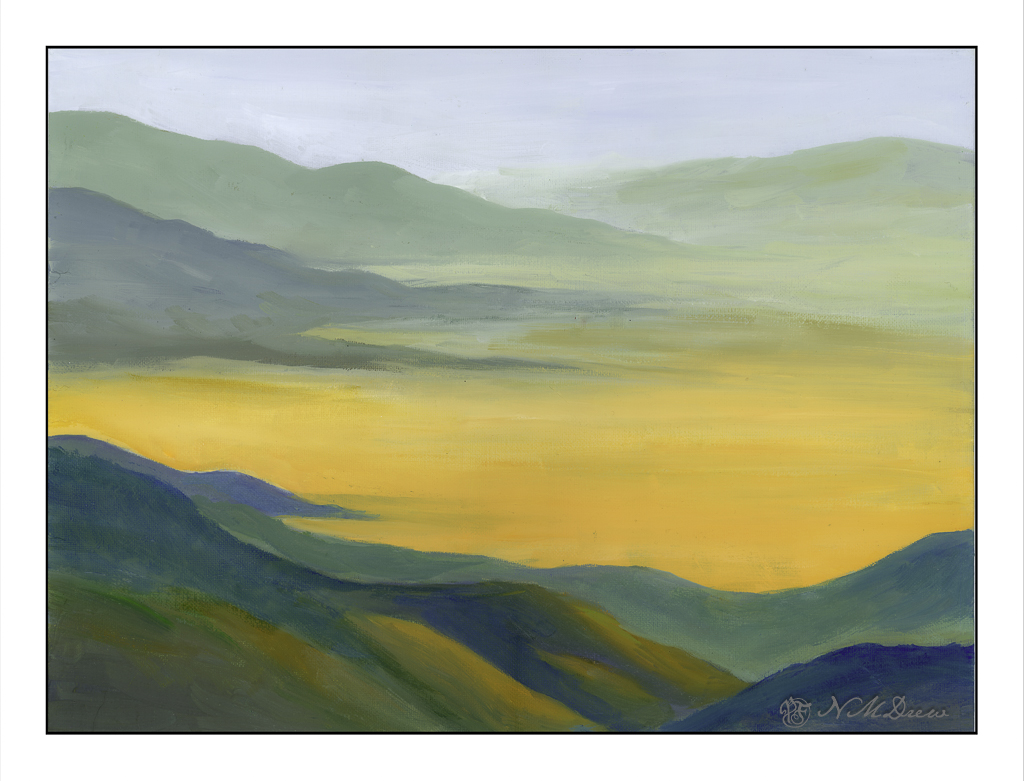
Between the Mountains

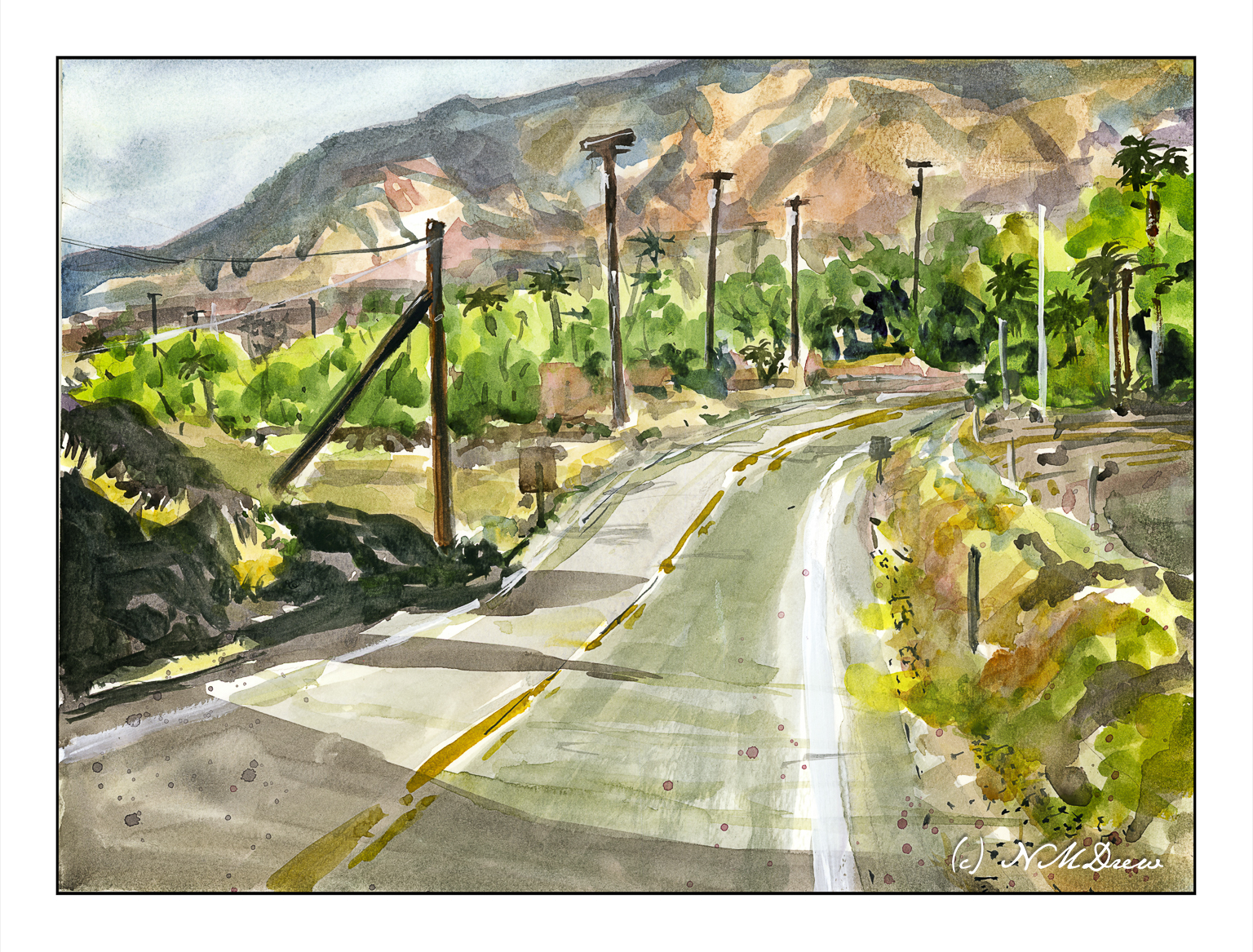
One thing I love about California is the fact that the geography varies so much! Oceans with flat beaches, oceans with cliffs, mountains with snow and mountains with pine trees, and deserts stretching flat and hot, surrounded by mountains and creating a secret world fascinating and forbidding. Worldwide, deserts host animals and plants and insects which survive on little water, are stark and seemingly dead – but of such beauty. Deserts are not for everyone – familiar and comfortable landscapes full of trees and greenery are very different. It took me a long time to appreciate a more stark landscape than the rolling green hills and woods of the midwest and eastern seaboard.

This is a painting I have been working on in my weekly class, inspired by multiple memories and photos taken. I had a limited palette of white, ultramarine blue, Indian yellow, and light green. I tried to catch a golden glow as well as give a yellow-orange cast to the desert floor and hillsides – and create a softly blended painting.

Oil, 12 x 16 canvas panel.

Sparkly Day

The way the light shimmers through leaves on a bright day is something so difficult to capture in a photograph or a painting. The contrasts between light and dark shift and change to be almost blinding.

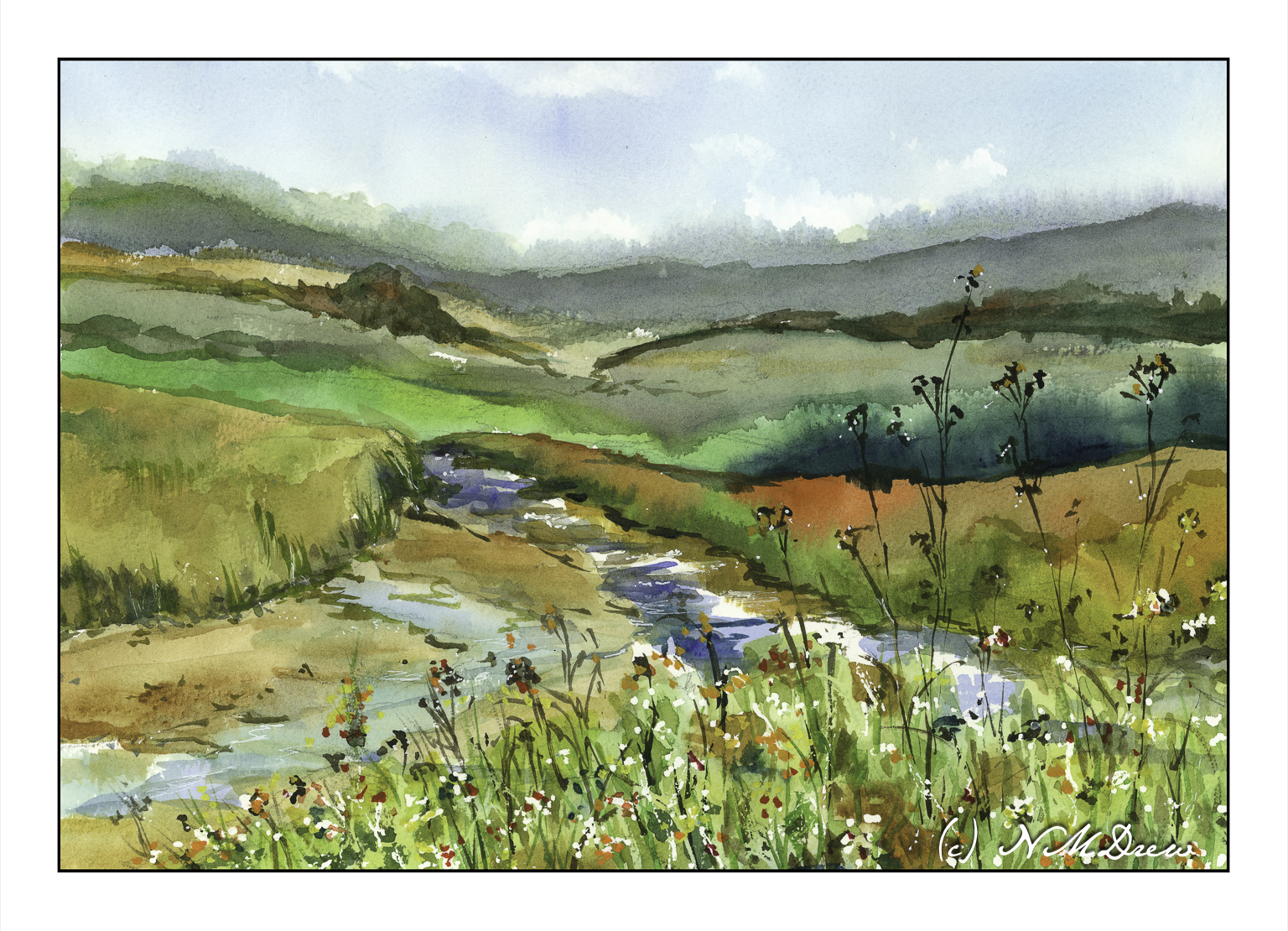
This is a creek running through the Coconino National Forest in Arizona. It is near Flagstaff and Sedona, and the terrain varies from alpine to the red rocks of Sedona and creeks and forests of Ponderosa pines. The above scan is a VueScan image with some corrections. Below is one using Epson Scan.

Neither scan really does justice to the colors, but the sparkle is caught. I think like a camera a scanner and software has difficulty with subtle variations from light to dark.

Sigh.

So, what did I try to do today? First, a bit of a limited palette. I didn’t do a triad, as with yesterday’s painting. I used (off the top of my head) mostly ultramarine blue, cadmium yellow, and burnt sienna, but into that mix I added Hooker’s green, cobalt teal, phthalo blue. The greys of the rocks came mostly from ultramarine and burnt sienna. Hooker’s provided a basis for some of the more obvious greens, but the cobalt teal mixed with yellow were used for the lighter, brighter greens you seen in springtime. Some titanium white gouache was applied here and there.

Additionally, besides limiting my colors, I tried some of the techniques for the water. Here, there were swaths of shallow water with an ochre coloring, reflections of rocks and trees in the water, and shadows beneath the rocks in the foreground and lower right. I didn’t use enough color and water to create a bead to allow blending – I have been told I would make a stingy bartender! – but still managed to get some of the colors to blend with one another. I also did glazes to show direction of water and movement. It turned out better than I thought it would – if nothing else, I need to be more generous and allow more paint and water than I think I will need. This something we all need to learn – how much is too little, how much is too much. Of course, the Goldilocks effect is best!

Watercolor, Arches 140# CP paper, 10×14.

Oh, hell – here’s another scan!!