
Haystack Rock

More of the northern coast along the Pacific Ocean. Here, Cannon Beach in Oregon, possibly one of the most dramatic beaches I have ever seen. Sea stacks, tide pools, sand, mist and fog. When the fog lifts and the sky brightens, there is a glare that cannot be explained. It’s not a summer day brightness as we have in SoCal, but a brightness that is cold but not like on a snowy day. There is a lot of moisture in the air, from sea and fog, and perhaps that is what magnifies the light to such a degree.
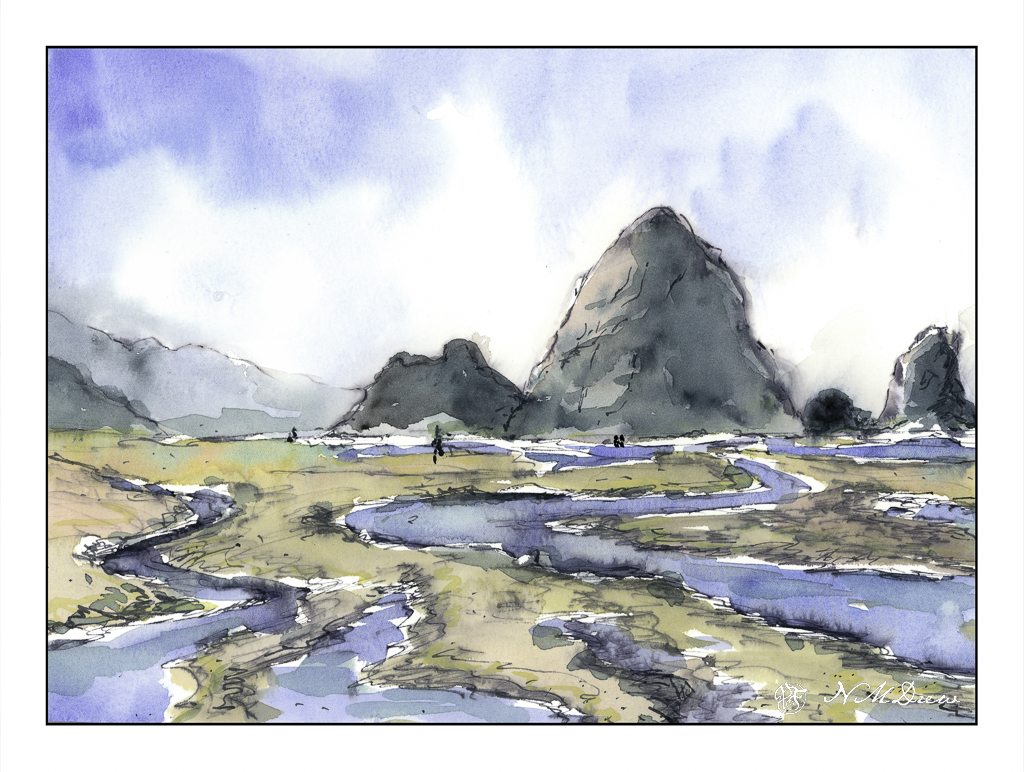
If you look closely, you will see some of my ink bled into the paint. I used my iron gall in, not my waterproof micron pens, and a stub nib to draw. From there, I wet the sky, dropped in colors, and then let things dry to dampness. I wanted to create soft edges for the mist in the distance which blurs and softens edges. The rocks themselves were painted wet-in-wet initially, and then other colors applied to either dry or damp paper. The sand and the rivulets were painted in the same manner. In the end, I drew again with my iron gall ink to add texture or detail.

Keeping this sketchbook is so much fun! I have room to paint as the sheets are big, the paper is strong so I can use both sides, and I can paint with a lot of water should I wish. It is proving to be one of the best decisions I have made of late!
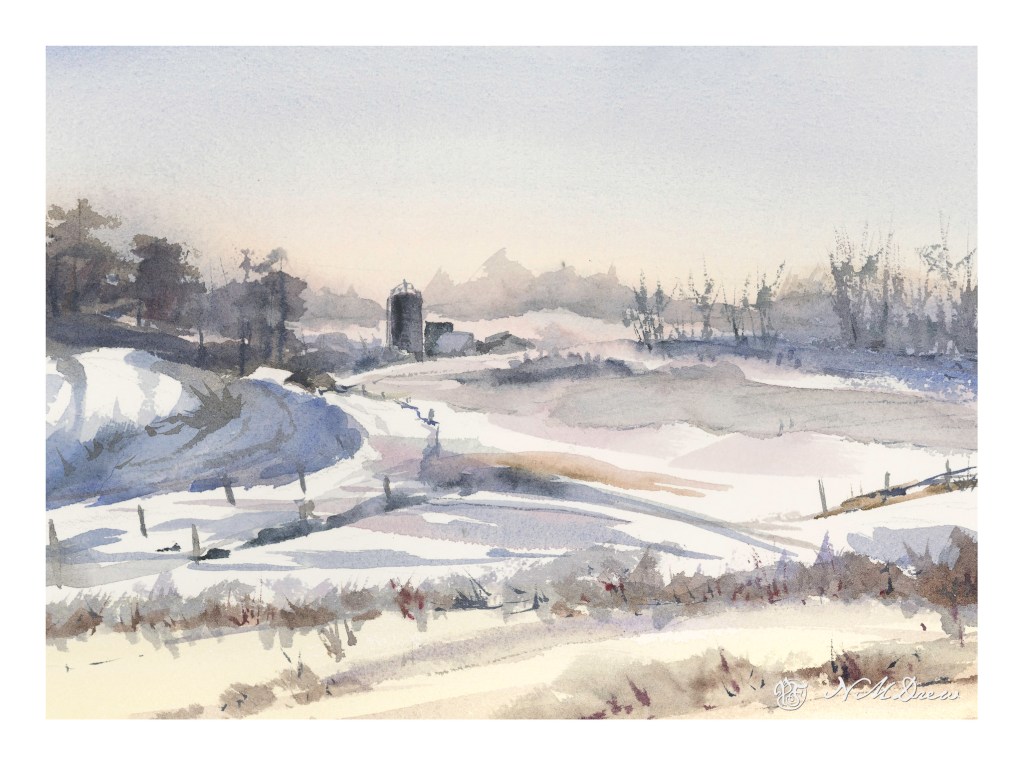
Winter in Hill Country

I needed a change of pace – a way to relax – after yesterday’s very intense painting of buildings and people. It’s nice to visit familiar territory. But, I was not without goals. Here I worked on subtle gradations and color change in the sky; misty / soft trees in the horizon using moist paper to blur and indicate distance; a couple of buildings with subtle rooftops; snow. On Arches CP 140#, 9×12.

Early Morning

Another wet, wet painting in watercolor.

Here, I wet the paper, and then began putting in areas of color, beginning with the sky in the central part of the painting, and then blobbing down the foliage in the foreground and the distance. The line of the slope was separated from the horizon beyond. As things dried, I blobbed on more colors, and continued to work wet-into-wet as the paper dried. In the end, I was able to draw the trunks of the distant trees without their blurring using diluted colors of the darker tree trunks.

It’s really hard to describe how to do a painting like this. In doing these kinds of paintings I am finding it is necessary to have a sense of the composition itself – lights, darks, soft shapes, hard edges. It is also necessary to think about negative and positive space while painting, as well as the overall effect desired. I worked light to dark, and strove to keep the earliest colors as separate as possible from others. In the end, I used glazes to unify areas with color as well as worked with thick paint and a very dry brush for some detail.

140# CP Arches, 16×20. It took about 3 hours to work on, using time in between to dry the paper with a blow dryer or let the water get absorbed into the paper so softer edges could be achieved.

Of the 3 “splish splash” paintings I have done, this one is my favorite. This technique works very well for areas with a lot of foliage, but what about ocean scenes, skies, and so on? That is next on my agenda for this method.

This was a lot of fun – I hope you like it!

To the Lighthouse

A bad reference to Virginia Woolf’s novel, which is an interesting read.

This painting is a dedication to lighthouses worldwide. They have saved so many lives by letting sailors know of treacherous waters. Add to that, lighthouses are often found in spare and rugged places, all of which make for dramatic and wonderful photos and paintings.

I have often thought I would like to live in such a place, hearing the waves crash, watching the light circling through the night, and, of course, the sound of fog horns. Throw in some seal barks and sea gulls, and I would be pretty happy. Sleep could be a challenge though.

I made up this painting, amalgamating lighthouses and buildings from various images. My goal was to practice shading, such as moving from a sunlit side to the shadow side, using pointillism techniques. You can see this on the conical shape of the lighthouse as well as on the buildings. I have tried to give a sense of cliffs and housing sunk down a bit behind the green of the grass. Morning or evening light for the sky, or an intimation of fog and filtered sunshine is also attempted.

As I work more in pointillism, I realize that this helps me tremendously in sorting out colors. As far back as I can remember, mud has been my most famous by-product in painting. It could be that this is something I really need to use as a primary technique, though I am thinking of doing a pointillistic painting in gouache, and then re-wetting it to blend the colors applied in dots.

Now, on to other adventures!

Dreaming of Snow

Our cold winter thus far has hit a low of 64F or so in the past several weeks. No snow, certainly; sadly, no rain, either. Perfect for the next fire season, which is becoming a longer and longer annual event.

So, I dream of snow, and pull up memories of living in upstate New York, hiking for miles across woodlands and farms in the early morning or early evening. The light slants, the air mists, and a winter wonderland becomes a magical world filled with rivers and creeks, trees, and trails left behind by others.