A Man from the Mountains

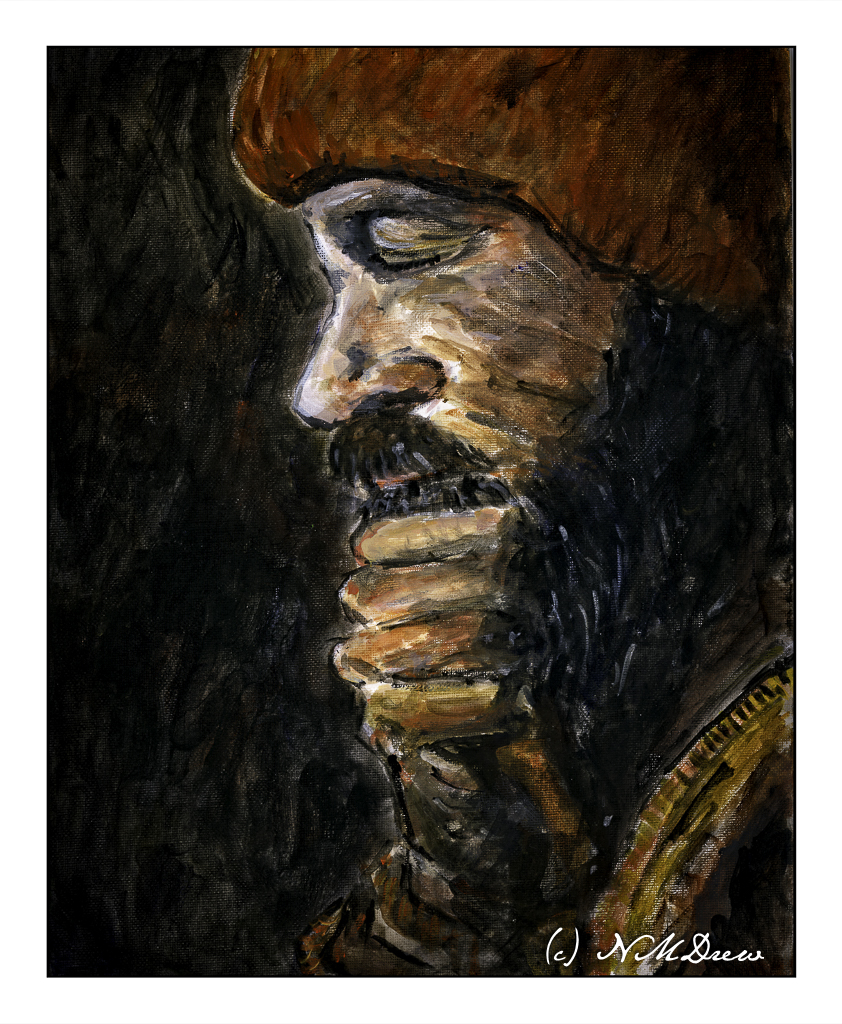
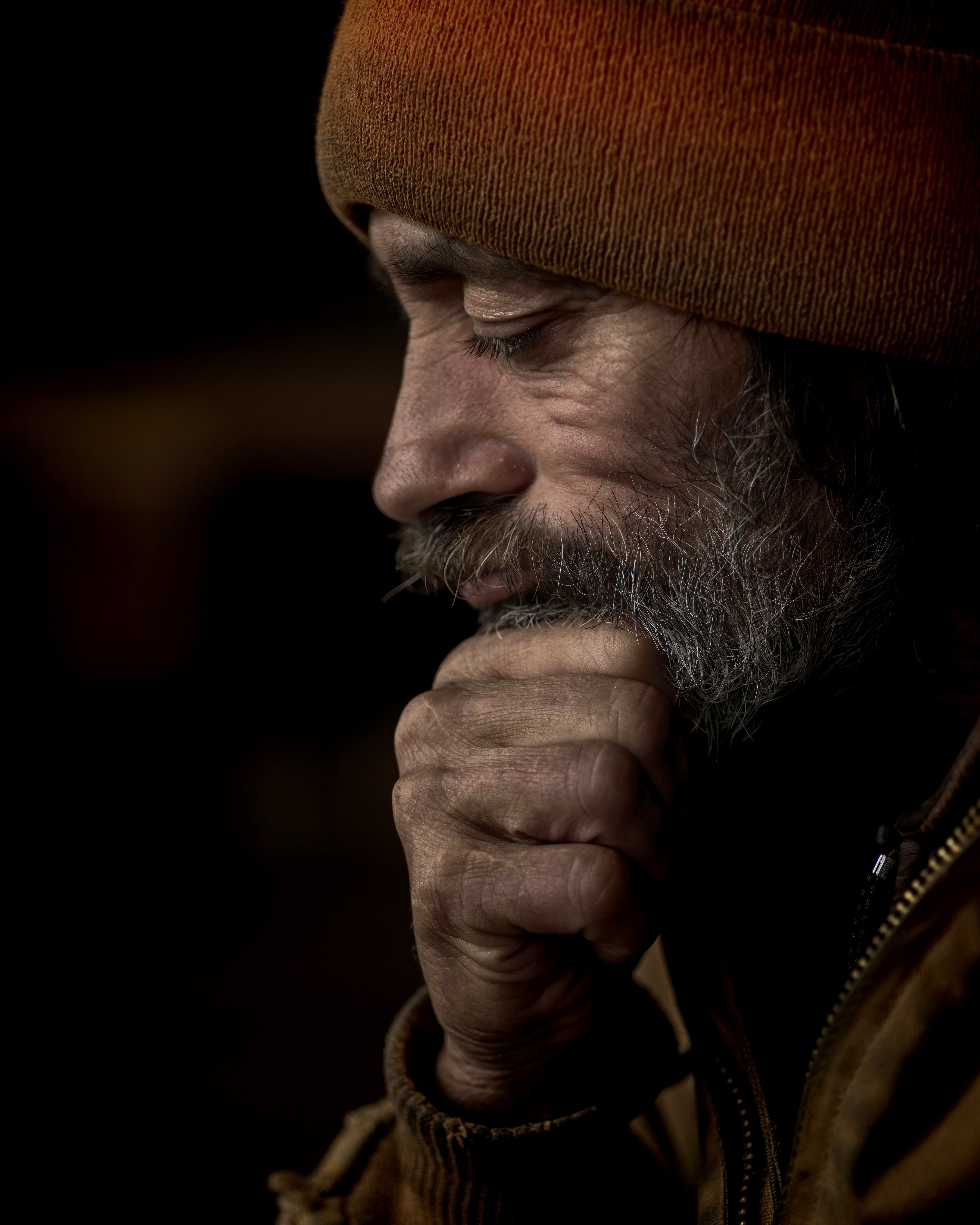
In between life and knitting disasters and housecleaning and purge-atory (I got rid of a lot of junk last week), I have been painting a portrait in acrylic over the last few sessions of my figure painting class. I used one of the many wonderful portraits available from Pixabay.

Painting this portrait was a challenge. I did not want to do a photographic reproduction. My idea was something moody and a bit sketchy, more so as I think such a style is more easily done in acrylics (which I swore to work on!) than a realistic rendition of the person himself. I painted using more transparent paint and scumbled a lot of the paint onto the canvas. Some areas don’t even have paint on the surface, or very little. Layers and glazes were built up. The quick drying quality of acrylics makes this easy to do in a classroom.

My palette was pretty limited, too. I used carbon black, ultramarine blue, raw umber, cadmium red light, titanium white, and yellow ochre. First step was to sketch in the man, working on proportions and then mixing general areas of color, slowly moving into details. I stepped back and forth to look at my painting.

What really attracted me to this portrait was the lighting, the expressiveness and rather mysterious quality of the man – he could be from so many places. My first impressions is he is a man from a remote part of the world, a man who works hard and labors with his hands to provide for those he is responsible. I wanted to catch this quality – a rugged ability to endure.

I think I will hang this on my wall to enjoy. Yeah, pretty pleased! That is after I correct the mistake under the man’s mustache . . .

Heavy body acrylic paint, cotton canvas panel, 11×14.

Black + White = Grey

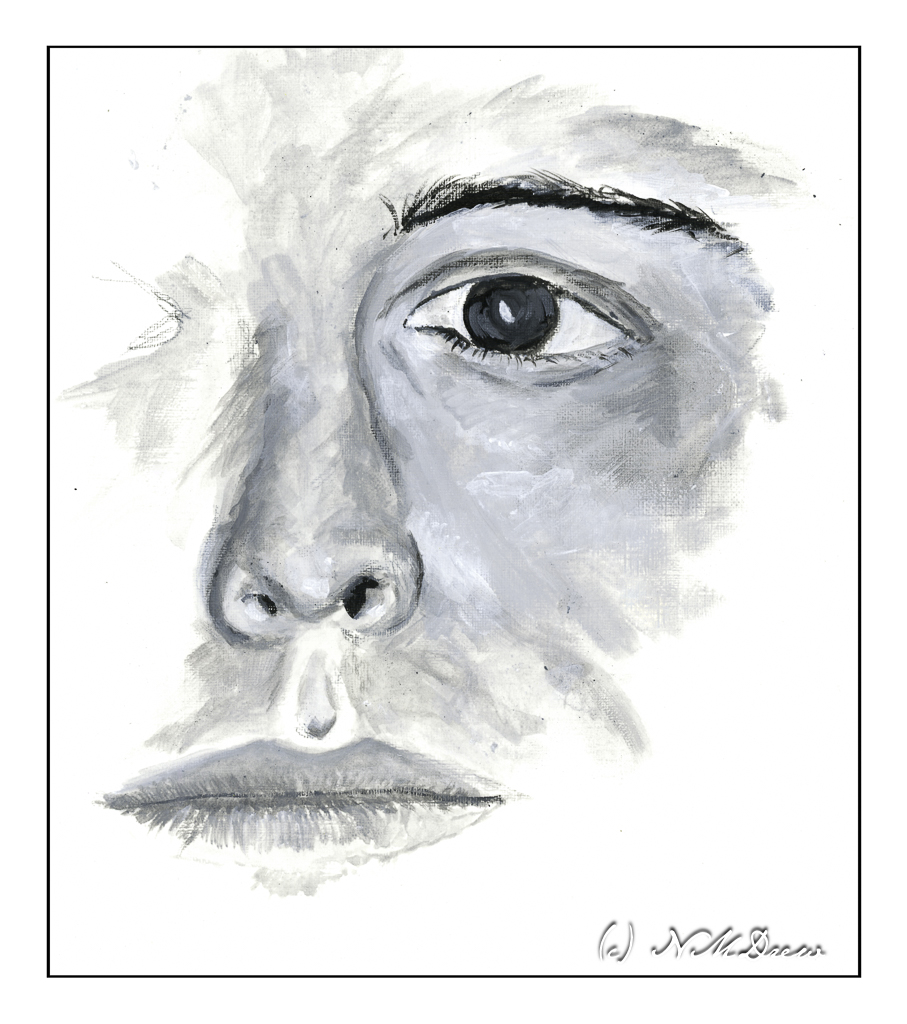
Yesterday was the beginning of new portrait class session with my favorite teacher. Having done 2 sessions with her, mostly with media within my comfort zone, I decided that I am going to conquer my general dislike for acrylic paints and portraits by painting them. So, armed with a black and white photo from Pixabay, I found an interesting man’s face as subject matter, zoomed into one eye, the nose, and the mouth.

For the surface, I am using Canson’s paper for acrylic and oil paints. It has a smooth, linen-like texture and responds well. The bit of tooth is pleasant under the brush. My colors are heavy-body acrylic paints from Golden and Liquitex and are simply ivory black and titanium white.

I consider this study to be a WIP – work in progress. The mouth is too small and needs to be re-worked. The guy’s nose looks like it was broken a few times in the photo and I have tried to capture its asymmetry. The paint under the eye of the skin is heavier and more opaque than a lot of the rest of the painting. It was applied first but then I realized that working in thinner washes of black and white might make for better shadow and light rendition. This is such a learning process! I am also using smaller brushes than I might otherwise – I want the details to be details, not big blobs of paint for this man’s face.

Overall, I am really pleased with how this is coming along. A couple of fellow students in my general painting class do such wonderful portraits and people that I decided to push myself. Acrylics will be my primary focus for awhile. I want to master them, learn how to work with them, and like them rather than cringe when faced with a tube of plastic paint.

Heavy-body acrylic paint by Liquitex and Golden, limited palette, Canson’s acrylic / oil painting paper, 9×12.

Above the Treeline – Mountain Peak & Snow

As always, I can never fail to but enthusiastically recommend the short watercolor courses by Shari Blaukopf! Her most recent one is called “Peaks and Valleys.” It is inspired by her trip into the Alps while teaching a class. Having lived near the Rocky Mountains in Colorado and driven through them many times, I found this course especially fun to do. Shari’s instruction is clear and to the point, but her lovely personality shows through to make the lessons personable and friendly.

I am not going to show you the subject matter I have done so far in the course. Instead, I am going to show you what I learned to put into my own painting. My reference for this watercolor was a mountain peak photo found on Pixabay – the best resource for public domain, royalty free photos (and other things, too!).

Mont Blanc was the first mountain top study in this course. At 14,000 feet, it is way above the timberline, covered in snow, and nothing else than barren rock and clouds. At this elevation, the view across the Alps must have been amazing with ridges of more and more mountains before and beyond Mont Blanc itself. To paint it, essentially blues and browns were used in the class – cobalt, ultramarine, burnt sienna – with the addition of Payne’s grey, some organic viridian, and yellow ochre to neutralize of brighten the colors. Myself, for this painting, I stayed pretty much with these colors, but threw in some dioxazine purple as well.

It seems that the one most important lesson I fail to really retain when I watercolor is to be patient and think ahead on what I want to do. Taking a class such as this make me remember to plan ahead.

On the other hand much of my color mixing is automatic because I am familiar with how my colors look and blend, but my natural impatience is sorely tested. This is where 99% of my mishaps occur – rushing. With this painting, not so much because I started playing a game with myself – how will I plot my next step? I didn’t do a value study, but I want to try to do that more often. Here, the strong contrasts of light and dark, warm and cold, made the values and contrast easy to perceive.

I am rather pleased with this painting. It is cold and starkly beautiful, and that was the whole point of this painting.

Watercolor, Arches 140# CP, 9 x 12.

Thoughts on Brushwork

In my last post, I looked at both portraits and brushwork. Doing both is sort of a new adventure for me – portraits, certainly, but brushwork is something I play with periodically. Two artists I admire for both their subject matter and brushwork are Maggie Siner and Hashim Akib. Both have very clear brush marks as well as a strong sense of graphics and color. Siner’s work often displays wide swaths of color and Akib’s often does the same, as well as creates movement and light with brush strokes. Their portraits are striking.

That said, I am a dabber and a rather haphazard (okay, very haphazard) painter in my approach. I paint and putz, sometimes getting it right, sometimes getting it wrong. I will draw in a general idea, but don’t do much more. In particular, I don’t do value studies as I want to look and decide on the scene. I want to train my eye to see them in the picture or landscape or person. It is far more difficult than I think it will be. Slowing down helps, looking and then going into the painting process.

I did the painting below vaguely based off a paining by Siner called “Golden Cumulus”. You can find it on her website. Siner’s brushwork is deliberate, and she says she scrapes her oils off until her brushstroke is as she wants it. She doesn’t paint over things.

What I was looking at in her painting were her brushstrokes. They are directional, sometimes heavy with paint, sometimes not. At times she smudges and edge into another to break things up. For my variant, a wide brush, a square canvas, and either oils or acrylics using the colors found in Siner’s palette, which is very limited.

A lot was learned here: A limited palette makes color choices easy and harder – gotta mix those colors! A big brush – here a flat – allows far more mark making than I thought possible. And a big brush forces me away from my dab-dab-dab with a pointed round.

I don’t remember when I did this painting nor what media I used, or even if I published it here before. I found it the other day and remembered what my goals were. Brushwork then, brushwork now. I’m trying to clean up my oils / acrylic painting skills like I worked on with (and sort of succeeded with ) watercolors.

Oil or acrylic on cotton canvas board, 12 x 12, sort of a master copy of Maggie Siner’s “Golden Cumulus” ca. 2018.

Outgoing Tide

After considering the intensity of colors of my last posted painting, I thought about trying something a bit more subtle. In landscapes that usually means fog and damp – and that can be a challenge in itself. Muted colors, subtle gradations, diffused light, soft edges – with watercolor, a lot is chance and a lot is forethought, and a lot is knowledge acquired by experience. I see each watercolor painting as an experiment and adventure and while sometimes things “just happen” or I am too impatient, a bit of thinking ahead doesn’t hurt.

Here, a pretty limited palette of indanthrene blue,ultramarine blue, yellow ochre, burnt umber, and perhaps a dab of this or that. I use carbazole violet often when I make deep darks, sometimes a bit of ivory black to neutralize a color a bit. Here, I also used a bit of liquid frisket to keep some areas of paper white, such as in the water and along the shore. Titanium white gouache also was applied intermittently for a bit of bright white.

Watercolor, 10×14, Arches Rough 140#.