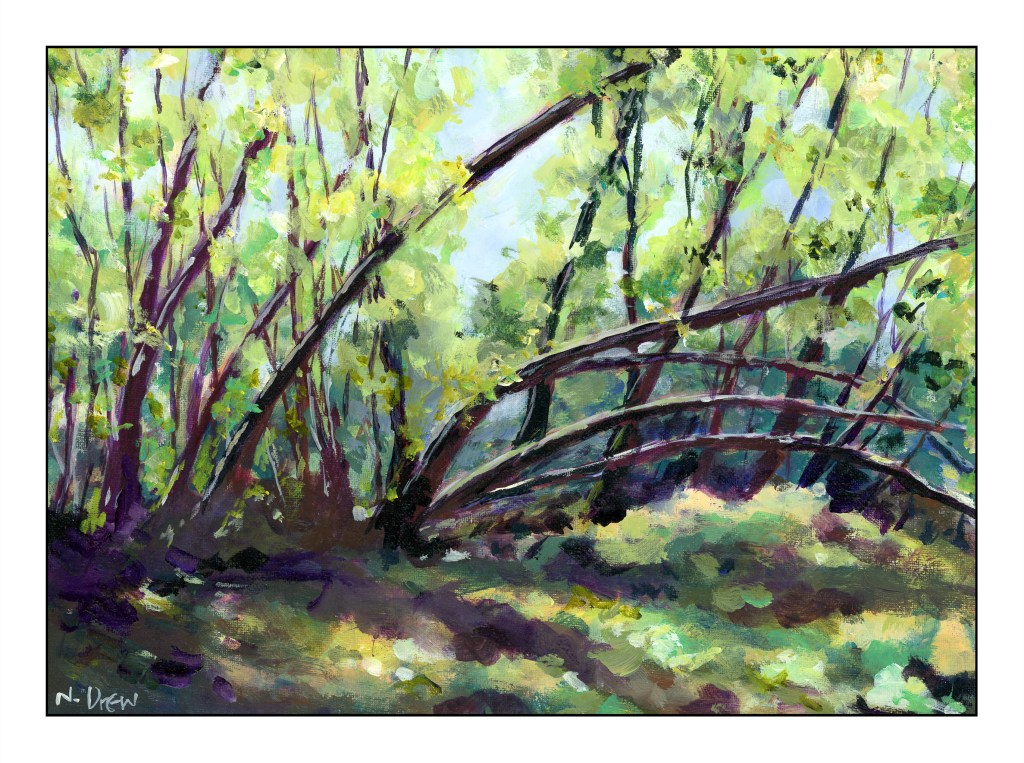
Here is the finalized rendition of Tanglewood in acrylic. If you look closely, you will see highlights added to the trees on the left nearer the trunks, and along the trunks in the upper area of the painting. I did a few other things, too, but don’t remember.
It is always interesting to see what people think about a painting or drawing. My husband says this version of Tanglewood looks like Mirkwood, from that famous trilogy, and the darkly spotted foliage in the upper right makes him think of lurking goblins. Success? Hmm. But, the photo I used really did make me think of Mirkwood myself, so there ya go!
I always like to have an extra set of eyes for the “final” viewing of a painting before the “final” edition. I am too involved, so another set, or two or three sets, of eyes is a big help. My sister and my teacher both brought up the need to lighten up the trees on the lower left, and to add dappled light on the trunks both high and low.
No goblins were used in the painting of this painting of imaginary goblins.
Several weeks ago I started thinking more and more about what I am doing in my spare time. It is then I realized that, for me, the best way to spend my time is to learn new things, in particular, new art techniques. Thus, colored pencils; I signed up for an in-person class with masks and social distancing. I plan to continue this summer with the class.
At the same time, I thought it about time I learned to paint with acrylics, something I always avoided because I just didn’t like the idea of painting with plastic! Add to that, years ago, acrylic paints were not as good as they are now. I was also a considerably more impatient person, and less experienced painter, than I am now. Thus, I enrolled in “Intermediate” painting – I’ve been using gouache, so I have experience!
The first class was yesterday afternoon. I always wonder about teachers and how “good” they are. It takes time to become a good teacher, and honestly, I have found the quality of teachers for arts and languages at adult schools a mixed bag. However, I know I am going to enjoy this painting class. Students I spoke to said they have been coming to the class for 4 years – that says something for the teacher.
I totally enjoyed this first class. People paint what interests them. The teacher helps when asked, offers appropriate and spot on suggestions, and has a really fun personality that doesn’t become overwhelming. Teacher and fellow students are pleasant, delightful, and fun. Can’t go wrong with that, I say.
Because I didn’t know what to expect in class, I decided to bring a kit of paints I’d boughten several years ago, one with about 10 colors, to play with. I used this same kit to begin a painting – after all, play and doing are the best ways to learn. Along with paints and tentative beginnings of a painting, journeying in my cart were rags, water containers, dish soap, brushes, paper palette, an apron, and other bits and pieces.
Above is the underpainting I had done prior to arriving in class. Then days went by – about a week – and I got too busy to do anything with it until I arrived in class.
This is where the painting was at the end of class – nearly there. The sand on the left bank was re-shaped after the river was moved (ah! I feel like God when I get to change geography!) and relocated. And since we are mentioning God, there are two rather eyelike things up in the upper left sky that definitely need removing.
This morning I finished the river, refining this and that. Altogether, I am not displeased for a first acrylic in 40 years. The final painting is the one at the very top. Below you can see them in progression.
The process of learning is often best by doing. By doing, you know what it feels like, you have experience. I struggled here and there, such as with the sky, with the viscosity of the paint, with the shadows and coloring of the sand on both banks. I rather think I like the river in the 2nd version, but decided to change it by adding reflections and ripples for the final version. I took out the “eyes” in the second version, added more fluffy and high-altitude clouds, and worked to create a sense of sand and shadows on the left, along with that wonderfully mucky sand in still water.
This was painted on 11×14 Canson XL, gessoed, and taped to frog board. The kit is by Daler-Rowney, which provides good basic colors for the beginner.
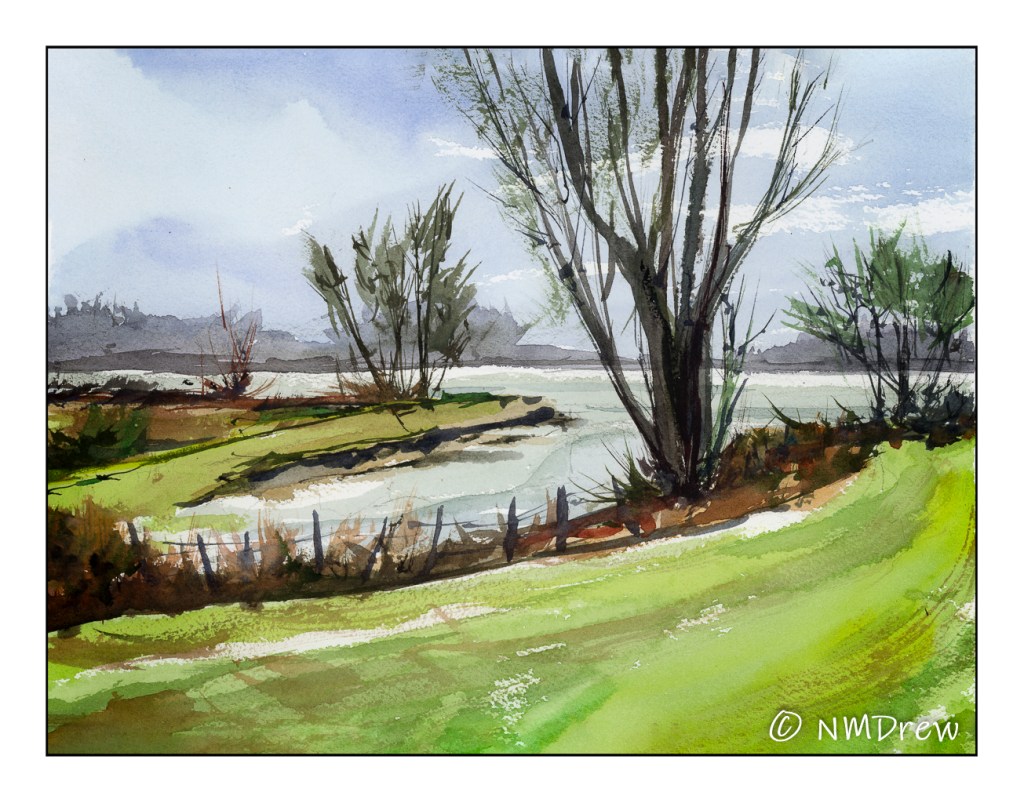
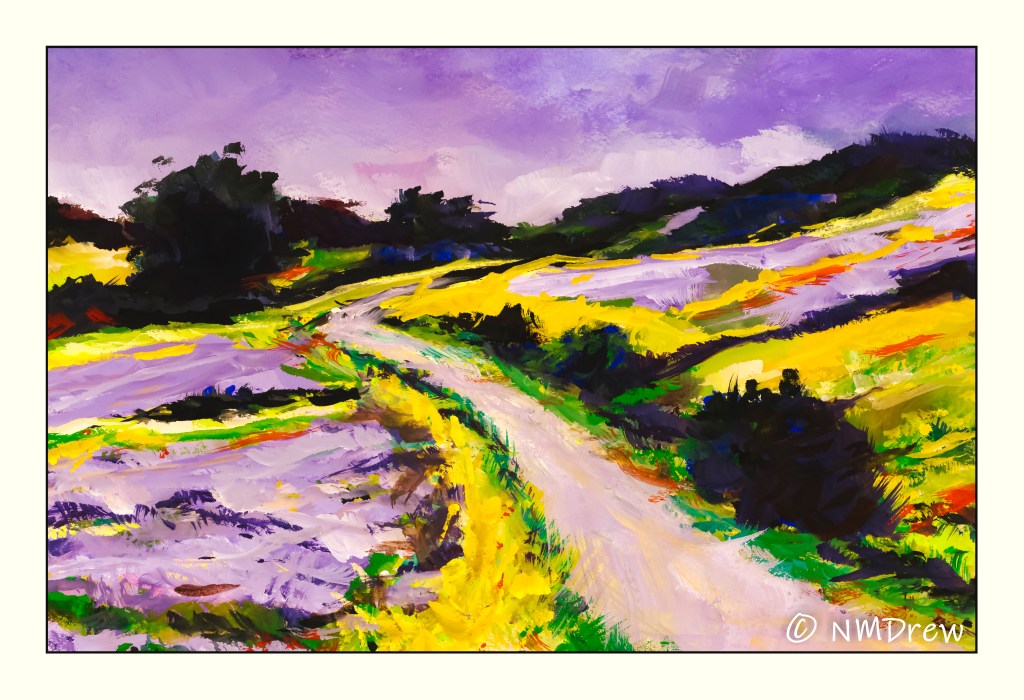
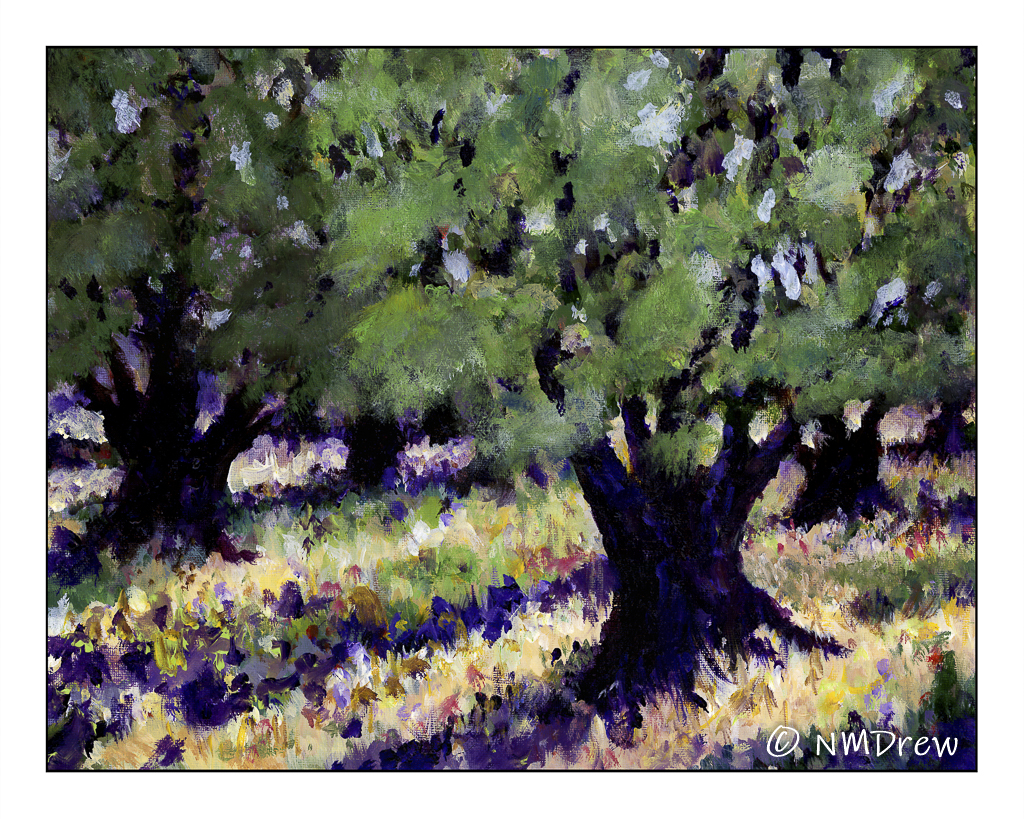
In keeping with yesterday’s quickies, today I present you with another timed study. This time I used only one brush to do everything. It was a 3/4 inch flat brush, rather stiff, and not able to hold a lot of water. It’s always a challenge to do a timed study, but also more challenging when one brush is used for everything.
Oops! I did you a fine line brush for some things, like the trees in the middle left, the windows in the buildings, and some of the grasses in the foreground. However, the flat brush did produce everything else, even the tree trunks. Practice like this is a lot of fun.
Another timed painting. This time the requirement was 37 minutes. I set my phone alarm and was shocked to hear it go off! I was checking it off and on, but suddenly it just rang, and here is the result.
This time I used Uart 600 grit paper, which is like a fine sand paper. It pulls the color of the pastels really easily so a lighter touch is required when painting than with the unsanded Mi-Teintes paper. I used a combination of photos for this one as I needed a creek, but I wanted some oaks and hills from around here. Not especially successful as far as I am concerned; the exercise was the point. I did get into the zone of painting even through I knew that timer would go off at some point.
Another painting done primarily with a hake brush.
This painting was done on the reverse of a previously painted piece of Arches 16×20 CP 140#. I wet the paper initially, taping it only in the corners, and was rather pleased to see how the paper relaxed once wet. I moved the tape as needed to keep the paper flat.
Anyway, the work here was themed on wet-in-wet, use of an excessively large brush (for me!), and standing up, rather than seated. The results were interesting – standing up allowed for more freedom of brush stroke. Getting the paper wet and letting it set a bit before starting the washes also helped.
Compositionally, I think it is a bit bland – really very little to lead the eye. However, this was not my focus here; rather, I wanted to use the hake brush to create sky and foliage as well as broader swaths of color. The nature of the soft brush allows for thin lines, rough splotches of color with white or underlying colors to show through, as well as washes of subtle beauty. From there I used a rigger to create branches, trunks, and some more calligraphic and suggestive lines.