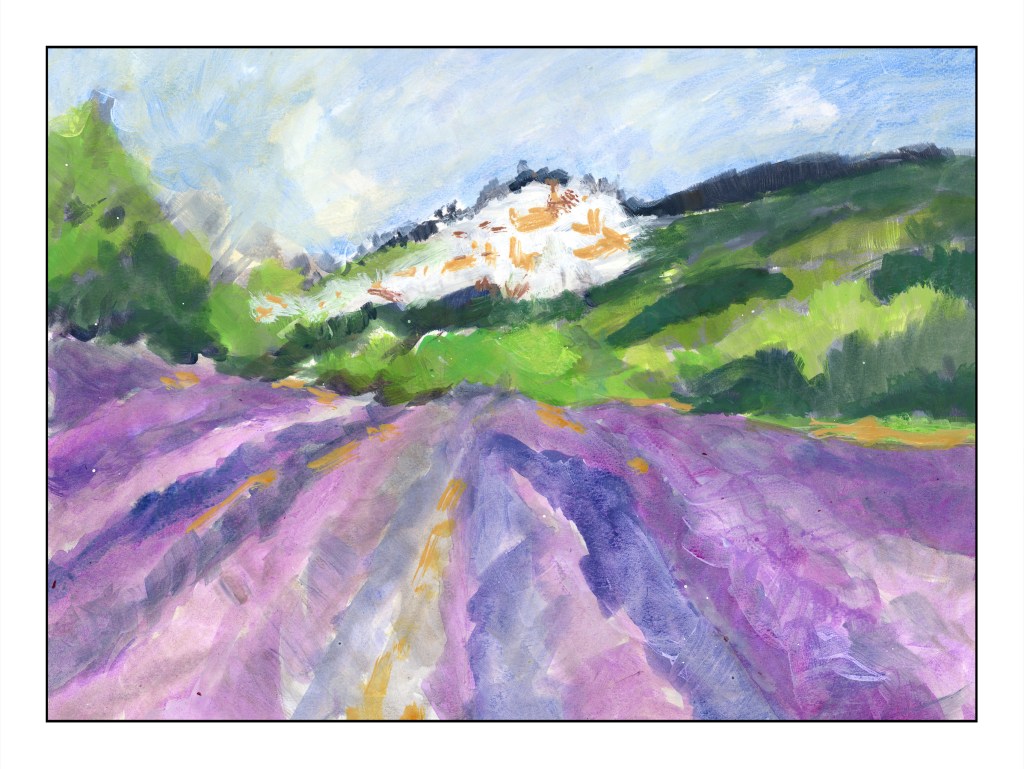
Today just got away from me!! Where it went is up for the imagination. I had plans to paint – but time to focus on another larger painting in acrylic was not there. Instead, I thought it would be a good time for me to get reacquainted with my sketch book, and what better way than ink and color? My lavender field from yesterday seemed to be the perfect subject.
So, back to the sketch book. Micron pens for a simple outline. Then color and I used water brushes, but sprayed a bit of water into the foreground and into the sky to get better effects – ones that water brushes and no cup of water cannot achieve. I did some painting, then I inked more detail in, did some more painting, paused to let things dry, and so on. Nothing exciting, but it was a definitely pleasant way to spend an hour or so on the patio in very pleasant weather.
Pixabay provides such a wonderful range of photos for free! This is based on one, a lavender below a village in France, which I think may be Bonnieux.
Yesterday I bought a number of fresh bottles of Golden Fluid Acrylic Paints. These are thinner than traditional heavy body acrylics, and unfortunately their color range is not equal to that of the tube paints. However, I have a number of small bottles, but my fresh ones are 4 oz. in size, and that will give me a lot of paint for some time. After playing a bit yesterday with the colors, mixing some, and then finding the ones I had did not meet my color needs, I ordered a few more from Amazon. This allowed me to get brighter spring greens and a good color for the lavender.
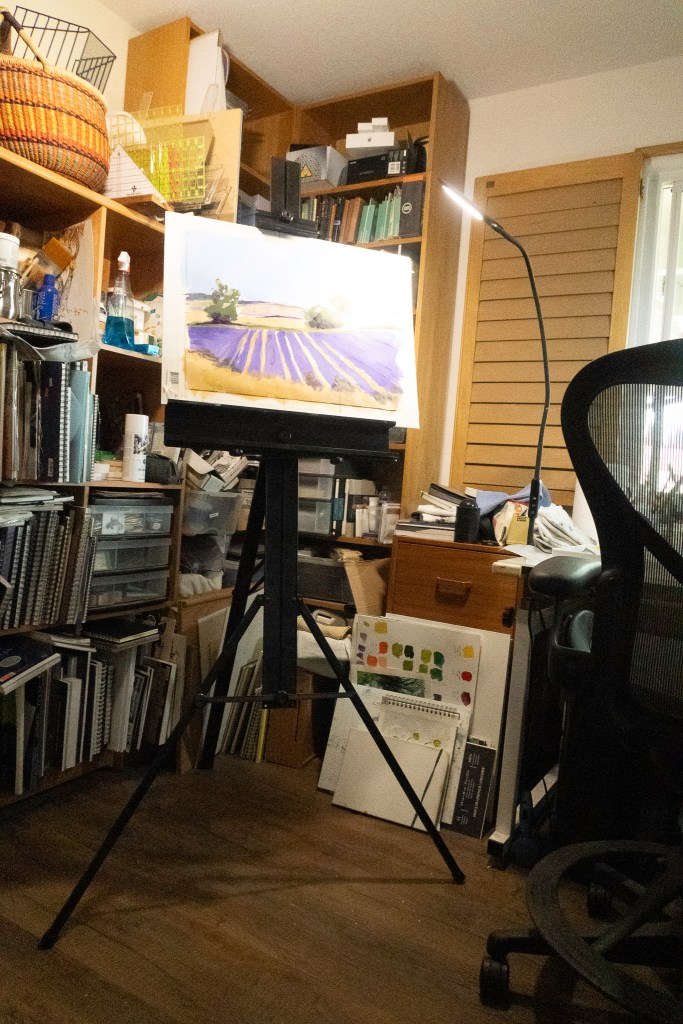
Yesterday I taped 1″ wide tape along the borders of a pieces of Canson XL watercolor paper in block format – 16×20 I believe. Then, I sketched in with pencil and laid down a foundation of values which gave me a sort of road map as to what I was going to do.
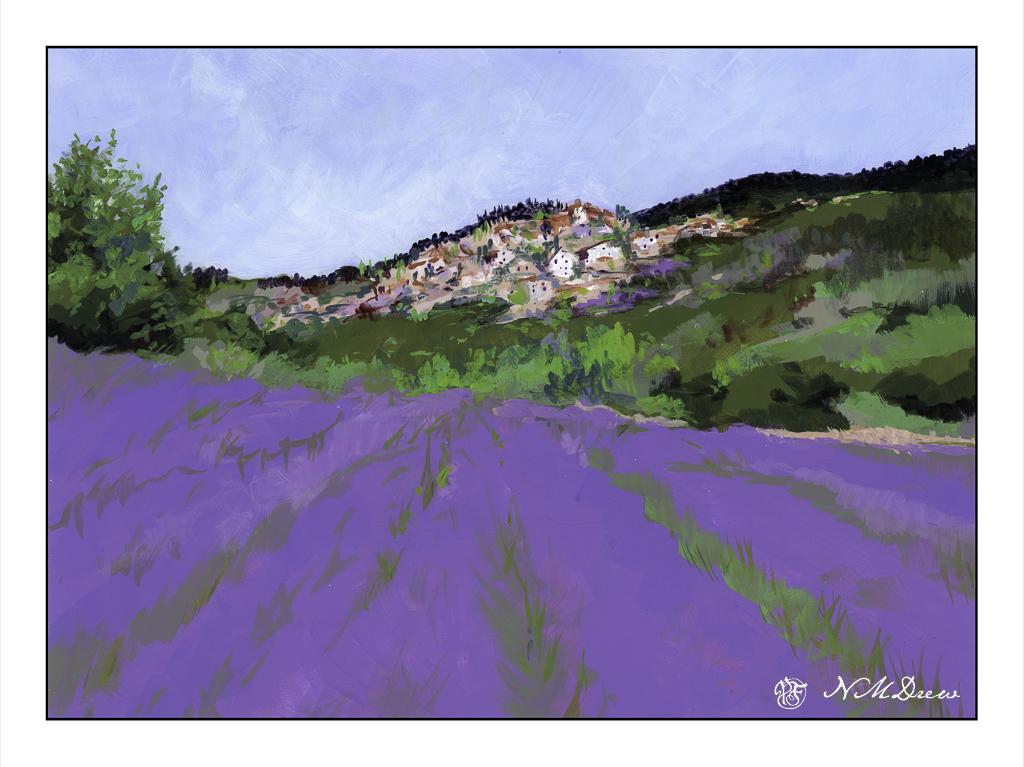
This is my second layer – colors this time with some values. The idea I had when I started out is I did not want to do a bunch of dabbing, which is my normal style, but instead make large swaths of flat color in the foreground lavender with some detail, and lead the eye to the village on the hill. To do this I used the lines of the lavender to lead the eye to the middle ground, but then chose brighter and warmer greens to sort of point to the village – lookie here!
I am not too sure how successful this is as a painting per se, but I am quite pleased with it. This is my first attempt at a big painting with the fluid acrylic paints, and as with all acrylics, I had to work with the quick drying time of the medium. The fluid acrylics were easier to use in a lot of ways than were the regular tube paints just because I didn’t need to work at diluting them. Straight out of the bottle, they work quite well. Shaking them a bit before use is a good idea, too. I will be ordering more titanium white as I have used a lot of it to just make this painting.
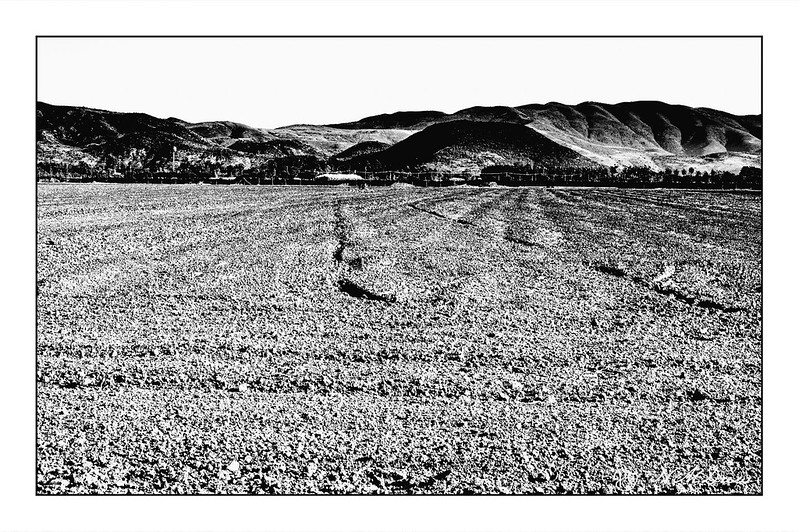
I was not especially pleased with yesterday’s painting. After leaving it alone, looking at it again, it seemed to have all the same values for the most part. Today I decided to look at shapes and values a bit more in depth.
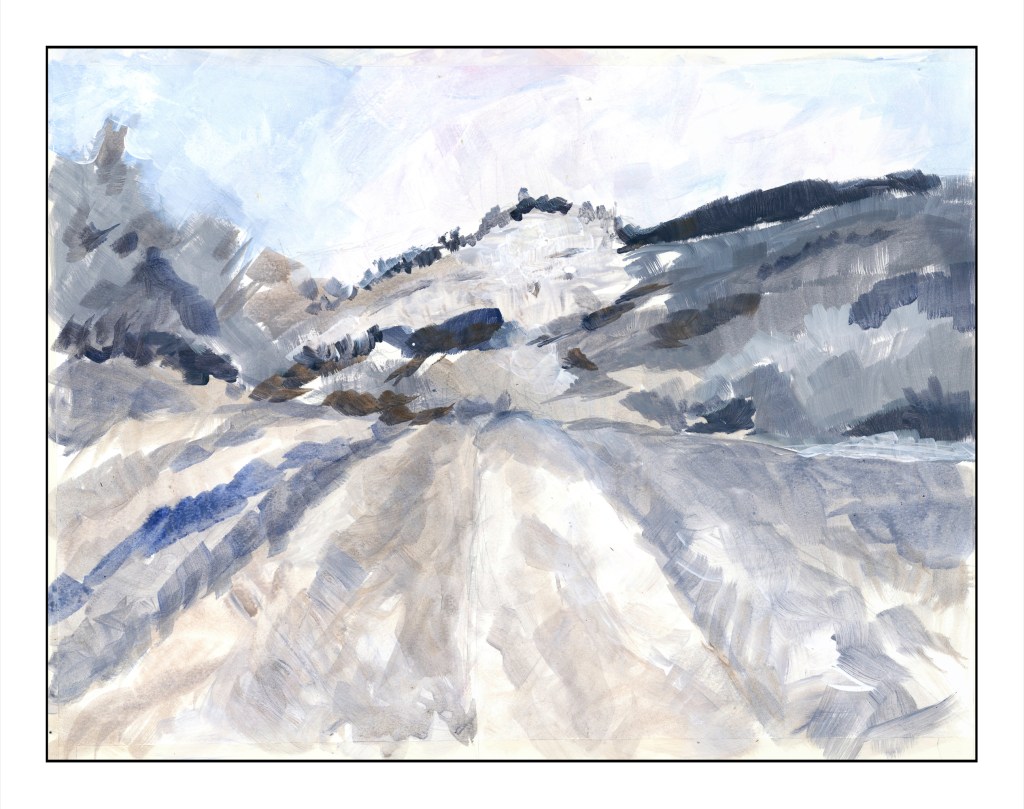
One thing I did was to change the elements of the picture a bit. I cropped off a lot of the left side and then made a composition out of that. Left side, middle value sky against light land and dark trees. Right side, darker land against lighter sky. In the middle, land and sky of similar value, mainly middle.
Obviously, the right becomes darker, and what I attempted to do was to create a shape of dark values with connections throughout the painting, connecting with right side to bottom and then to the left. Darks were connected throughout with the stone walls and into the trees. The dark trees in the upper left shift into a darker middle value with the sky.
I also tried to work with shapes – dark shapes with the middle ground tree being the focal point. The lighter shape is the land and the slope down the hill from the same tree. I have been reading a bit about how to work values to create focus – such as light and middle values as focal points surrounded by dark. The same can be light and dark to focus, and then surround that by middle values. Maybe that is what I was doing with the tree and shadow on the hilltop.
Anyway, my head is spinning. I know what I was trying to accomplish – shapes, values, warm and cool colors. Words are not easy to find to describe, so I will leave you for now with my mental and painterly chaos!
Over the past two or three weeks – really, since the last posting – I have not had time to lift up a paint brush or pencil. It makes for a good break up to a point but when I look back, some of the stuff keeping away from watercolor and paint have been the less attractive necessities of life! Today I have finally settled a bit, enough to take the time out of the day to see if I could even focus on paint without creating mud.
Apparently I can!
Whenever I have not painted for a bit, I like to dive into something which is comfortable – landscapes – and makes me happy – brilliant greens against an intense sky. The American Southwest can provide it, as can spring in California, but today I went to Pixabay to look at pictures of Great Britain. I love their landscapes, especially the Dales and the South Downs, and anything along the coast. Here, living in dry California, such lushness always appeals to me.
This is certainly not my best work, but it is not my worst. The usual lack of depth dogs me except perhaps for the hilltop in the upper left below the sky. I do like the simplicity of my colors, though; it is too easy to do detail after detail after detail.
Anyway, I spent a few hours somewhere in England, and it feels pretty good.
Above is a copy of Derain’s painting, ca 1904, done during his Fauve period. In an online class I am taking, we are encouraged to copy the work of a master artist, new or old, and learn from the experience. This is the second I have done, and certainly one I would not have really considered just because it is so bright! But, the colors and composition caught my eye, and off I went.
The first thing I did was to grid it onto paper. Derain’s work is obviously oils as acrylics did not exist in 1904. I used acrylics on ungessoed paper. As I moved along, looking more carefully, I think he underpainted his canvas with raw sienna or yellow ochre – you can see such colors along the bottom of his painting.
This painting took me probably about 8 hours. I gridded the image, which is about 11.5×17 inches, whereas the original is about 18×22 inches. Then I painted the basic shapes and colors yesterday morning.
This took a lot of time! I am glad I did a grid as the overall areas to be painted were fairly apparent as to shape. What they were – well, some leave me wondering. However, colors are shapes, and Fauvism is not reality, so I could do a bit of my own interpretation, too.
Next, I began to define areas as well as correct mistakes, such as my lopsided building in the lower left side. My paint was thicker, too. Below is this morning’s work.
After lunch, I aimed to complete my copy of Derain’s painting. As I moved along, I looked at Derain’s brushwork. There is a very graphic quality about his painting, which is very pleasing, but the brushwork, too, is fascinating. I did try to emulate it a bit, not just dabbing, but trying to see when he did a dab, a long horizontal push, and so on. Easier to do than to describe!
My final work really does please me. I love the bright colors. My limited palette worked pretty well and there was joy in mixing colors. I usually tend toward more “natural” colors, but the truth is I am a magpie at heart, and bright colors always do get my attention and make me happy. That is an emotional reaction. Classical paintings, though, do appeal to me. Copying a master is opening doors to me and leading me into areas I have never explored.