I took some time to rummage around the studio and found my pad of paper I had set aside – an inexpensive, 100% cotton paper. This paper does not work well with really wet washes, but does well with lighter ones.
I always enjoy the combination of ink and watercolor. Drawing in ink without a pencil drawing beneath seems to me to be far easier to do, and more logical (if that makes sense) than working with a pencil for a value study and then inking over it, erasing the pencil, and then painting. I guess the amount of lines makes more sense to me than the pressure of the pencil? Anyway, I decided to see what I could do with ink and watercolor.
Nothing fantastic, but it does have a nice composition and sense of value to a point. I think the details – or lack – makes an ink drawing express itself. From there, I began to lay in some light washes, referring to the color sheet from my new set of 48 Schmincke Horadam half pan set I mentioned a couple of posts ago. Already I can see my heading toward specific colors, but looking at the painted color sampler, I tried different ones, like English Venetian Red. That color has never made it into my palette, so this was fun!
It took awhile to get comfortable using the pans as I usually paint with tubes. I am experimenting with things to decide what I want for plein air painting and drawing. Thus, pan paints make sense as does pen and ink. I like to travel light, and don’t like lugging this and that around. Having a lot of colors also allows for less need for water, I think, when sketching and painting, as mixing colors can be a bit of a job. At the same time, I do mix, such as blues and yellows to make greens, and having a lot of choices makes for some new and interesting result.
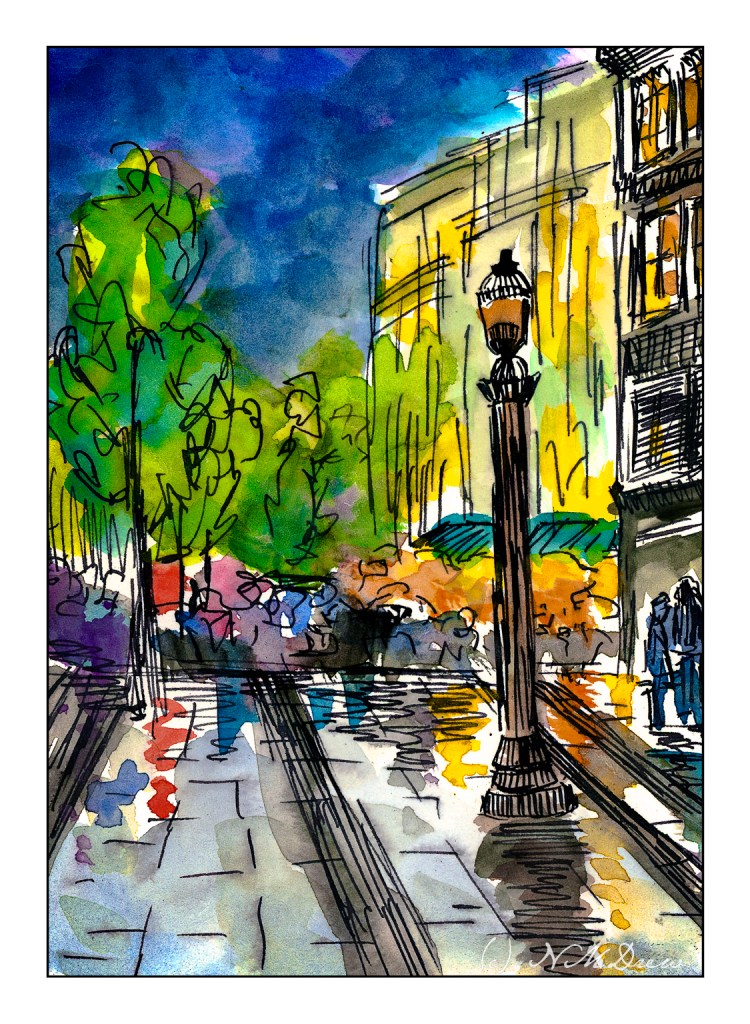
So, here is the finished ink and watercolor sketch. 9×12 on 100% cotton student grade watercolor paper. Light washes were used for most places, including the darker areas. For the darks, though, I did need to work on making my paint thicker and heavier. And I got to mix a lot of greens in addition to using the 4 or 5 available in the pans themselves. Altogether, I was pleased with the results and the experience.
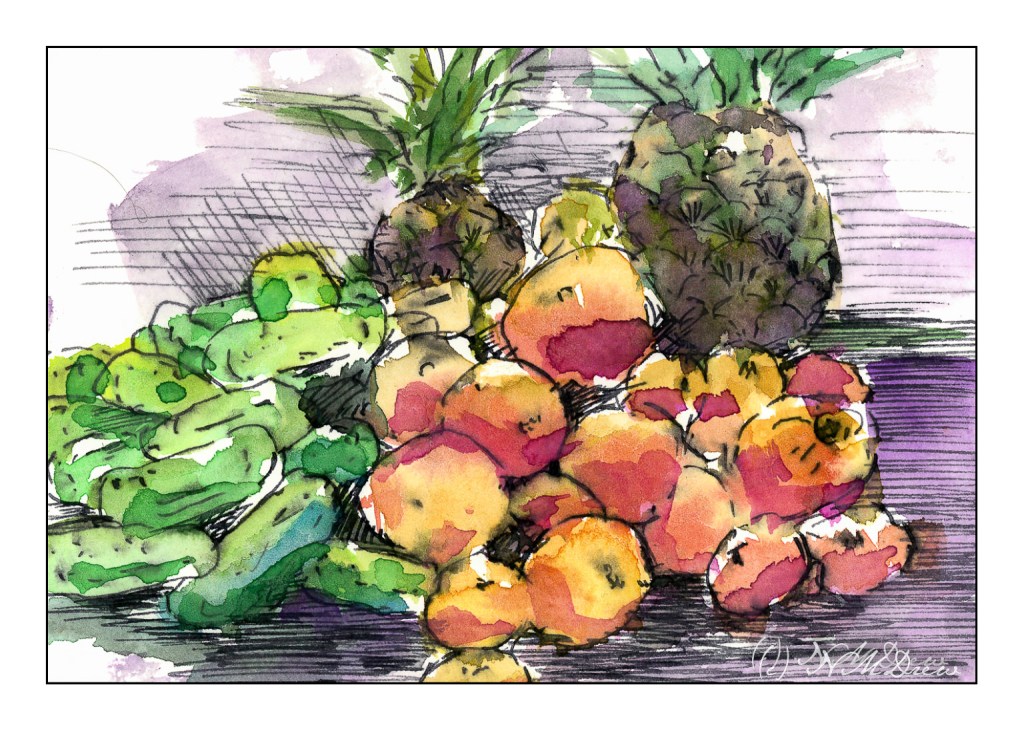
I’ve always loved pen and watercolor drawings, long before urban sketching became connected with it. The ink here is some of my homemade iron gall ink, waterproof and dark once dried. On top of that, opaque pan watercolors I picked up at a little store in Decorah, Iowa, this summer. The paper is 100% cotton Bee paper – nothing great, not expensive, but fun to use and responsive to both ink and color. Illustrations like this are fun because they aren’t “serious” – I get to play, practice, explore. Not a bad way to spend some time before lunch.
For the past year I have been keeping a journal – something I have done since I was 10 (I shred them, too!) – writing exclusively with goose / duck / turkey quill pens and iron gall ink, all made by myself.
Real quill pens don’t have all the feathery parts on them. They are removed when the quill is made. Not very pretty, but far more functional. All that fluffy stuff gets in the way when you write!
Why do this? I like the act of writing. Just paper and ink and my thoughts or lists or complaints or observations. In this time period, just the daily usage of ink and quill has shown me and taught me a lot of things, things which are perhaps lost through time and the changes in technology. The fact is, too, I like to make things that I can use, and a quill pen and iron gall ink are proving to be two favorites.
Quills gave way from common usage in the 1830s when the metal nib came into easy manufacture and availability. Why not? Easier than cutting your own quill. Iron gall ink is easy to make if you have iron galls (though any plant material with tannin in it also works), and other ingredients available. It just takes time. Interestingly, powdered iron gall inks were available to the public, and apparently in common usage during the Revolutionary War by soldiers and others on the move. The powder was in packets, and all you did was sprinkle some ink on a surface, add water or wine or beer, and with your handy quill and a bit of paper, off you wrote.
Today’s treatise is about the Yncke itself. I’ve made multiple batches and have found out a few things that may have been common knowledge back when it was the only ink commonly available.
Observations
Iron gall ink is best used in small amounts, such as in an inkwell with a lid. The ink evaporates and particulate matter settles out with time. By keeping your ink in a sealed container – I use a mason jar with a lid – you keep it relatively fresh. It won’t evaporate although settling of the materials occurs.
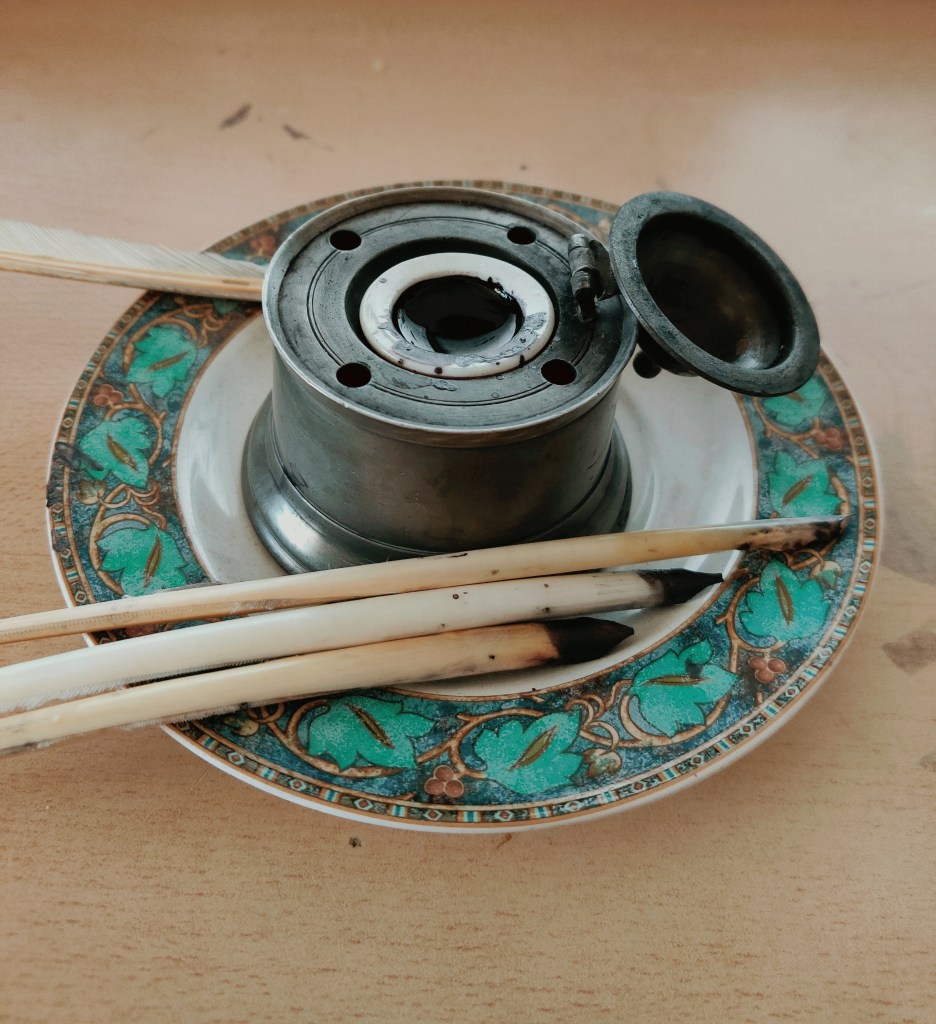
Here are my quills, ink well with porcelain insert, and saucer to catch spills. Notice the stains on my desk! I can usually remove them with some bathroom scrub that has bleach, rinsing thoroughly after scrubbing. Let the cleaner sit for a few minutes to let the bleach work, and use a bit of gentle elbow grease. This is a plastic-topped work station I have had for 25 years, and it has held up very well!
I use a pewter inkwell, reputedly from the early 1800s, with a porcelain well. I keep it on a saucer as spills from iron gall ink stain anything easily. The porcelain is easily cleaned up. I replenish my ink every two or three days – a lot gets used up! Watching it disappear is rather fun.
When I replenish my ink, my choice of adding more ink or thinning it is really my first question. Experience has shown that through evaporation the ink becomes thicker and thus does not easily flow from the pen. I add water in a small amount, but after having read that one should use vinegar or spoilt wine or beer to keep the ink’s color strong, I have tried both. My experience is too limited at this point to make a more definitive statement that either works fine.
How do I know when I need to dilute my ink? I know when I can no longer write a long line of words with a single dip of the quill. The ink begins to blob up and becomes more viscous. If I find I can only write a word or two before the ink is very pale, I know that the first problem is the ink, not the quill. Then, I add a bit of water or vinegar or wine or beer, just a bit, and try writing again. If the flow improves, you are fine. I use a plastic pipette with a squeeze bulb because I can control the addition of liquid more easily than just pouring it into the well.
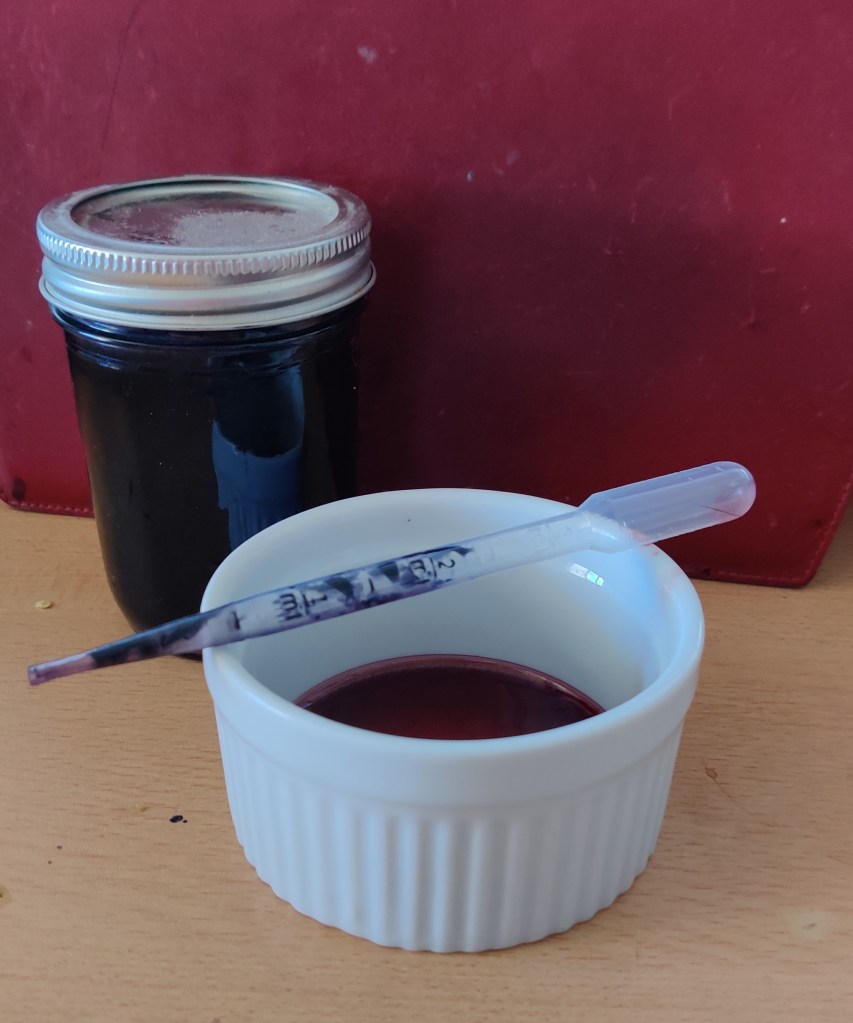
Here you will see the ink in a 1 cup canning jar with separate screw top and lid. The pipette is made of plastic and has a squeeze bulb on top. This allows for tidy delivery of either ink or thinning liquid – here, old red wine in a custard cup.
In using iron gall ink, I used to keep it in bottles with screw-on lids. Specifically, I used old fountain pen ink bottles. However, this ink is like a glue in some ways because the lids eventually stick to the bottle and become difficult to unscrew. Flying ink is not fun when you finally get that lid off! I store mine in 1 cup canning jars, the kinds with separate screw tops and lids, such as used in making jam or jelly. When I need more, if the lid is sticky, I can usually pry it off with a knife – slowly and gently! And I do it in the kitchen sink or with paper towels beneath the jar to catch any spillage. Clean any spills up immediately!!
Iron gall ink can spoil. I have had batches which developed a scummy surface on it, but it doesn’t seem to affect the quality of the ink. I just shake it up and mix it in. This seems to have occurred when I used water in making the ink. This last batch I made with some old wine, and the scum did not appear. I will say, too, that I like the smell of wine when I use fresh ink! It’s a nice addition.
Making it, as I said, takes time. There a numerous recipes on the internet. You can find my own commentaries on the ink by using the search feature. The recipe I use so far is as follows, and have been pleased with it, especially when I have made it with wine:
Receipt for Iron Gall / Oak Gall Ink
Oak galls: 80 g.
Distilled water / stale wine or beer / vinegar: 300 g.
Ferrous Sulfate (I used ferrous sulfate heptahydrate): 50 g.
Gum Arabic: 25 g.
Crush oak galls into small pieces or grind into powder using a spice or coffee mill. Place into jar and cover with 300 ml. of distilled water. Place in sunny window 3-7 days (depending on your life and schedule). I plan to do 3 as per the recipe from the Schoenberg Institute. After 3 days, there should be a dark murky liquid in the jar.
On Day 3, add 50 g. of Ferrous Sulfate to oak gall mixture; replace in sunny windows for another day. On Day 4 add the Gum Arabic and leave for another day. On Day 5, strain the liquid into a clean vessel and voila, ink!
My Check List For Using and Maintaining Iron Gall Ink
Take the time to make iron gall ink. I think a week or two is best. Anticipate when you will need a new batch.
Store unused ink in a closed container, such as a canning jar.
Use a small amount of ink at a time as it easily evaporates and settles out.
If your ink is thick, before adding more ink to your well, dilute first with small amounts of water, vinegar, stale wine or beer. Test with your quill. A pipette works well to transfer fresh ink or dilution liquid.
Paper towels are excellent as blotting paper. I use toweling to blot a page before I turn it over, and I turn it over onto another sheet of toweling. Sadly, we no longer have blotters as daily items on our desks.
Rinse your quill when done, and blot it dry. Have at least 3-4 quills available to use as they need to dry out between uses.
So, that is it for this posting. Hopefully it is of some use to those who would like to use iron gall ink and quills on a more regular basis. If you are just beginning to use these items, be patient and kind to yourself. Learning to write with a quill pen is not easy, and learning how to replenish the ink on your pen has its own quirks. We are used to pens where re-inking is not normal, but with both quills and metallic dip pen nibs, there is a pattern and rhythm to getting the right amount of ink on your pen. Once you master it – and it shouldn’t take long – you might find yourself quite happy with your new skills!
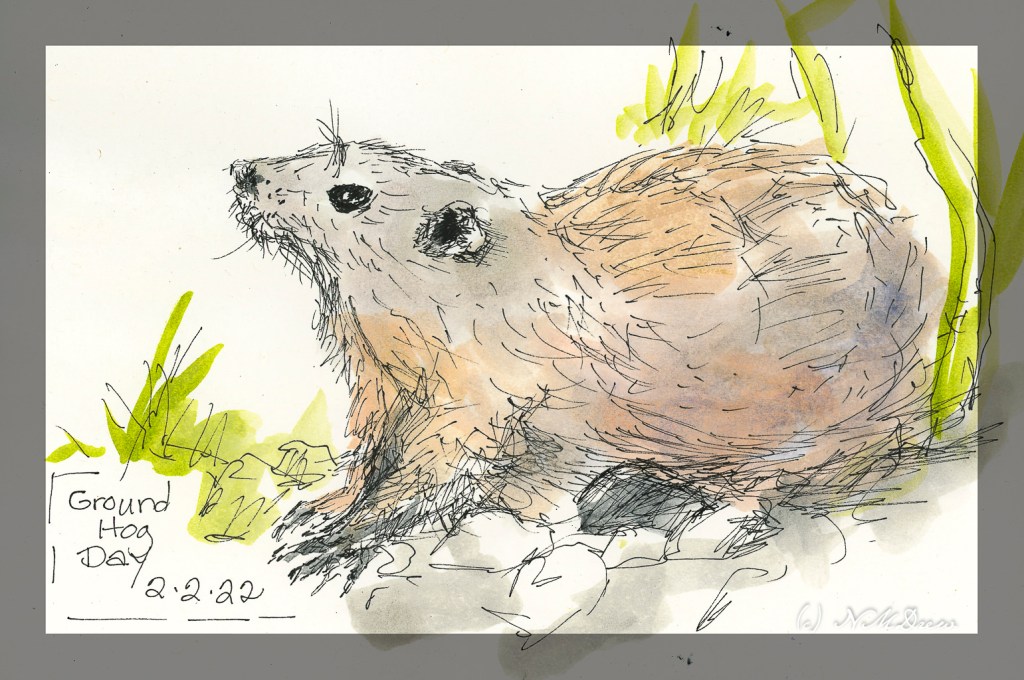
One of the beauties of drawing is you can create anything you want. This is a ground hog, but one I invented. I invented him when I realized his ear is all cockamamy. So, new subspecies: the Lopso-Eared Ground Hog.
Ground Hog Day has always been a favorite of mine. First, I like ground hogs. They are cute. Second, the entire idea of a day devoted to such a cute animal is rather delightful. According to the website history.com:
On February 2, 1887, Groundhog Day, featuring a rodent meteorologist, is celebrated for the first time at Gobbler’s Knob in Punxsutawney, Pennsylvania. According to tradition, if a groundhog comes out of its hole on this day and sees its shadow, it gets scared and runs back into its burrow, predicting six more weeks of winter weather; no shadow means an early spring.
Groundhog Day has its roots in the ancient Christian tradition of Candlemas, when clergy would bless and distribute candles needed for winter. The candles represented how long and cold the winter would be. Germans expanded on this concept by selecting an animal—the hedgehog—as a means of predicting weather. Once they came to America, German settlers in Pennsylvania continued the tradition, although they switched from hedgehogs to groundhogs, which were plentiful in the Keystone State.
Groundhogs, also called woodchucks and whose scientific name is Marmota monax, typically weigh 12 to 15 pounds and live six to eight years. They eat vegetables and fruits, whistle when they’re frightened or looking for a mate (they’re sometimes called whistle pigs) and can climb trees and swim.
They go into hibernation in the late fall; during this time, their body temperatures drop significantly, their heartbeats slow from 80 to five beats per minute and they can lose 30 percent of their body fat. In February, male groundhogs emerge from their burrows to look for a mate (not to predict the weather) before going underground again. They come out of hibernation for good in March.
In 1887, a newspaper editor belonging to a group of groundhog hunters from Punxsutawney called the Punxsutawney Groundhog Club declared that Phil, the Punxsutawney groundhog, was America’s only true weather-forecasting groundhog. The line of groundhogs that have since been known as Phil might be America’s most famous groundhogs, but other towns across North America now have their own weather-predicting rodents, from Birmingham Bill to Staten Island Chuck to Shubenacadie Sam in Canada.
In 1993, the movie Groundhog Day starring Bill Murray popularized the usage of “groundhog day” to mean something that is repeated over and over. Today, tens of thousands of people converge on Gobbler’s Knob in Punxsutawney each February 2 to witness Phil’s prediction. The Punxsutawney Groundhog Club hosts a three-day celebration featuring entertainment and activities.



 Ink, Yarn & Beer