A Bow to Loiseau

Not too long ago a painting done by Gustave Loiseau called Les Peupliers (The Poplars), ca 1898, caught my eye. I really liked the composition, colors, and overall atmosphere – a bright, sunny, breezy day in the countryside. I will leave it to find it based on my rendition of Loiseau’s lovely painting.
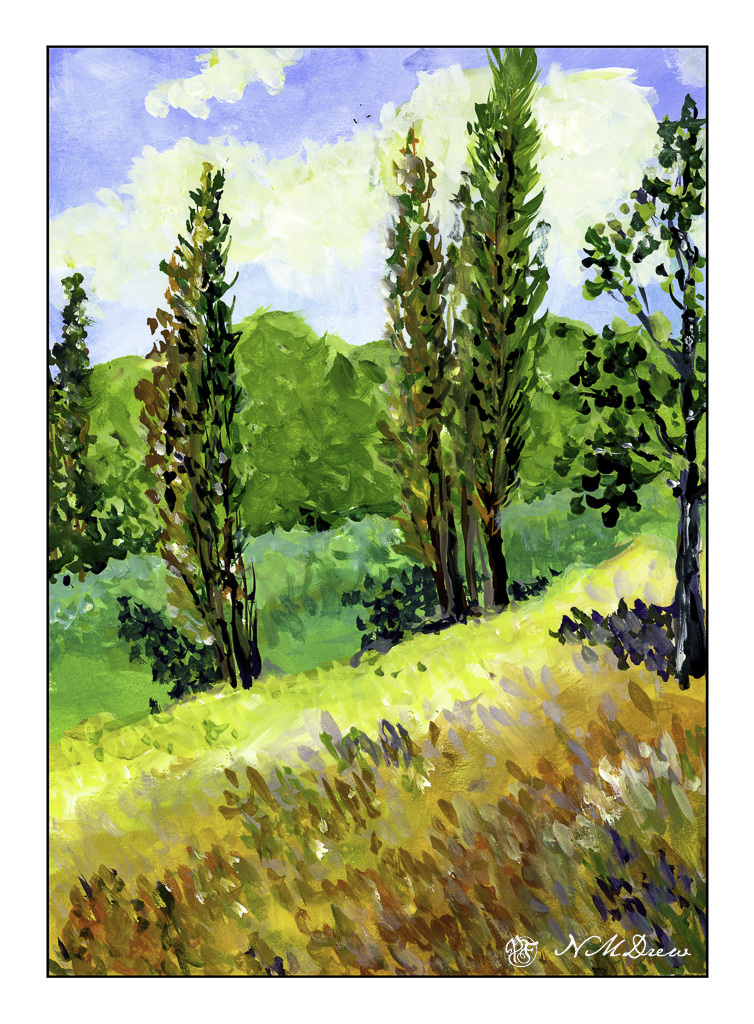
As with yesterday’s painting, this is done in gouache on Strathmore Vision paper. I painted in the underlying colors with an angle brush and then used a finely pointed round to do the remainder of the work.

Gouache is, to me, a rather strange paint, but one which I really enjoy using. The colors always strike me as a bit unreal, but not necessarily in a bad way. They always seem to end up rather cheery, even when I use them to create a rather monochrome or dull scene. It can be used really thin, as a wash, as well as thicker – it all depends on the amount of water you add to it. It is designed to be opaque, but its opacity depends on how much water you add. I think I am on a bit of a gouache streak as I have at least another painting to show you . . . .

Strathmore Vision 140# CP watercolor paper, gouache, 9×12.
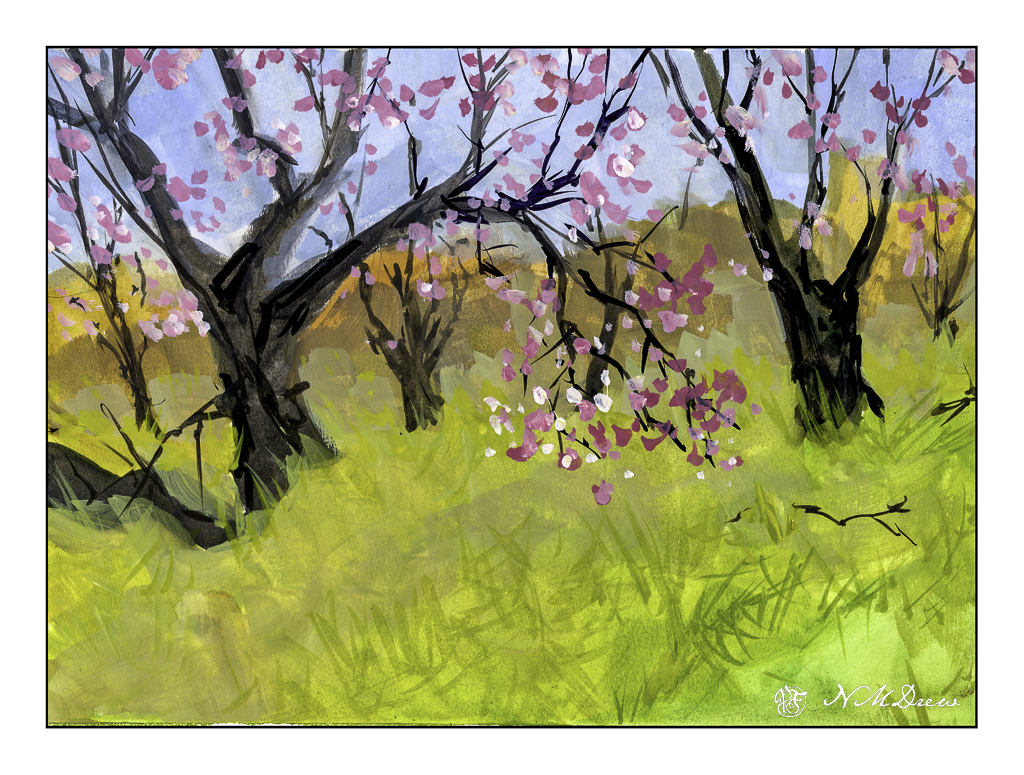
Spring Orchard

I had to miss my oil painting class yesterday as I had some things to do and some workmen to work. I had planned to use gouache while I waited. The workmen came, but I didn’t get around to painting at all. This afternoon I made up for my missed paint time. Spring is nearly here, so Spring it is!

As with any medium, if I have not used it for awhile, I need to get used to it again. As I was playing and it was lying around, I picked up my pad of Strathmore Vision watercolor paper. This is not a great paper for watercolor, but I love it for pen and ink. Why not gouache?

What I like about gouache is that it is opaque, yet diluted it becomes transparent – or certainly thin enough to show the colors beneath it. I painted with an angle brush and thin paint, laying in colors. Details were done with a small, pointed round. Additionally, as this is artists’ gouache and non-acrylic, the colors can be re-wet, and thus some fun blending can happen. I used all my little tricks to refresh my gouache memory, and here we are.

Gouache, Strathmore Vision paper, 9×12.

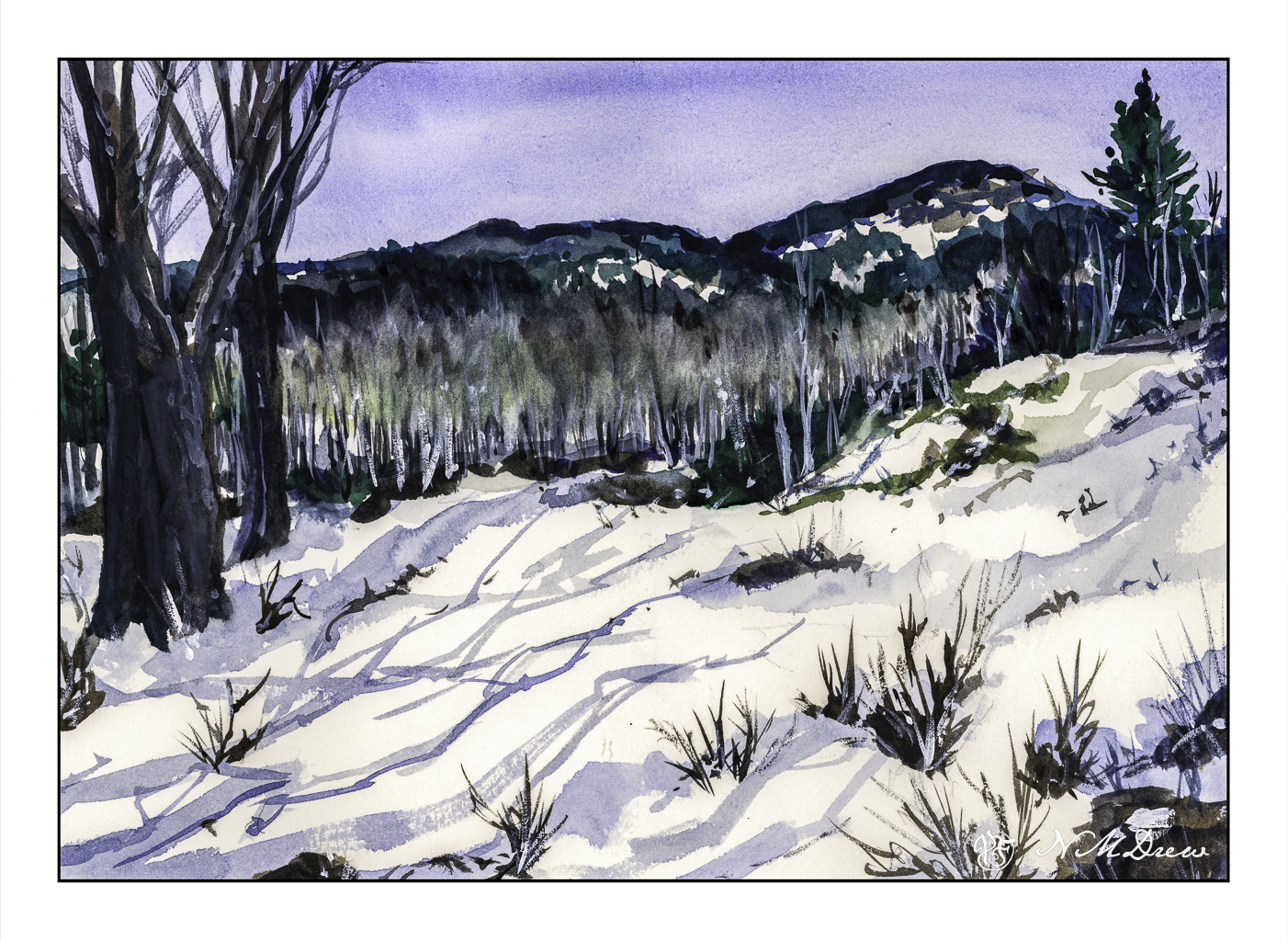
Winter in the White Mountains

It is exactly a week before Christmas. Today, in SoCal, the wind is blowing, there are fire warnings, and it is about 77F (25C). It is a bit warm. Snow seems to be a good subject to watercolor!

The focal point of painting this picture, besides wanting a bit of snow for the season, is to see if I could catch the softness of the bare birch trees that act as a barrier between the snowy foreground and the mountainous background. Anyone who has seen the leafless birch trees at a distance knows that there is a sort of haziness as all their branches overlap and merge into a softness with some detail and without much detail at all.

I used a relatively limited palette – mostly ultramarine, Hooker’s green, burnt sienna and umber. In some areas I used titanium white gouache, partly to place definite snowy details as well as to blur into the birch branches to create that softness I wanted to express.

Not a bad way to spend an afternoon out of the wind!

Watercolors, Arches 140# CP, 10×14, some gouache.

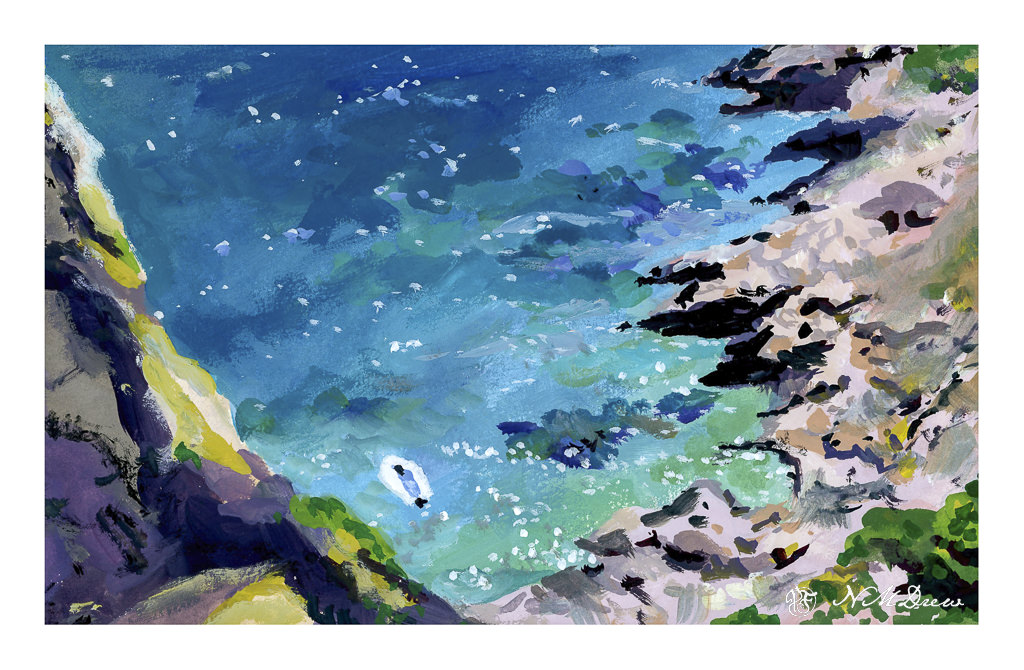
1. The Cove Below

Siena Blue did a series of 30 gouache studies – and she/he did a beautiful job! Inspired, I have decided to do a series of gouache paintings over the next several days, but I am not setting myself a goal as to how many. Gouache can be returned to easily enough as the paint re-wets quite well. As I have not worked in gouache lately and my life is going to be rather crazy over the next few weeks, it seems like the perfect medium for playtime.

So, a view looking over the edge of a cliff (I assume) taken somewhere on Capri – thus states the Pixabay description. As it is now summer, a rocky coastline, and a moored sailboat on a turquoise sea is quite a pleasant thought!

When I first began exploring gouache I found the work of Lena Rivo, observed her YouTube videos and took her short course. Both really helped me get a sense of how gouache works – it’s not watercolor nor oil or acrylic – and has an odd opacity that takes some getting used to – the colors are unique in many ways as there is a lot of white filler in the colors. Good quality gouache paints are opaque and cover well. All of my colors here are the same Lena Rivo uses, made by Holbein.

Gouache, about 8×10.

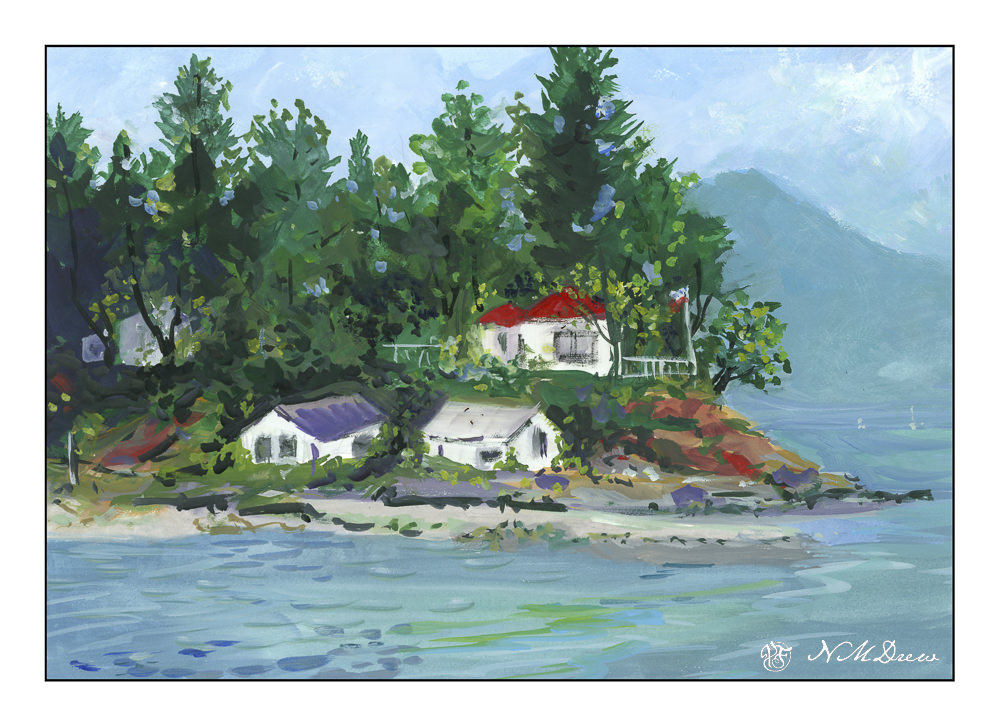
Gallows Point

Years ago we spent several weeks in Canada, and by far a favorite place was British Columbia. Protection Island is off Nanaimo, and on it is a lighthouse and residence. The lighthouse is called Gallows Point, and as you can imagine, the site of an execution. The history is interesting, and you can read more about it here.

I really did not have much of an idea what to do today – it is cold and foggy and so chilly that the house was 66F. The damp makes it worse. So, bundled up, I went looking for things to do. Some ukulele practice, chores, dog petting, and finally the decision to pull the gouache out of the refrigerator (keeps down the mold) and off I went. I spent a few hours painting and while not an especially beautiful painting, or accurate, it was fun to do a bit of color frenzy with gouache – which I have not done for awhile.

Gouache, 10×12, hot press paper.