
Offshore Fog

Living along the coast, fog is a part of the landscape. Coastal fog in particular is fascinating in California as in many areas the plant life depends on it for water. The beauty of fog is its ability to soften a landscape and create a mysterious effect. Inland, we don’t have much fog where I live, but in coastal areas, just a block can move you from gloomy and depressing by the beach to sunny and shiny and cheery inland. As a result, I prefer to live inland a bit so I don’t get socked in by fog.

There were two goals here. First, experiment with using only linseed oil as a vehicle to smoosh around paint, creating in the process soft gradations. The second was to experiment with using the Canson XL Oil / Acrylic paper. This paper has gotten some of the best reviews, in part because of its linen finish texture. I agree, the paper and the texture are very nice to work on! The rather grainy effect of white on the still water is done by dragging a wide brush across the underlying blue paint with dryish paint. It makes me think of fog resting above the water, but you can choose what it means to you if you are so inclined!

Because I am using linseed oil, the oil paint takes forever and ever to dry; after scanning this, I had to clean off the glass plate on the Epson V600 even after its drying for 2 weeks. So, it is back in the garage to continue drying.

Oil paint, 9×12 Canson XL Oil-Acrylic paper, linseed oil only.
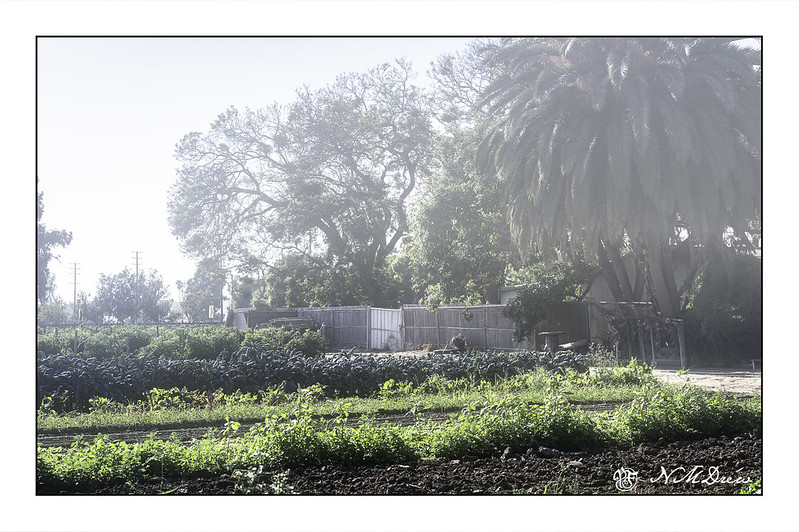
Coastal Farm

Coastal Farm

Along the California coast, fog forms and covers the land, usually in the mornings and later in the day. It is a very standard – and annoying! – part of summers here – “May Grey” and “June Gloom” and “Goodbye July” are the standard snarks about the lack of sun! Here, another view of the farm, misty fog coming in as the afternoon moves into evening.

Coastal Fog, Morning

I am trying to lighten up my handling of watercolor. Very often my colors are far more intense than I really want. I think part of this is the result of impatience and perhaps pre-cataract surgery days. Watercolor itself lends itself to a delicacy other media lack, I think, and to not play into the wetness and what it can do perhaps defeats watercolor’s beauty.

There is something about fog and early morning that always fascinates me. The idea that a cloud is on the ground (my father’s description of fog when I was about 5) still intrigues me. After all, clouds are UP!

So, a morning along the coast. Wet, soft, blurry, and giving way to a sunny, summer day.

Arches CP 140#, 9×12, watercolor.

Windbreak

I should have gone to my Pencil Portraits class . . . but it was raining and cold and it’s outdoors.  I’m a wuss, enjoying snow and ice from a distance.  Thus, biting cold, frost, and snow fog.  Wander along the road, beneath the trees, and remain in my snug house with a cup of cocoa and blues a-playing in the background.  Not a rough life.

To the Lighthouse

A bad reference to Virginia Woolf’s novel, which is an interesting read.

This painting is a dedication to lighthouses worldwide. They have saved so many lives by letting sailors know of treacherous waters. Add to that, lighthouses are often found in spare and rugged places, all of which make for dramatic and wonderful photos and paintings.

I have often thought I would like to live in such a place, hearing the waves crash, watching the light circling through the night, and, of course, the sound of fog horns. Throw in some seal barks and sea gulls, and I would be pretty happy. Sleep could be a challenge though.

I made up this painting, amalgamating lighthouses and buildings from various images. My goal was to practice shading, such as moving from a sunlit side to the shadow side, using pointillism techniques. You can see this on the conical shape of the lighthouse as well as on the buildings. I have tried to give a sense of cliffs and housing sunk down a bit behind the green of the grass. Morning or evening light for the sky, or an intimation of fog and filtered sunshine is also attempted.

As I work more in pointillism, I realize that this helps me tremendously in sorting out colors. As far back as I can remember, mud has been my most famous by-product in painting. It could be that this is something I really need to use as a primary technique, though I am thinking of doing a pointillistic painting in gouache, and then re-wetting it to blend the colors applied in dots.

Now, on to other adventures!