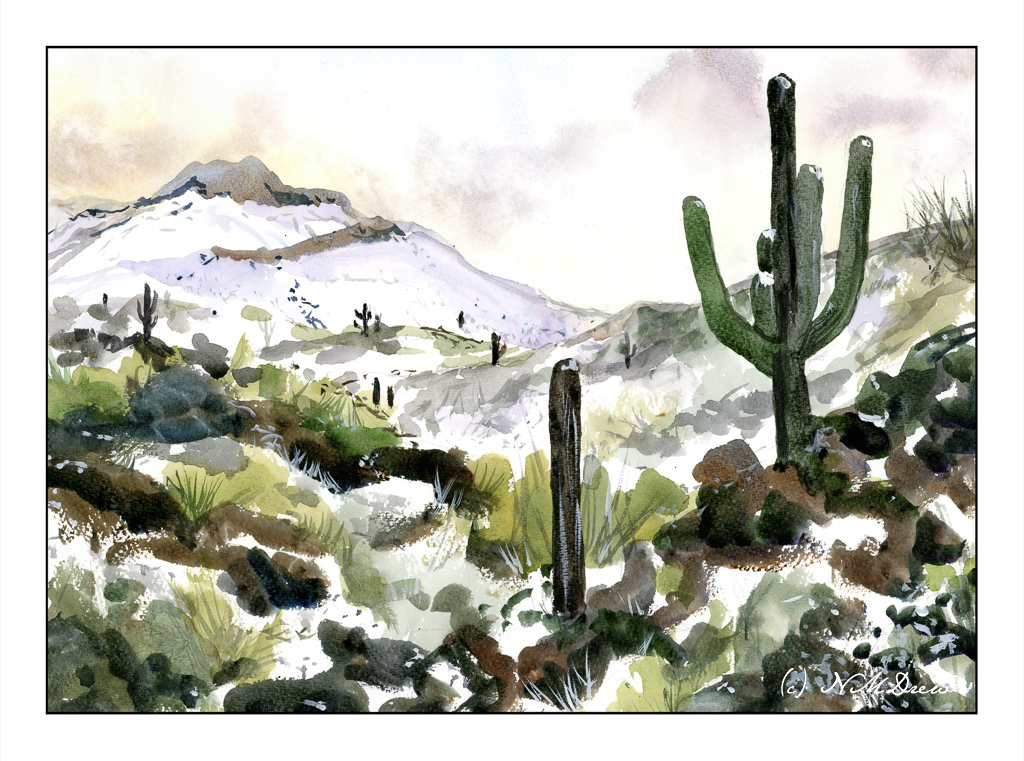
Snow in the Sonoran Desert

It seems appropriate to do a version of a western snow scene, and what better place than the Sonoran Desert? It is a bit closer to home than New York. I always find snow in the desert or places I don’t think of getting snow to be absolutely fascinating.

Once more, I am using a limited palette. Here, umber, ultramarine, Payne’s grey, and Hooker’s green for the landscape. The sky is ochre with some Indian yellow, quinacridone rose, and cerulean. Some of the Indian yellow is also present in the landscape, partly to lighten things up and to make some variations. Titanium white gouache is used here and there as well.

I am beginning to find limited palettes of color a lot of fun! When I am painting with them, I have not set out to use a triad of colors (such as a red, yellow, and blue), but picked the colors based on my need to succeed, at least in my head, in creating the painting I want. At some point, I will try primary triads, but that may be for warmer weather. Right now it is winter, and winter I shall paint!

In addition to a limited palette, I am also using larger brushes overall and abstracting details into shapes. Pale, pale washes, as for the sky, are also some of my goals. The scan, once more, is not as good as it could be, but in general the stronger colors are well portrayed.

My paintings are getting better, I think. At least I like them better than many others I have done. Yesterday’s painting was meh, but if I consider that 3 out of 4 have pleased me so far, I must be winning. 🙂

Watercolor, limited palette, St. Cuthberts Mill, Bockingford 140# CP, 12×16.

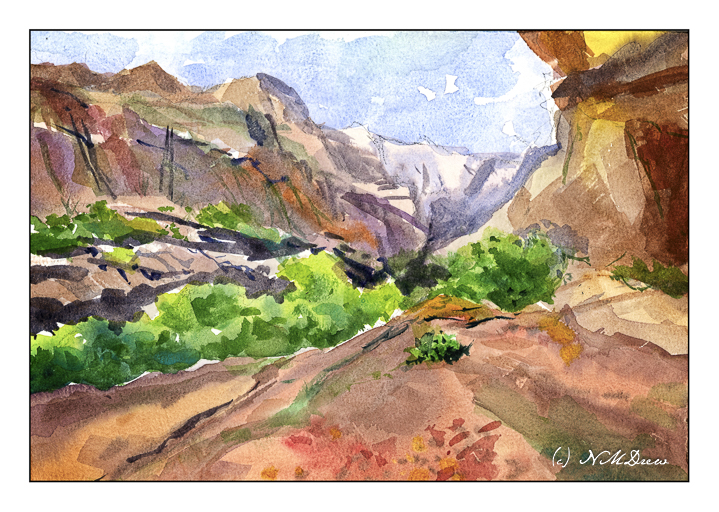
Deep in a Canyon

In the corners of southwestern canyons, near seeps, there is always something growing. These places are subject to harsh conditions, but somehow nature has evolved and beautiful trees and plants provide food and shade and protection for wildlife. And me.

I was really drawn to the contrast of the dark trees and shades of green against an ochre canyon wall. The shadows and the trees and brush create complex patterns in what is often a very barren landscape.

Watercolors, Arches 9×12 140# CP paper.

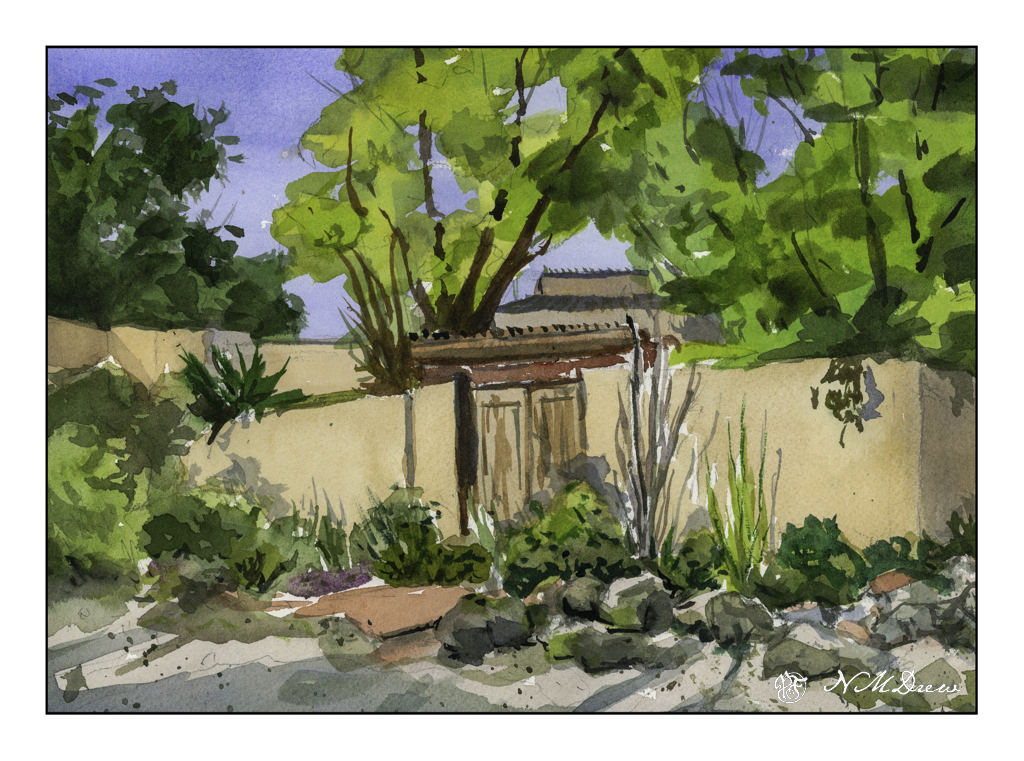
Adobe

Yesterday was Easter, a quiet time for us. The day was gorgeous and the weather so pleasant – perfect Spring. I love the way the light catches as the seasons turn, and the clear, dry air of the southwest pushes colors to a harshness which at high noon can be glaring, but early or late in the day, when the shadows are long, the light is clear and bright but doesn’t hurt your eyes.

For the past several days I have been working in watercolors on smooth paper to practice pale colors which would work well with ink. I think I am getting it. Easter Sunday, though, I was getting a bit bored with the colors I was using as well as the lack of papery tooth to hold colors. As a challenge, I decided to paint a building. I realized why I am intimidated by buildings – they have straight lines and a jerk of the brush can ruin a good, hard edge.

A few straight line glitches, but I will say I am pleased with what I did here. I took my time and tried to create a simplification of a complex structure that works well with shape, shadow, contrast. I know where I messed up my straight lines, but you can find them and tell me if you like!

Watercolor, Arches CP 140# paper, 9×12.

Back Country, Amargosa River

The Amargosa River is located in Nevada and California, moving into Death Valley National Park of the Mojave Desert. As a river, it flows freely both above and below ground, providing much needed water in an otherwise dry climate. Because of it, there are many rare and unusual plants and animals, some found nowhere else in the world. It is managed by the Bureau of Land Management (BLM) to conserve it . . .

This is another gouache painting. I wanted to capture the contrast of the river basin to the mountains it runs through, as well as illustrate the wonderful colors you can see in a desert or riparian area. Dry, rocky mountains, flat areas from flash floods and trails, the occasional tree, low-growing plants adapted to a dry environment. Plant colors are generally pale – sage green being a dominant one as well as bright yellow flowers. Dry air lets you see for miles into the distance and at times you wonder if you will ever see a cloud in the endless blue sky.

Gouache, Strathmore Vision 9×10 140# CP paper.

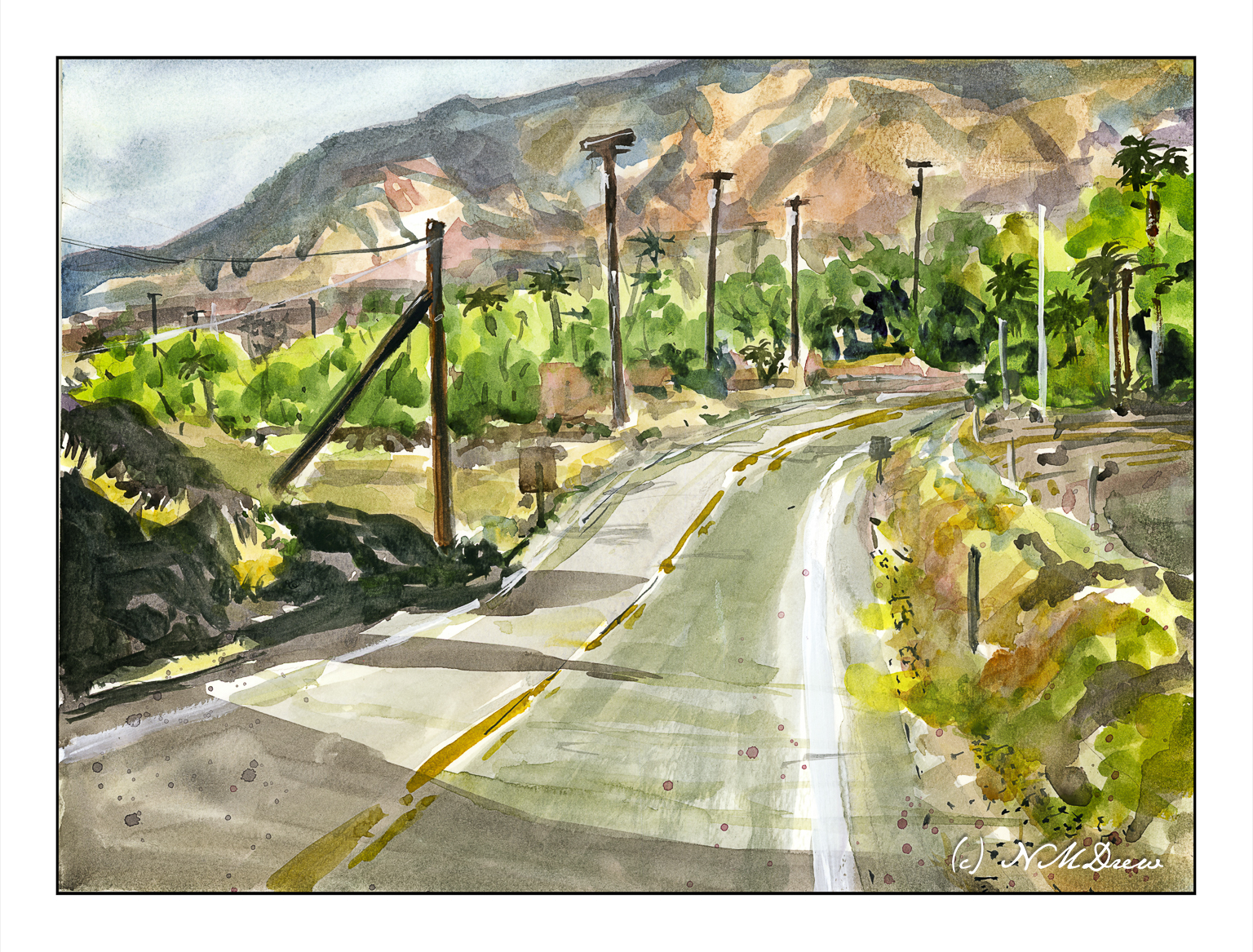
Between the Mountains

One thing I love about California is the fact that the geography varies so much! Oceans with flat beaches, oceans with cliffs, mountains with snow and mountains with pine trees, and deserts stretching flat and hot, surrounded by mountains and creating a secret world fascinating and forbidding. Worldwide, deserts host animals and plants and insects which survive on little water, are stark and seemingly dead – but of such beauty. Deserts are not for everyone – familiar and comfortable landscapes full of trees and greenery are very different. It took me a long time to appreciate a more stark landscape than the rolling green hills and woods of the midwest and eastern seaboard.

This is a painting I have been working on in my weekly class, inspired by multiple memories and photos taken. I had a limited palette of white, ultramarine blue, Indian yellow, and light green. I tried to catch a golden glow as well as give a yellow-orange cast to the desert floor and hillsides – and create a softly blended painting.

Oil, 12 x 16 canvas panel.