Offshore Fog

Living along the coast, fog is a part of the landscape. Coastal fog in particular is fascinating in California as in many areas the plant life depends on it for water. The beauty of fog is its ability to soften a landscape and create a mysterious effect. Inland, we don’t have much fog where I live, but in coastal areas, just a block can move you from gloomy and depressing by the beach to sunny and shiny and cheery inland. As a result, I prefer to live inland a bit so I don’t get socked in by fog.

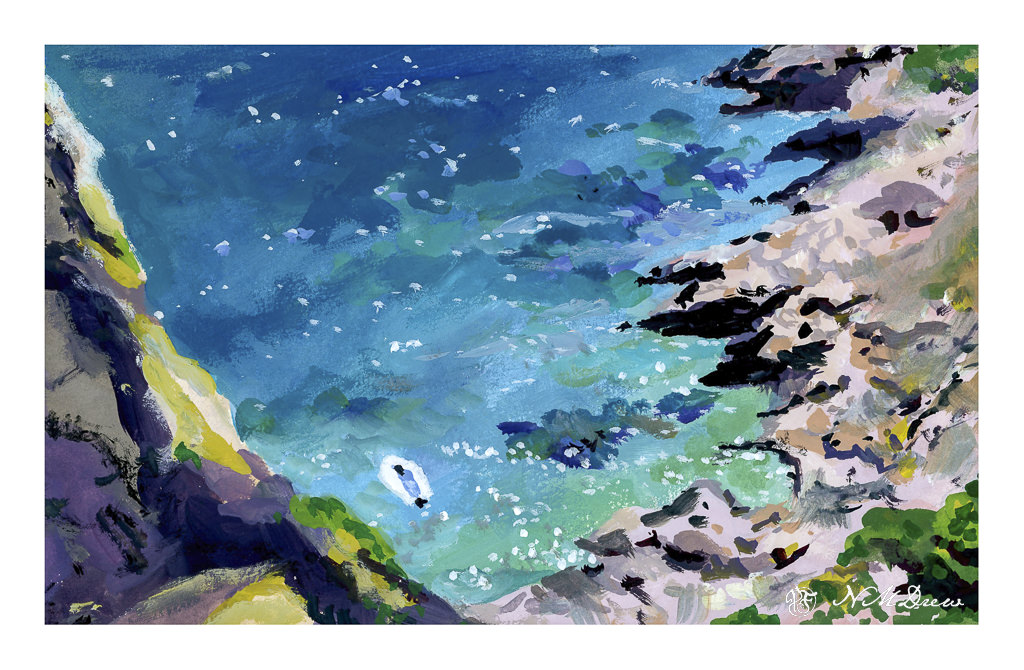
There were two goals here. First, experiment with using only linseed oil as a vehicle to smoosh around paint, creating in the process soft gradations. The second was to experiment with using the Canson XL Oil / Acrylic paper. This paper has gotten some of the best reviews, in part because of its linen finish texture. I agree, the paper and the texture are very nice to work on! The rather grainy effect of white on the still water is done by dragging a wide brush across the underlying blue paint with dryish paint. It makes me think of fog resting above the water, but you can choose what it means to you if you are so inclined!

Because I am using linseed oil, the oil paint takes forever and ever to dry; after scanning this, I had to clean off the glass plate on the Epson V600 even after its drying for 2 weeks. So, it is back in the garage to continue drying.

Oil paint, 9×12 Canson XL Oil-Acrylic paper, linseed oil only.

Haystack Rock

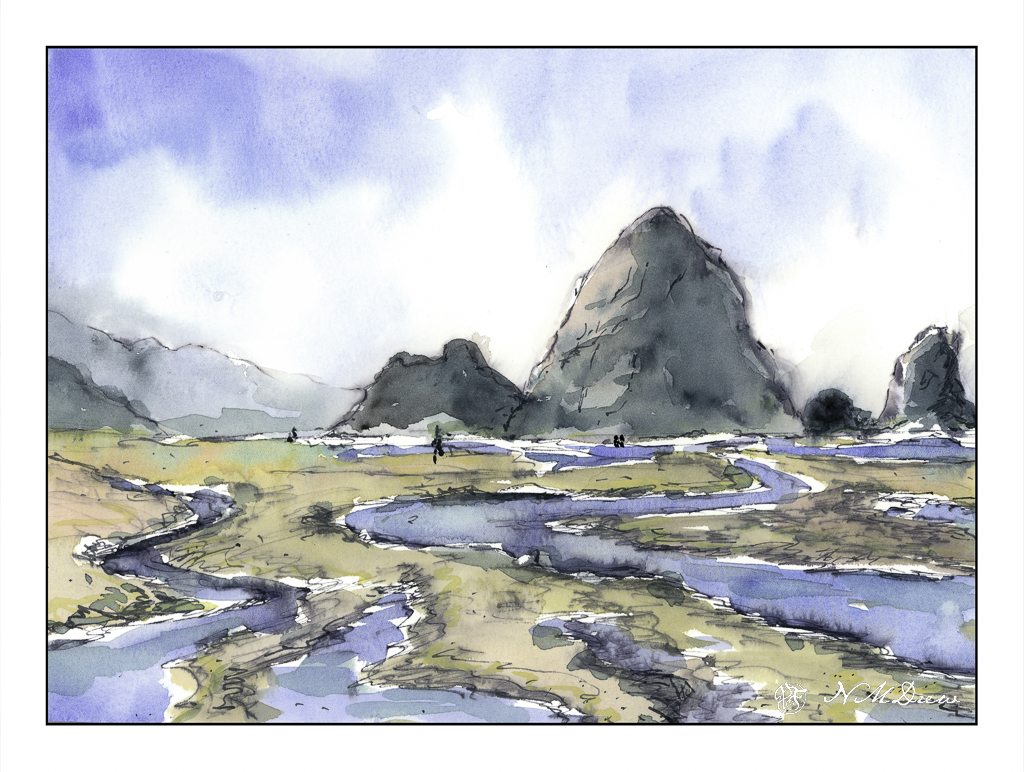
More of the northern coast along the Pacific Ocean. Here, Cannon Beach in Oregon, possibly one of the most dramatic beaches I have ever seen. Sea stacks, tide pools, sand, mist and fog. When the fog lifts and the sky brightens, there is a glare that cannot be explained. It’s not a summer day brightness as we have in SoCal, but a brightness that is cold but not like on a snowy day. There is a lot of moisture in the air, from sea and fog, and perhaps that is what magnifies the light to such a degree.

If you look closely, you will see some of my ink bled into the paint. I used my iron gall in, not my waterproof micron pens, and a stub nib to draw. From there, I wet the sky, dropped in colors, and then let things dry to dampness. I wanted to create soft edges for the mist in the distance which blurs and softens edges. The rocks themselves were painted wet-in-wet initially, and then other colors applied to either dry or damp paper. The sand and the rivulets were painted in the same manner. In the end, I drew again with my iron gall ink to add texture or detail.

Keeping this sketchbook is so much fun! I have room to paint as the sheets are big, the paper is strong so I can use both sides, and I can paint with a lot of water should I wish. It is proving to be one of the best decisions I have made of late!

Along the Coast

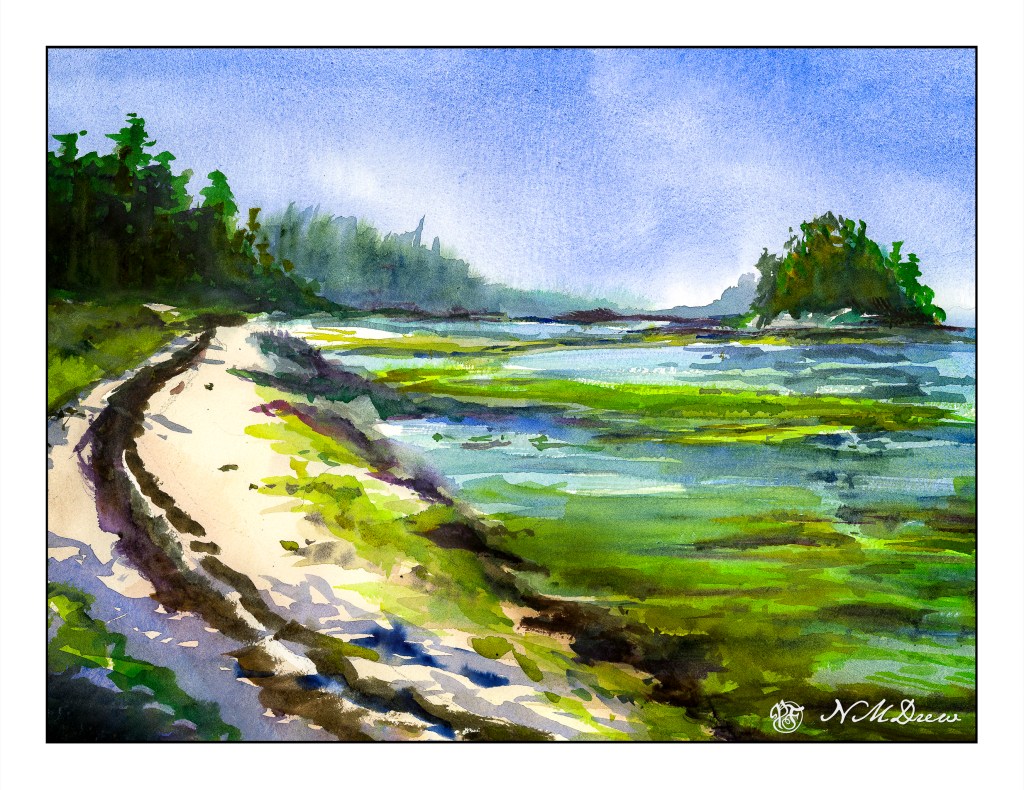
The same painting, scanned with an Epson V600 and merged. However, two different software were used to merge. One was Microsoft Ice. The other was the photo merge bit of Lightroom. It’s hard to really tell which software impacted the final image more as both were manipulated a bit in post. However, the difference was that the LR version had dark paper around the edge and was rather muddy. The MS Ice was lighter and more clean in overall appearance.

This is the image merged in Lightroom. .

This is the one merged in MS Ice.

It’s hard to see the difference in some ways, but I think either is fine to my eye.

Anyway, I am rather pleased with the result here. I think I got the depth of field properly done for once. Perspective doesn’t seem off. The sandy berm really pleases me because sand is hard to do! I mixed together ochre, alizarin, and cobalt blue and then added a gallon of water to make the wash. The shadows are ultramarine with a bit of carbazole violet.

Another thing I like is the murky, seaweed filled foreground on the right that fills the shallow water. And, too, I did some justice to the reflections of the island in the right background. In the end, I applied a light glaze to the foreground water on the right and to the grasses to the left of the sandy shore in the middle left background. Painted on 300# Kilimanjaro from Cheap Joe’s.

I have few other WIPs, but they need a bit more consideration at present.

Along the Italian Coast

This was a rather fun painting to do just because it forced me to really rethink using white.

The ocean was the problem.  I thought I had put it in so it would be fairly light, particularly toward the distant shore.  Instead, when it dried, it was darker than I wanted.  The trees on the hill in the midground were essentially the same value as the water!  This was quite an eye-opener.  In the end, I put plain white (zinc) onto the paper, and kept blending it in until I got it where it was acceptable.

From there, it was back to the background.  It was also too bright.  I toned that down, and greyed it up a bit.  The background shore was too bright.  More work.  Then, back to the midground, foreground, buildings and boats.  I painted – with oodles of white! – the buildings, making them abstract shapes and then adding slightly darker shades to make the buildings seem 3-D.  More trees.  Finally, reflections, boats, and their reflections.

While I don’t consider this to be one of my better paintings, it is certainly one filled with lessons, in particular the usage of white (lots!), perhaps in the future check the colors on a separate piece of paper to see how light or dark they will dry, and finally deliberately trying to create abstract color blobs for buildings and trees that are discernible as such, but still indistinct in the distance.

I am ordering more white today!