The Not Taken Vacation: Ronda, Spain

Located in the province of Malaga in southern Spain, Ronda is about 65 miles northwest of Malaga, Spain. It is a “white village” located in Andalusia – a vast region along the Mediterranean and inland – but it is more than just a “white village” as it is home to what I think is one of the most fascinating bits of architecture, the Puente Nuevo. We will explore that famous bridge later on, but for now, let us just enjoy the magnificent scenery of this lovely place.

Ronda has been settled since neolithic times, but the 6th century seems to be when itself became a more settled area. It is marked by cliffs and canyons, as you can see below, but it is also built up on either side of the Guadalevin river. As the countryside is steep, getting from one side of the river to the other is a bit problematic.

These buildings are on one side of the Puente Nuevo. They stand on steep cliffs. As someone without a head for heights, I am not so sure I would want to stand on a balcony and look down – but I think looking across would show some marvelous scenery. Also, coming from earthquake country with unstable soil, my thoughts are, oops! – why did they build there? However, I expect things are far more stable than they are in my neck of the woods as this is an area where a bridge spanning a canyon 400 feet deep and completed in 1793 still stands.

So much to see in the south of Spain! To be continued!

A Touch of the Fauve in Cinque Terre

Cinque Terre is located in Liguria, in northwest Italy, and comprises 5 villages built into the steep cliffs along the coastline. You can find all sorts of articles, videos, photos about it, and to my thoughts it sounds like an incredible place to see. However, it is not something I will get to do next week, so I thought it would make a good painting study. The idea of living in a house, built on a cliff at the edge of the ocean – I don’t know, but it seems quite a fascinating way to live!

I was more interested in playing with the paint and experiencing how to use the Golden fluid acrylics than I was in making a finished work of art. I am finding I like them when they have dried a bit and become rather sticky but still maintain the consistency of cream. Opacity seems to improve as the paints become more viscous. This stickiness makes for some rather nice ways of creating color combinations – one on another – and texture. This is all play, and play is the best way to learn how to use something, I think. The plan is to continue and come up with an opinion about if I like them – I think I do, sometimes more than other times – as well as just exploring painting with them.

This painting was inspired by a photo taken offshore and looking landward. The houses cling to the cliffs, and if you look closely at the photo, you can see pathways and stairs leading from one area of houses to another. There were more outcroppings of rock in the photo than I have here, and I think it would have been a better painting to have included them. It looks like I have two rock columns madly in love, and having a good smooch! Despite that, I had fun playing with not just the colors, but ways in which to apply the paint – like rubbing it in with a paper towel in addition to a paint brush. Soft and hard brushes also have and impact, as does using a filbert, flat, or round brush. So much to learn . . .

Golden fluid acrylics, a bit of a fauvist or colorist approach, 15×20 paper.

Art with a Broken Arm

I signed up for two art classes at the local adult school, one in acrylic painting and one in Chinese calligraphy. The acrylic painting class I have to drop simply because I cannot carry an easel, paints, paper, and all the other supplies with me, but I can do the Chinese calligraphy class because the teacher supplies all the stuff and there’s very little that I need to bring to class! That’s great.

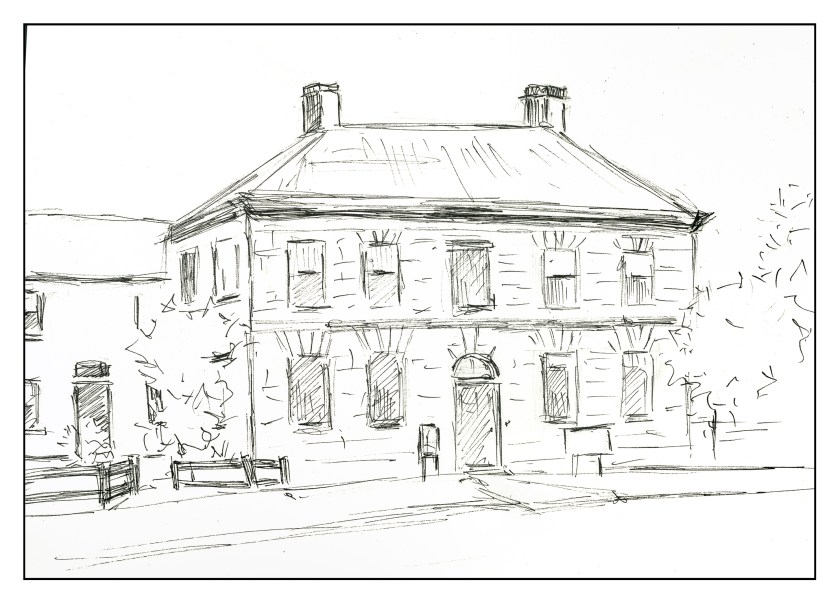
Consequently I thought, well, what can I do? I decided to try an online course in drawing buildings and learning from an architect of many years experience. I think this is going to be a really good lesson or group of lessons as I have never been good at drawing buildings and only through a lot of effort and learning about proportions and relationships have I been able to draw this one which is the preliminary drawing prior to any classes at all.

If I say so myself, I did a pretty good job on it and I am looking forward to seeing my progress in the future. There are a lot of tricks that I’m going to learn in this and I will be posting them perhaps as I go along.

And the class begins in 20 minutes!

Mastercopy: Andre Derain’s “Landscape Near Chalou”

Above is a copy of Derain’s painting, ca 1904, done during his Fauve period. In an online class I am taking, we are encouraged to copy the work of a master artist, new or old, and learn from the experience. This is the second I have done, and certainly one I would not have really considered just because it is so bright! But, the colors and composition caught my eye, and off I went.

The first thing I did was to grid it onto paper. Derain’s work is obviously oils as acrylics did not exist in 1904. I used acrylics on ungessoed paper. As I moved along, looking more carefully, I think he underpainted his canvas with raw sienna or yellow ochre – you can see such colors along the bottom of his painting.

This painting took me probably about 8 hours. I gridded the image, which is about 11.5×17 inches, whereas the original is about 18×22 inches. Then I painted the basic shapes and colors yesterday morning.

This took a lot of time! I am glad I did a grid as the overall areas to be painted were fairly apparent as to shape. What they were – well, some leave me wondering. However, colors are shapes, and Fauvism is not reality, so I could do a bit of my own interpretation, too.

Next, I began to define areas as well as correct mistakes, such as my lopsided building in the lower left side. My paint was thicker, too. Below is this morning’s work.

After lunch, I aimed to complete my copy of Derain’s painting. As I moved along, I looked at Derain’s brushwork. There is a very graphic quality about his painting, which is very pleasing, but the brushwork, too, is fascinating. I did try to emulate it a bit, not just dabbing, but trying to see when he did a dab, a long horizontal push, and so on. Easier to do than to describe!

My final work really does please me. I love the bright colors. My limited palette worked pretty well and there was joy in mixing colors. I usually tend toward more “natural” colors, but the truth is I am a magpie at heart, and bright colors always do get my attention and make me happy. That is an emotional reaction. Classical paintings, though, do appeal to me. Copying a master is opening doors to me and leading me into areas I have never explored.

My final copy of Derain’s masterpiece:

Things of Value

I am kind of a cheapskate at times, especially when it comes to paying for educational experiences. Too many times I have been disappointed by the experience, especially when it comes to art classes. Cost vs. course value and content are a big issue for me, and more often than not I am very disappointed.

One person, though, from whom I have taken online courses, and who has never disappointed me, is Shari Blaukopf. She is a Canadian watercolorist with quite a following – her workshops are always sold out – who provides economical and informative online classes in various subjects. Subjects have included snowy urban scenes, wintery scenes, flowers. Her courses last from an hour or so to more, depending on how you do them, for very good prices of about $30 US. I ain’t complaining!

Let’s begin with her most recent course on trees throughout the seasons. I think this is one of my favorites. What did I learn? As a dabber – tiny brush strokes – this class was perfect for me. I got a better grip on painting foliage, not a leaf at a time, but as color masses. Most instructors will tell you “paint foliage as a mass of color.” Okay, clear enough, except it doesn’t really sink in well for me. Shari’s method of drawing an outline of the areas in question is brilliant, and a lightbulb-going-off-in-the-head experience for me. My samples from this enlightening experience gave me quite a bit of pleasure.

While she is painting her tree she says that midway through, when the tree is just a bunch of colors, she begins to wonder if it is going to get any better – and it does. My own thoughts were the same, but continuing on, the results were pleasing.

These southern live oaks (above) were also done with masses of color, but a bit more detail. The maple tree was a great segue into the oak trees.

The standard or classical “way” to do watercolor is light to dark. I have followed this “rule” with mixed success, and as a little automaton, I do what is “expected” far too often. However, Shari often does the sky, then darker areas, or outlining certain areas with color.

Above was the very first tree study – a vast area of pine forest against a mountain and sky. Sky and mountain were both worked around a lot of the treetops. From there, the very dark pines were painted with the lower edge of lighter vegetation done last.

What?! That is the “wrong” sequence!

Working around the trees leaves areas of white paper, and this this gives a sparkle to the end painting as well as keeping colors more pure and fresh. Painting around the bright green tree was also a challenge – and to remember it was there. Shari had to remind herself, and did so as we moved along. I didn’t quite succeed, but caught myself in time.

This snow-laden maple – the brightly colored one from earlier, now in winter – was the last study. No frisket was involved to leave the snow fresh on the tree. Instead, hints on how to leave snow areas apparent in the drawing – put a dot on the snowy areas to remind you – worked very well. I’ve done such things myself, but it is a good reminder of little tricks.

In many ways, this winter tree was perhaps the most challenging of the studies because so much advanced thinking was involved in the journey to the final result. Snow on so many tree branches was sort of a logistical nightmare, but oddly enough easier for me than masses of colored leaves. Titanium white covers up a few mistakes, too, where the snow was painted over. Blue, too, was added very lightly to make shadows on the snowy branches, giving more dimensionality than without that subtle touch.

Shari even returns to her trees to add a bit more here and there to improve them. I like these little forays into imperfection or dissatisfaction – so many workshops don’t show these little bits of humanity.

If you like watercolor, need some good instruction, and are on a budget, Shari’s classes might be the answer. She doesn’t teach you the basics but assumes you know how to do washes and use colors and what a paint brush is. Her classes range from pretty straightforward to more sophisticated and complex subjects. No matter what, she leads you through the process quite nicely. For example – buildings terrify me. Perspective is not my forte and suburbia throws it at you from all directions. But, I did this, and learned that even I, who has no depth perception to speak of, can actually produce a painting with buildings!

I managed to produce the above – albeit with some glitches – by following her along with her “Urban Winter” class – which you can find here. Check out her work and courses – I don’t think you can find better value and better education almost anywhere. And as a final plug, here is my painting from her course “Winter Woods and Stream”.

And, for my own frugal heart, Shari offers course bundles that discount her already fabulous prices a bit more. Check her courses out and sign up if you are interested. Some courses allow you to upload your work – the later ones in particular. She always leaves feedback, too, even a bit late as she travels a lot. The personal touch is so nice, and being able to see what other students produce is good, too.

Thanks, Shari!