Vaduz Castle

We let the butler and staff off for the 4th of July weekend and decided to cruise to Lichtenstein for lunch in the Stratos 714. We needed a break, so we stayed a few days. Beer drinking, fine weather and a bit of plein air sketching with ink and watercolor.

When I draw with ink, I almost never use a pencil. I like the challenge of inking directly onto the paper. I seem to be more successful, too, than drawing in a pencil line and then inking.

Today I used PH Martin’s waterproof India ink. It needs some drying time. Fountain pen ink is almost dry as soon as you write a letter, but because of its nature, India ink needs a bit of time is needed. A hair dryer can help. India ink seems to dry more quickly than iron gall.

The goal here? Play with the ink – an ink I haven’t used since who knows when – see how it performs, and work on perspective, too. That meant buildings. Buildings with right angles are fairly easy to sort out, but I thought a combination of curved walls and right angles might be a bit fun. They were. As well, a bit of distance using varying greens to depict the curve of the grassy hill.

I am pretty pleased with this. Ink first, then color and dry and color and dry and then more color. I had a lot of fun trying to get the slightly uneven rows of stone in the round tower depicted somwhat realistically.

Sashiko #4

For this sashiko sampler I tried a couple of things. First of all I used two different thread colors, still sewing onto the soft, washed denim. I laid out a 7×7 grid and then just followed the grid lines using the white thread. Then I looked at the stitching and thought a second color would be fun to add, to see what it would like more than anything else, as well as to try to design a design of my own. I don’t really like the results of my own design and it makes me think about what kind of designs work well in sashiko.

When working threads, they need to be secured at beginning and end. I tried knots – meh. Loosely woven fabric lets the knots through a bit easily. Weaving threads in and out is messy but might work okay. I have even thought of using a bit of fray-check but have not tried it out yet. Back stitching over threads at the beginning and the end seems to produce the best results, but getting the needle into the right places to replicate the preceding stitches takes a bit of work – practice will most likely help. The softness of my denim is also a challenge in doing this.

So, a couple of thoughts. I read that many people do sashiko stitching on the reverse side of the fabric. This is something to try, to see how well it looks. As well, I want to starch my next bit of denim to see if that helps. For my next project, I will try both and report the results!

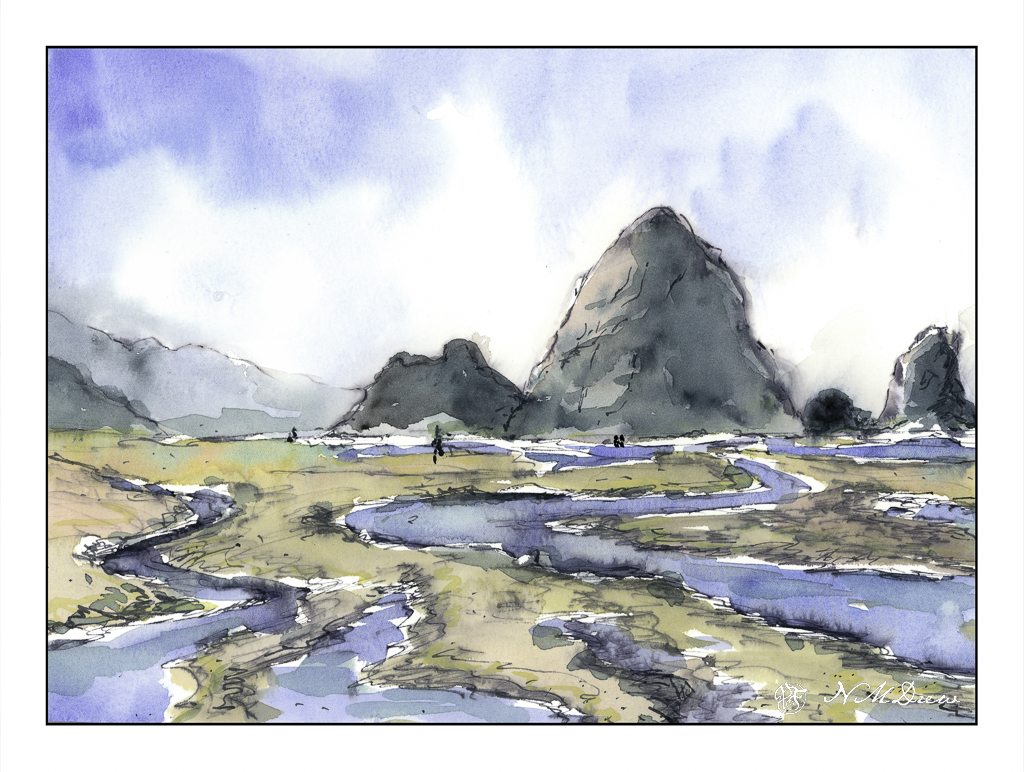
Haystack Rock

More of the northern coast along the Pacific Ocean. Here, Cannon Beach in Oregon, possibly one of the most dramatic beaches I have ever seen. Sea stacks, tide pools, sand, mist and fog. When the fog lifts and the sky brightens, there is a glare that cannot be explained. It’s not a summer day brightness as we have in SoCal, but a brightness that is cold but not like on a snowy day. There is a lot of moisture in the air, from sea and fog, and perhaps that is what magnifies the light to such a degree.

If you look closely, you will see some of my ink bled into the paint. I used my iron gall in, not my waterproof micron pens, and a stub nib to draw. From there, I wet the sky, dropped in colors, and then let things dry to dampness. I wanted to create soft edges for the mist in the distance which blurs and softens edges. The rocks themselves were painted wet-in-wet initially, and then other colors applied to either dry or damp paper. The sand and the rivulets were painted in the same manner. In the end, I drew again with my iron gall ink to add texture or detail.

Keeping this sketchbook is so much fun! I have room to paint as the sheets are big, the paper is strong so I can use both sides, and I can paint with a lot of water should I wish. It is proving to be one of the best decisions I have made of late!

Sashiko Pattern #3

The other day I practiced straight stitch – running stitch – sashiko. Holding a long needle and a palm thimble is a bit of a challenge. Yesterday I decided to try to draft a round pattern to practice stitching in curved lines. I used my pre-washed denim, a circular lotion tin, and a yellow chalk marking pencil I use in sewing. The big problem is that the fabric is very soft from washing – the sizing is gone – and I wonder if I should use unwashed denim or perhaps add a starch to make the fabric stiffer and easier to draw upon for design. When I was drawing the circles, the fabric slid around and some of the circles got squished up. You can see my sampler below!

Sashiko actually stitches up a lot more quickly than I thought it would. My stitches vary a lot, and that is something to work on, and I think how I hold the needle and thread in my right hand and manipulate the fabric with the left will help even things up. You learn as you go, for sure!

Below is the backside of my sampler.

One thing I do enjoy while working on sashiko is listening to audiobooks. It is a great way to sit outdoors, have some coffee, stitch and listen. Even better on a beautiful summer day!

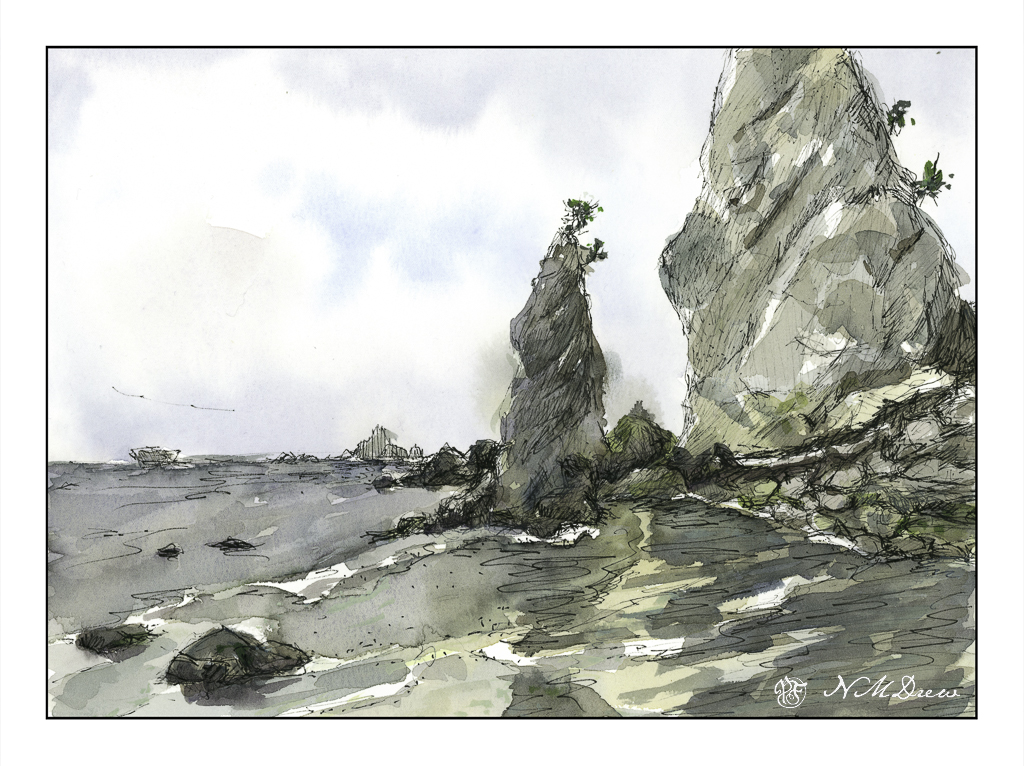
Memories of Rialto Beach

Several years ago Josh and I spent a few weeks traveling around the Olympic Peninsula in the state of Washington. It was such an amazing place! In particular I loved the Hoh Rain Forest and the beaches – vast, wide, wild.

The thing that amazes me about the northern Pacific beaches, ones in Oregon and Washington – as well as into Canada – are the sea stacks. They are tall rocks, worn away by wind and wave, but they are not barren. Pine trees grow on them – some have more, some have less. I think it would be a wonderful thing to live on one, in a warm cave (with running water and few other things!), to be at one with the sounds of the world . . .

More pen and color. This time I tried to have a more delicate touch with color. I inked in most of the drawing with a fine Micron pen, added color – mostly cool – and then drew more lines and dots with a thicker pen to outline and add textures. The sky was done after wetting the paper and dropping in color.

And that’s it!