California Oak Trees

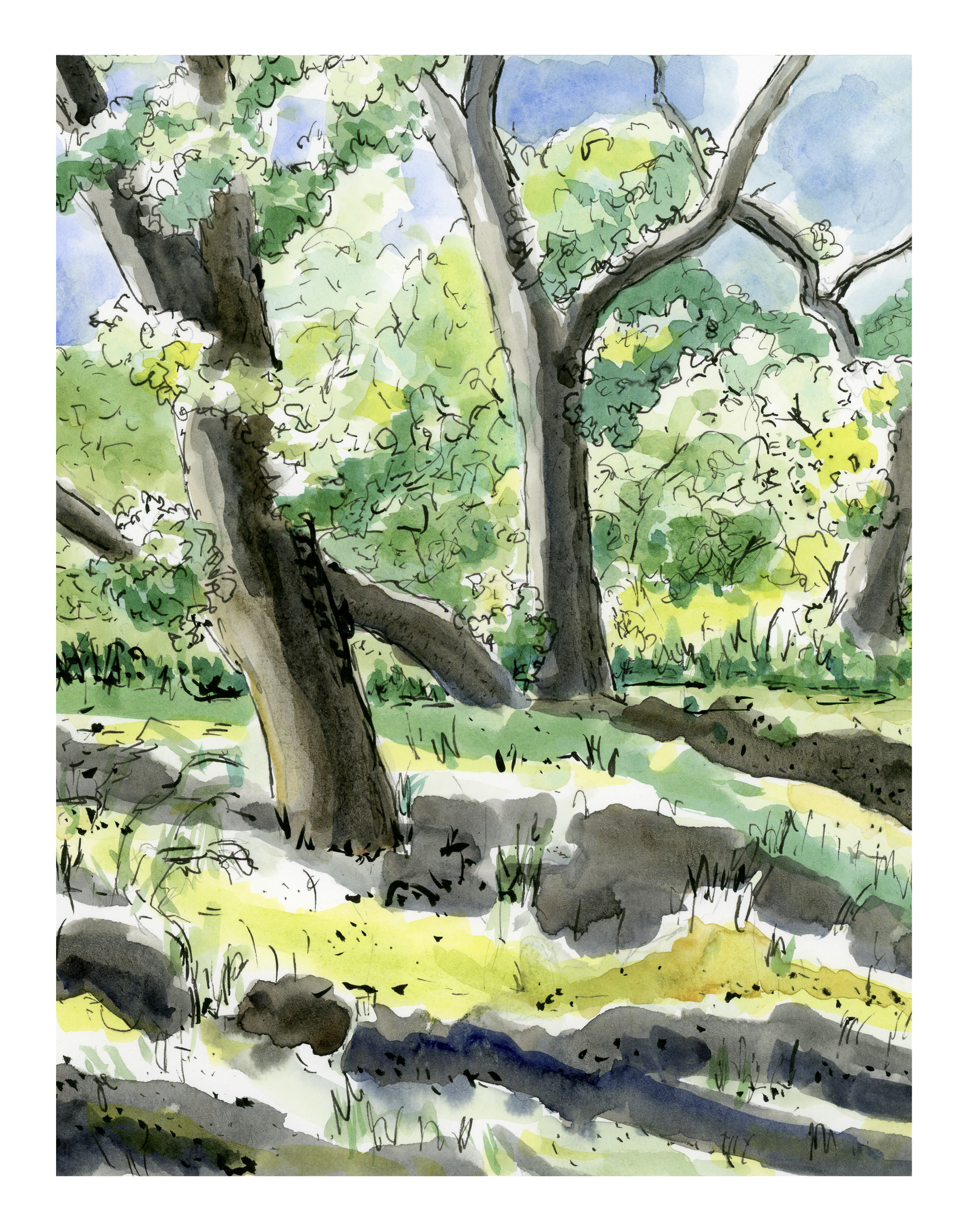
Today, my little Meetup group went to a local place, the trail by the Chumash Museum nearby my house.  (The Chumash are a California tribe.)  We were there for about an hour.  I began with a pencil sketch, and then, color.  We were settled in a small oak grove, with dark and light contrast about as contrasty as you can get.  At the end of the hour, this is what I had painted, knowing full well I would look at it and work it a bit once home.

Once home, I looked at the painting.  Still a need for contrast, and a bit more detail.  More pen, more ink brush, more colors, and some warmth.

Overall, the one above came out okay, but if you look on the mid-right, to the left of the furthest trunk, there is a bit of an odd space, so I went in and worked it a bit with ink to try to mitigate it.  I found it very distracting.  Here is the final image below.

The area has a few more lines in it, a bit busier, but somehow more in keeping with similar areas of the painting.

I used Koi watercolor brushes and the following paints:  Quinacridone Gold, Naples Yellow, Hansa Yellow Medium, Cerulean Blue, Cobalt Teal, Ultramarine Blue, Indanthrene Blue, Phthalo Green, and Burnt Sienna.  I used a Stillman & Birn Beta Series 8×10 inch softcover notebook, and scanned the images using my trusty, not rusty, Epson V600.  Ink is Carbon Ink, and an ink brush.

Working with Contrast, or, A Day Without Mud

Today, my little Meetup group was really little.  Initially there were to be 4 of us, but one cancelled, and then the third unfortunately got very lost using her GPS.  She wrote she was 3/4 of an hour late . . . and we waited 10 minutes, too.  Next time I post a Meetup meeting, I’ll spell out directions, so hopefully that won’t happen again.

So, contrast.  I am dreadful with it.  And with painting things so that they look like things rather than blobs of color.  However, that is probably something that time and experience will cure.  Today, though, I did manage to not turn everything into mud – a major accomplishment, let me tell you!

We went to a local place, the trail by the Chumash Museum nearby my house.  (The Chumash are a California tribe.)  We were there for about an hour.  I began with a pencil sketch, and then, color.  We were settled in a small oak grove, with dark and light contrast about as contrasty as you can get.  At the end of the hour, this is what I had painted, knowing full well I would look at it and work it a bit once home.

As you can see, I did leave areas of white!  Another first . . . As I was painting I made a monumental decision, too:  paint long horizontal stripes to represent the grasses under the trees, and the shadows crossing the foreground.  I sat there and painted stripes.  It was nerve wracking.  The blobby white areas were deliberately left for consideration later.

And once home, I looked at the painting.  Still a need for contrast, and a bit more detail.  More pen, more ink brush, more colors, and some warmth.

Overall, the one above came out okay, but if you look on the mid-right, to the left of the furthest trunk, there is a bit of an odd space, so I went in and worked it a bit with ink to try to mitigate it.  I found it very distracting.  Here is the final image below.

The area has a few more lines in it, a bit busier, but somehow more in keeping with similar areas of the painting.

My palette was somewhat unknown!  That is, I was not really sure the names of the colors as I was using them, but I do have a list of how they are laid out on the palette, which is why I can tell you now!  I used Koi watercolor brushes and the following paints:  Quinacridone Gold, Naples Yellow, Hansa Yellow Medium, Cerulean Blue, Cobalt Teal, Ultramarine Blue, Indanthrene Blue, Phthalo Green, and Burnt Sienna.  I used a Stillman & Birn Beta Series 8×10 inch softcover notebook, and scanned the images using my trusty, not rusty, Epson V600.

Trees & Fog

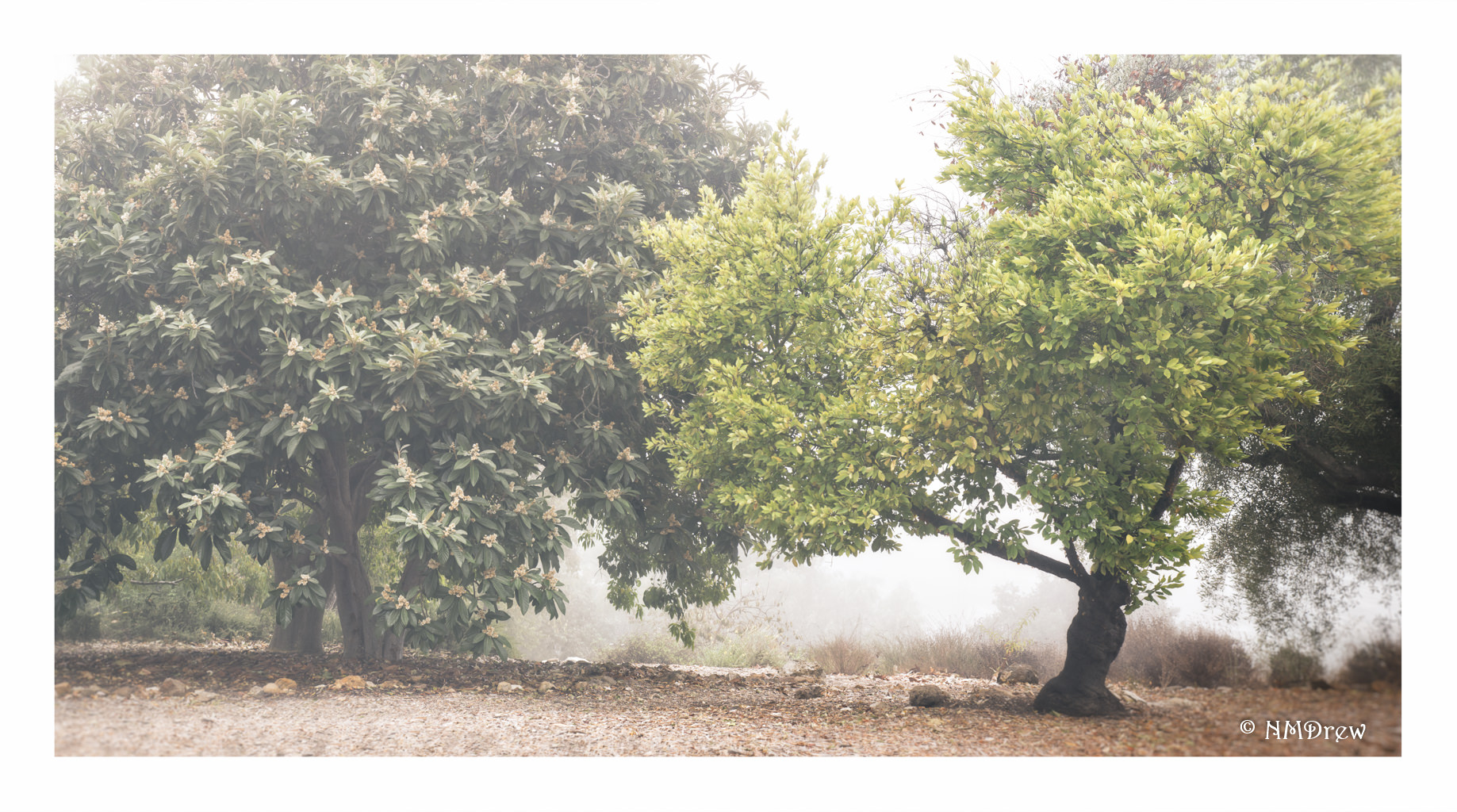
Another picture from my excursion into a damp and foggy world (a rarity of late here in SoCal where temperatures have been heinously high).  This time, a panorama of about 9 images, cropped and edited a bit.  I used the Df and 24-85 lens.

That morning, the fog was very thick, and even around 9:30 a.m. when I took this, the fog was dense.  Only later did the sun break through.  It was rather eerie to wander alone . . . just a few days from Halloween!

Book and Video Lessons for the Student: A Retrospective

I have picked up watercolor on a serious level, along with drawing and sketching.  I have neglected that side of myself for a long time, but have attempted to reconnect with that part of myself off and on.  Truthfully, it has been more off than on, but when I do delve into painting, it is such a pleasure.  Over the years, I have purchased video classes or viewed videos from a variety of people.  Today, I sat down and went through some of my notebooks and watercolor pads, and decided to scan what I have done to see if there is anything of value.

One person I have admired and enjoyed for a long time is Charles Reid.  I love his loose, wet, messiness in watercolor.  It works.  I have watched his videos and read his books, attempting to catch what he does – learning from the teacher by doing.  I have had some success, but I still tend to overwork and create muddy colors.

Another artist I have learned from is Birgit O’Connor.  Her approach is very different than Reid’s – not splashy, but controlled, thought out, and very disciplined.  The results are completely different, but valuable in that self-discipline and forethought are necessary to achieve results.  Reid’s discipline is from years of knowledge, such as how to paint negative spaces and create contrast.  O’Connor uses masking in varying forms, such as with contact paper and frisket to help preserve white space and create texture.

From both Reid and O’Connor, I have learned a lot . . . but without daily practice, it all is forgotten.  Besides needing to remember how to paint, how to manage color, I have also forgotten how to sketch.  Craftsy classes have proven to be helpful, with ones from Shari Blaukopf, Mark Taro Holmes, David Brody, and Kateri Ewing.  These classes range from urban sketching to an extensive, classical drawing class.  Each of these has proved, and is proving, to be very valuable.  Videos are some of the best learning tools when it comes to finding time to do and to learn.  Books with encyclopedic samples on how to do things are also great, such as Claudia Nice’s books on ink, pen, and watercolor, as seen below.

On YouTube, I have subscribed to multiple channels.  These range from using dip pens to lessons from extremely talented watercolorists and sketchers.  Of late, I have been working on negative painting – painting around things, rather than directly painting things.  This is in the hopes of learning to manage white space better.

It’s easy to use lines to compensate for a lack of contrast to define light areas in negative space.  The flowers are rather disastrous, but a lesson on YouTube (sorry, I don’t recall the video the trees are from, but it was fantastic!) was very helpful.  The key to that video was to paint from the foreground back, unlike in traditional watercolor, you paint from the sky down for the most part.

In addition to videos, books are an excellent resource.  I have a lot of books.  The ugly truth is that art books are damned attractive, but how many of them have I actually sat down with and gone through, step by step?  Not many.  In fact, none at all . . . until I came across a book by Jenna Rainey:  Everyday Watercolor:  Learn to Paint Watercolor in 30 Days.  Rainey’s painting style is not what I see myself doing, but what I do like is the “daily” approach and the short, structured lessons.  Thus far, I am up to Day 11, and have been really enjoying myself.  I’ve let go that nasty inner critic that expects perfection out of the gate, and have been loosening up, and doing some things that I like.

More than anything, I am happy to see I am not lacking ability – only self-discipline to work on painting and drawing when I have time.  Looking at what I have done is inspiring me to continue, despite frustrations and time.  Nothing like a retrospective to see what and where I have been, what I am doing now, and looking forward to what I might yet do.