We had a 2 week vacation trip planned. And it ended on Day 3. I had thought my sinuses were acting up, but to be careful I decided to have a Covid-19 test. It was a 1-hour quickie. Negative. Okay! Let’s go!
Our first stop was in Independence, CA, along the eastern Sierra Nevada mountains, traveling on Hwy. 395. My husband had a cold, mild, some sniffles and a cough. On Day 3, we left Independence, and continued north. Next stop was to be Virginia City, NV. Well, as we moved further north, the air became cloudy and sooty. The smoke from the fires in NoCal was moving east, and I could smell it. So could Tom and Judy, Josh’s parents. Josh couldn’t. We had mints. We could all taste them – except Josh.
And so the decision was made: return home and have tests. It was the ethical thing to do. Josh’s test came back positive; mine was “presumed positive”, and the antigen tests Tom and Judy had came back negative. Ethical decision made, people and places were called, and now we are self-isolating until our next test on 9/13. Test results will be around 9/15.
So, stopped by the plague . . . and ethics. Neither Josh nor I felt sick other than a tad under the weather. Josh has is sense of taste and smell back about 95%.
We have plenty to do, despite being stuck at home. I have a sketchbook, planned to document the vacation, and so the first drawing is the Winnedumah Hotel, built in 1927 for the film industry back in the days when westerns were shot in the Owens Valley.
I have a lot of fun setting the X100V to A (for “auto”) for everything, and just shooting out the window of the car as we drive along. Sometimes reflections in the car show up, but that is really irrelevant when trying to catch the flavor of a place and it’s over 105F in the shade. Here, a shot through the window which shows the lovely barrenness of the Owens Valley.
Manzanar was an interment camp for Americans of Japanese ancestry, native-born, citizens, Japanese-born. All of this because the Japanese attacked Pearl Harbor on December 7, 1941. This event drew America, at last, into World War II, in both Asia and Europe.
The Japanese are a minority within the US, and like many groups, faced discrimination. Other groups, though, because they were European – Caucasian – were not interred. Did the US inter people of German or Italian descent during WWII? No . . . and for sheerly pragmatic reasons . . . probaby 25% of the entire population of the country would have to be locked up, fed, and guarded.
A friend of mine, who is Japanese-American, said that the displays at Manzanar make it look like it was fun to be there rather than a prison. Granted, it was a concentration camp, but it was not like the camps run by Axis powers in WWII. Another friend, who spent her childhood at a camp in Arizona, said it was like going to summer camp. As a child, it could perhaps be seen as such, but as an adult? I wonder how many adults were “broken” by the experience.
Manzanar is in the Owens Valley along Highway 395 in California, on the eastern of the Sierra Nevada mountains. The land was once a fertile valley, but in the early 1900s, Los Angeles began buying up water rights. The result was the water that kept the valley green was sent to L.A., and Owens Lake and Owens River soon disappeared. As the water disappeared, so did farming and wildlife, and in its wake, a dryer, harsher land emerged. It is still beautiful, but it is also the result of politics and greed.
So, this was a perfect place to make an interment camp for people perceived as “the enemy.” It’s always good to have someone to blame and someone at whom to direct hatred. Governments and political forces do this all the time. We have evidence of it throughout history. The Japanese were the American boogey-men of the 1940s. However, the Japanese servicemen in the 442nd Infantry Regiment were the most decorated fighting unit, “enemies” fighting another enemy.
But I digress. Manzanar was one of many concentration camps to inter the Japanese. Today it is a National Historic Site, located between Lone Pine and Independence. It is dry and hot, cold and windy, depending on the time of year. I have driven through this area in summer, in 105+ F heat. We stayed in Independence, in a hotel with minimal modern conveniences, such as air conditioning. It was around 100F – and we were miserable. I can only imagine what it was like without it, in shacks slapped together in haste, insulated with nothing. Hell in winter. Hell in summer.
Life in some ways was normal – and in many ways it was not. Detailing life at Manzanar would take pages. Simply put, people lived and died and were born at Manzanar. Above is a memorial to those who died at Manzanar – people of all ages, from babies, teens, adults, and the elderly – for a variety of reasons. This obelisk is in the far rear of Manzanar, in the cemetery, set against the Sierras. It’s austere lines meet the sky and the harsh beauty of the land. It seems to say it all.
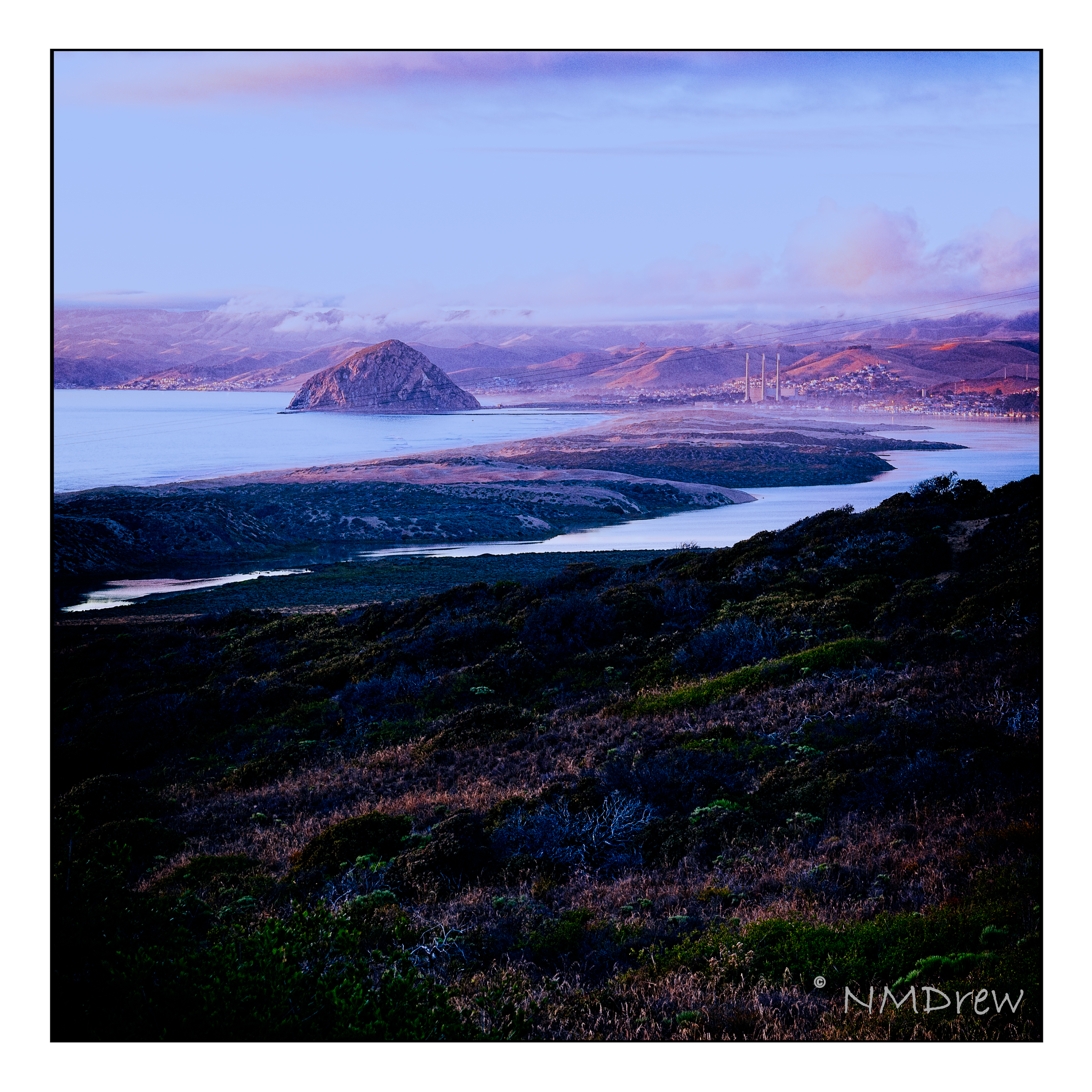
A few months ago, a 4-day trip to Morro Bay. Here, a sunset from Montana de Oro State Park overlooking the coastline and the town of Morro Bay. It was a great way to end a short and pleasant getaway.