North Coast

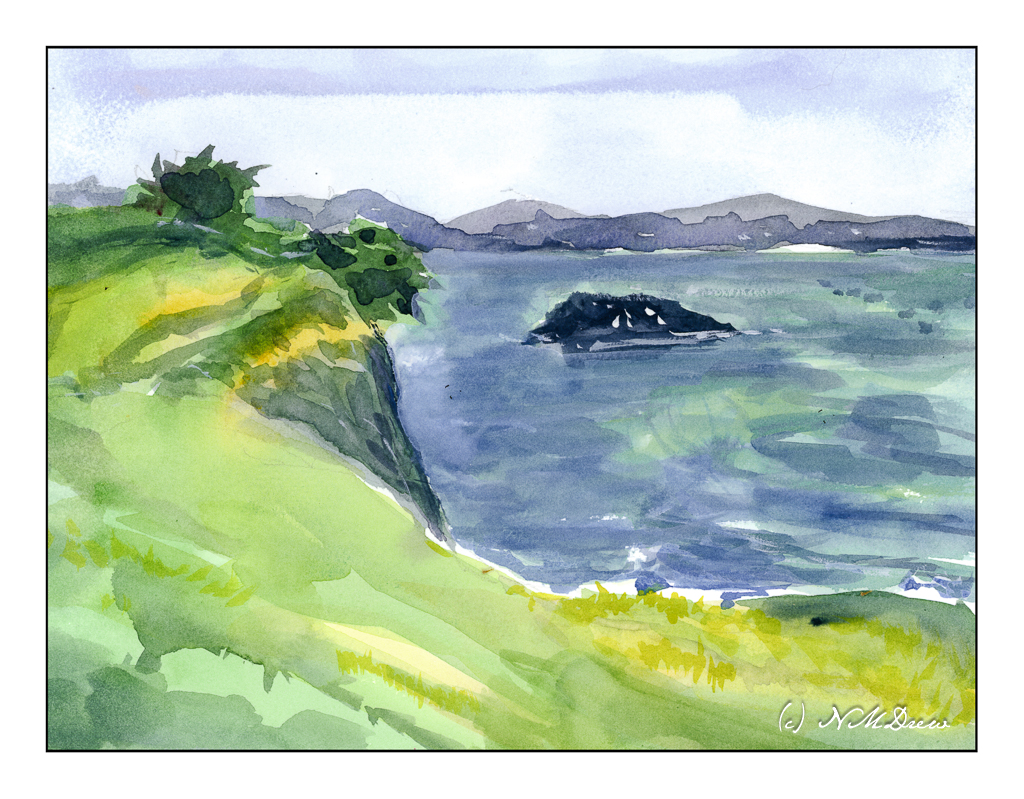
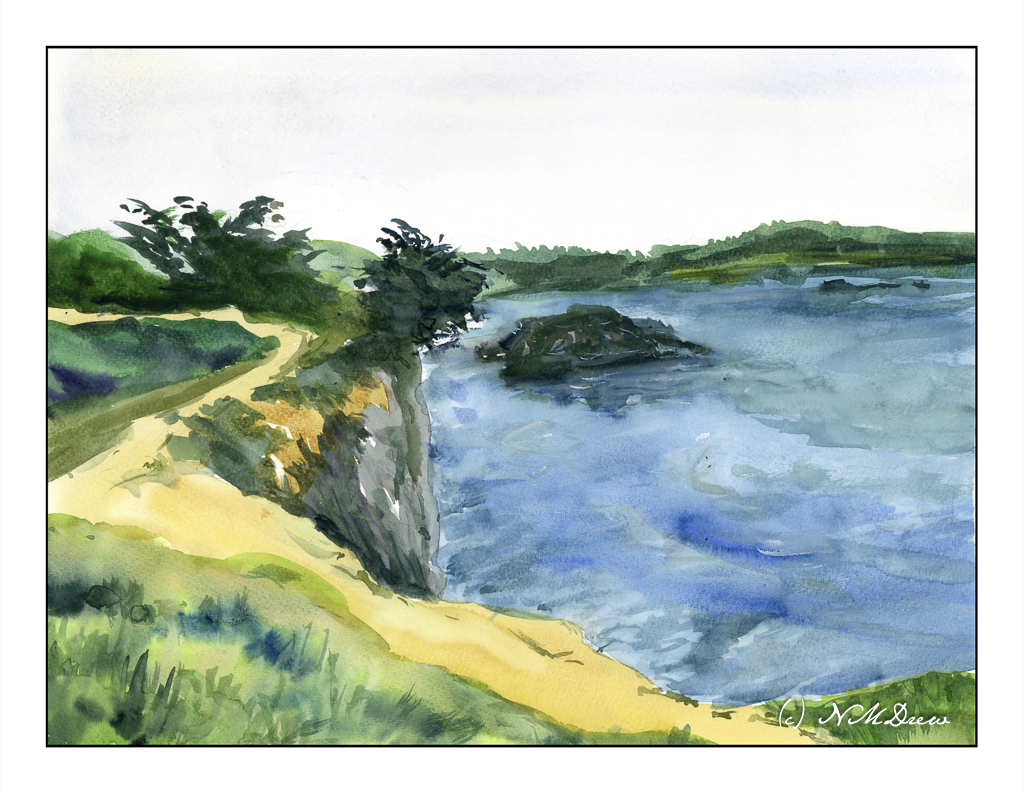
Once more – should I put something in or take it out!?!? The original of this painting, along the northern coast of California, is originally painted with a small island offshore. Looking at it I didn’t like it – perhaps too close to the tree on the left overhanging the beach. Thanks to Photoshop, I removed it.

The above painting is the one that exists in the real world. The one below is the one edited with Photoshop’s “generative fill” – poof! No island.

Because I am feeling kind of spartan these days, sometimes I think I have too much in a painting. Maybe it goes along with limiting my palette of colors?

And my palette? A bit more expansive than the previous, but the subject matter seemed to need a bit. I used umbers, sienna, ochre, Indian yellow, phthalo blue, a touch of ultramarine, a bit of dioxazine purple, and Hooker’s green.

My technique was to use oodles of water as I wanted to see how well the Bockingford non-cotton paper would hold up. It did quite well! Every large area – sky, ocean, land above the cliff – was wet with clean water, and then painted with the colors. The sky had one wash, but the ocean had multiple wet washes. The land in foreground and distance had a big wash later accented with dry on wet.

I am also pleased with this painting, even with my thoughts about the island.

St. Cuthberts Mill, Bockingford 140# CP, 12×16.

And what are your thoughts – island or no island?

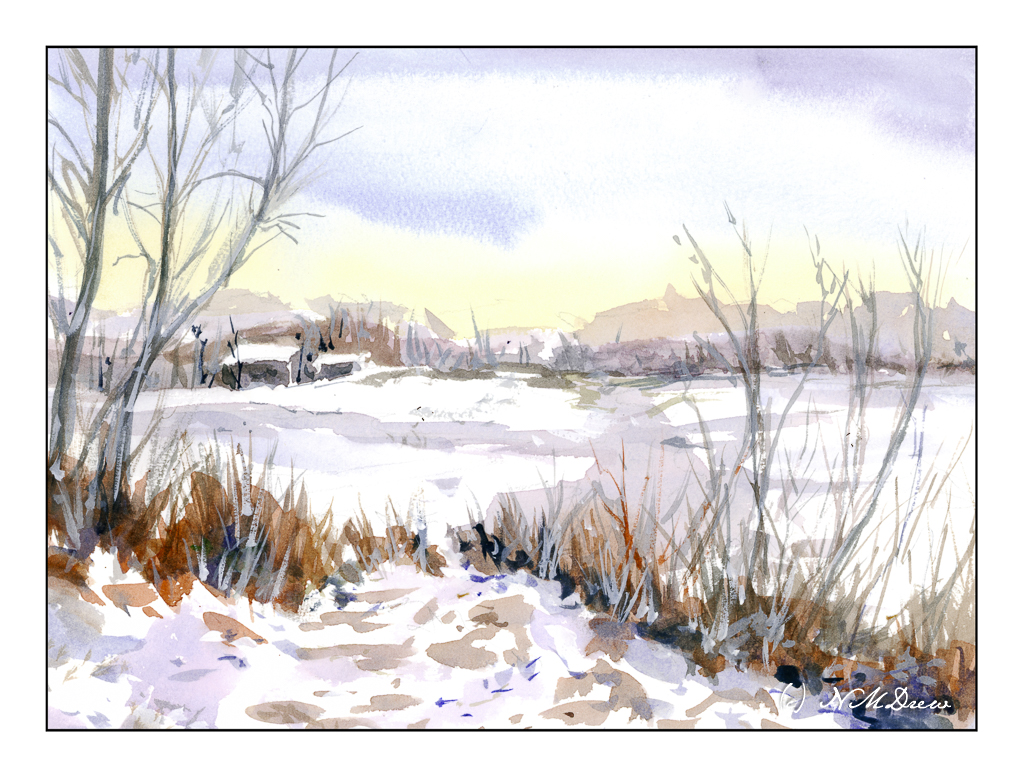
Winter Hill

I am working really hard to simplify my paintings. Winter scenes are perfect for this as I have to keep large swaths of paper white and untouched. Contours of the land are suggested by some blues and such for shadows. Additionally, I am trying to keep my brushwork fairly direct and using the brush’s qualities to dictate the result. A bit of a challenge!

This scan seems to be decent, too, as far as matching the painting’s colors.

I added some new colors to my palette for this painting. In addition to ultramarine blue, burnt sienna and Payne’s grey, I added some Winsor Newton brown madder and olive green, and McCracken black by Daniel Smith. I also used some white gouache for the snow on the right hand tree and in the viney-like things in the foreground along the fence. Altogether I am working toward getting comfortable with a limited palette. Winter lends itself well to this.

The wire fence was drawn in with colored pencil – a warm and cool grey.

St. Cuthberts Mill, Bockingford paper, 140# CP, watercolor.

A Bit Later

Now, a bit later, I wondered if that tree on the right was okay. I wondered if it was needed. I don’t think so. Here is the painting without the tree!

Thoughts?

Trees in Snow

This was an exceedingly hard painting to scan simply because of the very soft usage of blue in the foreground snow. While this scan does not represent the painting very well, the overall image is good enough unless I decided to really play with my scanner’s software. I am not so sure I want to do that.

There are a few “points” to this painting. Using a very limited palette was one point – colors here are ultramarine blue, burnt umber, burnt sienna. There is a touch of a few other colors here but nothing of any significance.

Another point is to keep as much of the paper as white as possible. I managed to do this, but the scan does not do justice to the pale blue of the foreground snow; to compensate for this I used a very light blue graduated filter overlay in my post production software.

And the final point was to work in layers – light to dark – for the trees. Yes, I used titanium white artist’s gouache for the snow on the branches.

St. Cuthberts Mill, Bockingford archival watercolor paper, 12×16, CP 140#.

Snowfall

Christmas Day! Nothing like a snowfall and the cold and the quiet of the woods for remembering the magic of the season. New and old traditions overlap, memories and hopes for the future all seem to be rolled into the end of the year and depth of winter. The stillness of the winter woods gives pause to our crazy lives. Holidays of any sort at this time of the year make us look backward as well as forward.

Here I worked from very light to dark. The colors I used for the greenish-blue sky were cobalt teal, a bit of ultramarine, and a touch of Hooker’s green, neutralized by a bit of alizarin. The leaves and autumnal foliage were various siennas and orange with a touch of Indian yellow. Trunks, from light to dark, were essentially ultramarine with burnt sienna and raw umber with a bit of Payne’s grey. Snow shadows were ultramarine and Payne’s grey. Finally, I watered down some titanium white gouache and tapped my brush across my forefinger to look like falling snow after applying a few lines and dots in white here and there.

This is another watercolor which pleases me. Perhaps I should stick to Arches Rough paper instead of my usual cold press . . . ?

Have a wonderful Christmas Day – or whatever it is you celebrate!

Watercolor, Arches Rough 140# paper, 10×14.

Later in the Day

A few days before Christmas and, while I don’t live in it, I do enjoy a snowy holiday! I’ve always thought that a walk in the woods, in the snow, on a misty but sunny day is the best way to enjoy the cold. Colors are soft in the distance. The contrast of bright white against dark branches and trunks is fascinating, creating twisty patterns on the intertwined branches of bushes and young trees devoid of leaves. There are lines and blobs, shades of blue and grey snow, bright white and deep shadow.

I used a limited palette here – mostly umbers, sienna, some yellow, blues. A touch of alizarin, too, to make some warmth. One of the goals of this painting was to create a soft view of buildings in the distance, suggestive of a misty sunniness. The pale blue of the sky is barely there. I used a lot of water for this effect! Coming closer to the viewer, colors are a bit brighter and shapes more evident. In the woods, sharp trees, shadows, snow, plants.

To date, I think this is one of my better watercolors.

Watercolor, Arches rough 140# paper, 10×14.