Above the Treeline – Mountain Peak & Snow

As always, I can never fail to but enthusiastically recommend the short watercolor courses by Shari Blaukopf! Her most recent one is called “Peaks and Valleys.” It is inspired by her trip into the Alps while teaching a class. Having lived near the Rocky Mountains in Colorado and driven through them many times, I found this course especially fun to do. Shari’s instruction is clear and to the point, but her lovely personality shows through to make the lessons personable and friendly.

I am not going to show you the subject matter I have done so far in the course. Instead, I am going to show you what I learned to put into my own painting. My reference for this watercolor was a mountain peak photo found on Pixabay – the best resource for public domain, royalty free photos (and other things, too!).

Mont Blanc was the first mountain top study in this course. At 14,000 feet, it is way above the timberline, covered in snow, and nothing else than barren rock and clouds. At this elevation, the view across the Alps must have been amazing with ridges of more and more mountains before and beyond Mont Blanc itself. To paint it, essentially blues and browns were used in the class – cobalt, ultramarine, burnt sienna – with the addition of Payne’s grey, some organic viridian, and yellow ochre to neutralize of brighten the colors. Myself, for this painting, I stayed pretty much with these colors, but threw in some dioxazine purple as well.

It seems that the one most important lesson I fail to really retain when I watercolor is to be patient and think ahead on what I want to do. Taking a class such as this make me remember to plan ahead.

On the other hand much of my color mixing is automatic because I am familiar with how my colors look and blend, but my natural impatience is sorely tested. This is where 99% of my mishaps occur – rushing. With this painting, not so much because I started playing a game with myself – how will I plot my next step? I didn’t do a value study, but I want to try to do that more often. Here, the strong contrasts of light and dark, warm and cold, made the values and contrast easy to perceive.

I am rather pleased with this painting. It is cold and starkly beautiful, and that was the whole point of this painting.

Watercolor, Arches 140# CP, 9 x 12.

Halibut Point

Halibut Point State Park is along the coast of Massachusetts. According to the park’s website:

Halibut Point is a granite edge between the Atlantic Ocean and the mainland. On this rocky coast, people have quarried the robust stone, built military structures to defend the nation, and today the park supports a wide variety of wildlife.


On a clear day, visitors to Halibut Point State Park will be able to see Mount Agamenticus, located 40 miles away in Maine, and the Isles of Shoals off the coast of New Hampshire. You can explore the park’s trails and tide pools, picnic on the rocky ledges, and learn about the park’s World-War II history and the Cape Ann granite industry history.

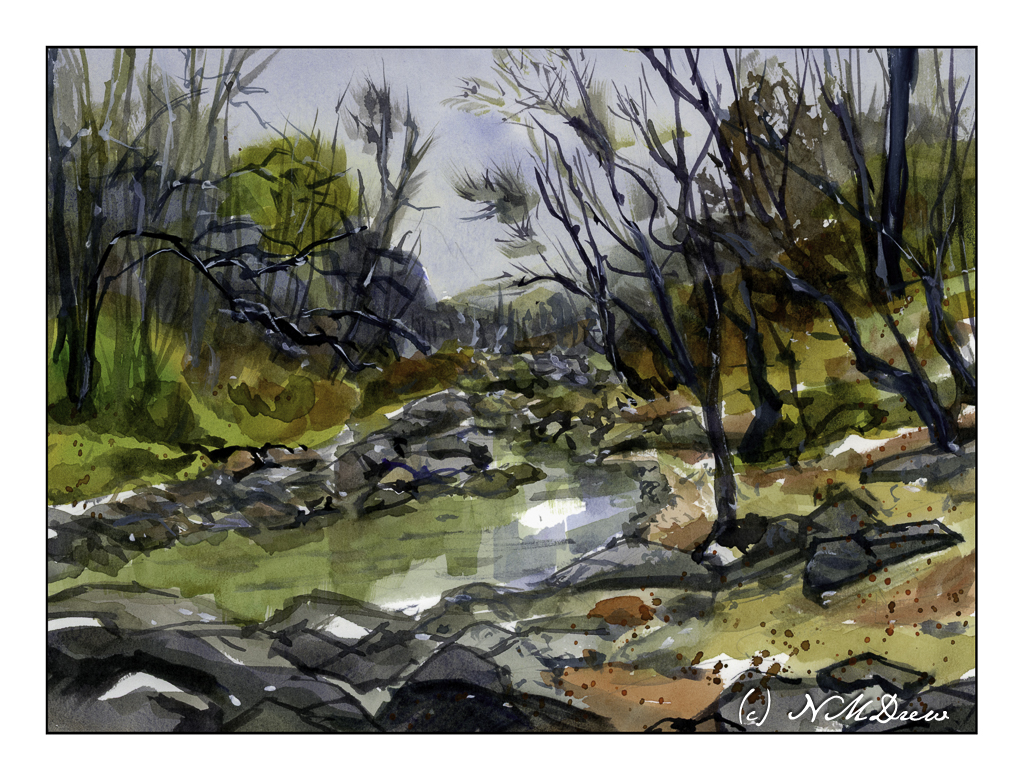
What draws me to Halibut Point is the quarry, its cliffs, and the geometric properties of the stones themselves. Water is everywhere. All these present challenges as the weather changes or the view changes. The East Coast is definitely different than the West Coast!

My focus here is the graphic quality of sky, land, sea, trees, stone, more water. The scene is quite simple but the detail can be a bit overwhelming – I want to be specific and show every leaf and grain of stone and wave in the water. I needed to make it very simple for it to work, keeping the sky and distant land and sea simple before moving to the middle ground trees.

And, I think it does. I like the way my trees tuned out – masses of greens in different value to add depth and suggest the denseness of its growth. The rocks of the quarry walls are filled with straight lines which can be vertical, horizontal, or diagonal. The color of the stone is a rather warm white to ochre, but light, too, renders it warmer or cooler. Finally, the water itself in the foreground. A calm water, but a bit of wind. Reflections in the water and ripples on the surface. More detail, but hopefully not too much.

Watercolor, Arches rough 140#, 10×14.

Rain Is Coming

Watercolor is a challenge, but I seem to finally be able to think about what I want to focus on, and work to meet and succeed, in varying degrees, my goal. Here, it is wet-in-wet painting. In watercolor this means working with very wet paint – a lot of pigment and a lot of water. This is not easy to control because you sort of have to know your paper and your paint and how wet or damp or dry the whole thing is.

For the sky, I wet the paper first and let it settle into the paper for a few minutes. Then, using a mix of mostly ultramarine blue and burnt sienna, I created a grey by adding a lot of water to my colors. I dropped the paint onto the paper and let it bleed into the water. As the paper dried, I made a stronger mixture of the grey – meaning darker – and dropped that into the already painted surface. With a bit of toweling I blotted up some of the paint to lighten areas as well as to give a shape to the clouds.

After that, I did the middle and foregrounds. Everything was done with damp paper and watery paint. No dry brush at all, just working with different degrees of wetness and color intensity.

Goals accomplished, I don’t think of this as a good painting but a good exercise.

Watercolor, Arches Rough 140# paper, 10×14.

Institution

This is sort of an amalgamation of pictures and buildings. It may be part monastery, part hospital, part something. So, “Insititution”.

A few goals here. First, a building of some complexity. Next, contrast on the building with sunny areas and shady areas. Mission accomplished, sort of!

I also used gouache, white and black, for different areas of the painting.

Watercolors, Arches rough 140# 10×14 paper.

Two Trees in a Field

Once more, it is hot and sticky, but not as miserable as yesterday. Today, I am a bit more energetic but still not running around in the 90F and then some heat. And I am in a far better mood, too! No flies. No mosquitos. And a replacement package for the stolen one arrived today. Now, September is here, and though summer is not yet over, Labor Day (American holiday always on the first Monday of the month) is, for many of us, the official end of summer.

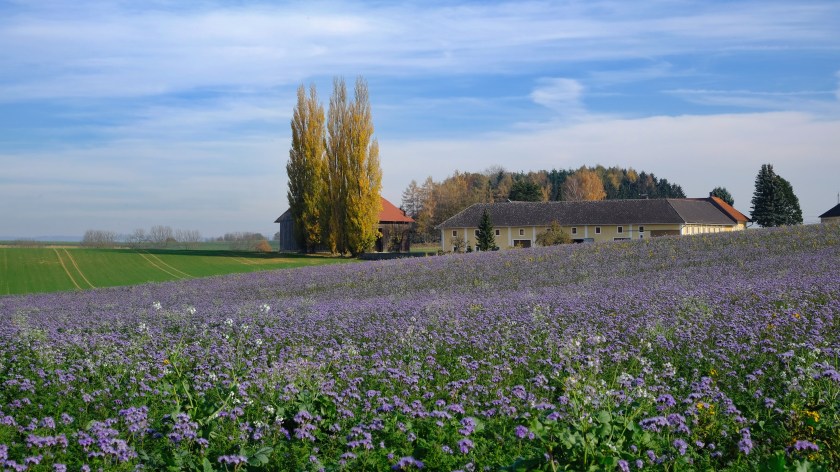
The end of summer means the fields are mown, crops and hay gathered in. Tracks and stubble leave lines behind in the shorn meadow. Heat, light, late afternoon.

That is all that this painting about. I did it after the one I posted the other day and, as with the other “Two Trees”, I am happy with the results here. I like the long shadows in the lower right, but if they are realistic or not is not the point – they just make for a bit more of an interesting picture!

In landscapes, you are the goddess of your painting!

Watercolors, Arches rough 140# paper, 10×14.