Nora asks, Nora gets . . .





Nora asks, Nora gets . . .
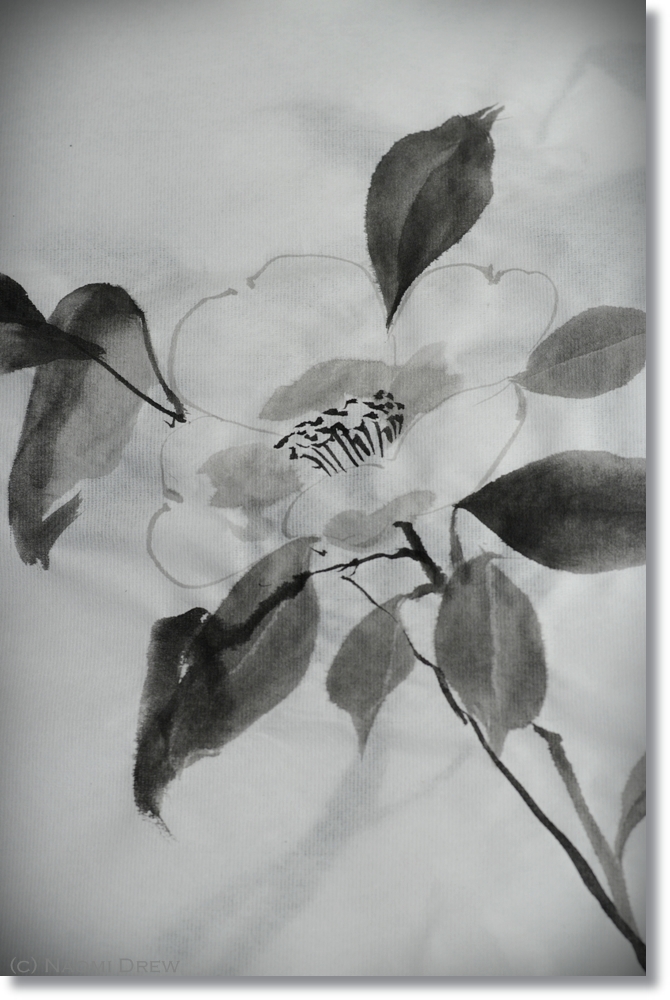
After the trip to the Descanso Gardens, and the Gardens of the World, I finally got out some ink, paper, and brushes. The camellias in bloom everywhere in the Descanso Gardens, and the rows of magnolias in the Gardens of the world, pushed it. Seeing something that I have practiced painting before, in abundance, was an amazing inspiration. So much beauty! It is much different to paint something, practice something, and become familiar with it in one form – and then to re-experience it in another form.
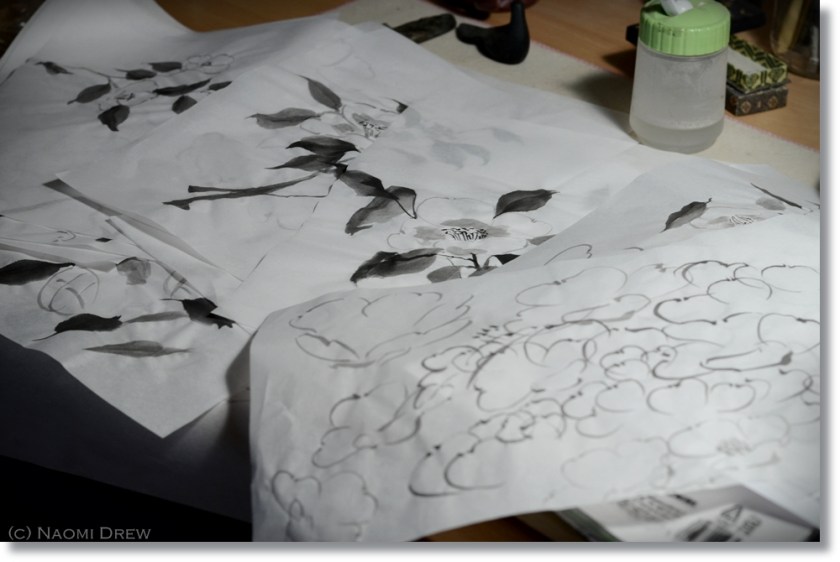
I chose to focus on the camellia, or tsubaki. There is a lovely painting demonstration by Kazu Shimura, as well as other images in sumi-e throughout the web if you google. Photographs help, too, ones you might take or you might find.

The petals have a light ruffled edge, the center stamens and pistils point outward. Blossoms vary from a few petals – as seen in Shimura’s paintings – to multiple layers. The leaves vary in shape, but in general are long and round and end in a point. The edges of the flowers are hard to do gracefully, for me at least. The leaves are easier. I spent several hours just practicing the outline of the petals.

Yesterday at a local garden supply store, there were camellia bushes for sale. I may just buy one for more up close studies as this is the season of bud and flower and leaf.


This is a beautiful little suzuri, ideal for calligraphers. It measures 4.75 x 2.75 inches (12 x 7 cm), originates from Japan, and is made of natural stone. The size makes it perfect for taking with you. Western calligraphers who like to use sumi with dip pens find the deep well at the end a perfect reservoir for ink. Brush calligraphers also find it useful as the brush tip can be dipped straight in. Because of its small size, obviously this is not going to work for someone who needs a lot of ink, but for someone who is writing with a pen or fine brush, this is a superb little stone.
For the sumi artist, a deep well is equally useful. The flat surface can be laid with water, the tip dipped in the well for dark ink followed by a small amount of water, held tip up, and the two will combine in a lovely gradation of ink.
Combined with a professional grade sumi stick, this little stone produces rich, dense ink with little effort.

I love color. Lots of color. The fact is, it is extremely difficult for me to buy things that, to me, do not have color. That means beige, white, and black. A Japanese kimono full of vibrant colors is far more interesting than the serenity of monochrome; Hawaiian shirts hold endless attraction. Prints intrigue me far more than a brilliant, single color.

Because color is so attractive, the absence of color in a painting – such as in sumi-e – and in photography – become endlessly fascinating in the variations of black-grey-white. Color reduction, meaning decolorization, can be done in various photo editing software programs. This pushes the photograph to near monochrome, but with an essence of color. The same may be done in an ink painting. Both become intriguing as the color draws the eye, but because of the lack of color elsewhere, it also becomes a messenger, speaking to the viewer on a symbolic level. Or, it can simply become an attractive element essential to a composition.

In sumi-e, there is a challenge in gradation and contrast. This is managed by both how the brush is loaded as well as forethought and knowledge as to how dark something will dry – or, more challenging – how light. Understanding the paper being used, the qualities of the ink stick, the subtleties of the brush become an art in themselves, all of which lead to the success or failure of the final painting.

In photography I am finding much the same challenge. In playing with software, such as Corel Paintshop Photo Pro X3 and Photoscape, I can take a colored photograph and either decolor it, separate it into multiple pre-press layers, or simply change it to a grey-scale image. Red flowers which look awful in color can become quite fascinating when rendered into black and white.

Composition also plays into photography, as much as it does in painting. Because one is physically doing a painting, I think that the elements of composition have time to unfold, and the unconscious works toward the final result long before the concept is visible to the artist. It is a slower process altogether.
The very nature of photography lends itself – especially with digital – to taking picture after picture after picture. Only now am I considering more carefully my compositions. Knowing I can crop and edit in software, as well as the fact I don’t have to pay for printing, lets me shoot all over, all and everything. This lets me play. Play is creative, fun, and educational. Happenstance leads to analysis in looking at photographs, which leads to thought about all the elements which come together, as they do in painting, to create the final image: light, subject, color, direction, contrast. As a result, I am developing the skills which permit me to think ahead a bit; these are the same skills, conscious or not, which I apply to a painting.

I am finding that my preferences in photography echo those I have for paintings. Simplicity and contrast. Less is more. Whether or not I succeed is up for question.
I love the color of persimmons – bright orange fruits silhouetted against the sharp blue of the autumn sky. These are the hachiya variety, and when you buy them in the store, they are hard. As they ripen, they become blacker and squishy.
Honestly, I bought these with photographs as my primary thought, but in the back of my mind, ah! persimmon bread! And now, having photographed them, my current thought – before turning them into bread – is to paint them. And so I shall, later on. Right now, though, on to photographing them.

The photo shoot took place on the south side of the house, with the sun rising from the east. No clouds, just a bit of wind. Above is the set up – you can see the directional cast of the shadow. Light was quite contrasty. The camera shoot involved about 100 or so images (ah, the glories of digital photography!), at all f/ stops and exposures, with a polarizing filter and without. Add to that, some with flash and some without; some with filtered flash, some without.

The final images here were done with a filtered flash, using f/32 and 1/60 second for exposure. Post processing was done to clean up spots in the background in the paper, as well as to clean up a few flaws on the fruit. Color was adjusted to some degree, with the final photo given a slightly warm setting to give an impression of reflected light from the fruits, or from a bit of a glowing evening light.


I pulled on compositional elements in painting – three items, three directions. I also cropped the photo at one point to create a different image, using the two persimmons on the right. However, the last picture, supposed to suggest an evening glow bombs now that I think about it! The reason is because the tint of the background is too consistent – certainly not something one would paint! So, in the final analysis, the ones with the white background are more pleasing to me, and so is the black and white one below.

I expect I will do something in sumi-e with these persimmons in the next few days, with and without color. I need to pick up that paint brush!
 Ink, Yarn & Beer