More Rocks – A Rocky Shore

It is always good to break up your routine. I have been sewing a lot over the last few days, and I am now ready for a change. I am also contemplating modifications to what I was making, namely pockets for a kit car. While I contemplate that, other things prevail! Today, I did all those fun things you have to do – specifically, clean house. A friend is coming in from overseas tomorrow, and I have no idea if he will be coming to visit, so I figured I better get it done. Who wants to welcome a guest to a dusty, dirty mess?

But messes are not really interesting to me. Color is.

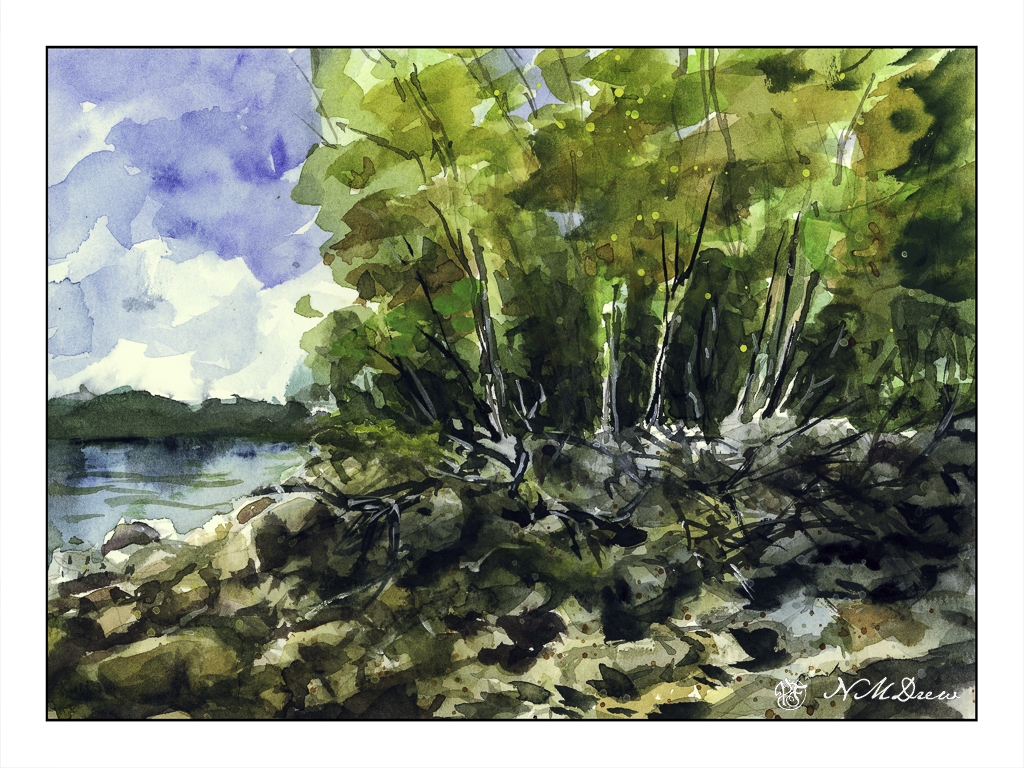
So, back to the rocks in a quick sketchbook painting. In the US and elsewhere, some lake shores are not covered with soft sand, but are home to boulders and rocks at the edge of a forest. Trees fall and die, water freezes and thaws, snow and ice and heat and sun all wreak havoc as storms of all sorts come and go. I love the wildness of these places and their lack of order and tidiness imposed by civilization.

Today I wanted to express rocks in a more abstract manner – suggesting boulders and rocks. Fallen trees, too, and the edge of the summer as it moves into autumn. I splashed on some light washes in the trees and on the shoreline after doing the sky, and from there worked with negative painting to create the rocks and boulders.

I rather like the rocks, but in general, the painting is nothing much – I just like to paint some sort of picture when I am practicing things.

Stone Buildings – And What Photos Don’t Show

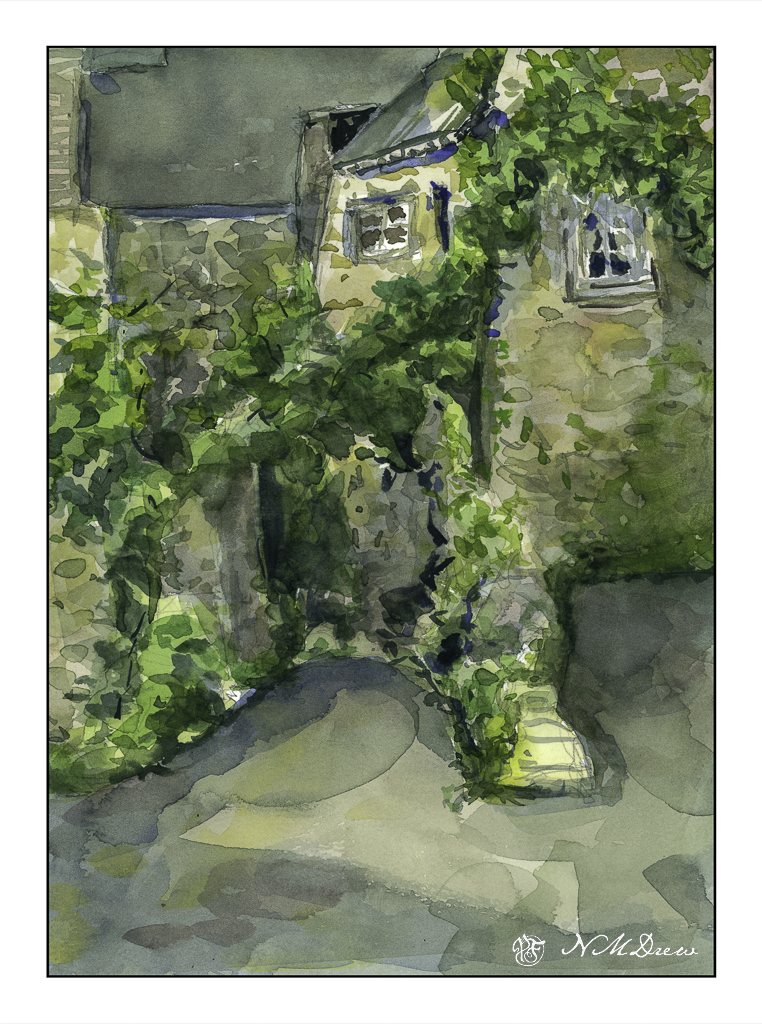
Anyone who paints from real life and then references a photo of the same knows that photos do not get all the information. This is even more evident when you paint from a photograph of something or someplace totally unfamiliar. Such is the case here – stone buildings from somewhere in Brittany, downloaded from a royalty-free site for the primary purpose of trying to render stone buildings in a painterly fashion, not a nit-pickingly detailed fashion.

First round – colors applied to a pencil sketch in a very wet and general way. As color and paper dried, some details added and attempts at creating contrast done. It took awhile as I didn’t use my trusty hair dryer to speed things up.

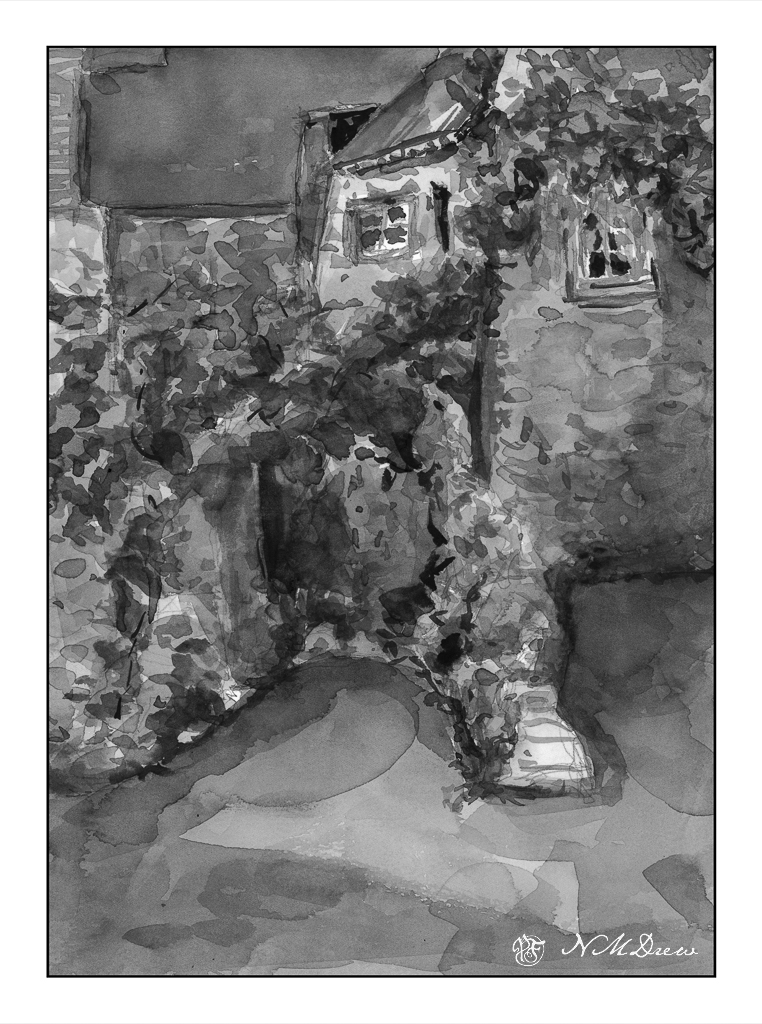
I like to desaturate my color scans to see how the picture I am painting works with contrast. IMHO, not too bad, but still in need of stronger contrast. I used my brush in LR to get an idea of where to make things darker, and using that as a reference worked on the arching greenery in the middle and other areas, as well as choosing a source of light – the sun – from the left somewhere.

As I looked at the reference photo, I noticed a window I had not seen in the tunnel below the arching greenery, as well as shapes and areas of light and dark. Was there space without greenery beyond that arch? Was there a turn to the left at the end of the tunnel? How did all these buildings all interconnect? The fact is – I don’t know! So, artistic license as you will, reality is also important as I would like to figure out what I am dealing with, especially when painting the challenging and unfamiliar – old, stone buildings.

Wonky perspective, inappropriate contrast, but I rather like the stone buildings and interplay of shadows, such as in the foreground. The shadows lead the eye (good question where!) and add some interest to an otherwise dull foreground. The light in the reference photo was very flat, so I made up my shadows. As the focus was on the buildings and rendering them in a way I liked (which I do to a degree) I was not especially concerned with the plants.

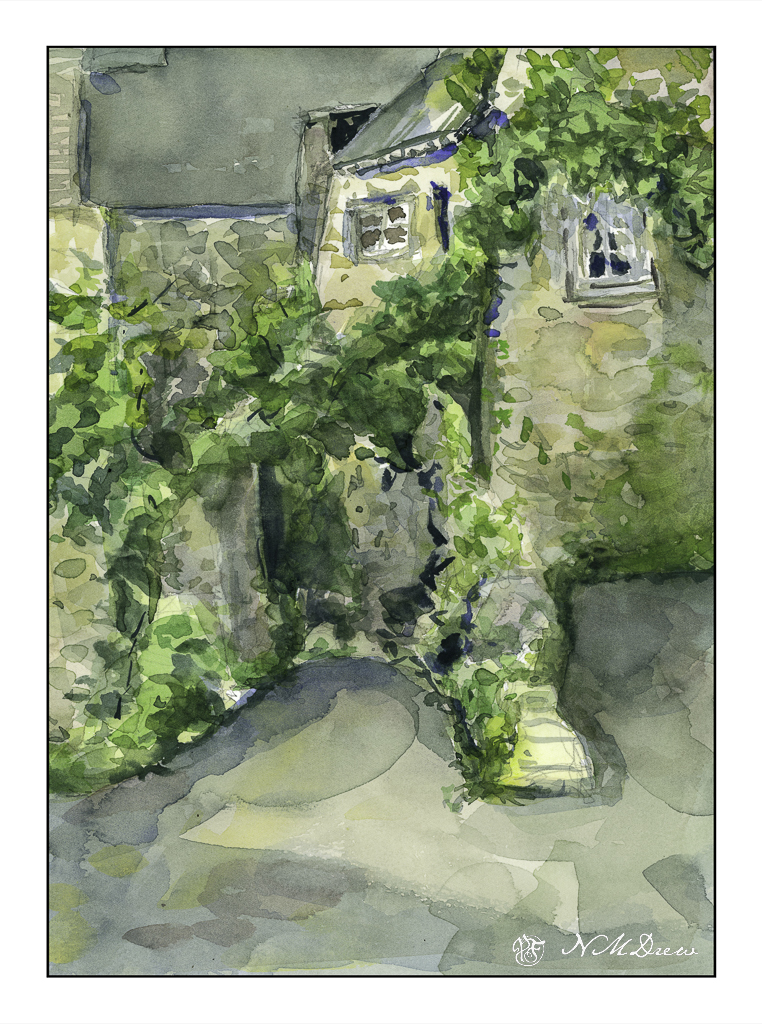
Looking at the paintings, I am rather pleased with them, but think that perhaps the center upper roof might need some horizontal texture, or do I need to use some ink to define some of the shapes better?

Your thoughts would be appreciated . . . .

Anne said she liked the first one better – it is lighter. In LR I increased the exposure a little bit.

Too Much Work

“For every 100 photos, 1 is a keeper.”

“Two steps forward, one step back.”

Well, that is true for me in the world of trying to make my watercolor paintings more simple in painting style though not necessarily in content. Of late, rocks and plants.

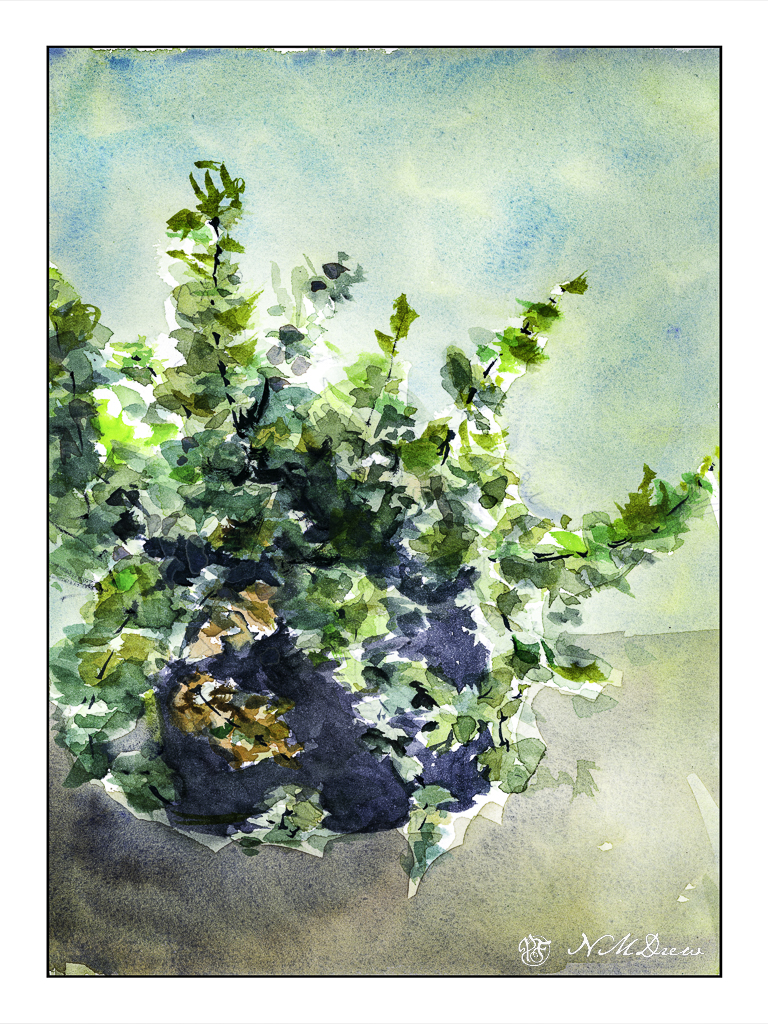
Let’s start with my painting of Greek oregano, growing like a weed in a pot on the patio. The leaves are simple enough, shaped somewhat like an egg (but flatter 🙂 ) on long, straggly stems. The color is sort of that dull, sagey-olive green that plants in the Mediterranean climate often have. In sunlight, a bit of warm yellow shows up. In shade, the greens are darker. Pretty logical, right?

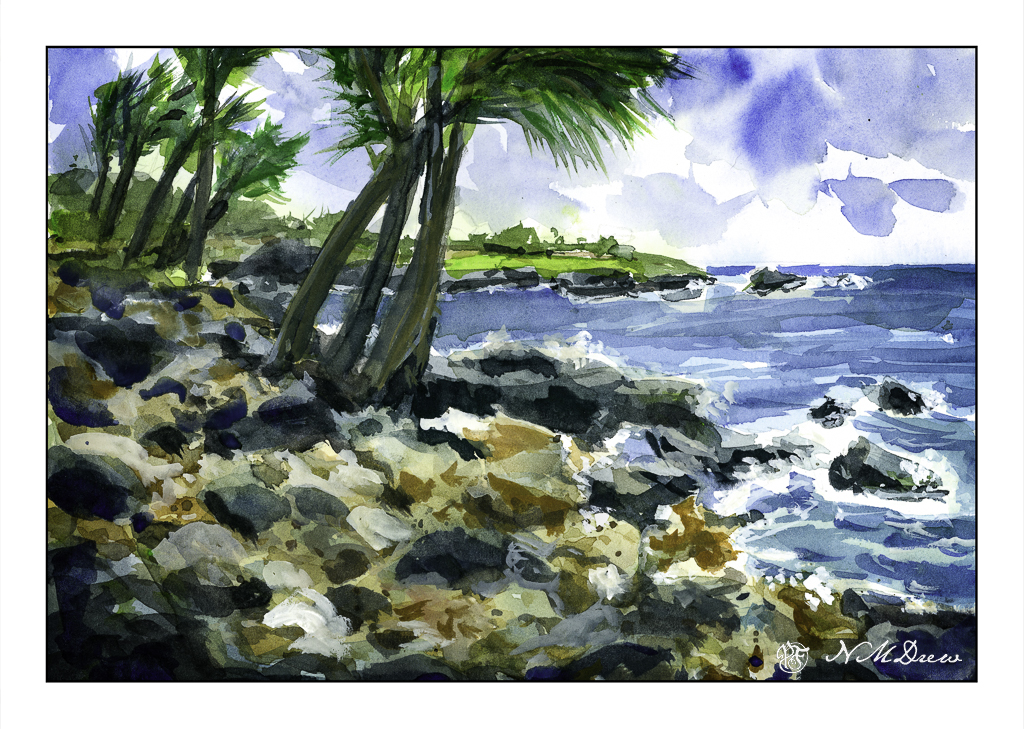
And then there are the rocks I have been thinking about since I did the much more successful cliffs of the other day. The rocks in the fort in the VI was okay as a rock building study, but not so hot as a painting. The beach scene below is of a rocky beach of lava stones – many black ones in particular, but with softer sandy rose colored stones in between. And a few palm trees. And an ocean. And a spit of land sticking out. The rocks were the primary focus as that is the rocky subject I am approaching. Simplification of shape and shadow – some successful, some not.

I sat outside yesterday, using reference photos of lava rock beaches around the world, and then using the oregano plant a few feet away on the concrete. Good to be outside. Good to work on two opposing pages of the sketchbook, waiting for one to dry and working on the other. Back and forth. I was amazed I was out there for at least two hours, with more indoors. I am spending more time on painting a picture than I have before . . .

Success? It comes in steps. A lot of crap with a few successes.

I think it is time to go hem some pants.

Practice Stones: Fortress in the British Virgin Islands

After working on the cliffs, I also want to work on another item found in nature – rocks and boulders. These are also used as building materials, so why not a building of rocks and such cemented together in the 1600s? I always love stone buildings – or fortresses – constructed of nature’s gift. Stone has been used for millennia, so why not? This is a painting of what I believe is Fort Recovery on the island of Tortola, which I visited some time ago.

The purpose of this picture is not a complete picture but a way of figuring out how the stones might be done. The palm trees are really part of the actual fortress, but I put them in as it helps me see if something works.

The stones are simple but I am experimenting with how to express such rock and stone buildings. I could try to do all of the stones, but what a yawn. More, it is the texture of a building made with the irregular shapes and colors of rocks.

What I have chosen to do here is to simplify the structure – not paint rock for rock – but give an impression of it. The stones in many instances are more round than depicted, but it is on the beach – that gorgeous sand is so bright! – with a few plants and palms and newer construction around it. If I recall, the day was glaring and sunny, very hot and humid as is the norm for the V.I. that time of year, and it was also in July.

Cliffs

There is nothing so dramatic as a sea and cliffs, sometimes a sandy shore – but rugged rocks and trees clinging on for dear life always catch my eye. Northern California has its share, as do Oregon and Washington. All over the world such drama is there for our pleasure and to keep us humble.

My approach, thanks to having a sketchbook – my lovely sketchbook! – is becoming more deliberate and more patient. I am working with larger planes of color, going for the grand before homing in on the detail. I also wanted strong contrast of sun and shadow. Simplicity. Clarity. Less is more, etc. As well, warm and cool.

I am honestly very pleased with how this painting turned out. I think I will leave it at that!