Playtime

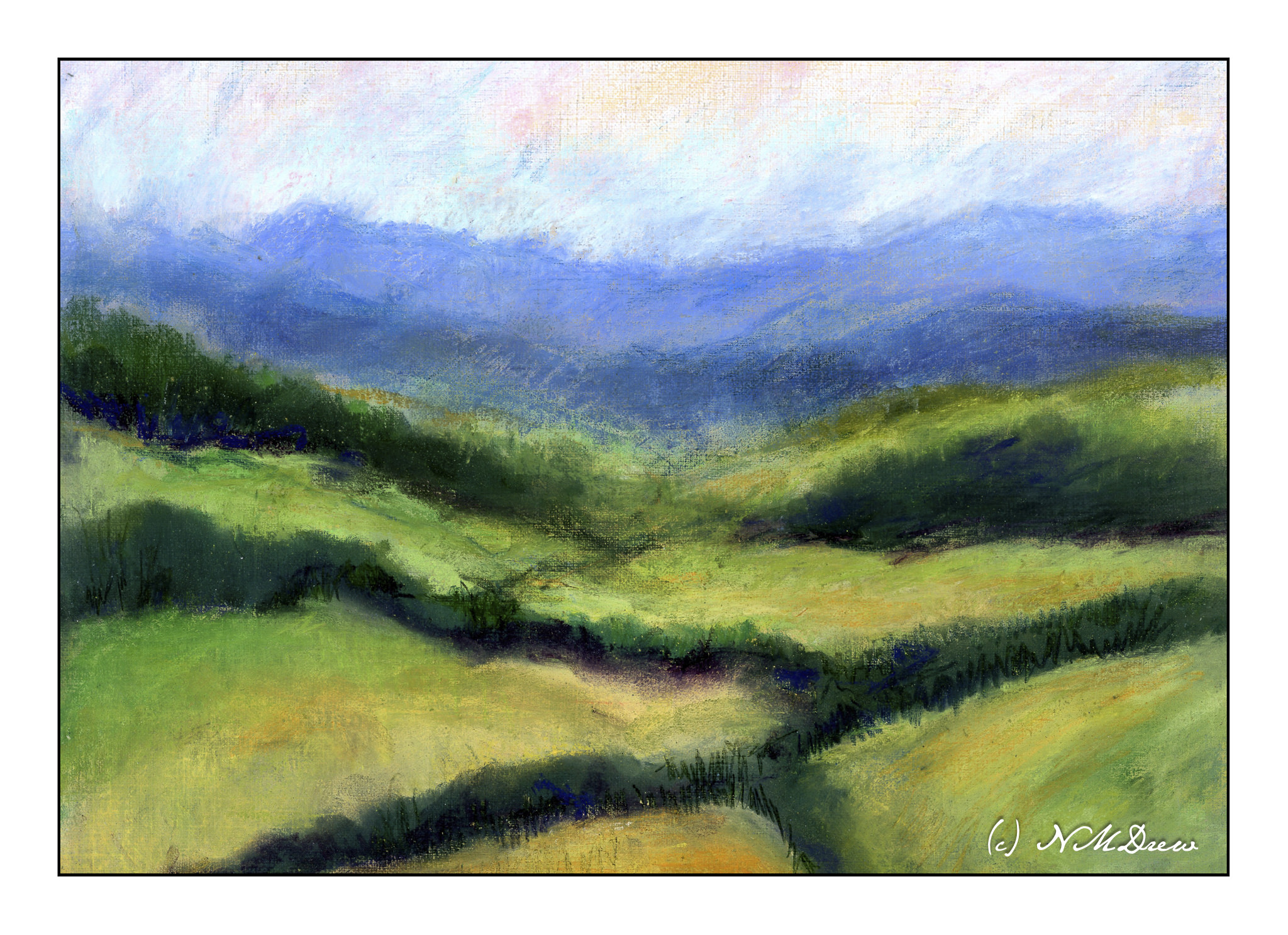
For some reason I remembered the fun I have had with pastels – soft, hard, pencil. I dug them out yesterday afternoon to play with, not to do anything great. I have not used them in a year or two, and with that comes the need to re-learn what to do with them. I figured an imaginary landscape somewhere would be good territory for exploration, so in the Land of Something, I began.

The first thing I did was to used Golden Pastel Ground which I mixed with some fluid yellow ochre acrylic paint and water, thinning it to the consistency of cream. I applied 3 thin layers onto Canson XL oil / acrylic painting paper, letting it dry in between each layer. This give a sanded surface with a bit of grit, and it held up really well.

After the paper and ground were dried, I pulled out all my pastels. I have soft pastels by Rembrandt and Terry Ludwig; harder pastels called Nupastel, and some reputable pastel pencils by Derwent and Faber-Castell. The first layers were done with soft pastels to lay in the values. I used rubbing alcohol and a paint brush to establish values. The alcohol seals the pastel pigment and once dried the colors do not flake off.

I applied layer after layer after layer of soft pastels, blending as needed, and using a very fine mist spray bottle with alcohol in it to settle each layer. In the end, I used the Nupastels and the pastel pencils to see what they can and cannot do. When finished, I sealed the painting with more alcohol and used a hair dryer to hasten the drying.

Last time I did pastels I got frustrated, and it seemed everything I did got worse and worse! My own thoughts are I am more accomplished or skilled with colors and such now than I was a few years ago, so this may be why I feel this is a successful foray into a forgotten medium. I expect I will be carrying on with pastels as they are a lot like drawing and painting, messy and bright. I think I may attempt a building with the next painting.

Working with pastels produces a lot of dust. I wore a face mask and damp wiped my work area after I finished. If I continue to paint in pastels, I plan to get a good air purifier with a HEPA filter to keep the potential dust hazard to a minimum.

9 x 12 Canson XL oil / acrylic paper; Golden pastel ground with yellow ochre and water; Terry Ludwig and Rembrandt soft pastels with pastel pencils and Nupastel. Rubbing alcohol used to seal dust. (Now let’s see how it works as a final fixative!)
WIPs

WIP means “work in progress” – and here are my current ones. Both are causing me no end of frustration – but despite that, I am having fun (or so I keep telling myself).

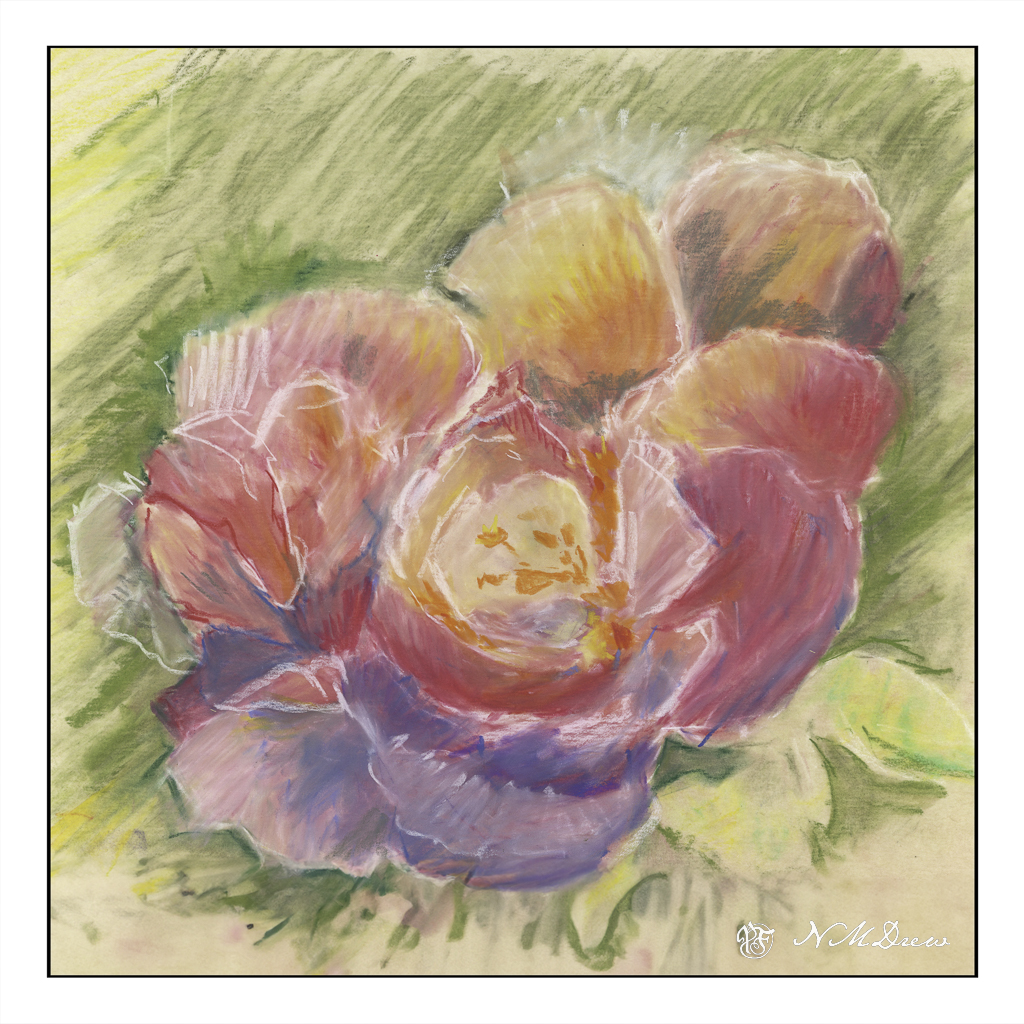
This is a rose which might be turning into a peony or a flower from another planet. I am using 9×12 Uart sanded paper (600) and a couple of sets of pastel pencils. The larger set has 24 colors, the other has 12. I am trying to paint a light pink rose, but there is no pencil, even combined with white, which will give me what I want. So, I carry on, and eventually I will find a stopping point. It is fun to do, and as I am not taking it seriously, I can blunder off in many directions as I learn the quirks of pastel pencils. I have soft pastels, which would be far easier, but I am determined to finish this with what I started with.

Here, more painting with the fluid acrylics. The point is to paint white on white, and so that means really looking at what is white, and what is white in shadow or with reflected color. The center of the flowers are greenish yellow with a bit of black, and there is one stem which appears greenish in the reference photo, while all the other stems are black. I can see flaws in the paint where it was diluted with water, and the brush work is not the finest. I wonder if I will need to get out the heavy body acrylics for this effort – but, again, I need to practice to learn the quirks of the fluid acrylics.

So, there we are. Done for the day.

Apple, Anyone?

I was feeling rather depressed by my rather poor watercolors of the other day – so, time for a break. What to do? Well, how about a bit of serious cleaning up of stuff that this gal has accumulated? What I am talking about is my bill and finance drawer. Need I tell you what was in it – nay! But let us say I shredded up about 4-5 fifteen gallon trash bags worth. Now there is a lot of room in the drawer, it is organized, and I have made the resolution to shred unnecessary items about every other month.

Okay, stop laughing. There is a definite pack-rat gene in the family, specifically on the paternal side (sorry, Dad!). De-pack-ratting requires a break, and a break from watercolors means using something else. Enter revisiting pastels. I did an apple.

I was doing pastels a few years ago and really enjoyed the medium. It is a combination of painting and drawing, both of which I like. Apples are rather generic and very recognizable, and cheerful, too, if you like bright red. I do like bright red, and so here we are.

I think I am going to be doing pastels for awhile. I need a bit of a break and a change from watercolor, even though I am really trying to work hard at it. The only drawback to pastels is the dust, but I wear an N95 mask and clean up the dust with a damp cloth afterwards. Here, Nupastels and Rembrandt soft pastels, and a touch here or there with a pastel pencil. I have some fixative arriving tomorrow which supposedly will not darken the pastel painting much. The paper is Mi-Teintes, reverse surface, painted upright.

Coastal Hills in Late Summer

Since I had all the pastels out from Tuesday’s class, before I straightened up the mess in the studio, I decided on another study. This time, the oak-covered hills of California. In spring, the hills are brilliantly green, often covered with wildflowers, such as poppies and lupines. As spring gives way to summer, the heat comes, and the grasses dry out. Perfect conditions for all these dreadful wildfires of late . . . Anyway, the coast can be socked in with the summer fog, but inland, the hills are under the brilliant sun. As you look toward the Pacific, you can see the “fog monster” lurking on the other side of the range.

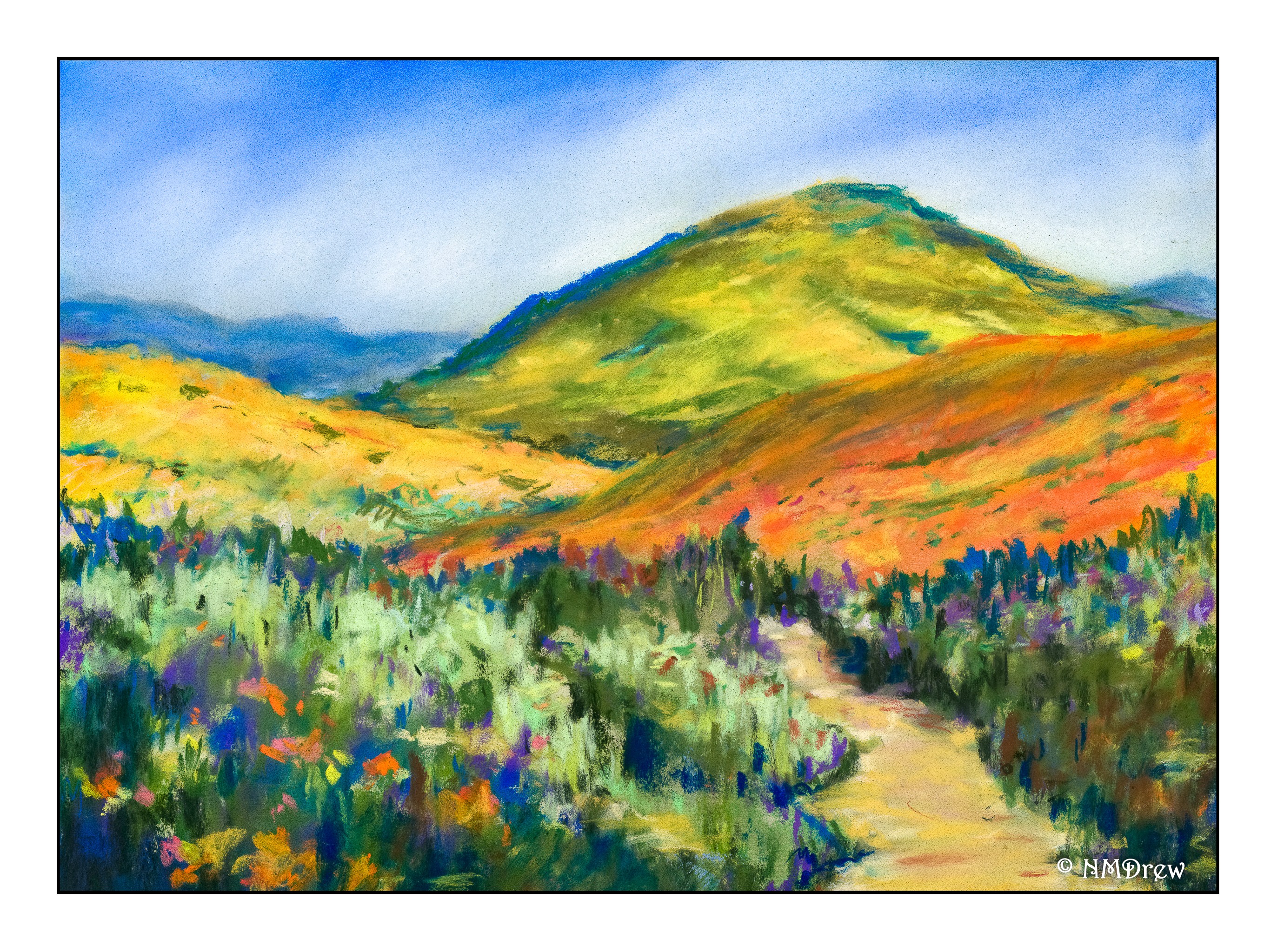
Poppies in Pastels

This is the second week of an online class in pastels, through the local adult school. I had begun the class last spring, a couple of weeks before the pandemic lock down hit California. I got my money refunded, which was good as I’d only had 2 of 8 classes under my belt. This fall, the same school and same teacher are available as a virtual class, using Zoom.

I am not a big fan of online classes that are live simply because I love the real-world interactions of students and teacher. Being able to wander around a classroom, have a conversation or two, discuss things with a teacher in depth (and close up!) when painting are all big, big advantages to a lap top and a poor monitor, as well as limited video capabilities. Still, learning does happen! I just like real life better than virtual. Nonetheless, critiques are possible as are good suggestions, some of which helped my painting out a lot.

That said, it is fun to paint in pastels. Here, the California Poppy Reserve was the subject matter, particularly wonderful after the beautiful, wet spring and “super bloom” we had. I used 400 grit Uart sanded paper, Rembrandt and Nupastels with a bit of charcoal, and sealed it with a Krylon semi-gloss acrylic finish.