In a Pickle!

Pickles - 1

If it weren’t for Elizabeth Fluehr, I wouldn’t be in such a state.

I did a search for negative painting on YouTube, and came across a series of three videos on the subject which she did.  The first one is pretty simple – it explains what negative space is, and what it is not.  Very clear explanation.  The heart of the matter is in the second video, all done with a pile of pickles.  The third is the actual painting, time lapsed a bit because of the time needed for paper and paint to dry.  Check out her website as well as her YouTube channel.  You will see some lovely work at her website.

Pickles 2

As Elizabeth defines it, you are painting a defined edge, and painting away from it.  You can have a lot of edges, or a few.  A whole painting may be made of negative space, or integrated inside a painting with positive space.  Her suggestion is to paint what is closest – in the video’s case, and in my practice sample, the pickles on the top of the pile.  Then work to the next layer, on down, until the very bottom layer is done.  She explains, too, that in a landscape, it would be the object closest, such as a barn, and the last painted would be the horizon.  I think that would apply for a landscape done entirely in negative painting, which might be worth a try, and could create a really interesting abstract.

Pickles - Finished

For me, negative space is a hard thing to address. Working in sumi-e, one does some work with negative space, but its handling, from my perspective, is a bit different. Partly this is because of color, which for me is altogether a big distraction. However, Elizabeth Fluehr’s pickles are a great exercise, and one which I intend to follow up on with more paintings.

Hard Edges & Negative Space

And while I was doing the pickles, in between I tried a bit of a still life, painting around the flowers in the background, and some of the edges, working wet-into-wet. Not a nice painting, but the practice was the purpose.
Brushwork and Value in Watercolor

Watercolor Brush Strokes a la Sumi-e


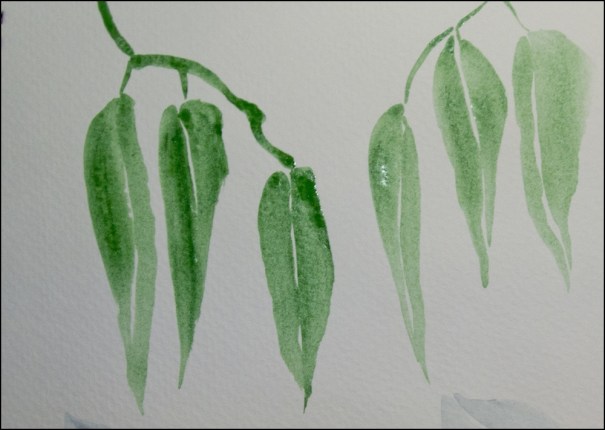
Having been doing sumi-e with some regularity for several years, I am finding it helpful in watercolor. Because the brush is the vehicle for watercolor, as it is in sumi-e, it is important to understand how the brush works.

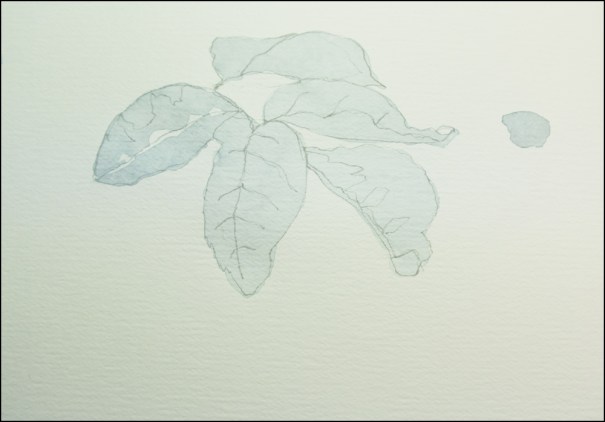
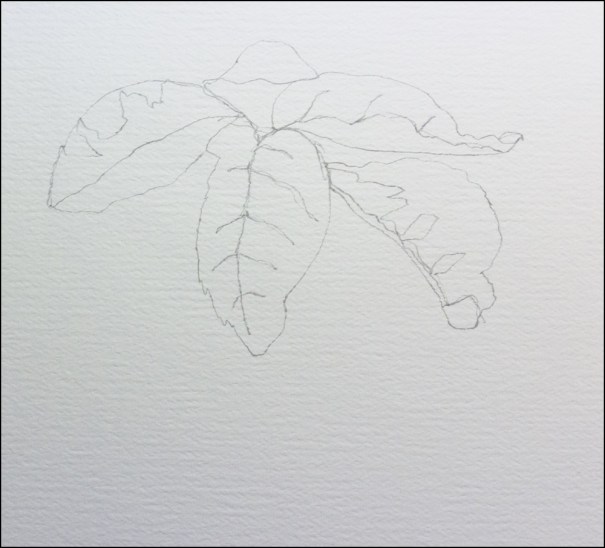
Pencil Outline

Kolinsky sable watercolor brushes can be considerably stiffer than the white-haired sheep brush used in sumi-e, but much more flexible than the wolf and horse brushes, which have darker, more stiff bristles. Basically, a western watercolor brush combines both qualities in one brush, but this does not mean that it is the same at all! A good point is important for a Kolinsky round (I am using DaVinci Maestro Series 10s and Escoda Series 1212) just as it is with sumi-e brushes, as is the ability to carry water and color.

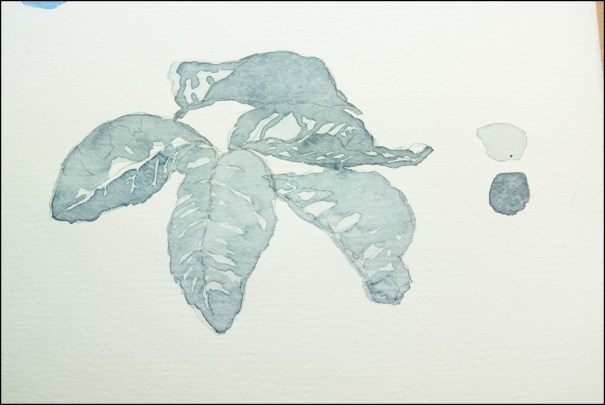
Layer 1

Many of the same techniques used in sumi-e can be applied to watercolor. These include brush strokes, such as increasing and decreasing pressure to change line thickness. Two or more colors may be applied to a brush, as in sumi-e when different ink intensities are applied. In Western watercolor, a brush stroke may be modified, working wet-into-wet, wet-into-dry, dry-into-wet, and glazing or layering colors. This does not work well in sumi-e, unless one is doing fine line Chinese painting.

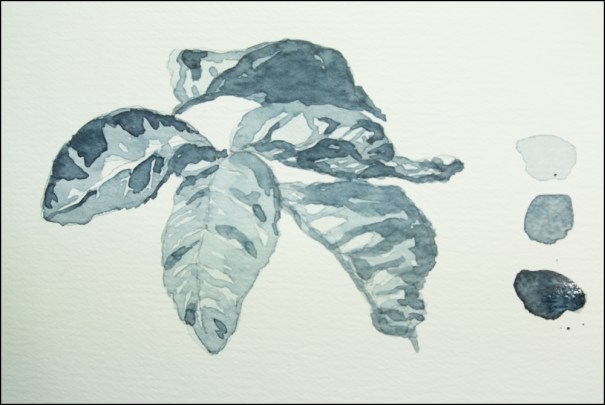
Layer 2

The major differences between sumi-e and western watercolor are responsiveness of paper. Japanese and Chinese painting papers are generally much more porous than traditional Western watercolor papers. Heavily sized Asian papers are used for fine line painting, where color layers are used, and bleeding of ink, so characteristic in sumi-e, does not occur. Western watercolor papers will vary in the amount of sizing used, and this, in turn, affects the absorbent qualities of the paper. Knowing how a paper responds takes time and practice, whether in Asian painting, or Western.

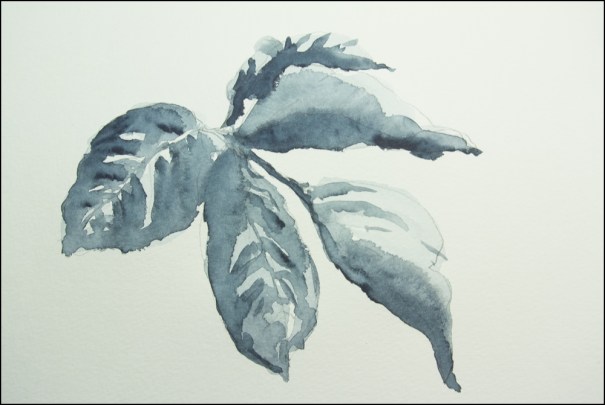
Layer 3

Value in sumi-e is achieved in how the brush is loaded. Ink can be very pale, and while it is still damp, darker ink may be applied to good effect. A sumi brush can also be loaded with pale ink, then a medium ink, and finally a tip or dark, or even one edge of the brush in dark ink. The stroke of the brush creates all the gradations. In watercolor, value is achieved by layering, as well as working wet-into-wet. Layering, also known as glazing, is the application of wet paint on a previously painted layer which has dried. Glazes are also built up light to dark. Wet-into-wet can be sopping wet, or in varying degrees of dampness.  In some ways, wet-into-wet requires more self-discipline than glazing, which requires patience and forethought.

Wet-into-Wet

Each painting technique, sumi-e and watercolor, have similar techniques, as well as some which are exclusive to that medium. The key is to learn from both, and to master each.

All these paintings were based on demonstrations from Linda Stevens Moyer’s book LIght Up Your Watercolors Layer by Layer.

Green

Greens

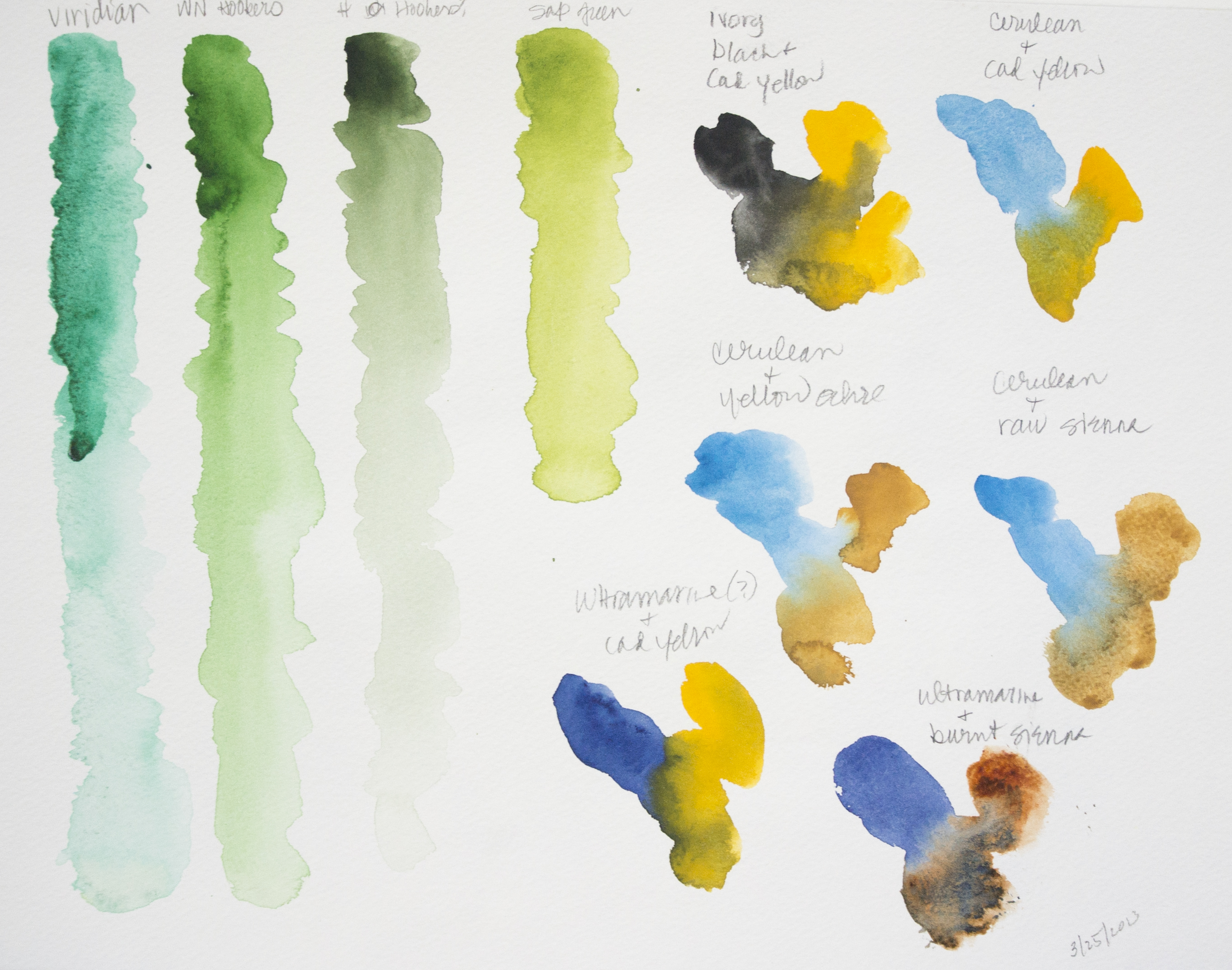
Green is one of my eternally favorite colors. In my opinion, most mixed greens lack greeness, if that makes any sense. The best greens are already made, and then modified with other colors, such as the addition of more yellow or blue, or even red. The clarity of viridian, Hooker’s, and sap just have a lot to offer.

Traditional greens are mixed from yellow and blue, and in watercolor, you can use cerulean and cadmium yellow, burnt sienna and ultramarine, and all other yellow-blue combos. Some pigments are more “settling” than others, which can be more transparent, and this will affect the final color quality.

Maybe I just need to work on mixing them more . . . but can you really get such a clear green as sap?

Practicing

First of all, apologies for the big copyright in the middle of the pictures, but hopefully it will act as a deterrent to theft.  Probably not.

Leaves 2

That said, I have been working a lot on just thinking about painting, and how to do it without creating a big mess.  Patience and mindfulness and focus are necessary.  These are not my virtues.

Nude Study

I’ve been looking at videos, re-reading books, and reviewing palettes and formulae for colors.  I have also been working on drawing and brushwork.  Sumi-e does help, as the movement of the brush, even with color, still plays an important part in creating a painting.

Astrolomeria

There are other tools for painting as well.  I used some watercolor pencils for fine lines, as seen in the onion.  I used pencil drawing to lay the foundation of the nude.

Onion

Some progress has been made.