Thoughts on Brushwork

In my last post, I looked at both portraits and brushwork. Doing both is sort of a new adventure for me – portraits, certainly, but brushwork is something I play with periodically. Two artists I admire for both their subject matter and brushwork are Maggie Siner and Hashim Akib. Both have very clear brush marks as well as a strong sense of graphics and color. Siner’s work often displays wide swaths of color and Akib’s often does the same, as well as creates movement and light with brush strokes. Their portraits are striking.

That said, I am a dabber and a rather haphazard (okay, very haphazard) painter in my approach. I paint and putz, sometimes getting it right, sometimes getting it wrong. I will draw in a general idea, but don’t do much more. In particular, I don’t do value studies as I want to look and decide on the scene. I want to train my eye to see them in the picture or landscape or person. It is far more difficult than I think it will be. Slowing down helps, looking and then going into the painting process.

I did the painting below vaguely based off a paining by Siner called “Golden Cumulus”. You can find it on her website. Siner’s brushwork is deliberate, and she says she scrapes her oils off until her brushstroke is as she wants it. She doesn’t paint over things.

What I was looking at in her painting were her brushstrokes. They are directional, sometimes heavy with paint, sometimes not. At times she smudges and edge into another to break things up. For my variant, a wide brush, a square canvas, and either oils or acrylics using the colors found in Siner’s palette, which is very limited.

A lot was learned here: A limited palette makes color choices easy and harder – gotta mix those colors! A big brush – here a flat – allows far more mark making than I thought possible. And a big brush forces me away from my dab-dab-dab with a pointed round.

I don’t remember when I did this painting nor what media I used, or even if I published it here before. I found it the other day and remembered what my goals were. Brushwork then, brushwork now. I’m trying to clean up my oils / acrylic painting skills like I worked on with (and sort of succeeded with ) watercolors.

Oil or acrylic on cotton canvas board, 12 x 12, sort of a master copy of Maggie Siner’s “Golden Cumulus” ca. 2018.

Profile of a Man

One of the painting classes I am taking is one on portraits. The teacher, Barbara, does beautiful work in oils. She is detailed, observant, laissez-faire, and is getting me into enjoying painting portraits of people. For me, I like people I don’t know. Personal portraits are too personal, and while I have done some decent pencil drawings, paint is another story altogether.

If you like free, public domain images of all sorts, check out Pixabay. It’s free and I use it over and over again. For portraits and figures, as well as anything else you might want including “adult” matter (i.e.nudes), you can find it. Many of my art teachers like my photos I use in painting class, and unless I have taken them, most come from this resource.

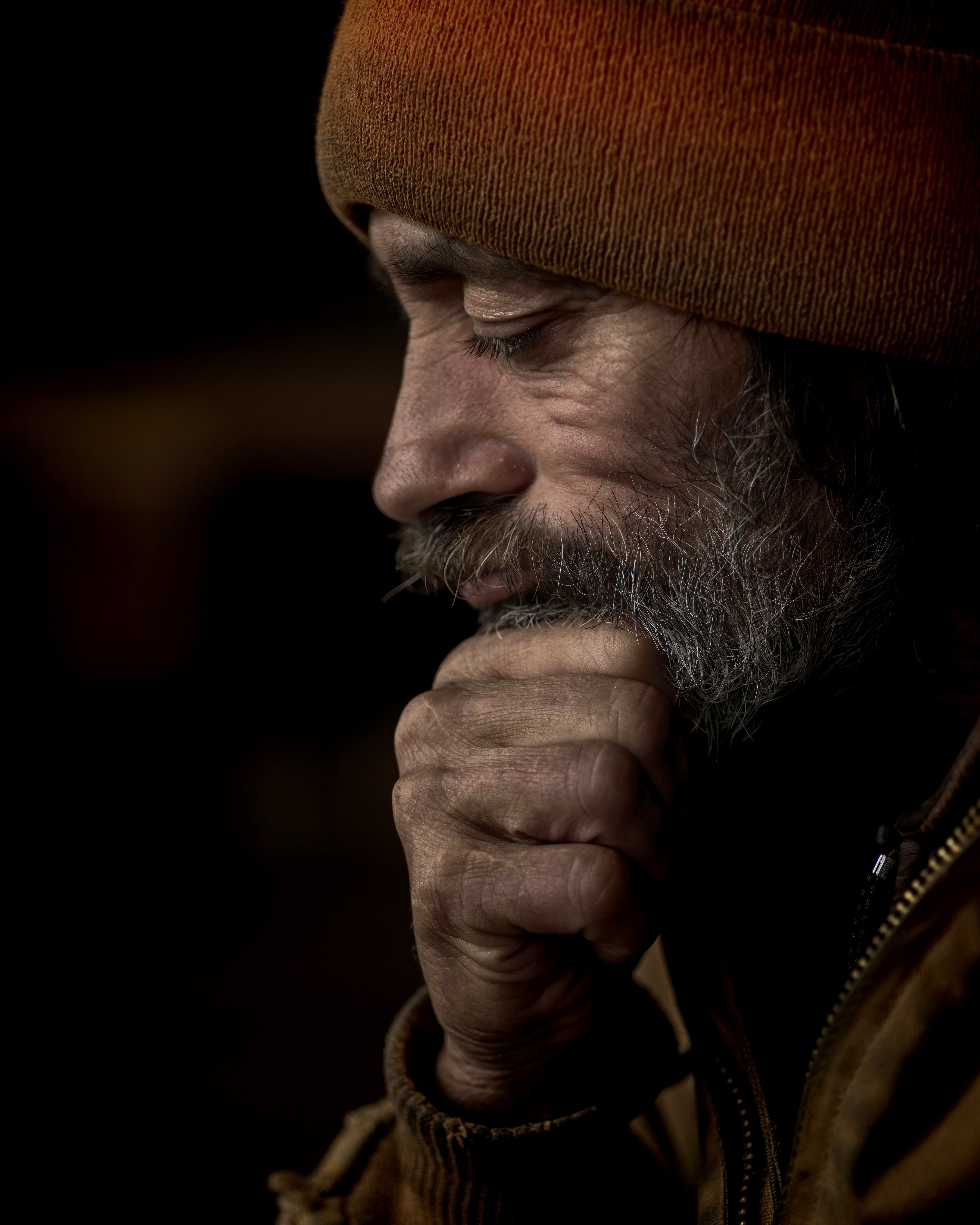
I am giving myself an exercise to paint portraits. How many, no idea. Different positions are certainly ones to study – profile, 3/4, frontal, looking up or down, etc. I also intend to do bodies, working on action and movement, but that is for another time. Today’s post is my painting of the model above.

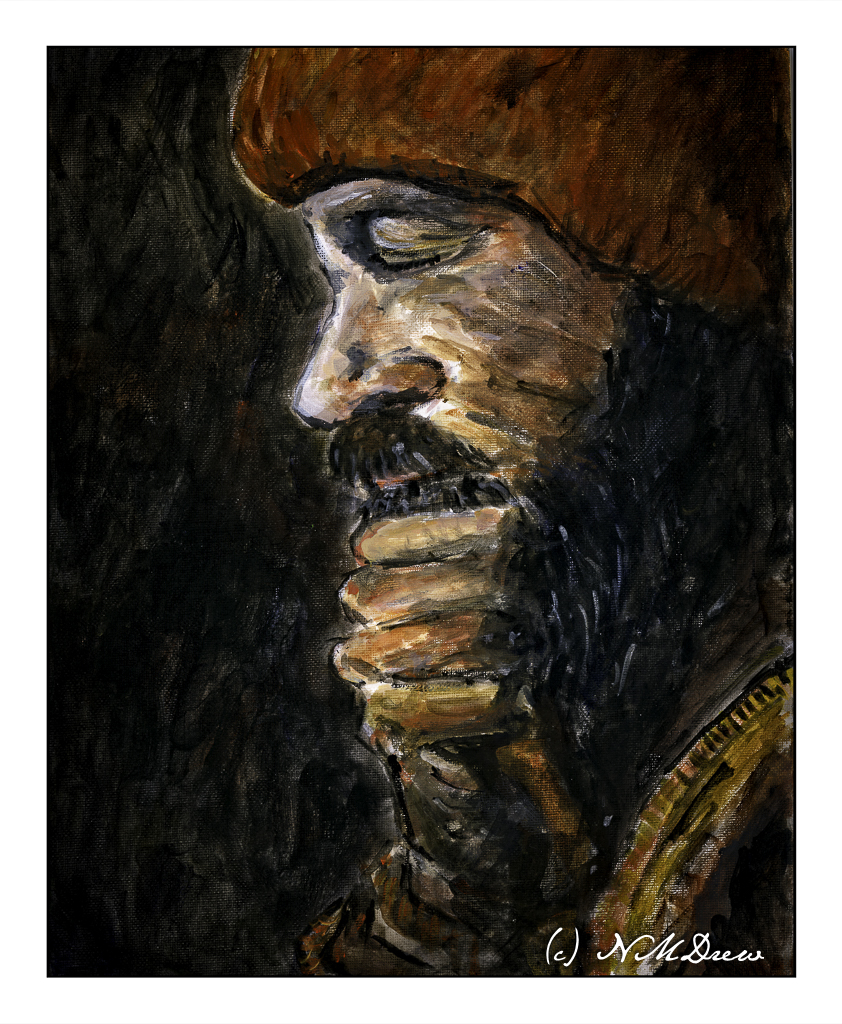
What drew me to this portrait was its simplicity. Profiles are a good place to begin. The strong light and contrast in this portrait makes things not too subtle, which I think is a good place to begin for a portrait. Below is my painting.

My chosen medium is fluid acrylics, which are about the consistency of heavy cream. In the beginning, I laid in the background with thinned paint, and the same for the general features of the face. As I progressed, I increased the paint’s density by not thinning it, but as time progressed I varied its thickness depending on the opacity I wanted.

Besides rendering good values, I also wanted to focus on brushwork. I have said many times I tend to be a dabber, using a round pointed brush. I set that aside and worked in flats ranging in size from 1/4 inch to about an inch. One of these flats is also an angle brush. For tiny details I did use a fine round.

Altogether, this was painted over 3 days, using time to let the paint dry (or a hair dryer) and take time to step away from the painting. That way I could review what was done and think about changes. In the end, I am pleased with this painting quite a bit.

Fluid acrylic paint, Canson XL oil paint / acrylic paper, 9×12, finished size 8×11.

Pair and a Half

Pear season is here! I think that says it all. So many to choose from, but my favorites are Bosc and d’Anjou.

This is the original orientation of Pair and a Half, but rotating it showed me this one looked pretty nice, too.

I sort of like the second one the best. What about you?

Oil on cotton canvas panel, 10×10. Or maybe 12×12?

Halibut Point

Halibut Point State Park is along the coast of Massachusetts. According to the park’s website:

Halibut Point is a granite edge between the Atlantic Ocean and the mainland. On this rocky coast, people have quarried the robust stone, built military structures to defend the nation, and today the park supports a wide variety of wildlife.


On a clear day, visitors to Halibut Point State Park will be able to see Mount Agamenticus, located 40 miles away in Maine, and the Isles of Shoals off the coast of New Hampshire. You can explore the park’s trails and tide pools, picnic on the rocky ledges, and learn about the park’s World-War II history and the Cape Ann granite industry history.

What draws me to Halibut Point is the quarry, its cliffs, and the geometric properties of the stones themselves. Water is everywhere. All these present challenges as the weather changes or the view changes. The East Coast is definitely different than the West Coast!

My focus here is the graphic quality of sky, land, sea, trees, stone, more water. The scene is quite simple but the detail can be a bit overwhelming – I want to be specific and show every leaf and grain of stone and wave in the water. I needed to make it very simple for it to work, keeping the sky and distant land and sea simple before moving to the middle ground trees.

And, I think it does. I like the way my trees tuned out – masses of greens in different value to add depth and suggest the denseness of its growth. The rocks of the quarry walls are filled with straight lines which can be vertical, horizontal, or diagonal. The color of the stone is a rather warm white to ochre, but light, too, renders it warmer or cooler. Finally, the water itself in the foreground. A calm water, but a bit of wind. Reflections in the water and ripples on the surface. More detail, but hopefully not too much.

Watercolor, Arches rough 140#, 10×14.

Rain Is Coming

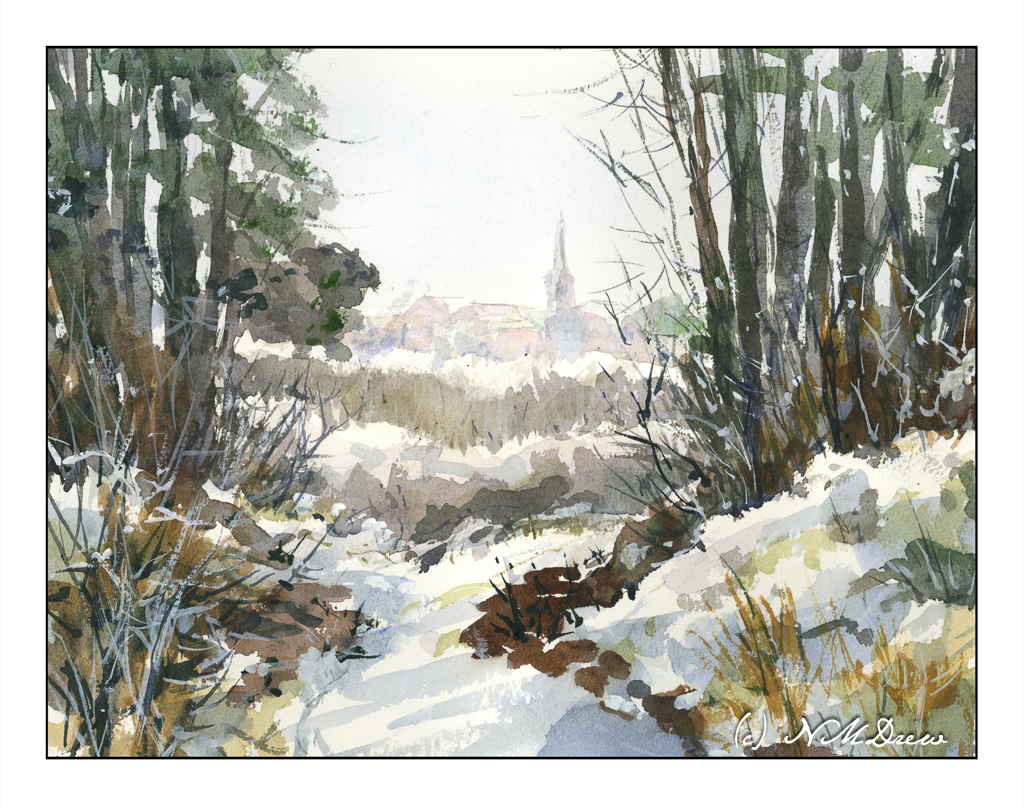
Watercolor is a challenge, but I seem to finally be able to think about what I want to focus on, and work to meet and succeed, in varying degrees, my goal. Here, it is wet-in-wet painting. In watercolor this means working with very wet paint – a lot of pigment and a lot of water. This is not easy to control because you sort of have to know your paper and your paint and how wet or damp or dry the whole thing is.

For the sky, I wet the paper first and let it settle into the paper for a few minutes. Then, using a mix of mostly ultramarine blue and burnt sienna, I created a grey by adding a lot of water to my colors. I dropped the paint onto the paper and let it bleed into the water. As the paper dried, I made a stronger mixture of the grey – meaning darker – and dropped that into the already painted surface. With a bit of toweling I blotted up some of the paint to lighten areas as well as to give a shape to the clouds.

After that, I did the middle and foregrounds. Everything was done with damp paper and watery paint. No dry brush at all, just working with different degrees of wetness and color intensity.

Goals accomplished, I don’t think of this as a good painting but a good exercise.

Watercolor, Arches Rough 140# paper, 10×14.