Another Look at the Nikon 1 System

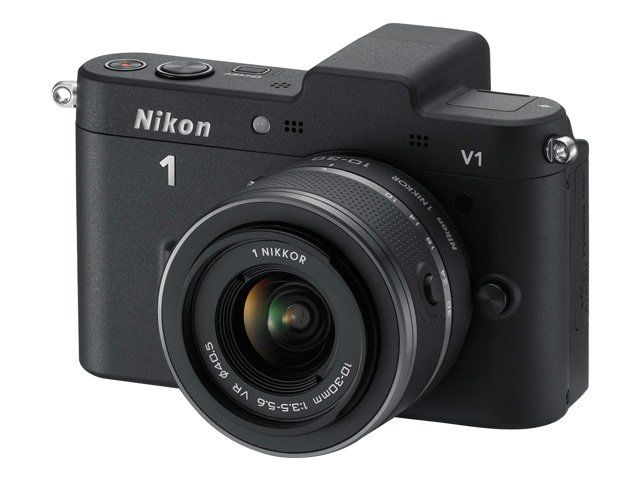
Nikon V1

When the V1 came out a few years ago, I thought it looked good; when its price dropped drastically, it looked really, really, good, and I bought one. It came with 10-30mm and 30-110mm lenses. Since then I have added the 6.7-13mm, 10mm, 18.5mm, 32mm, and now the 70-300mm, and the FT-1 adapter. If that says anything, it says I like the system, or else I am just overly acquisitive. (I will leave you to figure that out!)

If you are familiar with the Nikon 1 system, you know it has gone through multiple iterations, and has had numerous models in the S, J, and V series. I am not sure if the S series is still in production, but the J is now up to a J-5 being released in a few weeks. The V3 is the current version of the V series, so I cannot help but wonder if the V4 will be even more interesting.

One major gripe people have about the entire Nikon 1 series is the smallness of the sensor. It falls in the 1″ (2.5cm) category. Does it really matter? Isn’t the image produced the most important thing? To me it is. It also means knowing how a system works, and to use its strengths and limitations to the best advantage. This means using it under all sorts of situations, pushing it, controlling it, whatever.

Besides the Nikon V1, I also have a D7000, and the Df, and a number of different lenses with a different F mount, from vintage lenses from the 60s, to newer ones produced in the last couple of years. I got hooked on Nikon because a friend loaned me his D70 a few years ago, and I haven’t looked back. I also have a Nikon FM2N, which is a cool film camera, and can use lenses on it, too.

So, why another look at the Nikon 1 system? It is because it has sat on a shelf for awhile, until I started seeing work done with the 70-300mm lens (officially labeled 1 NIKKOR VR 70-300 f/4.5-5.6 on the Nikon USA website). The lens becomes a 189-810mm lens on the Nikon 1 cameras. The distance that can be covered is phenomenal, and is very petite. A regular 70-300mm lens coupled with the FT-1 adapter works great – but is gargantuan. Because it is small, I went for it.

A lot of birders enjoy using the lens as it is easy to use handheld. Tom Stirr has done a great job demonstrating the quality of images, as can be seen in his work below.  He uses the V2 and V3, which are considerably more advanced than my V1, but you get the idea:

Using the lens handheld, I cannot complain. While it is still heavy (in my opinion lots of things are heavy, like national debt or guilt), the VR works well, and I have found for myself, setting it to normal in the camera, and coupling it with continuous shooting, has allowed me to move in closer to things or people or animals I would not otherwise be able to.

Another photographer whose work I like is Aurora Santiago, on Flickr.  You can find her work here.  She uses the V3 and 70-300mm for her birds, and other shots, too, I imagine.

I use this lens to photograph plants, distances, and finally, the other day, I met up with a friend to photograph birds at a lake in a local park. Unfortunately, the lake was fenced off as clean-up goes on, and reconstruction. So, the egrets I wanted to photograph seem to have decamped, but the geese, ducks, grebes, and pigeons were still hanging out. Waddling birds were easy to capture – they are pretty tame – but swooping flocks of pigeons were amazingly impossible to capture with panning. Floopity, whoosh! I wanted to see how the V1 and the 70-300mm worked together to produce good pictures, still and with my largely unsuccessful attempts at panning.

Below are a number of pictures I have taken recently, using the 30-110mm, the 6.7-13mm, 32mm, and the 70-300mm lenses on the V1.

I have found a few things out in using the V1/70-300mm combo. First, I need to up the iso. Next, if necessary, shorten the exposure time to 1/500 and leave the camera to do the rest. For panning, use the central focal point, and use the continual / burst mode of the camera. Bright daylight also helps. The pictures I like are not all crystal clear, but they are pleasing to my eye. Some might be a bit soft or show some blur. Again, the photo is most important.

Besides the quality of the photo, post production is also important. Some people believe and strive for every picture to be perfect in composition, exposure, and so on, before even taking it. Sorry, not so for me. For me, post means rendering a mood, or shifting colors to something I like. I am not a purist that way. To me, some photography is a crap shoot – point, shoot-shoot-shoot (like when panning) – and pray, pray, pray! And then, look and look again. What works, what does not? Analysis is important, and reassessment of what was done.

And finally, just have fun. I don’t make money off my pictures, and couldn’t care less. For me, the creative process and intellectual process are important, as is simply getting outdoors to enjoy the world around me, by myself, or with friends.

Spring Evening

Anyone living in an arid climate longs for rain.  With the rain comes new growth and pungent smells.  Little flowers, clusters of flowers, big flowers, grasses, vines, new leaves, flowering trees.  This greenery lasts for a very short period, and then fades away to browns, beiges, and greys, and you wait for the next rainy season – if it comes – when it comes.

Josh, Puppies, Poppies

Puppies in tow, we set out for the open space around Newbury Park, in Ventura County, California.  It is part of the Santa Monica mountain range, and there are trails you can hike, up and down, to the beach.

Early Evening, ii

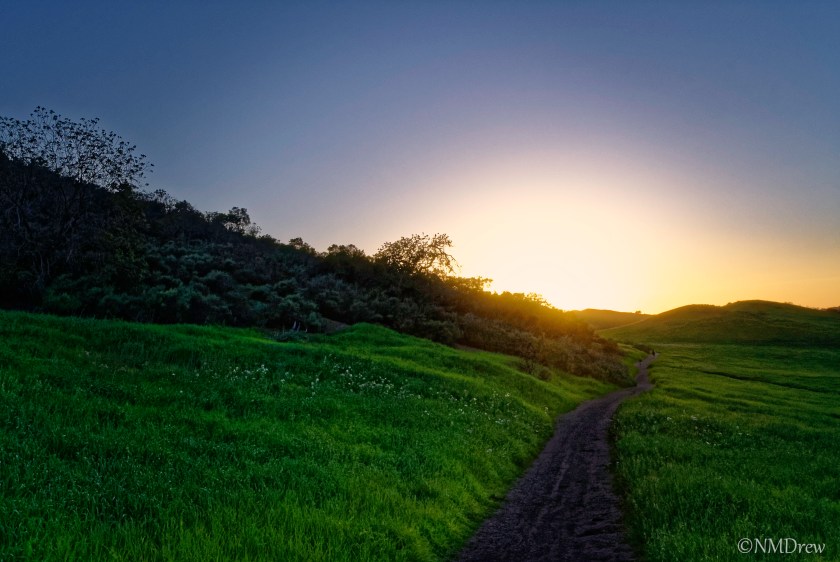
We got here about a little after 5 p.m. – the night of the daylight savings change – and hiking in, the sun was in our eyes. At times, the glare of the sun blinded us on the trail, and I had to shade my eyes to even see. The light through the trees was really lovely, with streaks of light through the foliage.

Grassy Hillside-2

Once through the little oak groves, we moved onto the grassy flats. In summer, the grasses are dry and brown, and while beautiful, the abundance of green, and the blooming spring flowers, is a balm for the beige-weary soul.

Poppies at Sunset

California poppies were out, in small clumps.

Wild Pea

Wild pea, too. (I always think of Mendel when I see these!)

Early Evening

To the side of the trail, rocks and lichens, along with clumps of brush and scrub. Everything in the sunset had a glow to it, as only the low angle of the sun can give.

Spring Evening

At some point, we had to turn around, or stumble home in the dark. Looking back as we began our final leg, the sun, as they say, slowly sank in the west.

Train Ride

Trains are not a common form of transportation where I live.  To go anywhere, you get in the car.  Fortunately, some thought has been given to how the area I live in was planned; it did not “just grow” (like Topsy, I think), but ideas of liveable space at its root.  We have little shopping areas within walking distances, and parks in every neighborhood.  Much of what I want can be had by walking, but to get to work, I need to drive.  When I was a kid in Chicago, public transportation, specifically the El, is my remembered form of getting someplace.

Anyway, there is a bit of romance about trains.  The Istanbul Express comes to mind.  The lonely whistles of trains heard as they cross the prairies.  Rushing rivers seen from the windows of narrow railways winding through the mountains.  Jack Kerouac and Carl Sandburg.

And then, the local historical train:  The Fillmore and Western Railway.  This is a a small company, for tourists and train enthusiasts, riding the no-longer-used rails in the backwoods of Ventura County, through orange groves and behind the houses of Fillmore, Santa Paula, and Piru.  It’s really fun!  There is an old Pullman, from the 20s, to dine in, with possibly some of the old fixtures, and another car with a combination of what looks like old seats from the 40s or 50s, and perhaps earlier.  Behind the cars are open carriages, shaded from the sun, so you can get out and look at the countryside as you ride through it.

Riding a train is sort of like spying.  Things you don’t see from the road are seen from the train.  Looking into the farmland, we saw orchards and beehives, as well as transients sleeping behind fences and in makeshift camps.  Paths amongst eucalyptus trees looked inviting, as did the oranges and lemons on the trees.  The air was clear and blue, and with the small rains of the past couple of months, the hillsides have emerged into a green that is already beginning to fade back to beige and brown.

Besides looking out the windows and wandering to the back of the train to take pictures, people were fun to look at and to talk with.  We saw families with small children, couples, kids of all ages.  Once we settled in, and the rhythm of the train became familiar, comfort levels rose and we – and others – wandered around.

Bits and pieces of the train became interesting – whether it was the debris left behind by the wanderers, or the small details of the train itself.  Waving at children who waved at us was so much fun – I remember doing that when I was little.  Look!

One of the fun things is that this train is just slow.  We used our phone apps to determine how fast we were going – no faster than 16mph while we were recording, and certainly much slower through the little towns – old California farming communities.  Our trip was from Fillmore to Santa Paula, with about an hour in Santa Paula before returning to Fillmore, stopping for 30 minutes at a local koi vendor.

California is not just freeways and too many people.  There is a lot here.  Agriculture, history, people, scenery.  Ventura County is north of Los Angeles, and like much of the state, has a variety of things to offer.  It is a beautiful place to be, and certainly this short little trip reminded me how lovely it is.

_DFS7415

Some Yarn at Last, or, Asta Sollilja

Asta Sollilja

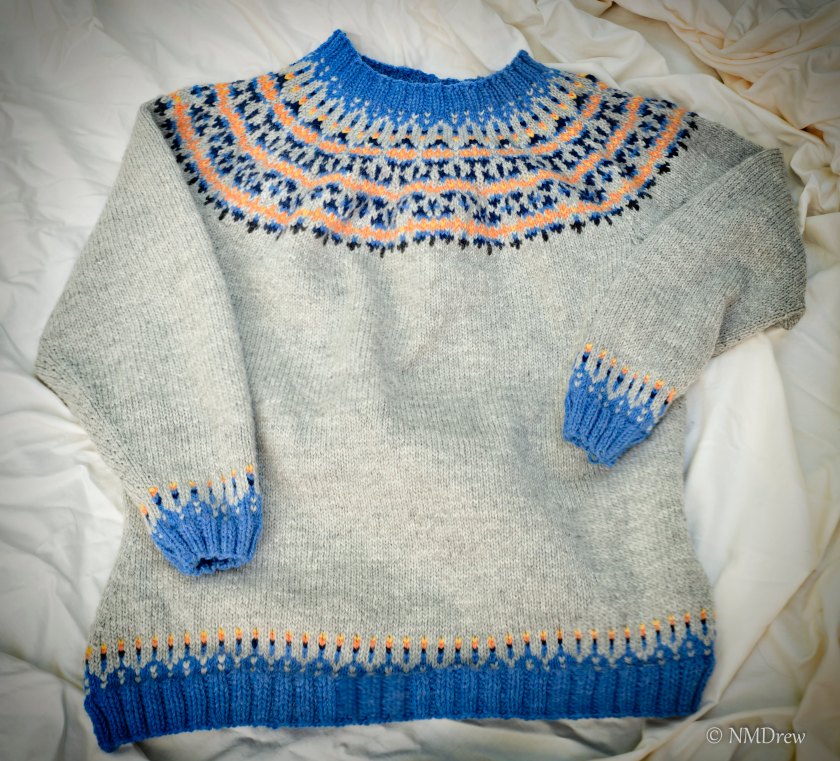
Beginning mid-December, I started this sweater, designed by Kate Davies, and available in her book Yokes.   Asta Sollilja is a sweater derived from traditional Icelandic sweaters, but with waist-shaping (not that I have much of one!) and short rows to make a distinctive front and back. Traditional Icelandic sweaters have neither, but are wearable in any direction, although with regular wear, take on, perhaps, more of the owner’s body shape.

I used Cascade 220 and changed the colorway a bit, cutting down on one color and using navy blue for the dark brownish color as well as the navy.

I just finished this sweater and was soooo excited, I just had to take pictures of it! I used Jeny’s Stretchy Bind Off, which is fantastic in that it is tidy, and stretchy, and can be done quite nicely with 2×2 ribbing at the neckline.  You can see the video here.

I still have ends to weave in and armholes to graft before the final wash and blocking – but this is the first Finished Object of the season – my New Year’s resolution – the BIG ONE – is to finish up my plethora of UFOs.