Oak Gall Ink: Day 1

Yesterday’s post was about oak gall ink (which I may also refer to as “iron gall ink”), how it is made, some historical information, and what not.  Today I will tell you about what I did, accompanied by my fine photography!

The Receipt:  Take 80 g. oak galls, pulverize into fine powder, and dissolve in 300 ml. of distilled water.  Place into jar, seal, and set out in the sun for 3 days.

I weighed out 300 ml. water on my digital scale, followed by 80 g. of oak galls – which came to exactly 3 ounces!  I put the galls into my non-used coffee mill, but the outside was so tough I took them out, placed them in a baggy, and took a 3 lb. hammer to them – well, Josh did the first honors of crushing the galls, and I immortalized him.

After the crushing in the baggy, the galls were placed in the coffee mill a second time and were pulverized into a powder.

Thence, they were transferred to a pint Ball jar, water added and powdered stirred in.  I placed a thin layer of plastic wrap between the lid and contents, shook it up a bit, and took it outside to enjoy the benefits of the sun for the next three days.

Shaking will occur daily, as thought about, and on the 25th the ferrous sulfate heptahydrate will be added.  Who knows if that step will work at all!

Note:  To see the pictures larger, click on one in each group to work through a slide show.
Oak Gall Ink: What To Do


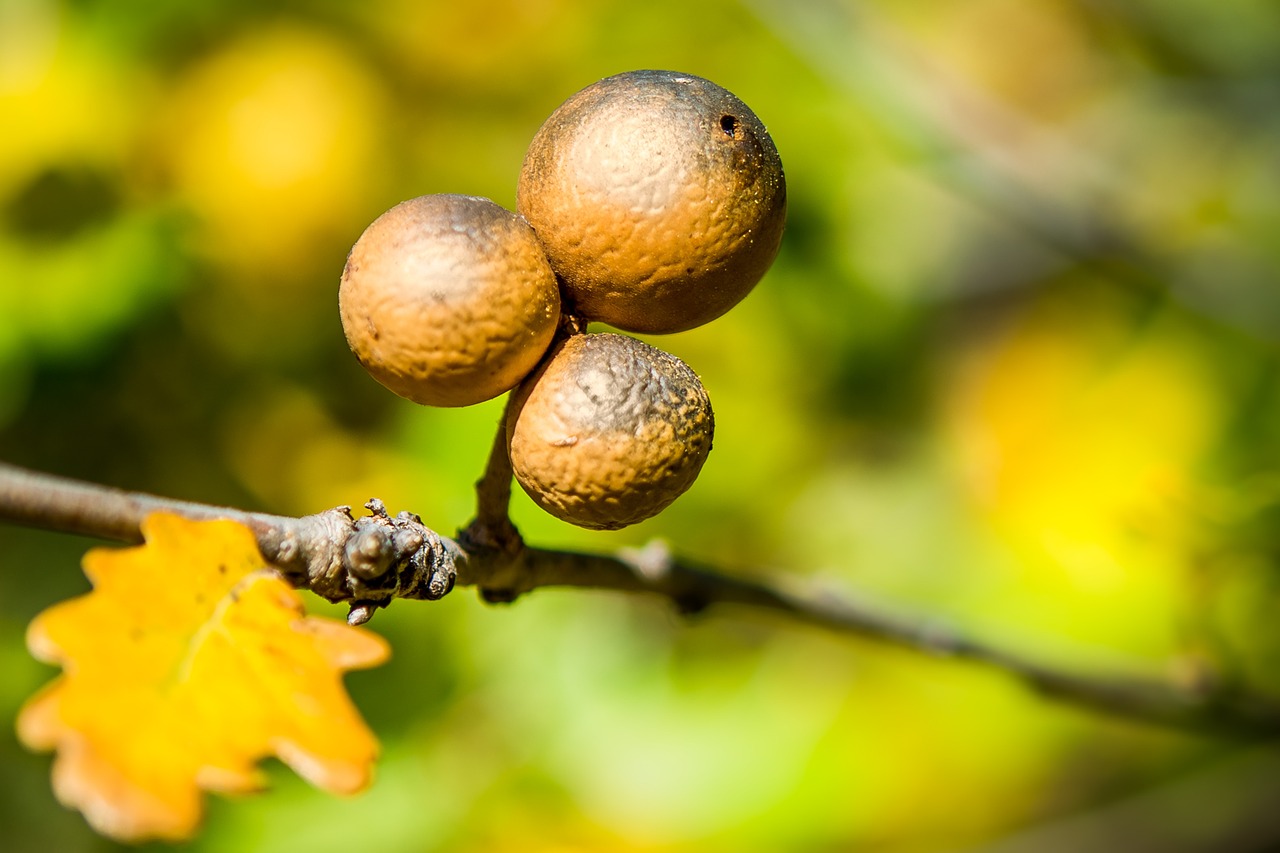
If you were to google “oak gall ink” a bazillion links turn up.  Videos, message boards, recipes, historical documents are revealed to the unwary.  In particular, there are two ways in which oak gall ink – also known as “iron gall ink” – may be made.  One involves the simple crushing of oak galls and then steeping them in water (distilled is probably the best choice as  there are no chemicals to interact with the galls), and the other is a 2-month long ferment which gets (eww, gross) all moldy.  I’m not sure the latter is up to my tastes, but I will give it a shot nonetheless. Today, though, is the “short version” – perhaps a process lasting a week or less.

There are two sites which I think give a good indication as to the process I plan to use.  The first is this video from the British Library:

This next link is from the Schoenberg Institute for Manuscript Studies, out of the University of Pennsylvania Libraries.  I rather like the description, the detail, the grey kitty Chloe, and the historical evidence of a cat with inky paws on a manuscript.  Both are good reads, so take the time to travel a bit.

Receipt for Iron Gall / Oak Gall Ink

  • Oak galls:  80 g.
  • Distilled water:  300 g.
  • Ferrous Sulfate:  50 g.
  • Gum Arabic:  25 g.

Crush oak galls into small pieces or grind into powder using a spice or coffee mill.  Place into jar and cover with 300 ml. of distilled water.  Place in sunny window 3-7 days (depending on your life and schedule).  I plan to do 3 as per the recipe from the Schoenberg Institute.  After 3 days, there should be a dark murky liquid in the jar.

On Day 3, add 50 g. of Ferrous Sulfate to oak gall mixture; replace in sunny windows for another day.  On Day 4 add the Gum Arabic and leave for another day.  On Day 5, strain the liquid into a clean vessel and voila, ink!

Thoughts and Concerns

My first concern is I am using ferrous sulfate heptahydrate, which is apparently a hydrated form of ferrous sulfate that dissolves more readily in water than the normal.  My next concern is the ratio of oak galls to ferrous sulfate – it is 8:5, or much closer than the 5:1 and 3:1 ratios I have seen in other recipes.  The more acidic the ink, the more destructive to pen nibs, quills, and paper.  However, at this point, I’ll take it as the ferrous sulfate heptahydrate may not create such a strong acid.

Quill & Ink

I have always enjoyed ink and writing with pens.  Years ago – back in the days of my being just out of university – I fell in with a group of evil re-enactors.  Making things from scratch was the trend, and in that time period I learned to weave and spin and dye – the last two I still do – as well as to cut quills and the rudiments of calligraphy.  My Italic is still acceptable, and I can do a good Spencerian and Roundhand and a few others when pushed.  For some reason, it crossed my mind that I should re-learn how to cut feather quills, to write with a la Jane Austen, and from there it evolved into making oak gall ink.

And so, it has begun.  Supplies are in hand.  I have quills (turkey, not goose, but they are pinion feathers it appears) and the makings for ink:  oak galls, ferrous sulfate, and gum arabic.  Now, time to find instructions on how to cut quills (which I have) and recipes for ink.  Oak gall ink is very acidic, and thus not especially archival over the centuries – but who will give much thought to my musings in 300 years if they are still around?  Luckily, not too far from me is a feather wholesaler, and of course there are some excellent online resources; I also have a good supply of pen nibs from the last few centuries and nib holders, ranging from repousse silver to student plastic and wooden.

The fact is, I love making things and creating from scratch.  Quill cutting is an art, and one I was only beginning to master years ago.  I have never made ink, and am looking forward to it, using both “quick” methods, and “slower” ones wherein the oak galls ferment for a few to several weeks.  Meanwhile, I will look up inky recipes and begin my adventures into the 18th century . . .

Topsy-Turvy, Crazy-Making Chaos

Well, maybe not that bad.  But, there are just some days when the proverbial best laid plans of mice and men totally fall apart and you wonder what the hell is going on.

Today was that kind of a day.  I had to make a phone call for some medical stuff – no  call returned, but I’ll push it more later on.  A friend is being badly treated at work – trying to help her figure out what to do in the sea of contract breech and lies.  Then there were the plans to paint which produced crap.  And a lack of sleep at night and an interrupted nap mid-afternoon.  And then, I have just discovered that steel-cut oats make for a wonderful savory addition to a meal and are not as weird as I thought they would be – they paired really well with tonight’s salmon, fermented mango sauce, tzatziki, and salad.  I mean, that is just too strange for my “oatmeal for breakfast” mentality.

The whole day felt really unproductive and messy.  Somewhere I read that for the French, their verb “etre” (to be) is how they live – more in the moment.  English speakers, on the other hand, live by the verb “to do.”  Life in the English-speaking world is accomplished by things checked off on a list, written or mental.  I really like the idea of living more immediately – flexible to adapt, able to plan, able to accomplish and not accomplish.  The French are smart in that way, if such is true.  I just felt crazy all day!

It is so funny how a culture is determined by words and verbs and habits.  Americans are descended from Puritans – the Australians from criminals!  What a contrast – rules and fear and conformity versus rebelling against society out of need or perversity.  When everything does NOT go as planned, what can you do?  Just kick back and laugh, think about it, and move on.  In the end, I had a quite enjoyable – if unpredictable – day!

Gardening

There is something about the smell of dirt, whether in the form of sodden leaves and dirt in the fall rain, or a pot of soil, or spreading amendment into a garden bed.

For years I had a house with a fenced-off area for gardening.  I grew tomatoes and corn and lettuces and lemons and figs for the most part.  There was a 40-foot tall avocado tree too, but it was old and diseased.  The soil was clay, and if I watered it, I could sink into it up to my ankles unless I put paving stones around the beds.  It wasn’t the best of situations, and had I the wherewithal, I could have rototilled amendment to make a better bed, but it never happened.  Still, going out to play in the soil, plant and weed and pick were some of the best bits of summer.

Since then we have moved.  The guy we bought our current house from put in too many trees, and now we are paying the price of having them removed over time.  About a dozen more to go (that’s down from about 20).  Then, a small back hoe or something is going to need to come in to dig down to get at roots and such – probably 24″ or so – and put in a new watering system and dirt.  In hindsight, I should have done it when we moved in, but that is hindsight!  With foresight, I am planning ahead.  It will take time and money and a bit of thought, and perhaps even a landscaper or professional.

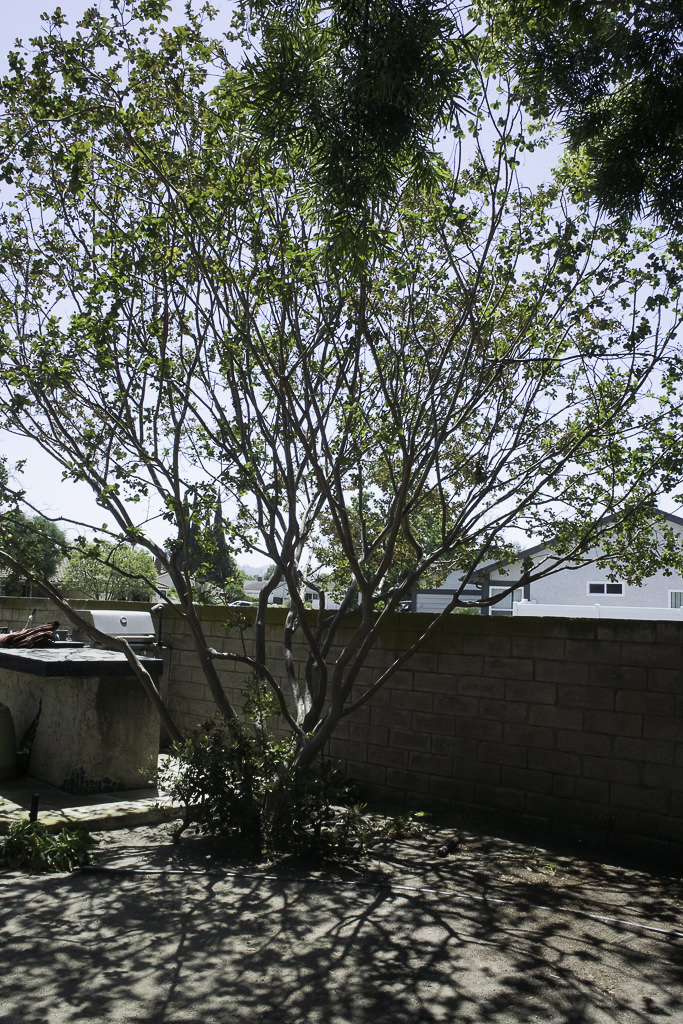
Only one tree is going to be saved – the crepe myrtle (above).

However!  All is not lost as I have a Dog Free Zone (a.k.a the “DFZ” – a side patio where the dogs are forbidden, and is fenced off).  There is also a small flower bed in the front yard, and gardening areas for a fig tree and roses.

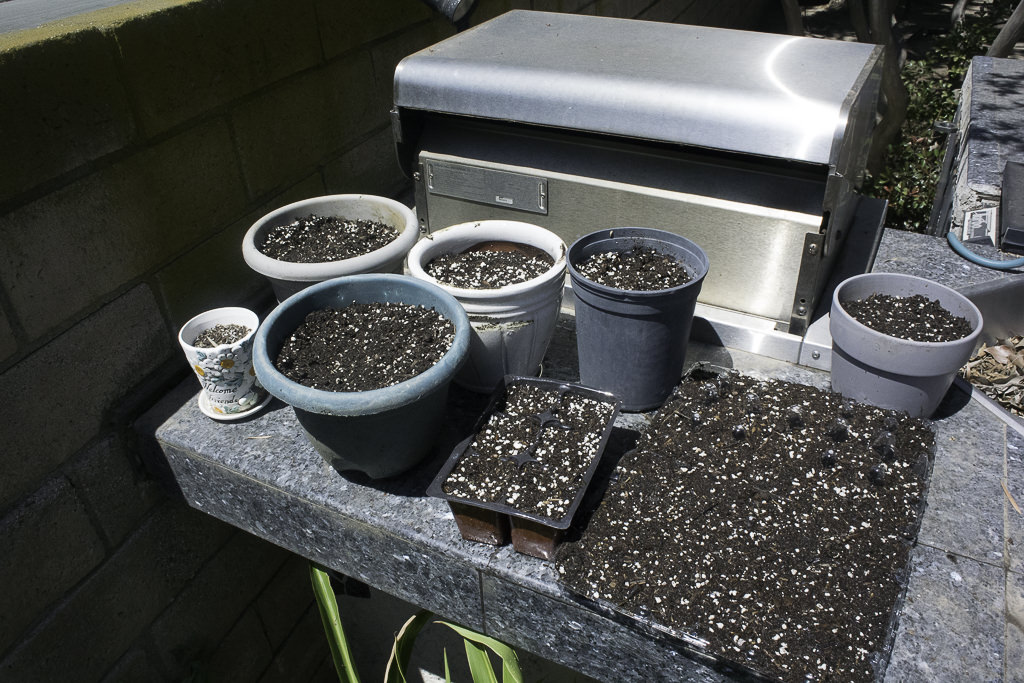
We have a couple of tangerine trees in pots on wheels which we roll around on the back patio to collect the sun.  Today I did some transplanting of flowers into larger pots, pruning, and general clean up.  After that, I started some old seeds in starter containers – things like cucumber seeds from 2008, long beans, mesclun, holly hocks, lupines, stock and carnations, pimientos and cayenne peppers.  If they come up, great; if not, at least I tried, right?

Flowers and vegetables and fruit – all are better when home grown!  Besides what I put in today, I also have a couple of tomatoes, odd bulbs, lilies, zinnias, more peppers (about 12 or so), mint, milkweed, lavender, alyssum, sunflowers, marigolds, and few other bits and bobs that attracted my attention these past months.  Front and back are getting spruced up!

Gardening is one of the great joys of retirement, a beautiful spring, and an unfolding summer season . . .