Vision

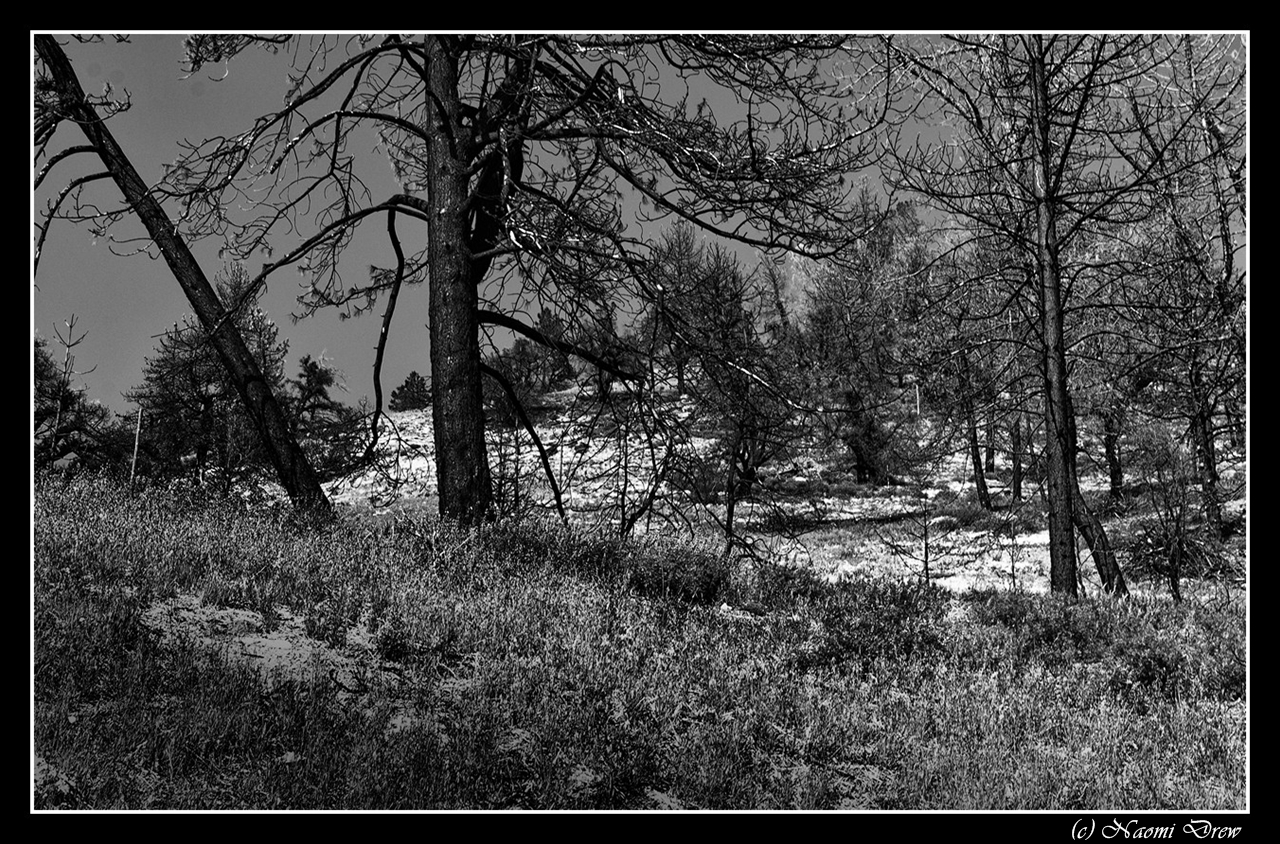
I have been pondering just removing this blog from the blogosphere, but haven’t done that.  I have been ignoring it because I am not so sure that it is going in any direction right now.  I am going in some directions, but not necessarily the ones that created the impetus for its existence.  The result is something of a conflict, because I have been “doing” photography for a bit, and ignoring other things I really love.  The fact is, though, photography gets me outdoors more and more, and I have forgotten how much I like that.  Not outdoors at the mall, but outdoors in the wilder parts of town (i.e. places with trees and plants, not crazy drunks!).  Suburbia is sadly lacking in open space at times, and that means actually taking time out to travel and drive somewhere to be outdoors.

On the other hand, photography also means packing things to lug along.  I have always been a minimalist in hobbies.  I don’t like to need a ton of stuff to do anything, but often photography seems to require a few things more than I really want to haul around.  The trade off, though, is producing things that are better than just okay.  I also think I have reached a point where I have a fairly good handle on some of the technical aspects of photography, along with more thought about composition and light, and not just running around pointing and shooting everything I see.

In a nutshell, I have reached a point of dissatisfaction with photography.  That is interesting, don’t you think?  For me it is.  What this means that I am now at a point where it is necessary to push past the do-able to the less do-able.  This may mean making advances in technique.  It also means advances in creativity.  At this point, photography is rather boring.  Sitting at a computer to post process a picture is horribly boring – but useful.  Even that, though,I prefer to keep to a minimum.

For me, the most frustrating part of photography is that it is not as manual as I would like it to be.  Simply put, I like working with my hands.  Cameras are not especially complex when it comes to pushing a button . . . there is not a lot of finesse, as there is in painting.  It is different.  On the other hand, I do get outdoors and crawl around in the bushes.  That is kind of fun.  And I don’t do that when I paint or knit.

The question, here, is what is my vision as a photographer – person – artist – human?  Perhaps by defining my artistic vision I can open the elusive.

So, let me make a start . . .

I want to find the essential and the beautiful in the world around me, whether in nature, in a person, or in an object, whether simple or complex.

Bull?  Let’s see where it goes.

Toy in the Morning

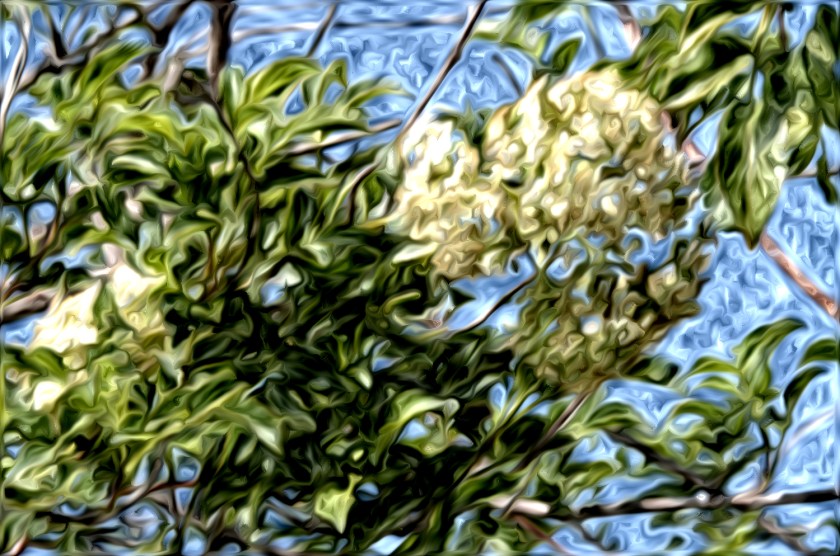
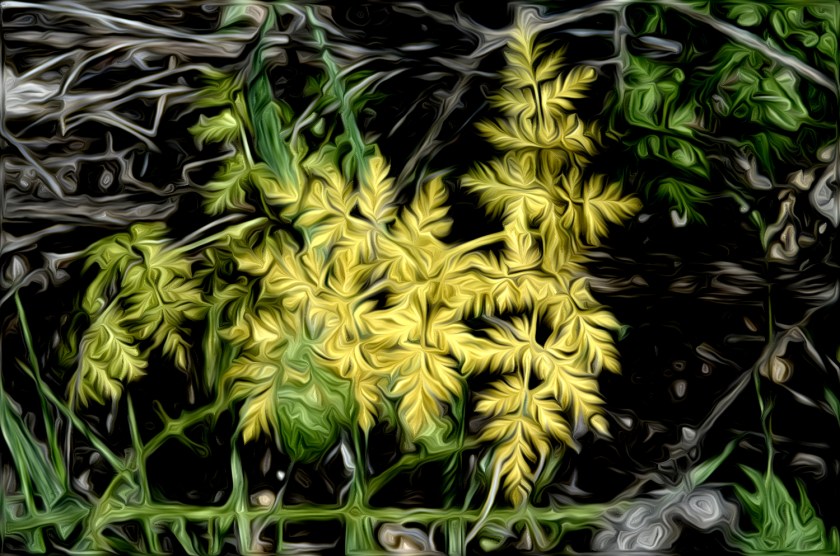
Hmmm.  Nothing like playing with software to keep one amused in the early morning!

Adobe has a filter called “pixel bender” for CS4, CS5, and CS5.5.  I expect they will have one for CS6 when it comes out.

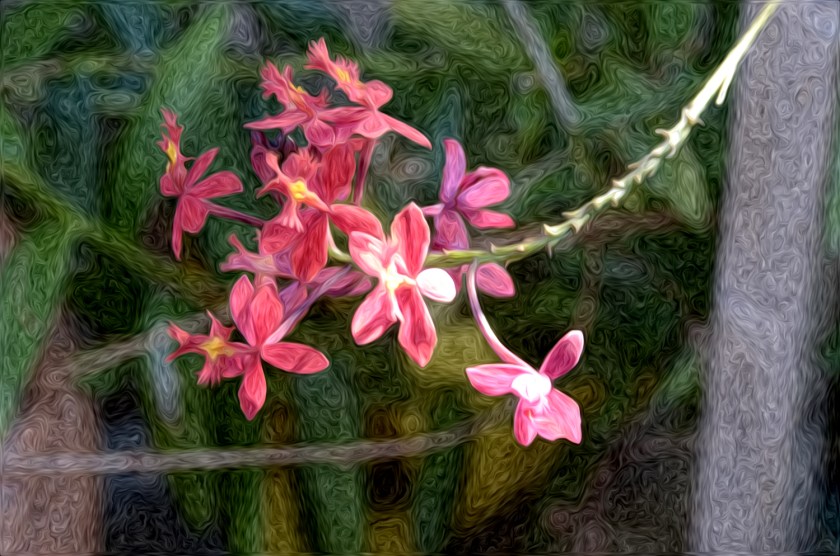
I have been playing with the “Oil Paint” one, with maybe another thrown in by accident.  Kinda like the results.

Is this “art”?  Or not?

If you use it, reduce the picture in size.  My system crashed using full-sized 16 megapixel images; no problems when reduced to 1500 in Photoscape along the long edge.

A Bowl, A Brush

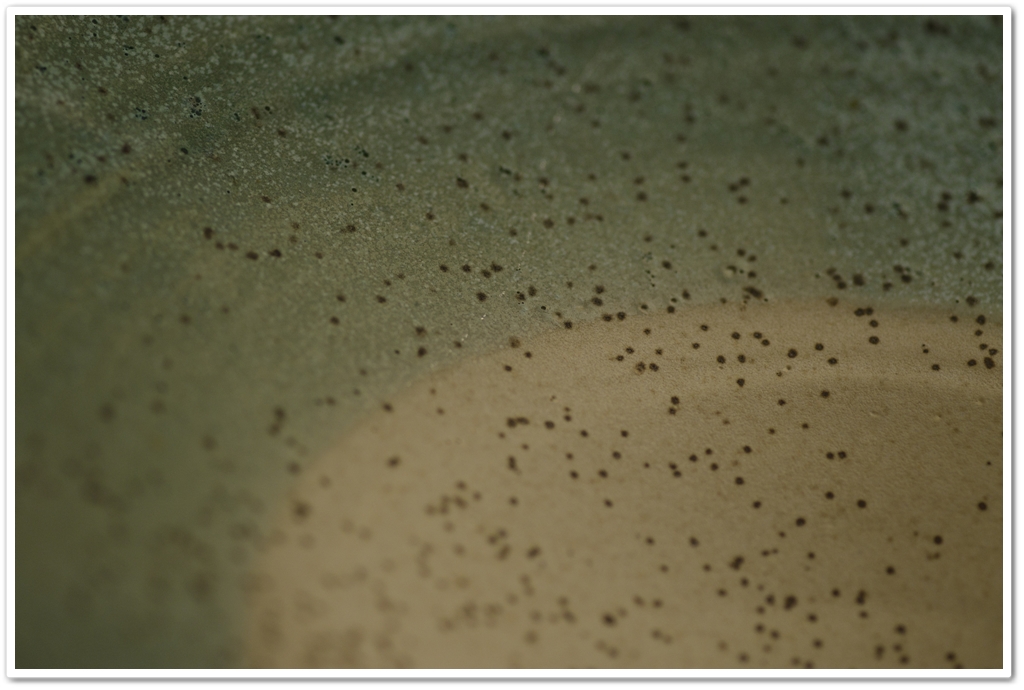
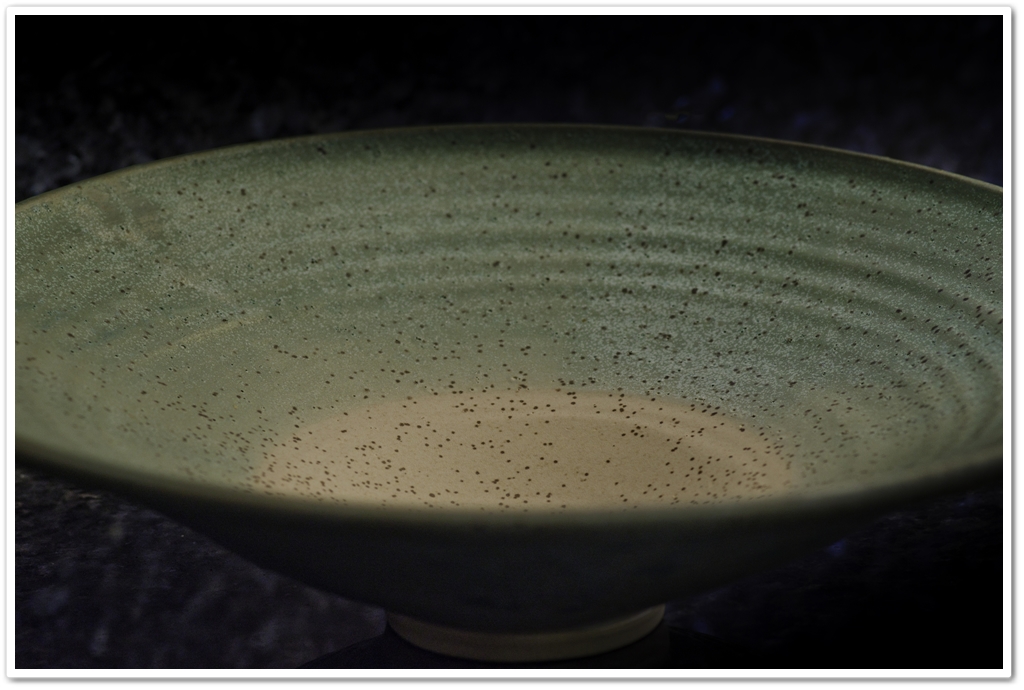
Yesterday a friend who is a potter came over.  I’ve only known her a short time, but she is one of those people you like the minute you meet, and like even more as time goes by.  She brought some of her work to show me.  For some reason the term “organic” is the only way I can describe her pottery – it is earthy and elegant at the same time, and seems to be perfect for the clay.  I liked what I saw.

The point of the visit was sort of show-and-tell.  You show me yours, I’ll show you mine.     She wanted to learn about sumi-e and brush work so she can apply it to her pottery.  For me, this was a much-needed diversion from the technology of photography and post-processing software.  It also motivated me to dig out a rather large supply of brushes I have from Japan, bought for resale.  And it reminded me of just how peaceful it is to ink up a stone, and take the time to do something with my hands other than pushing around a mouse, doing dishes, or whatever.

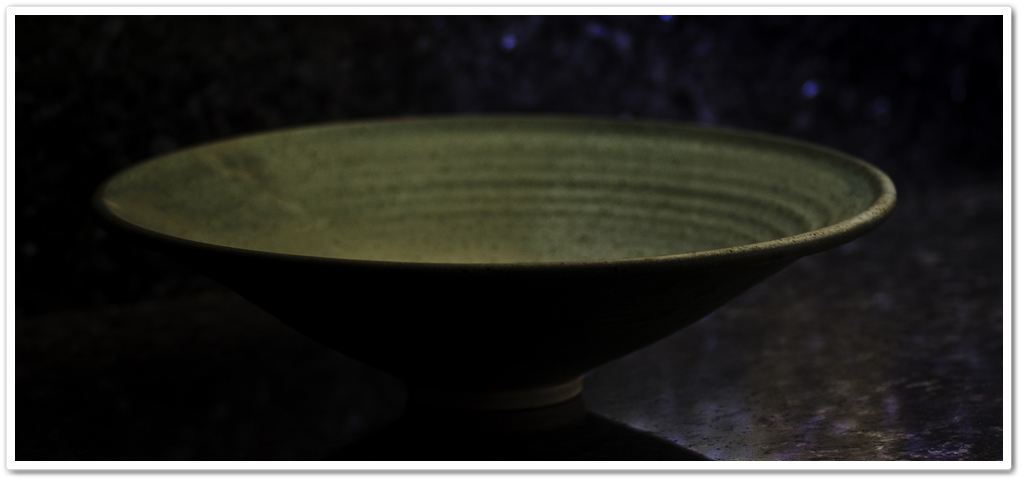
She is a lefty.  The movements I find difficult are easy for her, and vice versa.  Together, we went through a bit of paper, tried out different brushes, and have agreed to do some more of this.  She left with a stone and ink, a mosen, and a package of sulphite paper.  I got a bowl and the reminder to move away from the computer.  Maybe I will make some pottery with her at some time.

Composition: Some Thoughts

Composition is, by definition, the act or process of “arrangement into specific proportion or relation and especially into artistic form.”  This can apply to written and visual arts, and other areas as well.  Composition can be practical, it can be adventurous.  Whatever it is, it is the individual’s sense of design.

One of the most challenging areas of composition is deciding how much is enough?  That will be dependent on a number of things – what are you trying to express?  In the old days, when photography did not exist, detail in Western art was much appreciated.  Being able to capture realistically an object or person was highly prized.  Detail was also valued in Asian art, but differently; scrolls made for a visual adventure, section by section, as can be seen in part of Long Scroll of Sesshu below, unlike the more limited flat surfaces of books.

Besides hand scrolls, multiple scrolls, such as this one presented in the Weng Collection’s catalog, hung side-by-side, created a larger work with individual panels, such as the triptych of Western art.

With photography, realistic and intimate recording of details became possible, and simplification and interpretative exploration began in the visual arts.  Zen in the east influenced ink painting because of its simplicity and focus of the moment in which the painting or calligraphy was produced.

Simplicity may have multiple levels.  A single line or movement may be repeated.  Details can also be within those elements.  For instance, in a garden, a curved walk may be the most dominant visual detail, but within that curve may be found many details, such as rocks or leaves or plants.

Simplicity by itself may fail.  Placement of elements in that simple composition need to be considered.  The most common compositional element discussed in photography is the Rule of Thirds.  If you are unfamiliar with the rule, draw a tic-tac-toe grid:  this is the Rule of Thirds.  Where the lines intersect is where you should consider placing the subject of interest.  Placement of subject in each of those four intersections gives a different energy to each picture.  Using this same precept prevents placement of horizontal or vertical focal subject in the dead center of the picture.

A picture or painting based solely on horizontal and / or vertical elements is tedious.  In this mix something needs to break this up.  Diagonal lines, shapes such as circles or triangles, or curves are compositional elements which add visual interest.  Balancing all of these can create a visually dynamic composition, but too much or wrongly placed, these same elements may destroy an otherwise compelling composition. At the same time, it is also necessary to consider colors, contrast, and scale.  These, too, impact the final image.

How the eye is led to the focal point of the image is key to good composition.  This can be called framing.  In photography, placement of objects in the foreground is common.  Shadows and bright areas are other ways to accomplish the directional sense in a composition.  Combine these with diagonals or curves, and the eye is led along a visual path to the area of interest.  In photography, this can be a bit of a challenge, but with cropping and airbrushing, distractions can be minimalized or removed.  In painting, these elements are far more easily avoided.

In photography, the natural world continually gets in the way.  We have all taken portraits of people with things protruding from their heads.  Painting a portrait, this is much less likely to happen.  Avoiding these distractions can be a challenge, simply because the photographer can be very focused on the subject.  However, as one progresses in understanding composition, these become more than obvious, and easier to avoid.  What is more subtle is an awareness of color.  For example, a person in a blue jacket against a background similar in shade (degree of blackening) or color may be more difficult to assess.  Similarity in color is called a merger. This is where an understanding of contrast is important.

Contrast may be high or low.  High contrast images display few shades of grey; low contrast studies contain many.  If you are not sure about this, take a color photo or paint a picture, and then change it to black and white in your photo editing software.  It becomes much more apparent when you do this.  Short scale / high contrast subjects can be very dynamic, and often this is more easily seen than the subtleties of long scale / low contrast subjects.  Long scale subject matter can be very beautiful, but if there is a lack of adequate contrast compositionally and in adjacent areas, a weak picture may result.

* * *

In the four weeks since I started my photography class, my sense of framing a photograph has changed, as has my sense of color and composition.  More than anything, though, I have become more aware of light and shadow.  I’ve always liked the shimmering of light through leaves – as much as I love the rustling sounds – but now I find myself looking at shadows in general.  Our next assignment is to use light – flash, strobe, whatever – in different ways, such as diffusing it or bouncing it or reflecting it.  Of course, YouTube comes to the rescue on that note!

This short course has shifted my perceptions, and I am looking forward to seeing how it plays out in sumi-e.  Today, my studio will lose its tenant, and I am looking forward to some quiet and privacy and being able to use my space again.  My brushes and ink await.

Hirokazu Kosaka

Hirokazu Kosaka made a series of four videos, all of which are readily available on the different video services.  These videos are particularly interesting to me because of their content:  the Japanese brush, and calligraphy.  

A brief biography of Kosaka can be found at the Montalvo Arts Center, which has this to say about him:

Born in Wakayama, Japan in 1948, Hirokazu Kosaka now lives and works in Los Angeles, where he serves as Visual Arts Director at the Japanese American Cultural and Community Center. As a student at the Chouinard Art Institute, where he graduated with a BFA in painting in 1970, Kosaka began to explore the art of performance, looking toward artists such as Wolfgang Stoerchle, Allen Ruppersberg, William Leavitt and Chris Burden for inspiration. As a young artist, Kosaka also began to incorporate Eastern traditions in his art, drawing from his appreciation of the centuries-old traditions of Noh drama and Kabuki theater, his knowledge of the ground-breaking experimental art of Japan’s Gutai Group in the mid-1960s, as well as his own experience with Buddhist chanting and Zen archery.

Today, Kosaka is known for his large-scale, performative pieces, which often use publicly accessible space as a platform for dance, performance, and visual art practice. Kosaka’s work has been seen and performed at venues including the Museum of Contemporary Art, Los Angeles; the Japanese American Theatre, Los Angeles; the J. Paul Getty Center; the Seattle Art Museum; and the Indianapolis Art Museum. Selected grants and awards include a Creative Capital grant, a Rockefeller Foundation grant,  a California Arts grant, and a Los Angeles Endowment for the Arts grant.

In 1973, Kosaka returned to Japan where he completed a three-month long performance piece called “Soleares” and later embarked upon a traditional 1,000-mile Zen pilgrimage called “The 88 Temples.” After completing this spiritual journey, Kosaka remained at a Buddhist monastery and was ordained as a Shigon Buddhist priest. He later returned to Los Angeles where he began to create large-scale, process-oriented artworks infused with the teachings he learned as a priest.

The Alliance for California Traditional Arts writes this about him:

Dating back to the 11th century, Japanese Kyudo – or archery, literally meaning “way of the bow” – has been used as an art of purification in ceremonies within the Imperial Court of Japan and within Zen Buddhism. Practitioners of this ceremonial and contemplative form focus on attaining “the perfect shot.” In order to accomplish the perfect shot, one must have immediate action without any intervening thoughts; this entails proper form, physique, patience, and dedication.

Reverend Hirokazu Kosaka can trace Kyudo in his family’s lineage back multiple generations, and often responds “300 years” when asked how long he has studied the art. His father began teaching Kosaka when he was 10 years old, just as his grandfather taught Kosaka’s father, as was done in previous generations. Kosaka says, “My art, and therefore my life, is the result of centuries of ‘spiritual mutation,’ the manifestation of my experience with Kyudo.”

In 2009, Hirokazu participated in ACTA’s Apprenticeship Program with apprentice Ferris Smith. The apprenticeship deepened Ferris’ training in form, patience, and the historical pursuit and endless search for the perfect shot.

Interestingly, Kosaka does not seem to have a personal web page, and so in a way he becomes an elusive figure.  Searching for him on Google, it becomes clear that this is a man who is creative in ways not traditionally recognized, and his art is experiential to a great degree.  It makes the search for the evanescent tangible, and should one find a scheduled event, it may be worth the enquiry.  I certainly am curious.