
This is the engine which made travel to the moon possible. Dedicated on 20 July 1979 to the mark the 10th anniversary of the first lunar landing, this site will soon be torn down to make way for apartments, condos, and shopping.

This is the engine which made travel to the moon possible. Dedicated on 20 July 1979 to the mark the 10th anniversary of the first lunar landing, this site will soon be torn down to make way for apartments, condos, and shopping.
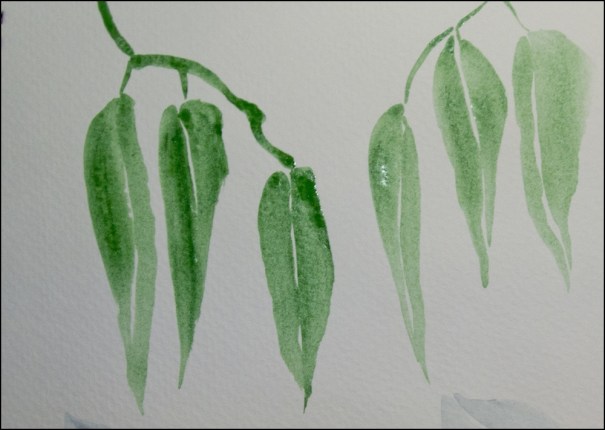
Having been doing sumi-e with some regularity for several years, I am finding it helpful in watercolor. Because the brush is the vehicle for watercolor, as it is in sumi-e, it is important to understand how the brush works.
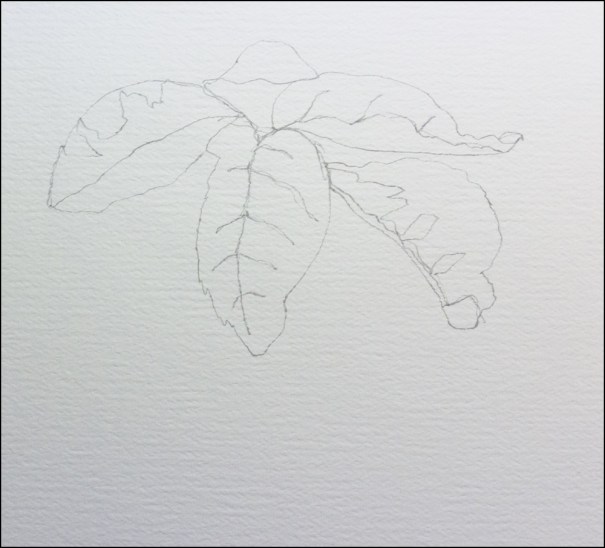
Kolinsky sable watercolor brushes can be considerably stiffer than the white-haired sheep brush used in sumi-e, but much more flexible than the wolf and horse brushes, which have darker, more stiff bristles. Basically, a western watercolor brush combines both qualities in one brush, but this does not mean that it is the same at all! A good point is important for a Kolinsky round (I am using DaVinci Maestro Series 10s and Escoda Series 1212) just as it is with sumi-e brushes, as is the ability to carry water and color.
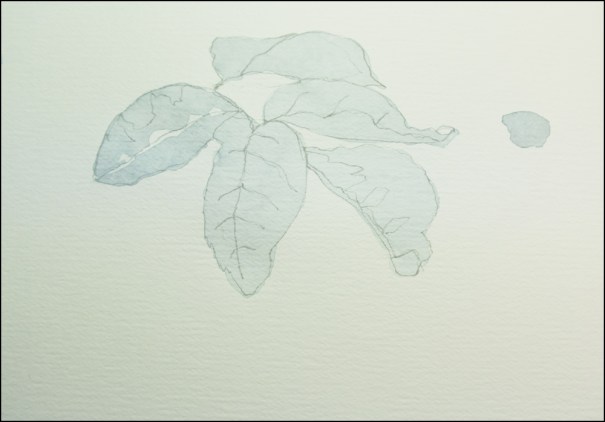
Many of the same techniques used in sumi-e can be applied to watercolor. These include brush strokes, such as increasing and decreasing pressure to change line thickness. Two or more colors may be applied to a brush, as in sumi-e when different ink intensities are applied. In Western watercolor, a brush stroke may be modified, working wet-into-wet, wet-into-dry, dry-into-wet, and glazing or layering colors. This does not work well in sumi-e, unless one is doing fine line Chinese painting.
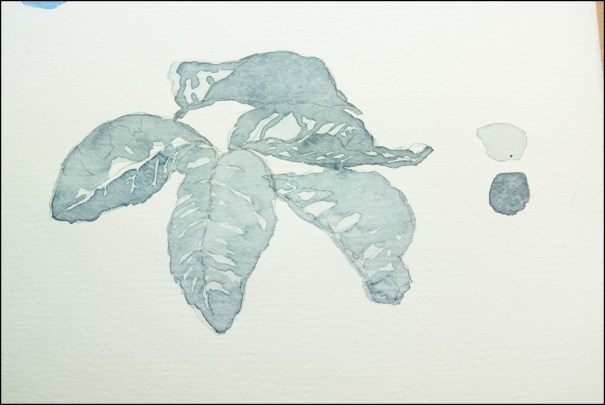
The major differences between sumi-e and western watercolor are responsiveness of paper. Japanese and Chinese painting papers are generally much more porous than traditional Western watercolor papers. Heavily sized Asian papers are used for fine line painting, where color layers are used, and bleeding of ink, so characteristic in sumi-e, does not occur. Western watercolor papers will vary in the amount of sizing used, and this, in turn, affects the absorbent qualities of the paper. Knowing how a paper responds takes time and practice, whether in Asian painting, or Western.
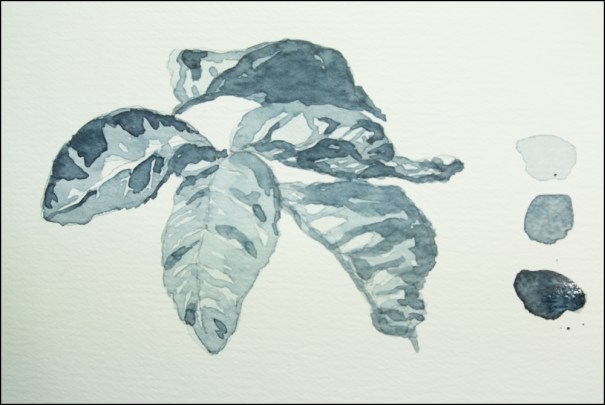
Value in sumi-e is achieved in how the brush is loaded. Ink can be very pale, and while it is still damp, darker ink may be applied to good effect. A sumi brush can also be loaded with pale ink, then a medium ink, and finally a tip or dark, or even one edge of the brush in dark ink. The stroke of the brush creates all the gradations. In watercolor, value is achieved by layering, as well as working wet-into-wet. Layering, also known as glazing, is the application of wet paint on a previously painted layer which has dried. Glazes are also built up light to dark. Wet-into-wet can be sopping wet, or in varying degrees of dampness. In some ways, wet-into-wet requires more self-discipline than glazing, which requires patience and forethought.
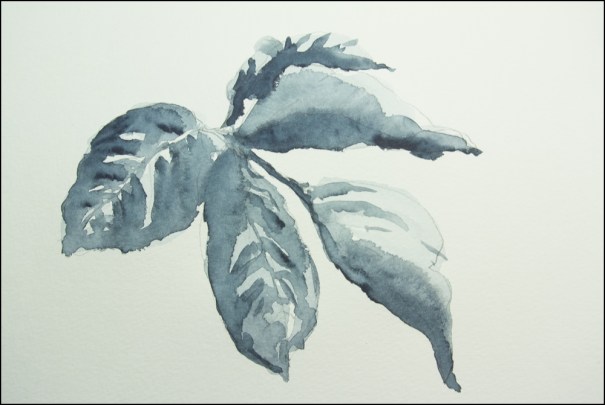
Each painting technique, sumi-e and watercolor, have similar techniques, as well as some which are exclusive to that medium. The key is to learn from both, and to master each.
All these paintings were based on demonstrations from Linda Stevens Moyer’s book LIght Up Your Watercolors Layer by Layer.

New growth!
This is a particularly lovely little tree in the Japanese section of the Gardens of the World. The bark is multicolored and has an interesting texture. Viewed from different vantage points, and at different times of the day, the little tree glows with colors.

In the lower elevations, the poppies are beginning to bloom. Always a sign of spring in California!
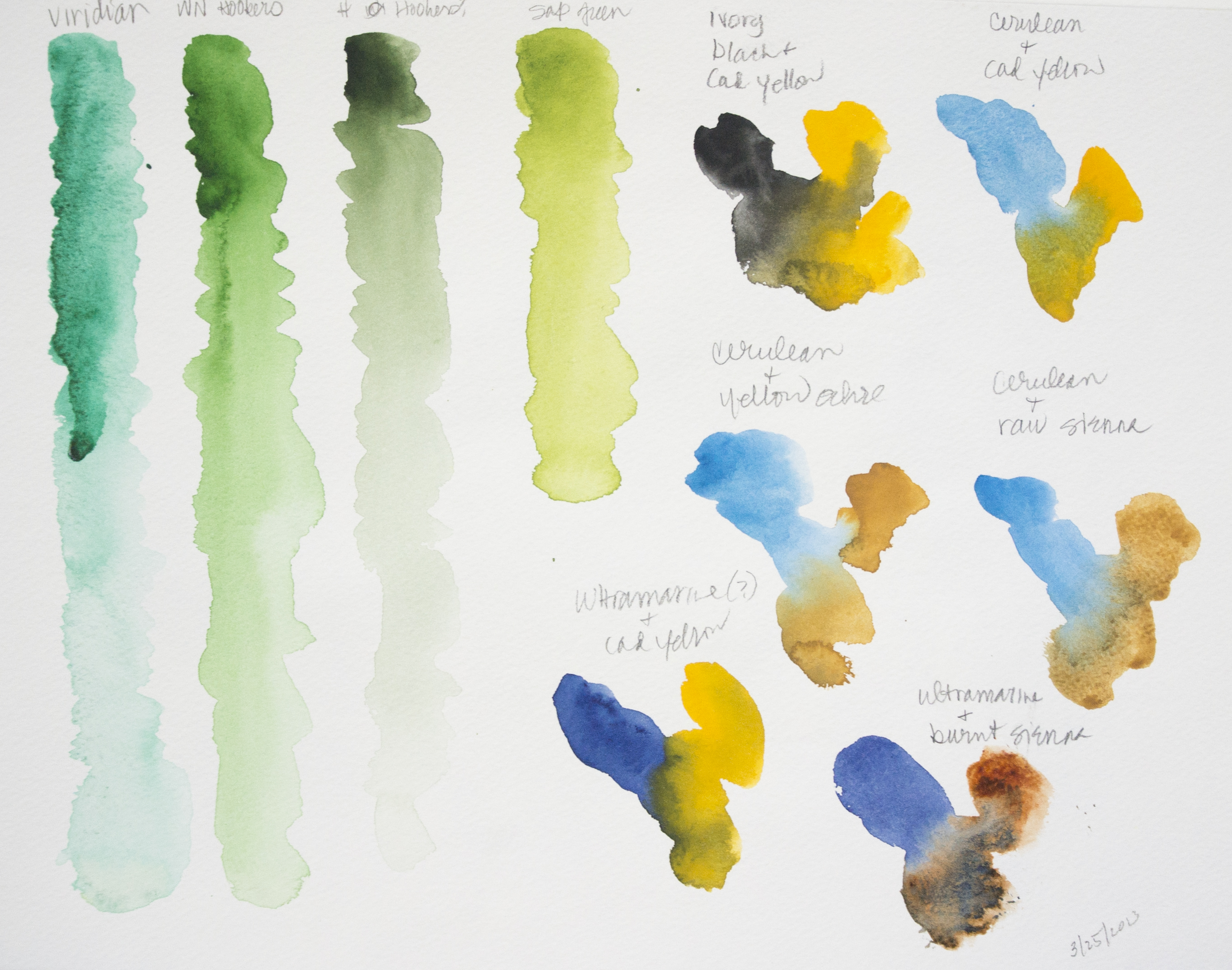
Green is one of my eternally favorite colors. In my opinion, most mixed greens lack greeness, if that makes any sense. The best greens are already made, and then modified with other colors, such as the addition of more yellow or blue, or even red. The clarity of viridian, Hooker’s, and sap just have a lot to offer.
Traditional greens are mixed from yellow and blue, and in watercolor, you can use cerulean and cadmium yellow, burnt sienna and ultramarine, and all other yellow-blue combos. Some pigments are more “settling” than others, which can be more transparent, and this will affect the final color quality.
Maybe I just need to work on mixing them more . . . but can you really get such a clear green as sap?
 Ink, Yarn & Beer