For the past month, every Sunday, I have been taking a beginning quilting class from 1 to 4 pm. It’s like boot camp! The teacher is detail oriented, explains the whys and wherefores, and is perfect. At this point, we beginners are “piecers” and not quilters. No quilting in this session – to be continued in 2019.
I have been sewing forever, since about 10 or 11, and now that I am closing in on retirement, you can guess that I have been doing it for awhile. However, quilting is different in some ways. No backstitching. Precision seaming. Scant 1/4 inch seams. How do my points look? (Those are where the points of square or triangle meet another piece – are they pointed, blunted, exposed?) Every time you make a seam, you iron – press the piece flat, open the seam. Then move on.
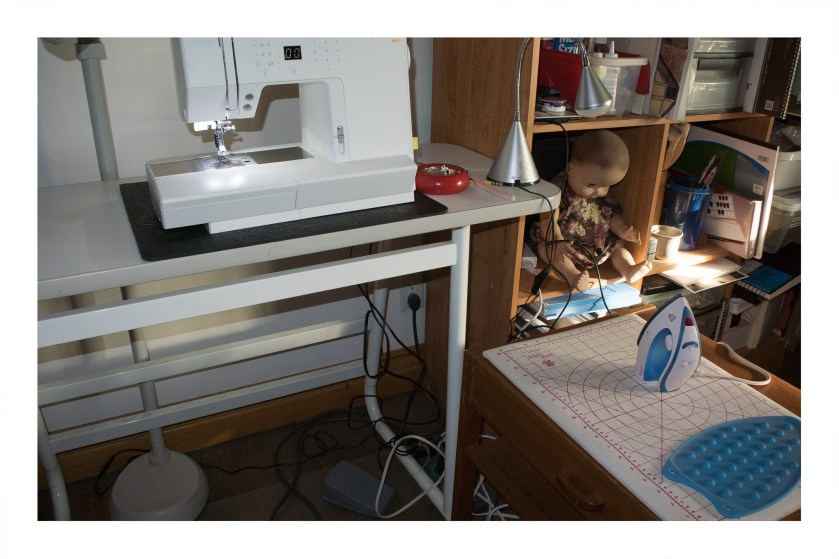
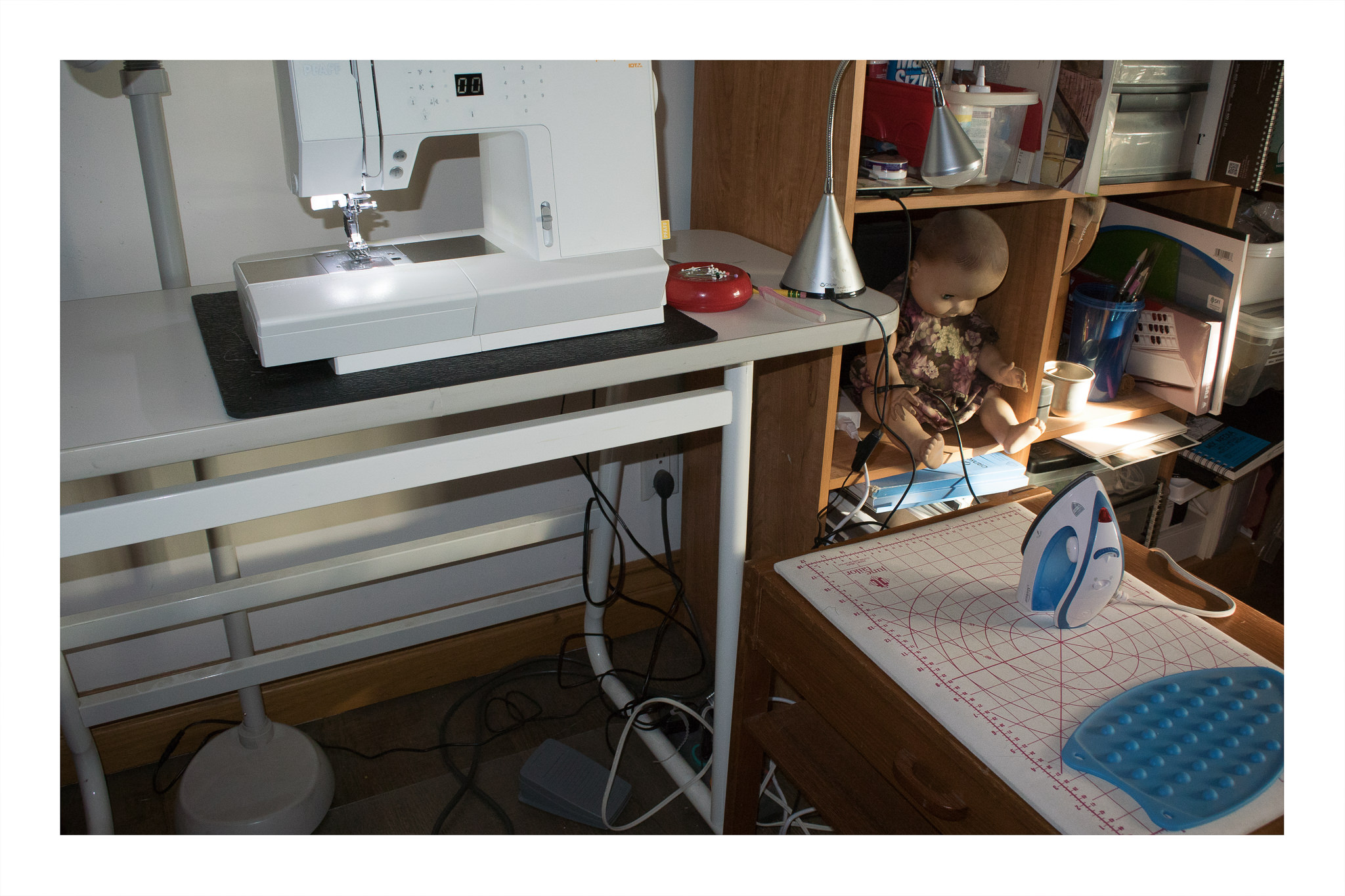
In the picture above, you can see that I have set up a small pressing station next to me. This keeps me from getting up and down with each seam. Many people do this. The little iron is really nice – and really inexpensive, too! It’s a “Hot to Trot” mini iron by Sunbeam, with a mini price of $12.99 at Target or on Amazon. It heats up quickly, has steam, has steam bursts, and is comfortable in the hand. The ironing pad is also a cutting board on the other side, but I find it easier to walk over to the drafting table if I need to cut anything (first picture).
The pattern itself is filled with lessons. To read a quilt pattern requires a bit of work, and a poorly written pattern will kill your enthusiasm very quickly. This one was written by the teacher, Becky, and she’s done a really good job. Her being the teacher, she knows this pattern. Last week, I had sewn a couple of pieces wrong – in just a glance, she said, “You need to fix that!” I think I am so – sew? – lucky to have an exacting and knowledgeable instructor. This is really important as I have been to a few other quilting classes and they have all left me very disappointed. While I don’t see myself becoming an obsessive quilter like some people, I know that I am going to walk away with an appreciation of quilting and a new sewing skillset.
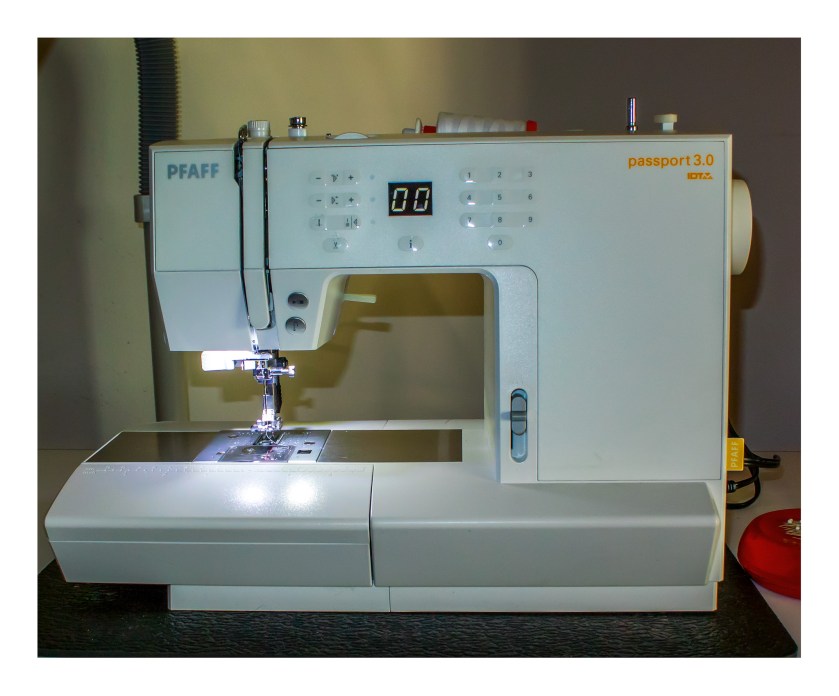
Finally, as a birthday present, I was given a lightweight, take-to-class sewing machine by the best guy in the world, mi esposo Josh. I’ve had a bit of a love-hate relationship with the machine, partly because of problems with a foot being made of a flexing, flimsy plastic (which the dealer replaced with a metal foot – much nicer – love goes up, hate goes down), but also because I am learning a new skill with a new machine. This is a Pfaff Passport 3.0, weighing in at less than 15 lbs. Considering one of my machines is a 50 pounder, a portable, class machine is necessary. This machine was made for portability, and in that arena I really like it. In the big picture, I think this machine is a keeper. If I need to have more harp space – the area between the needle and the right hand part of the machine – I can always use a bigger machine. For the quilting, I may bring in my Janome 6500 as it is more powerful, has a quilting table, and more harp space.
Finally, the quilt itself. In class I completed the center square, and then one of the 3 different squares which will surround the center. I need to complete all 12 squares – 3 different patterns – by next Sunday. That is when we start working on the borders, which consist of strips and squares. I think we will also begin on “squaring the quilt” – when you make your quilt an even shape. Or, that may be the final class. The center square is fairly large, and the other squares will surround it. The center square is below. It is a graphical representation of a flower basket.
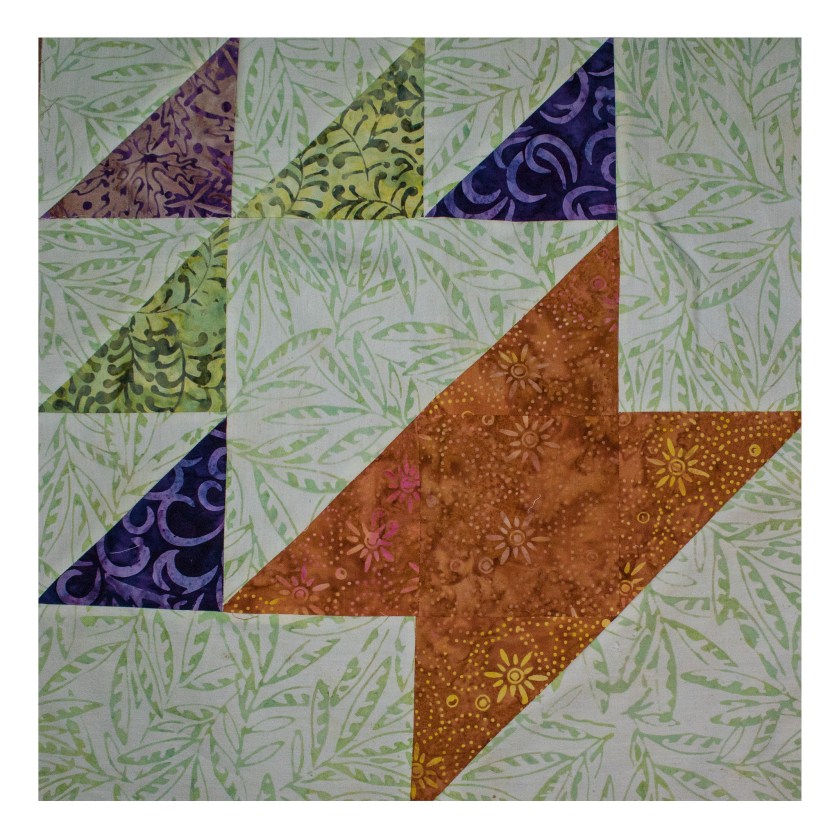
The surrounding squares are all variants of flower baskets. Below is “square 1” of the three. Each square requires 4 renditions of the same square; yesterday I completed all of this square – all 4 of them. It took a bit of time.
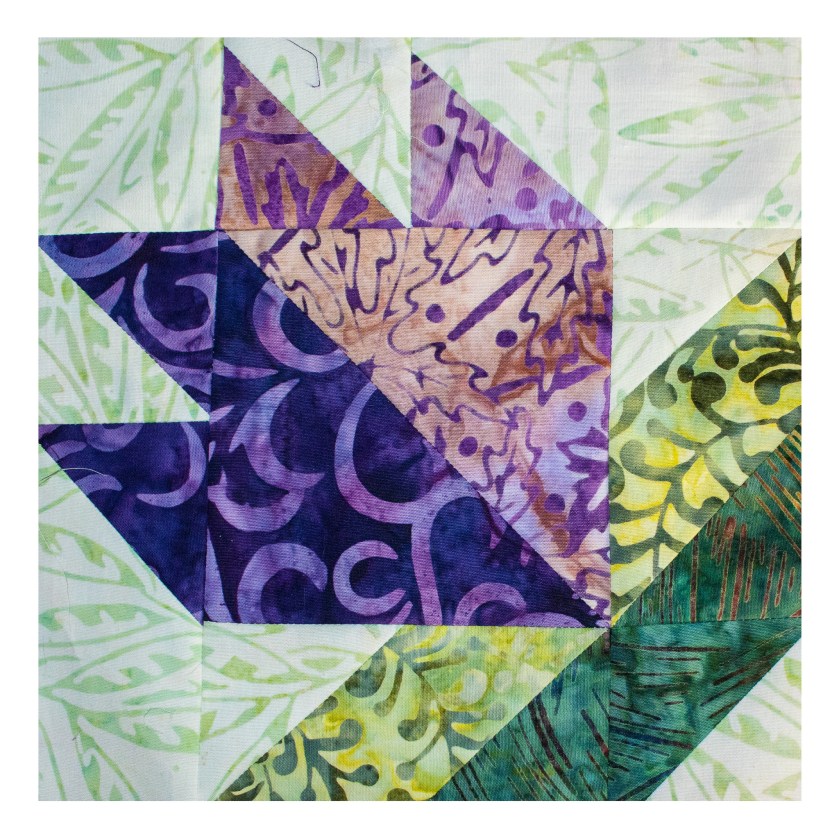 Over the next few days, today included, I will complete the remaining 8 squares. The dog ears will be trimmed. Fortunately, I have cut out all the pieces for the entire quilt – except the border – and placed each one in a baggy, each piece labeled in size and for which square. These are the details Becky has been so good with! It would be all to easy to get lost in colors, shapes, sizes, and so on.
Okay, time for breakfast, and then on to sewing! To be continued . . .