As the World Turns . . .

In today’s world, change and upheaval seem to be the norm. Stability is something we want but eludes us. I think this interview with Bertrand Russell, done in 1952, says a great deal.

And from thoughtco.com, some quotes on history:

Voltaire
“History is only the register of crimes and misfortunes.”

Napoleon Bonaparte
“What is history but a fable agreed upon?”

Karl Marx
“History repeats itself, first as tragedy, second as farce.”

Winston Churchill
“History is written by the victors.”

Thomas Jefferson
“I like the dreams of the future better than the history of the past.”

John Maynard Keynes
“Ideas shape the course of history.”

William Shakespeare
“There is a history in all men’s lives.”

Mark Twain
“The very ink with which history is written is merely fluid prejudice.”

Henry David Thoreau
“It is remarkable how closely the history of the apple tree is connected with that of man.”

Alexander Smith
“I go into my library and all history unrolls before me.”

Robert Heinlein
“A generation which ignores history has no past and no future.”

Marshall McLuhan
“Only the vanquished remember history.”

Mohandas Gandhi
“A small body of determined spirits fired by an unquenchable faith in their mission can alter the course of history.”

Stephen Covey
“Live out of your imagination, not your history.”

Martin Luther King, Jr.
“We are not makers of history. We are made by history.”

Dwight D. Eisenhower
“Things have never been more like the way they are today in history.”

On to “Brushwork”!

A few months ago I joined Ian Roberts’ online class “Mastering Composition.” First several weeks were simply drawing exercises, learning about values and shapes to create a 3D effect on the flat surface of paper. Two weeks ago we began the “Brushwork” component. I decided to use oils for this section simply because I have not painted with oils since high school – back in the last century.

What I like about Roberts’ class is he makes sense. He discusses things on very pragmatic terms as well as on a bit of a more esoteric plane. Both are satisfying. Exercises are clear and with stated purpose. The key components thus far are values and edges. He says, “If you can’t see it, you can’t paint it.” And that is true. If you don’t look and observe and get picky, well, it’s just not there.

Week One

Simple value studies of a landscape. I did 4, in 4 different mediums in order to decide which I wanted to default to – I chose oils (see above).

Watercolor
Gouache
Acrylic
Oils

I won’t say any of them are great, but by posting them, fellow students give feedback. It’s useful as others see what you do not. As well, it is also useful to give feedback as it sharpens your eyes.

Week Two

Now, onto still life, demonstrated by Roberts and then practiced by students. This was followed by a landscape. The still life focused on edges and values – and so does the landscape. The landscape is ours alone to do – no demo! I tried to make my landscape simple masses. Parts work, parts are illogical, and taking a photograph of both was a pain as they are both still wet. Oh, well.

Still Life in Oils

This was a fun study, and it was a challenge to really take the time to look, and to see, edges, shadows, shapes, etc. Overall, I am pleased with it. My sphere is a bit on the floating side, but I can fix that later. As well, it is fairly bright but monitors make it look darker or lighter, depending on which one I am using.

Landscape in Oils

This one is a challenge. It is wet and hell to photograph! One thing I have learned is that I will need to come back with a fine brush after it has dried to clean up some of the whites on the guardrails and perhaps elsewhere.

Thoughts

By far, this is the best online course I have ever taken! If you want to paint and learn a few things, you might check out Ian Roberts. He is on YouTube, so how he is there is how he is in the Zoom class meetings.

Stay tuned for Week Three and Week Four!

By the Water

I am taking an online watercolor class, and I am sort of this way, that way about it. There is feedback and some great videos, but I find that I like to have a more personal contact than such. Another online class I am taking has weekly Zoom meetings and even though we aren’t all yacking with the instructor, it is more personal.

Anyway, despite what I would like to see different, there is a lot of value in pursuing online learning. To a degree, you have to motivate yourself. You have to have the discipline to do it. One thing that I do find especially hard in all my classes is the making of value studies – oh, how I hate them! I don’t have them as part of my routine when it comes to painting, and the discipline of doing them is what I hate. I expect that doing them will pay off in the future – but it may be a bit down the road as I force myself to do them without appreciating what I know they are supposed to provide.

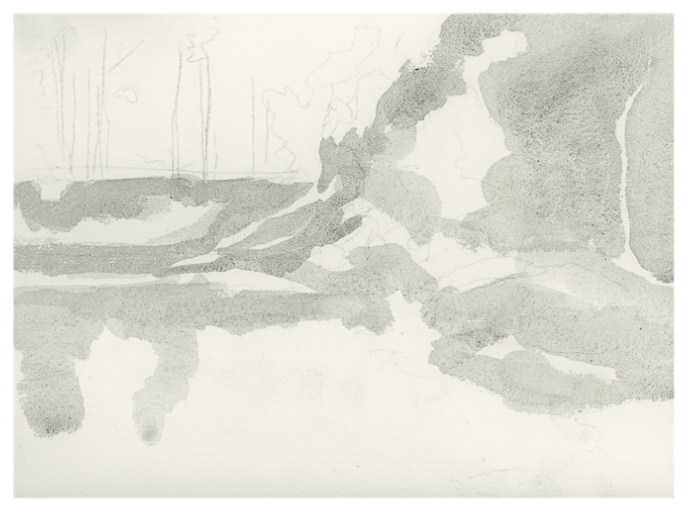
Above, a study from a photo in my watercolor class. Below is the first value study showing the midtones

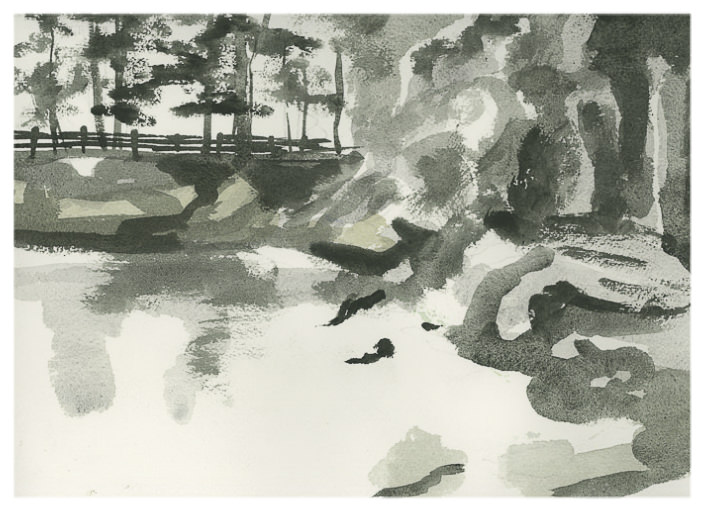
All the white area is supposed to be sky and the lightest areas of the picture. The grey is the middle value. These are used to help shape the painting before refinement with darks and details. Below is my dark-added value study.

I actually really think this idea of doing middle values for the first step of a value study is a good idea. Do these values first, paint your lights and mid values in color, and then move on to the darker ones in the value study and the final painting. Doing this is very nice, really, because the dark values and details get distracting.

Like I said, this is a thing I am not enjoying doing but know it is probably going to reap bigger rewards than I can imagine at present. Values and edges are what I am trying to see in anything I do.