
Negative Painting

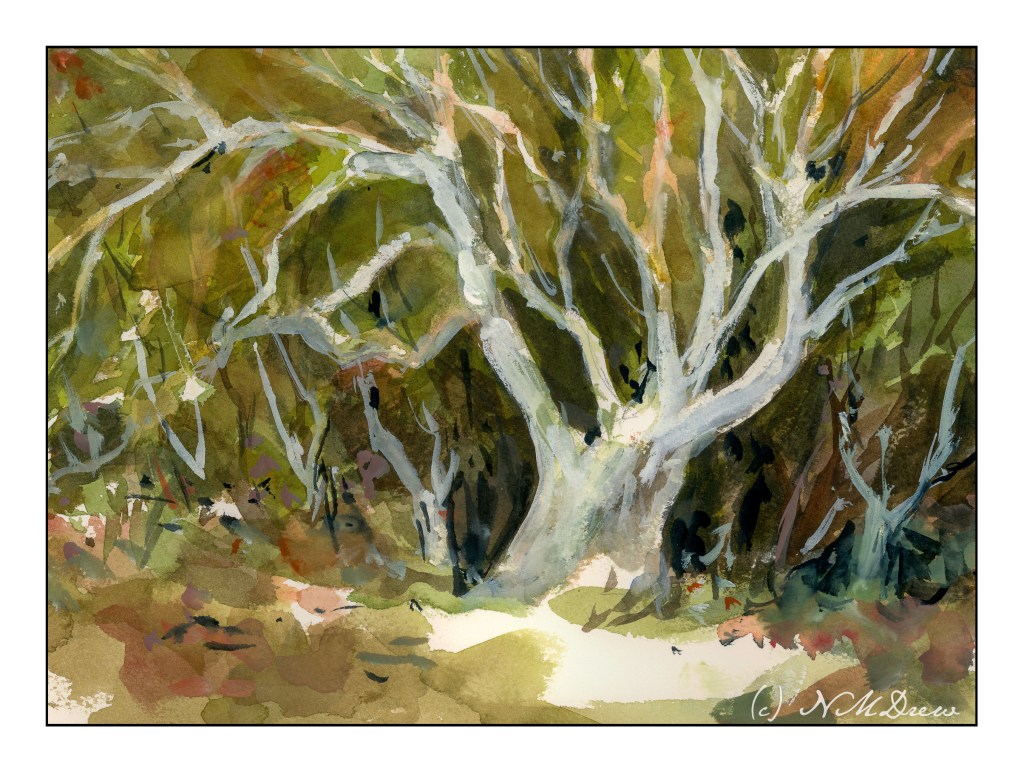
Negative painting is painting around a shape. Positive painting is painting an actual shape. The first is hard to do. The second less so, but the skill of negative painting is necessary and can produce some pretty dramatic results. It is also a skill if you don’t want to use liquid frisket to block off areas to keep white. Positive painting sounds easy, but it ain’t. (My flower paintings are evidence of this!)

A common exercise to show the learner how to do negative space is to paint a tree, paint around it in a light wash, draw another tree on the colored wash, and then paint around this, until you have a lot of trees ranging from white to the varying values of the wash. Sterling Edwards has a lengthy but very good video about this method:

While I know about negative painting, and have stated it as one of my goals, along with flowers (which benefit from the skill of negative painting), I thought this was a good one of the many I watched. What I liked was how he blends his paint inward.

Anyway, I did trees. Rick Surowicz is also a master at negative painting, and if you look at Edwards’ paintings, and those of Surowwicz, you will see both apply the same techniques. In my painting, I used Arches 140# CP, 9×12. I outlined the tree, and then painted around it. At some point I was frustrated and decided to do some painting with white gouache, on both the primary tree and then adding others.

Overall, I rather like the effect, particularly after adding the gouache. I think it enhanced the painting rather than making it just another annoying experience! I used to be quite rigid about not using gouache, much less gel pens or diluted acrylics in my watercolors, but rules exist to be broken, and I expect purists would call this “mixed media” – but that no longer bothers me as much as it used to. Watercolors they are (water soluble), so watercolors these remain.
Tomato Season!

We can all agree that homegrown tomatoes are the best! I also have some lettuces.

Even with water restrictions in place, we are able to do some gardening. The drip system is working well in the front yard. This weekend we will install the emitters on the patio plants. Not all will get water as some are at the end of their lives. We also need to decide how much water to give each pot.

Yay! Tomatoes!

A Bowl of Roses

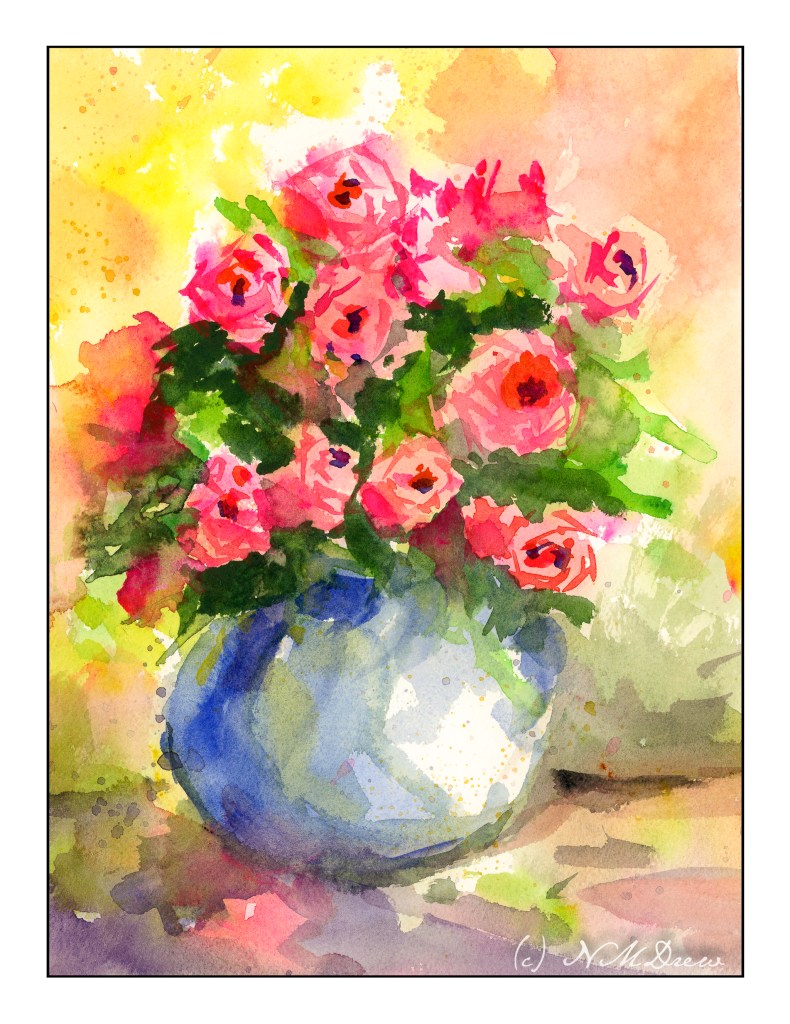
The above study was fun to do, but I had a lot of help in the form of (what else?) a YouTube video. Videos are such good ways to see what a person does, and how they paint. To me, watching the methods an artist goes about accomplishing something is one of the biggest ways to learn.

The video I used was one by a YouTuber called “Draw with Shiba.” There are a lot of good videos on his channel, and none of them are so difficult you cannot learn something. As my goal is flowers I found this video of his quite helpful.

Our images sort of match, sort of don’t. His paper seems to hold on to water more than mine does (Arches) so he can lift color from the sides of the roses. He also begins with a lot of wet-in-wet. In this video, he wets the paper entirely with a brush before he paints, and then drops in color so it blurs into all the major areas of the paintings. In other videos he simply drops water droplets onto his paper, thus controlling areas as he disperses the water with his brush. He paints, flat, too, from what I can see.

Overall, I enjoyed this video. The flowers are roses (thumbs up there!), the vase is simple, and the entire painting covers a lot of techniques. I liked the way in which he lifted the paint and painted the roses. I learned a bit and produced a painting that doesn’t make me cringe. I tried to apply a lot of the techniques here to my flower flop of yesterday, and some worked, some did not, but that is life. Live to paint another day!

Flower Flop

For the next several weeks I have decided to focus on watercolors, except for the remaining few sessions of my oil / acrylic class. The reason for this is we will be out and about, traveling across country by car, and watercolor is the most transportable art medium I can bring with me.

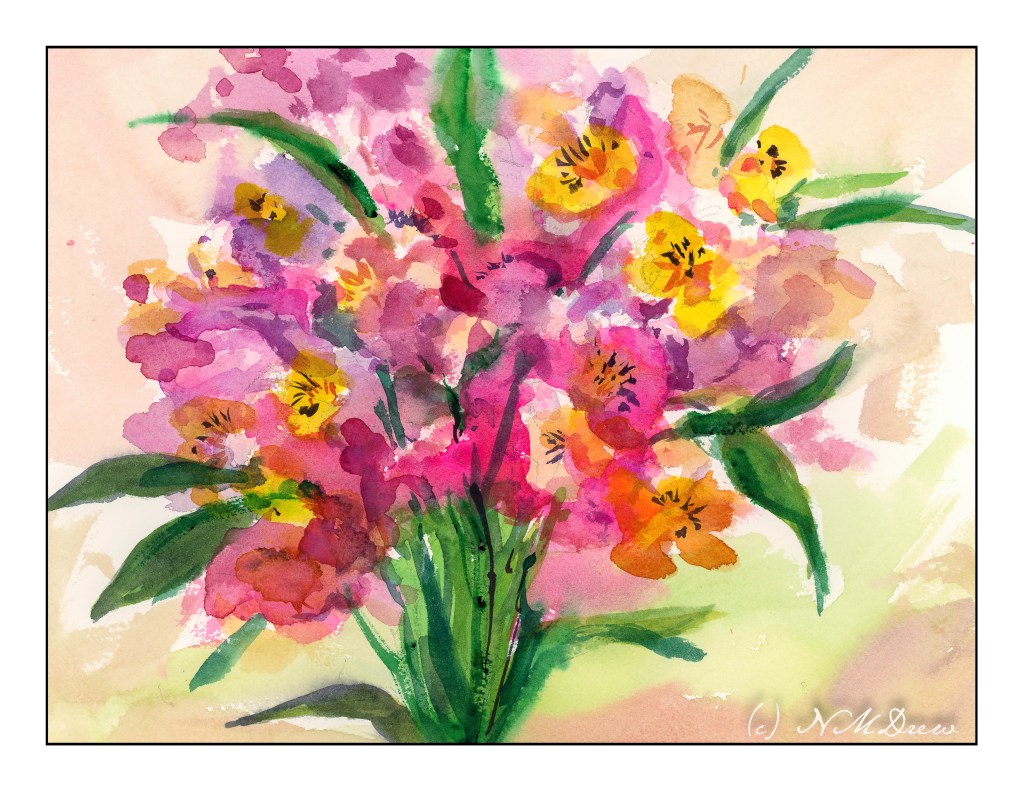
Two areas in watercolor are foremost in my mind at present. One is negative painting. The other is flowers.

Like anything, you need to practice. Here, an attempt at negative painting, and painting flowers. While not creating mud, I definitely need to simplify what I am doing and figure out how to do it. Supposedly these are alstroemeria, but not sure it anyone would think that is what they are!

I’ll just make the statement a few areas of negative painting worked and leave it at that!

Coastal Fog, Morning

I am trying to lighten up my handling of watercolor. Very often my colors are far more intense than I really want. I think part of this is the result of impatience and perhaps pre-cataract surgery days. Watercolor itself lends itself to a delicacy other media lack, I think, and to not play into the wetness and what it can do perhaps defeats watercolor’s beauty.

There is something about fog and early morning that always fascinates me. The idea that a cloud is on the ground (my father’s description of fog when I was about 5) still intrigues me. After all, clouds are UP!

So, a morning along the coast. Wet, soft, blurry, and giving way to a sunny, summer day.

Arches CP 140#, 9×12, watercolor.