
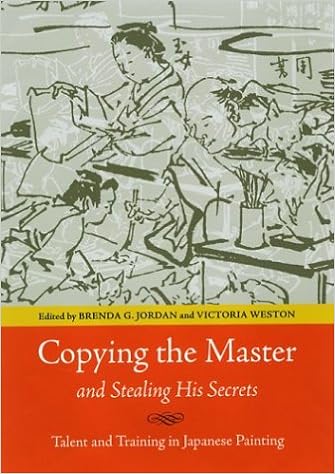
This book remains a favorite of mine, in part because of the history behind art apprenticeships, but also because it serves to remind that in all arts, a period of apprenticeship – with or without a teacher – is needed to gain mastery. As I struggle with watercolor, I remember how I struggled when I was working with sumi ink. In sumi-e, the brushes, ink, and paper are enough to make you scream. Watercolor is perhaps worse!
What makes watercolor difficult? For me, it is always a matter of less being more. With colors, I am a magpie – all those colors! I am hard-pressed to use only a few. With sumi-e, you have one color: black. And shades of grey (50 if you want). Another struggle is to not create mud. I seem to be moving away from that. And finally, lines. I like lines. However, I want to paint without lines . . . sort of like giving up training wheels on a bicycle.
At some point, I expect I will be able to master watercolor far more than I am now, but it is a long, hard haul. And, I admit, one I am not very happy doing. I wasn’t happy with the struggles with sumi-e, either.
Finding a master is not something easily done in this day and age. Rather than being apprenticed to learn a skill or craft from a master, many of us go to school. I am way past spending 4 years or more in college – I am an old workhorse – so I learn by observation. This means finding an artist I admire and trying to copy his / her work, as well as subscribing to numerous YouTube videos. I also have to learn by doing, which is the most challenging part. A part of me expects to be perfect, and my temper flares when I feel frustrated. That is when it is time for the proverbial deep breath, retreat, regroup, refocus, retry. Patience is also taught with such apprenticeships!
Thus, in cruising the internet, yes, I do “steal” from the master. In “stealing,” I learn about color and composition, light and dark, contrast. I do not ever intend to pass someone’s work off as my own – that is not right. But, if you go to a museum, you will find people sketching the work of a master. Why? To learn. The best learning is by doing.
Various painters come to mind whose work I enjoy; when I find someone whose work I admire, I like to look at their paintings and try to figure out how they did it, the order it was done, and the colors used. By copying I learn about color mixing and how to create an image that (might) work. Every artist is unique, and each has something to offer. There is a lot to learn from out there, and I am humbled by the talent I see. And I learn when I copy from the masters.
 Ink, Yarn & Beer