Red Building on the Pier

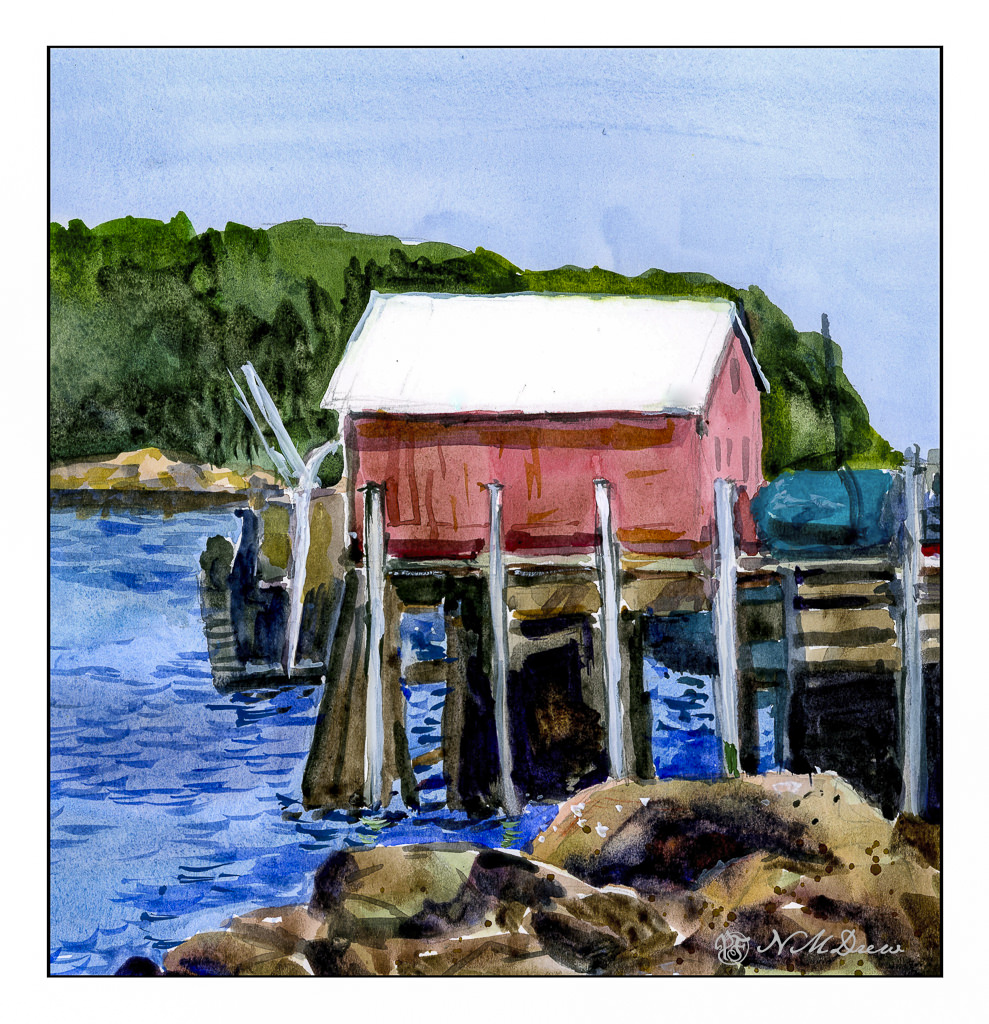
After playing around with the Strathmore Vision watercolor paper, I used it for today’s painting. Knowing its strength lies in painting directly on it with little to no lifting or scrubbing, I had to reset my thinking for this painting.

First, I did a pencil sketch on the paper, working to get proportions and placement of the bits and pieces in fairly good proportion to each other. From there, I worked as directly as possible to get values and colors the way I wanted them. I moved around the paper, too, laying in big washes and areas of color before adding detail.

First, the foreground rocks. The wash was laid down to get the ranges of tonality and vary the colors within them. Once dried I added the darker areas to create shadows. If you look, you will know the sun is coming from the upper right, and thus shadows will be toward the left.

Next, the sky. It is a very flat sky so I did a wash of a blue mix once I had dampened the paper, carefully working around various shapes. From there, the red of the building on the pier, working around the light uprights. Then, the green of the trees in the distance, being careful about the roof. Finally, the water.

Once all this was dried, the little things began, such as sorting out the supports and boards on the pier, some rock details, and the ripples of darker blue on the water.

This painting took me quite awhile as I tend to splish-splash and be quite impatient. This time around I worked hard to consider the colors and the paint before placing them on the paper. My mind is fried! Still, even though it is not by any means a great watercolor, I do like the way it looks – there is a bit more freshness to it than some of my other ones. I ordered some Sakura Gelly pens in white for better details for more delicate areas – I couldn’t find mine at all.

More watercolors to come, but I am going to use my 100% cotton Arches and try this same approach – more direct and thoughtful. I am curious as to how I will feel about Arches absorbency vs. the Vision. The Vision paper works rather well in this area – a good balance of absorbency without drying out. Surprisingly, even with a fair amount of water, Vision does not buckle as much as Canson XL does, and it seems quite capable of handling water when applied over the entire sheet without a problem.

Both Canson and Vision have problems with lifting color or scrubbing, and in many ways I think continuing the usage of Vision will force me to retrain my painting techniques a bit by requiring patience and forethought.

Brain Training with Negative Painting

No, I don’t mean painting with negative themes or thoughts, but painting around things – but you already knew that!

The normal course of painting, for the major part anyway, is to paint the object you are focused on. Then you paint around it. Most often it works, but for light-colored objects, or flowers, sometimes you just need to paint around the white to keep it white. Paper also can affect negative painting by how well it absorbs water and pigment. 100% cotton watercolor paper is best for this, and its sizing also will affect its absorbency. Cellulose papers, even if heavy, react differently to layers and layers of watercolors and pigments.

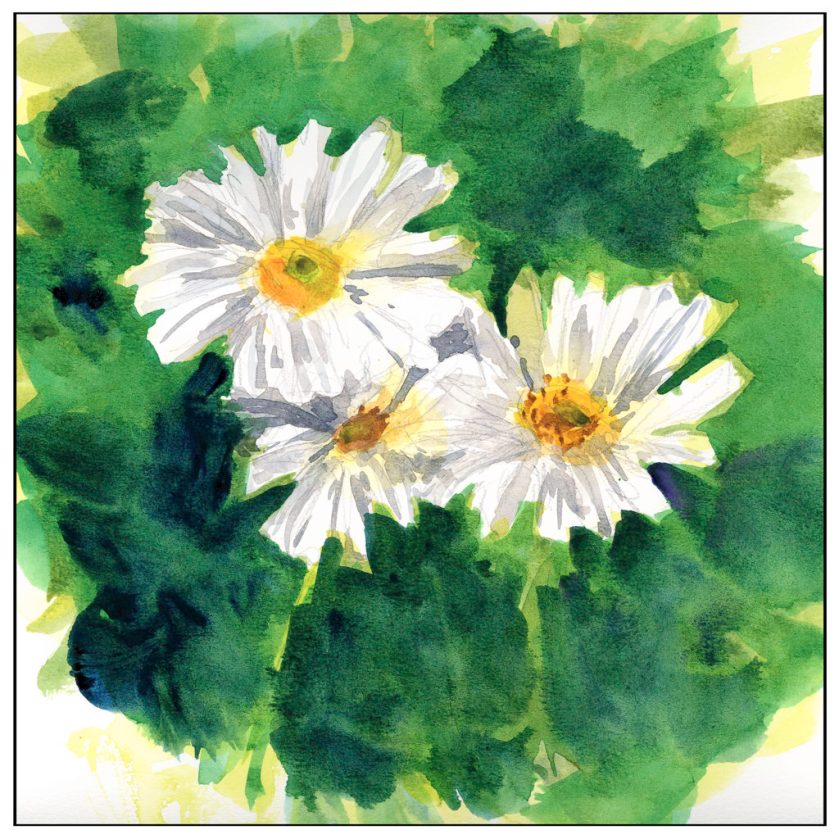
Below is one of my first focused attempts on negative painting. Supposedly these are chamomile flowers, but the fact is they look a lot like any generic daisy. Painted on the cellulose paper, absorbency was an issue, as seen clearly on the flowers. Blending of color was rather forced. However, I could paint around the white of the flower and get crisp edges. The outside green was more difficult; I think if I used water between two green values to soften the edges, blending might have been more successeful.

From this paper I went to 100% cotton Kilimanjaro 140# CP paper, natural tone. Already a difference can be seen and, while painting, felt. Color is easily absorbed and blurs nicely. Layers of color, laid in while wet and dry, still creates a lovelier quality than above. It was far easier to paint the petals with shades of grey and with thin glazes than above since the paper’s response was more absorbent and less resistant to both water and color.

Finally, a painting of yellow lilies – lilies? you ask? Yeah, me, too. Anyway, yellow flowers. I painted the basic shapes of the flowers, then painted around them, and then added what was supposed to add character and depth to the flowers, and then back to the back ground, and then back to the flowers, and so on. As a flower painting it is nothing great, but it was good practice for negative painting. I worked at shapes more than anything – the shape the yellows create as well as the greens and darks outside and in between the flowers themselves. This, too, was on the Kilimanjaro paper, and it shows.

The cellulose paper fails when it comes to lots of washes, but for more direct painting it works pretty well. For lots of water and color, as with the two on the Kilimanjaro, the cotton paper is far better. The frustration level with the cellulose paper is certainly there as I had to pick up drops of water and spend a lot of time with the hair dryer so I could move on to the next wash or glaze. With the Kilimanjaro, only when I wanted a totally dry sheet to paint upon, to add glazes or more paint or another layer of clean water, did I need to use the hair dryer.

So, more painting and focus. Not great, but it is in the doing and the play the learning is done.

Paper & Hyacinths (or Gladioli?!)

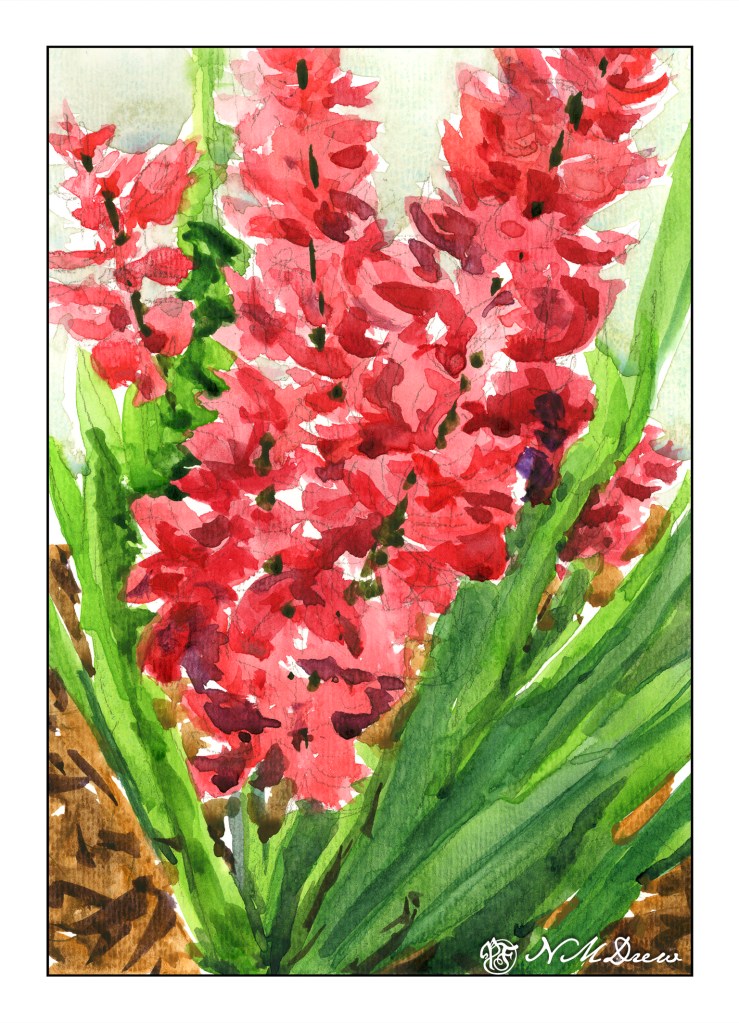
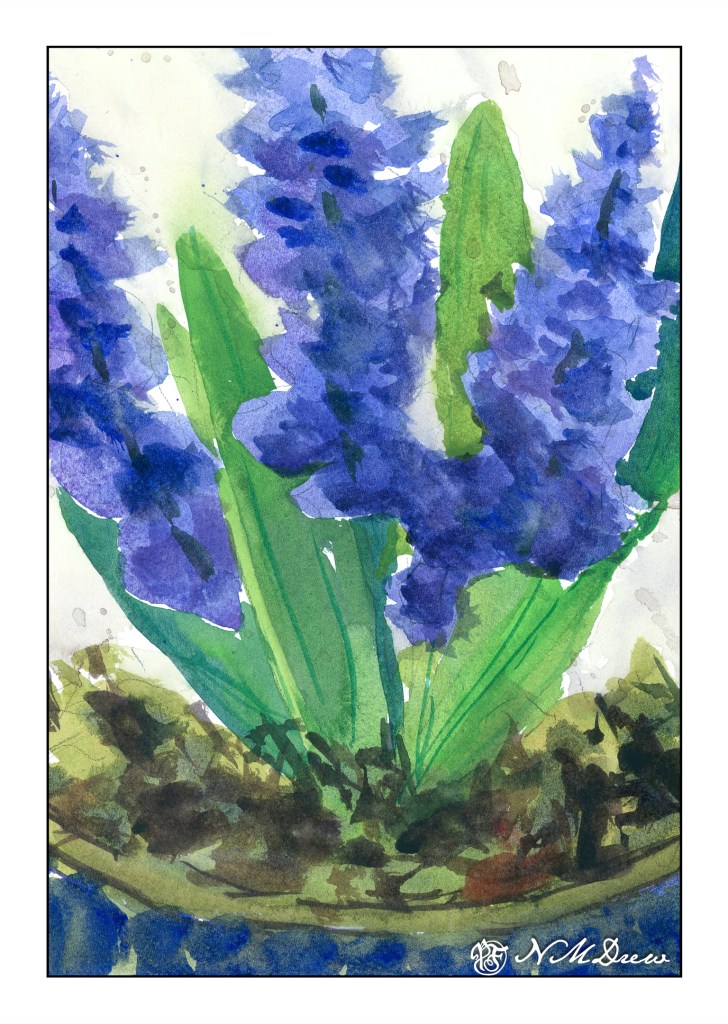
These paintings serve two purposes. First is to check out two different 100% cotton papers and decide which has a better feel to it when it comes to handling copious amounts of water. Second is to take a color on a long journey down a sheet of paper, adding similar colors for variety as I go along. I did it in both.

This is done on ArtBeek paper. I consider it to be a student grade paper even though it is 100% cotton. I like it as it has a nice absorbency but it is not up to snuff to my preferences. It is good for studies, though, and a very affordable and nice paper. I prefer it to Strathmore or Canson watercolor papers – they don’t come close as far as I am concerned. This paper has a texture imprinted on the front, but the reverse side is smooth. This actually makes it a good paper for gouache as well as value studies with pencil. No complaints in general.

I mixed together alizarin crimson and some other red to try to get a pink – big failure there, so I ordered some Opera, which is a rose pink of a definitely pink leaning. I worked a bead of color down for leaves and flowers, adding different colors to vary the major color. From there, once the flowers were dry, I added darker values with thicker paint.

These hyacinths are not as appealing to me as the pink-red ones (which could be gladioli, too!), but the paper is. The paper is extra white Fabriano 100% cotton 140# CP paper. It connects with the paint more readily and there is a sense of contact and control that I don’t feel with the ArtBeek. This same feeling comes with Arches and Kilimanjaro (from Cheap Joe) watercolor papers.

As with the pink flowers and leaves, I worked beads of color down and added various colors as I moved. I started out with a blue that I think is too dark now, but that is part of experience. The same techniques as the pink also applied – dry the painting, add darker colors, creating some sense of depth and detail.

I tried to keep each painting pretty direct as far as colors, not adding too much in the way of glazes. I also worked on negative painting, painting the background around the flowers and leaves.

The past two days’ studies of flowers in sketchbooks were rather precious. Fussy, annoying. That, though, is the purpose of sketchbooks in many ways, as well as memories of places visited or developments of ideas.

Both paintings are 9×12.

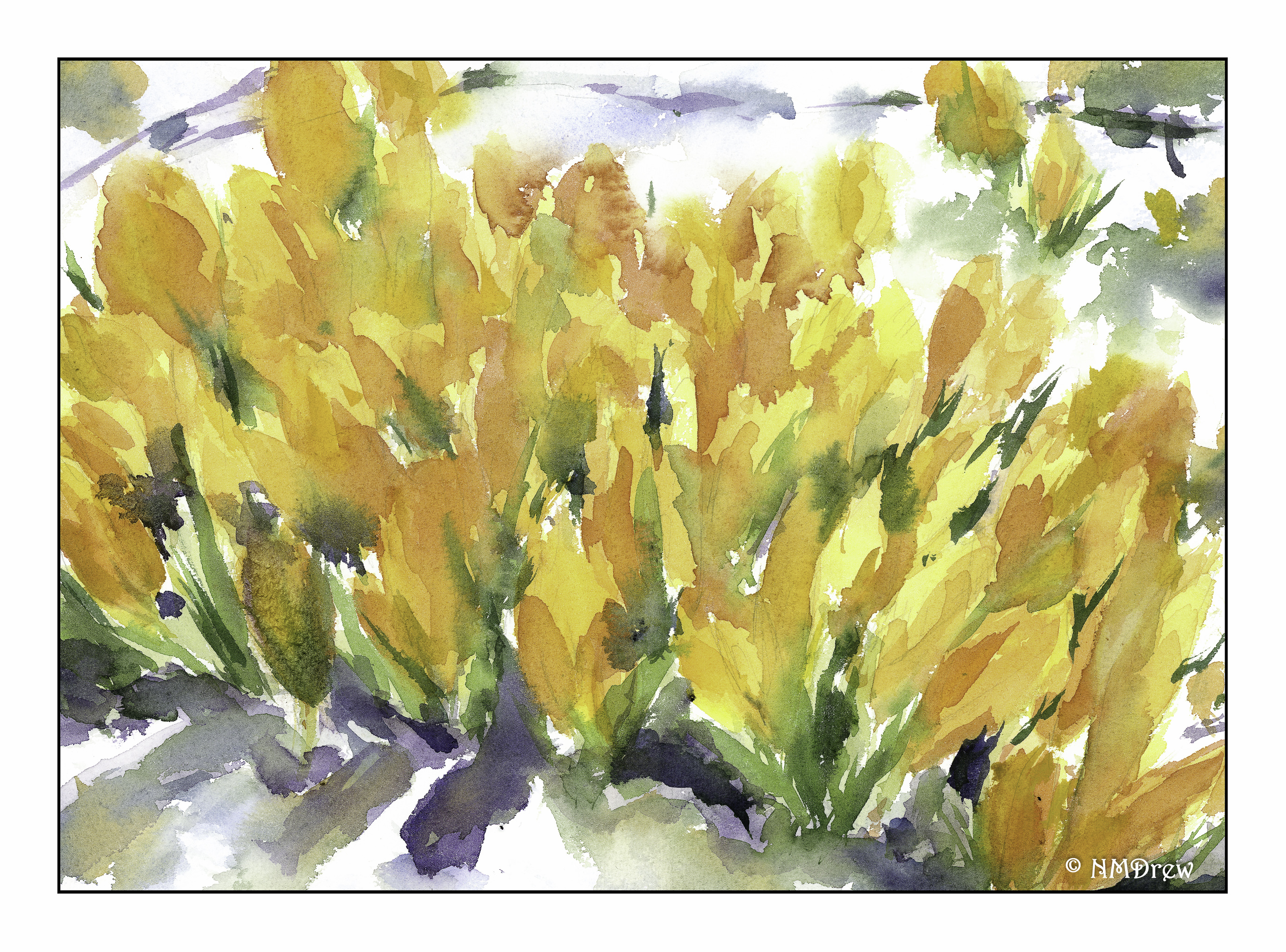
Crocus

This became more of an impression of crocus rather than a detailed study.  To tell the truth, I have never seen a crocus in my life!  I can imagine the joy they bring, though, as they peek through the last of the winter’s snow.  Hyacinths were the bulbs that bloomed in the snow in the midwest, soon followed by tulips and daffodils.  I tried to work with negative space to define the flowers, as well as blur the background and put a bit more detail in the foreground – perspective in action on a conscious level!

This is the reverse side of the paper I used yesterday, St. Cuthbert’s Millford.  This paper has a really nice tooth, not smooth or CP, and smoother than rough.  It catches the brush bristles rather nicely.  Colors are dreamy when blending together.  It also lifts well – some color ran into another area and I was able to lift it out and recover to a degree from the mischief.  I don’t know if Arches would handle it as well as this paper, but that is something I should check out.

In addition to no longer making masses of mud, I find I am actually remembering things – make long brush strokes, lay down large areas of light colors and leave the whites in the process; think about the direction of the light; a few rules about perspective.

A Few Paintings

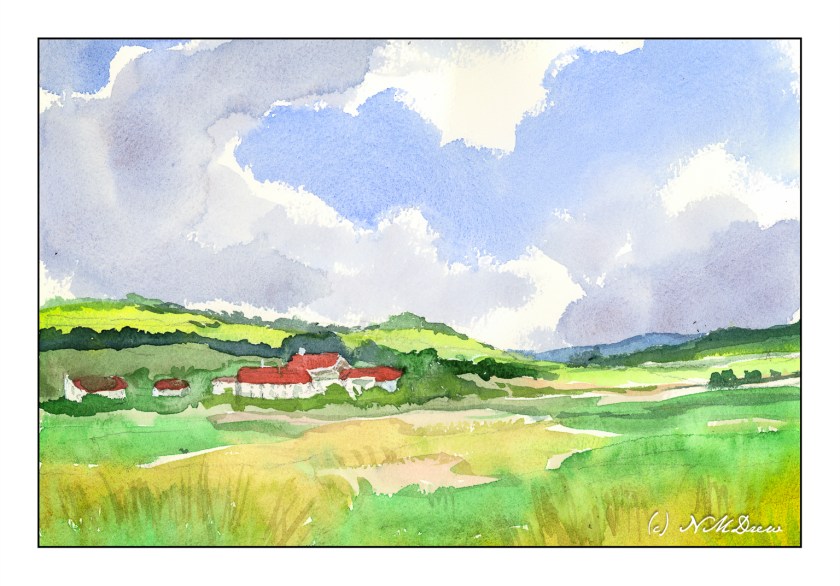
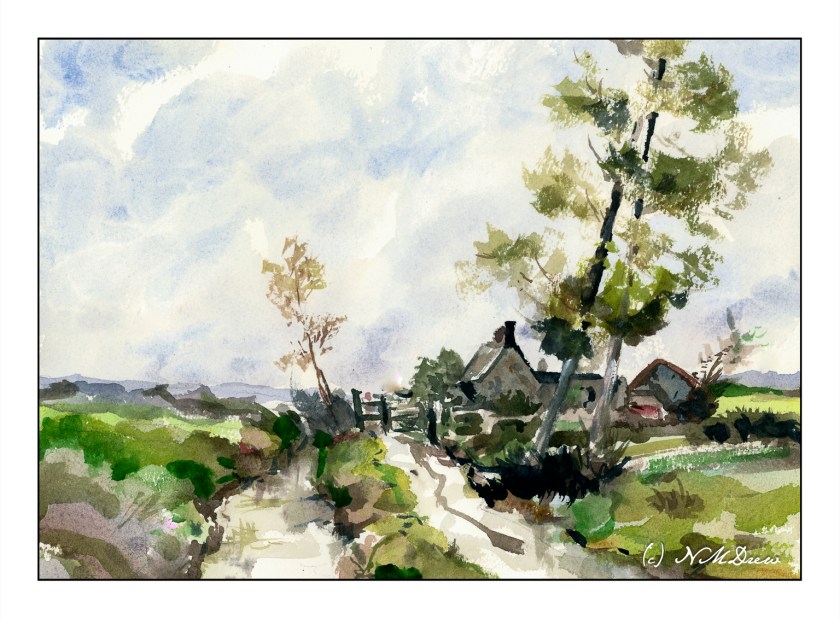
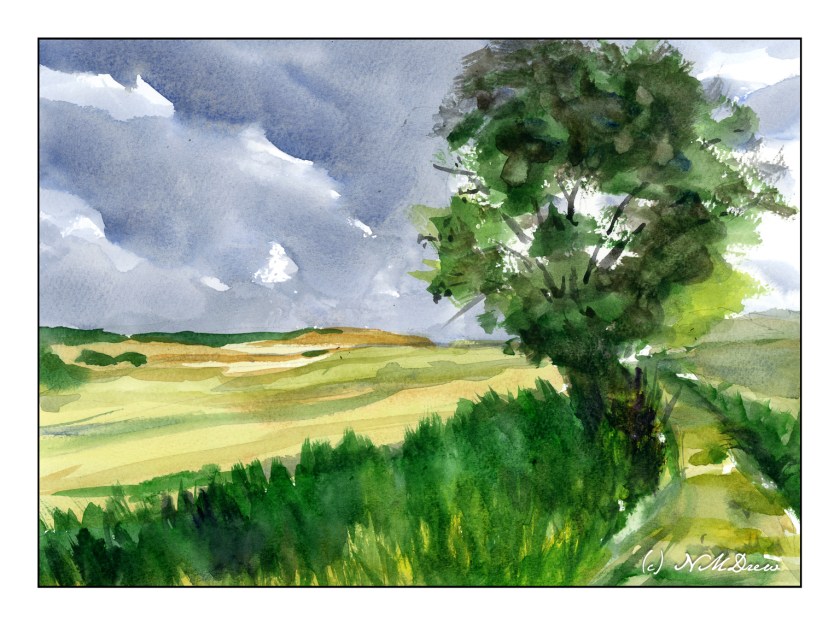
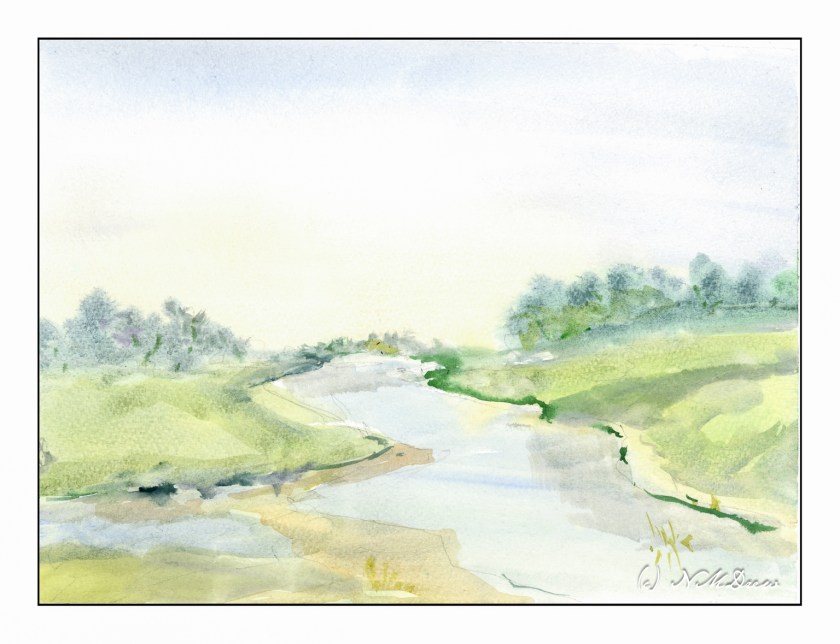
No joking when I said my “new job” was watercolor painting and drawing!  I’ve been getting daily life stuff done, but somewhen in between, I manage an hour or two a day with paper, pen, and paint.  It’s paying off (that’s what jobs are supposed to do, right?) I think.  Still a lot of goofs, but some progress, too.  Mud is now something I decide to paint more often than not.  Below is a gallery of the work I’ve done in the past few weeks – not all of it, just some of it.  Click on one picture to begin scrolling through them.

I have been using two different types of paper for the watercolors. One that is inexpensive, 100% cotton is Bee Paper, in 6×9 inch format. The other is Fabriano, in block format. 11×15 inch Artistico; this is a higher quality 100% cotton that is still affordable. Both papers are really good for heavier washes. The Artistico has more tooth than the Bee paper, but the smoother surface of the Bee really lends itself well to ink-and-watercolor drawings.

So many plans with impending retirement, and I am finding I certainly will not be able to do everything I want to do – just not enough time! I used to give myself 30 minutes to paint – now I can give myself whatever time I want. Thus, first loves take over other loves, but the sewing and the photography and knitting and, and, and will get in there. Time will be dedicated!

So, on this rainy Saturday morning, the studio will get cleaned up again, and the fun continue.