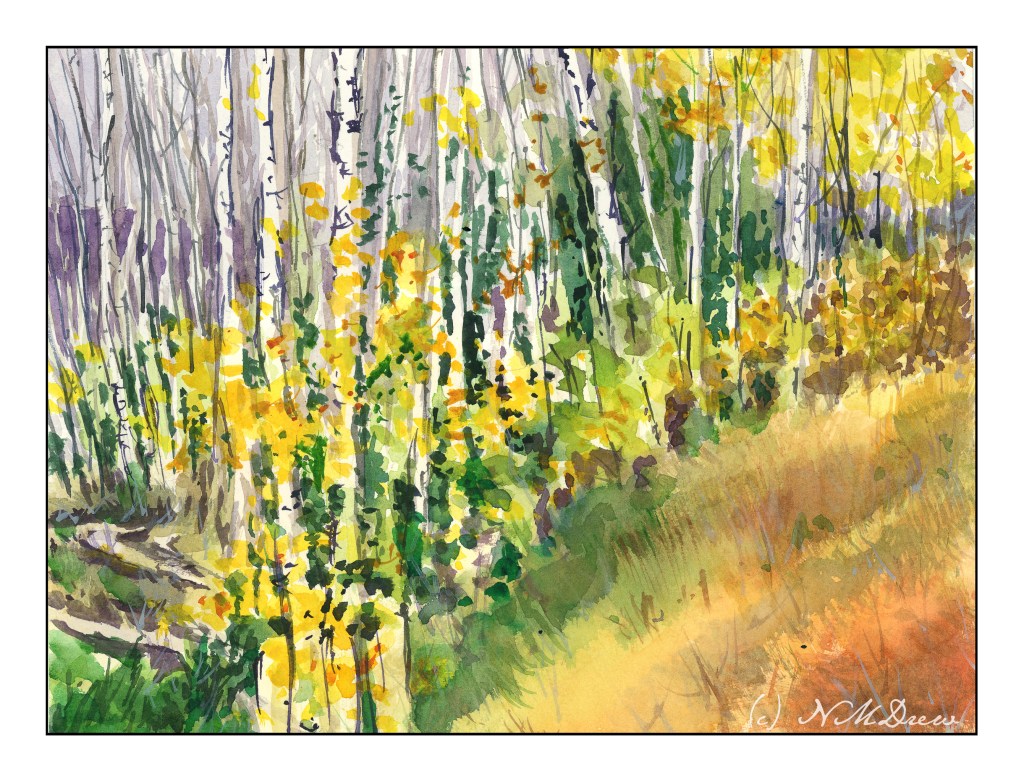
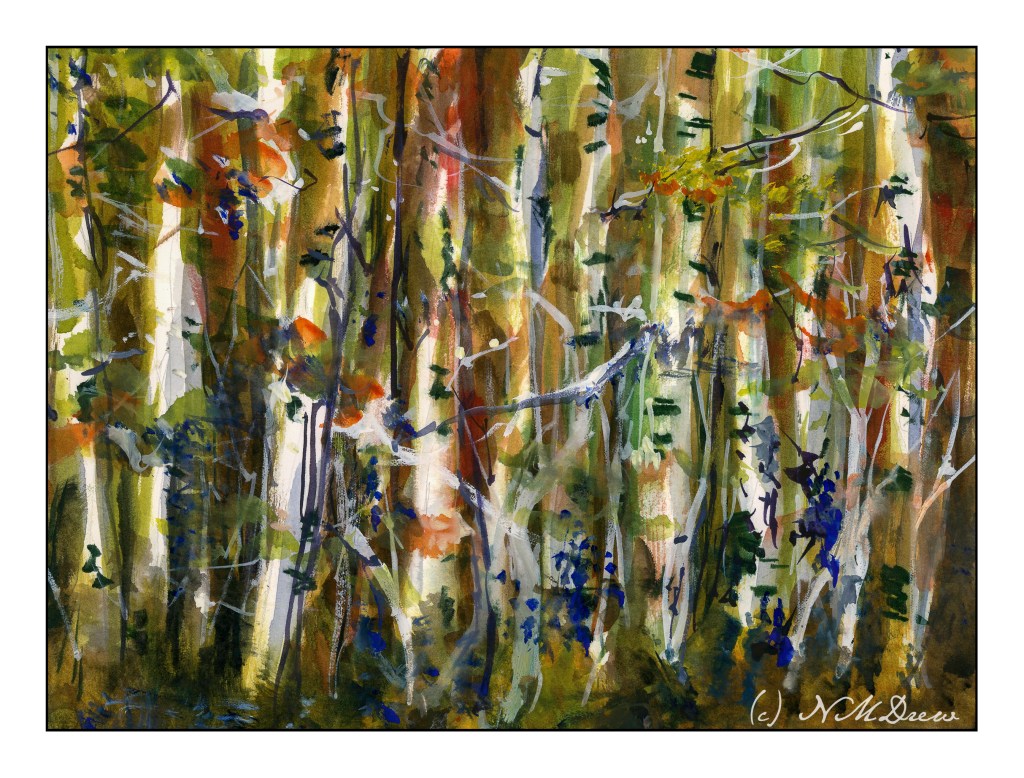
Somewhere in Utah or Colorado or California or Wyoming, an autumn’s hike; a hillside with bright aspens (or birch?) and pine trees. Colors against color.
I thought this would be a good way to practice negative painting . . . 9×12 CP Kilimanjaro paper and watercolor.
Meanwhile, I haven’t ignored my oil painting . . . .
I have been taking an oil painting / acrylic painting class through the local adult school, and the current teacher is pretty good. I am only doing oils this go around – I did acrylics last class – and I am finding them far more to my liking than acrylics. Much more to offer in terms of – what? – pleasure in using. With acrylics I feel like I am in a mad dash to paint and that really is not a fun experience. With oils, you can play and take your time, and that for this impatient person is actually a pleasure after the pressures I felt with acrylics!
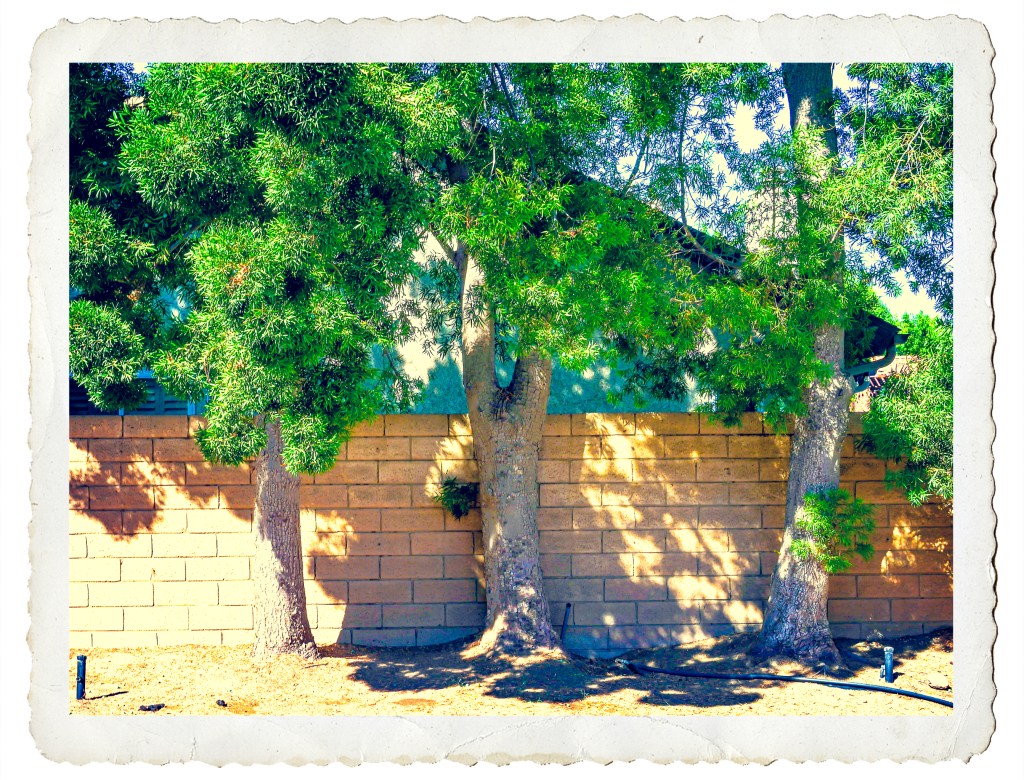
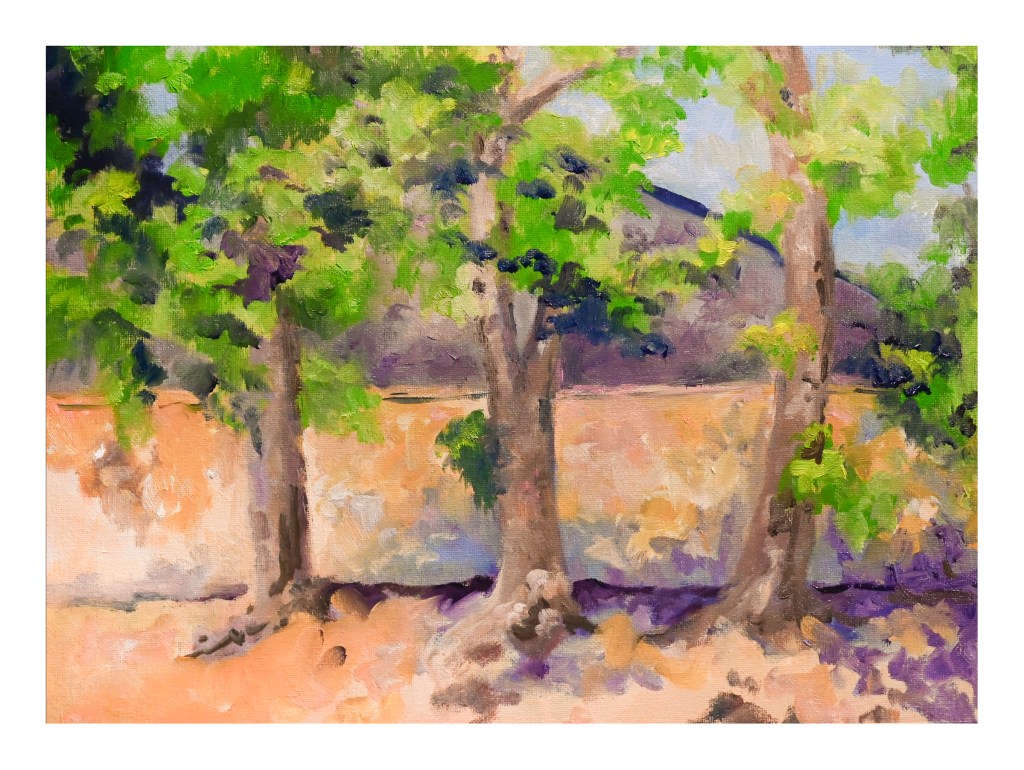
This is what my backyard looks like – hell. There is no grass and there are too many big trees. Once we get rid of 10 more 35 foot tall trees and have the back yard plowed up to be rid of tree roots, then I might be able to make it far more habitable. Nonetheless, looking for something to paint, I decided to take a photo of some of the trees against the back wall and push it in color to an extreme. By pushing the colors in LR I thought I might find new colors to use in the painting. And, it worked – I found purples and turquoises and rather icky orangish yellows.
So, I am trying to do this alla prima, but it’s not going to happen. It is happening so far in two alla prima sessions, and probably will need three or more. I am not trying to create a masterpiece. I am trying to learn how to use oils. So, this is play, and here it is, after my second alla prima session.
Next class is in a couple of days, so let’s see where it goes from here . . .
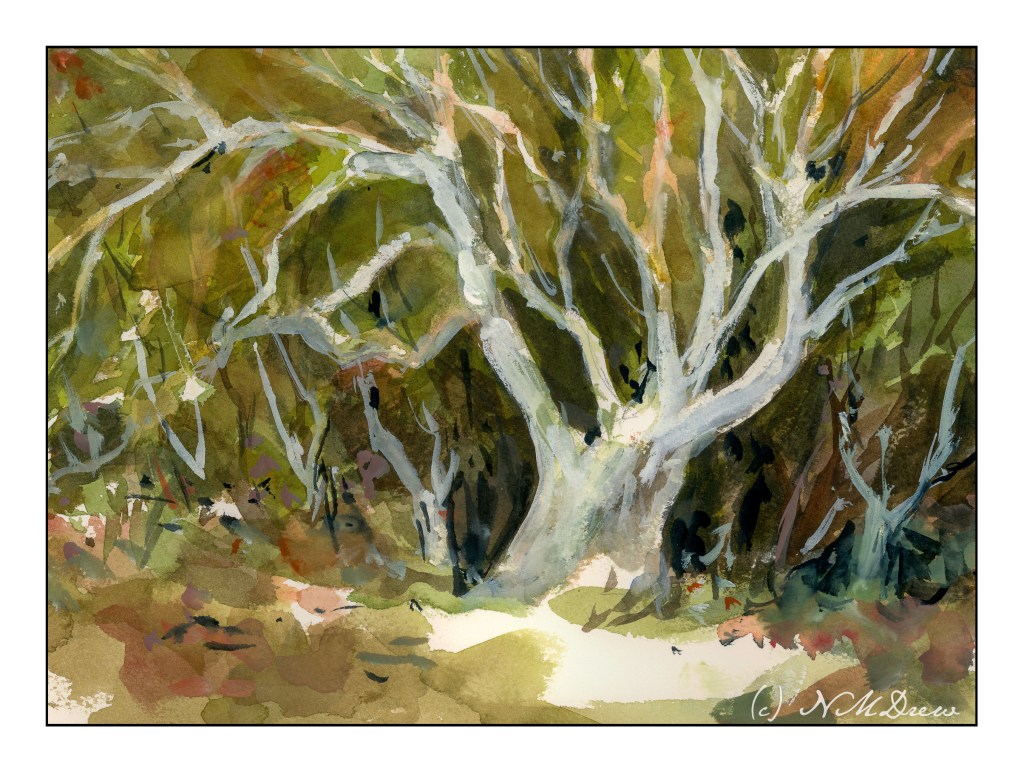
Another adventure in negative painting. As I have mentioned earlier, trees are a very good way to practice negative painting.
Here, I painted around the white trunks, and then more tinted trunks. I couldn’t find myself getting rigidly graphic with this, and just did a splish-splash approach. I also think I did a fairly decent job of moving from a dark, shady forest floor to a more sunlit canopy.
In the end, I used some white gouache, too, and rather like the vibrational energy of it all.
Negative painting is painting around a shape. Positive painting is painting an actual shape. The first is hard to do. The second less so, but the skill of negative painting is necessary and can produce some pretty dramatic results. It is also a skill if you don’t want to use liquid frisket to block off areas to keep white. Positive painting sounds easy, but it ain’t. (My flower paintings are evidence of this!)
A common exercise to show the learner how to do negative space is to paint a tree, paint around it in a light wash, draw another tree on the colored wash, and then paint around this, until you have a lot of trees ranging from white to the varying values of the wash. Sterling Edwards has a lengthy but very good video about this method:
While I know about negative painting, and have stated it as one of my goals, along with flowers (which benefit from the skill of negative painting), I thought this was a good one of the many I watched. What I liked was how he blends his paint inward.
Anyway, I did trees. Rick Surowicz is also a master at negative painting, and if you look at Edwards’ paintings, and those of Surowwicz, you will see both apply the same techniques. In my painting, I used Arches 140# CP, 9×12. I outlined the tree, and then painted around it. At some point I was frustrated and decided to do some painting with white gouache, on both the primary tree and then adding others.
Overall, I rather like the effect, particularly after adding the gouache. I think it enhanced the painting rather than making it just another annoying experience! I used to be quite rigid about not using gouache, much less gel pens or diluted acrylics in my watercolors, but rules exist to be broken, and I expect purists would call this “mixed media” – but that no longer bothers me as much as it used to. Watercolors they are (water soluble), so watercolors these remain.

 Ink, Yarn & Beer