Snow in the Sonoran Desert

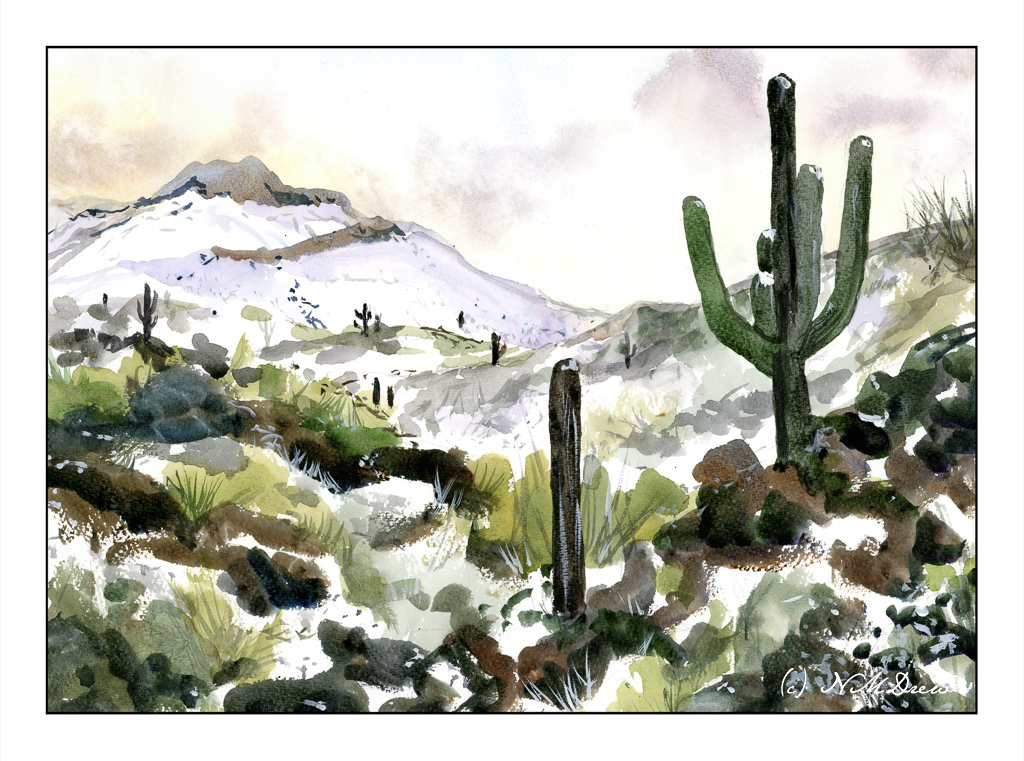
It seems appropriate to do a version of a western snow scene, and what better place than the Sonoran Desert? It is a bit closer to home than New York. I always find snow in the desert or places I don’t think of getting snow to be absolutely fascinating.

Once more, I am using a limited palette. Here, umber, ultramarine, Payne’s grey, and Hooker’s green for the landscape. The sky is ochre with some Indian yellow, quinacridone rose, and cerulean. Some of the Indian yellow is also present in the landscape, partly to lighten things up and to make some variations. Titanium white gouache is used here and there as well.

I am beginning to find limited palettes of color a lot of fun! When I am painting with them, I have not set out to use a triad of colors (such as a red, yellow, and blue), but picked the colors based on my need to succeed, at least in my head, in creating the painting I want. At some point, I will try primary triads, but that may be for warmer weather. Right now it is winter, and winter I shall paint!

In addition to a limited palette, I am also using larger brushes overall and abstracting details into shapes. Pale, pale washes, as for the sky, are also some of my goals. The scan, once more, is not as good as it could be, but in general the stronger colors are well portrayed.

My paintings are getting better, I think. At least I like them better than many others I have done. Yesterday’s painting was meh, but if I consider that 3 out of 4 have pleased me so far, I must be winning. 🙂

Watercolor, limited palette, St. Cuthberts Mill, Bockingford 140# CP, 12×16.

Trees in Snow

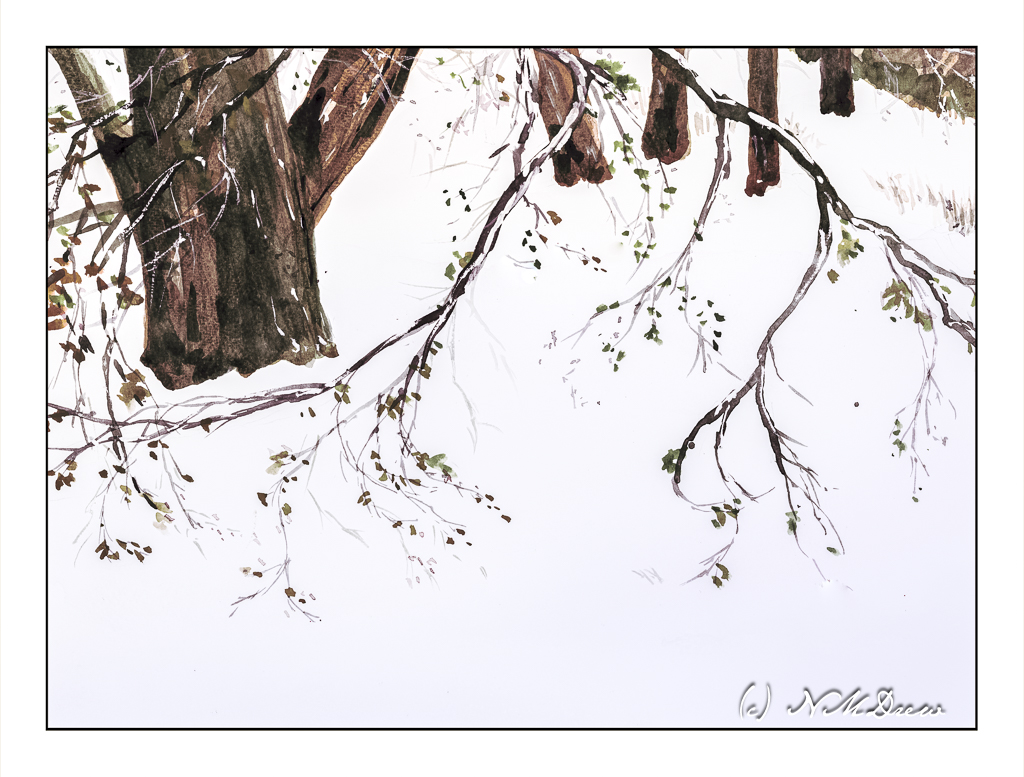
This was an exceedingly hard painting to scan simply because of the very soft usage of blue in the foreground snow. While this scan does not represent the painting very well, the overall image is good enough unless I decided to really play with my scanner’s software. I am not so sure I want to do that.

There are a few “points” to this painting. Using a very limited palette was one point – colors here are ultramarine blue, burnt umber, burnt sienna. There is a touch of a few other colors here but nothing of any significance.

Another point is to keep as much of the paper as white as possible. I managed to do this, but the scan does not do justice to the pale blue of the foreground snow; to compensate for this I used a very light blue graduated filter overlay in my post production software.

And the final point was to work in layers – light to dark – for the trees. Yes, I used titanium white artist’s gouache for the snow on the branches.

St. Cuthberts Mill, Bockingford archival watercolor paper, 12×16, CP 140#.

Beach at Saint-Malo

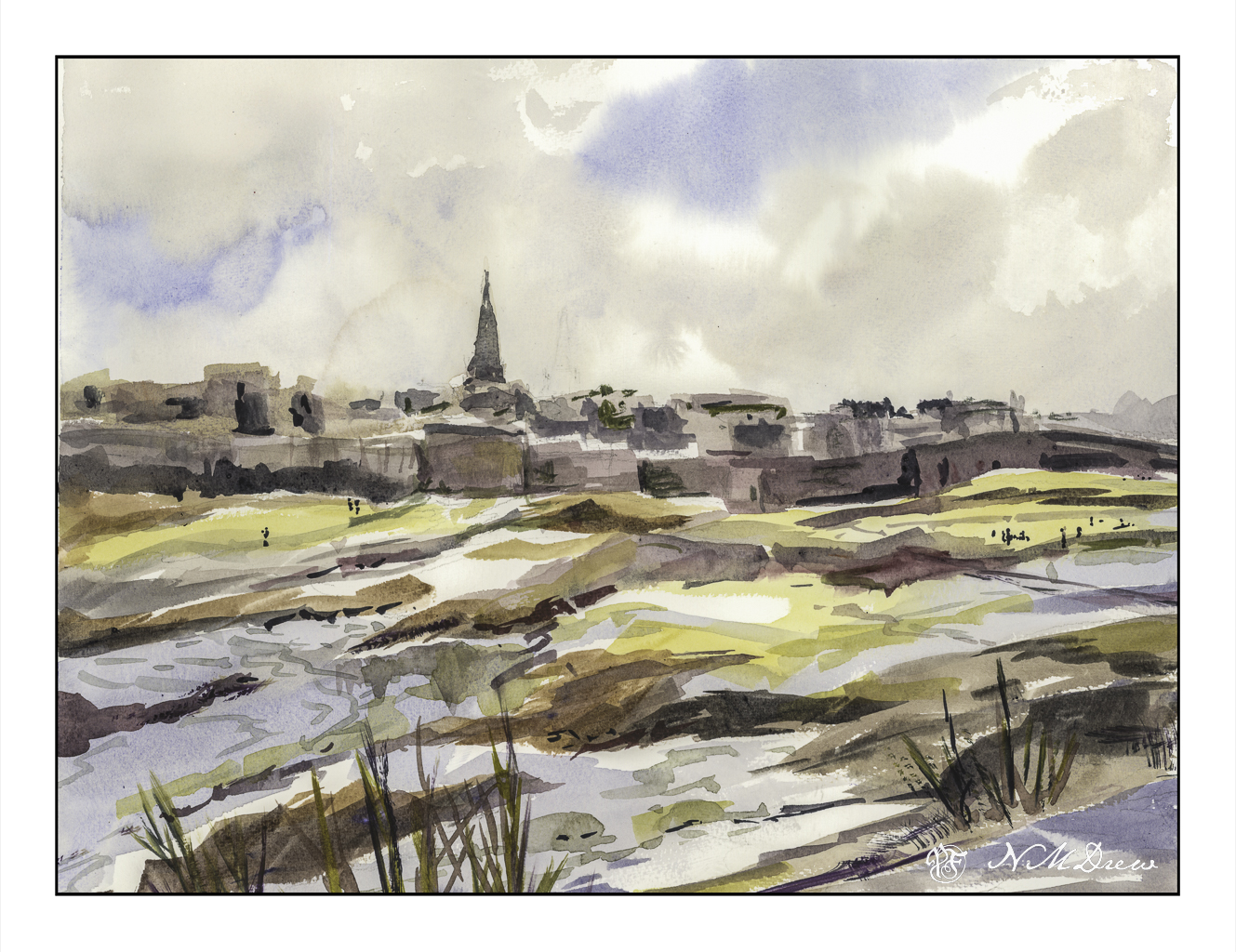
Remember the story All the Light We Cannot See? Ever since, the city has intrigued me. The story is worth reading, and if I remember, the movie was decent as well.

This painting was a quick one, and it turned out pretty good in my opinion. The point was to just paint, as well as to try out a new-to-me watercolor paper. This paper is St. Cuthberts Mill’s Bockingford paper. It seems to be a fairly soft paper as the tape around the edges of the painting pulled up some of the paper even though the tape was on the paper itself for only a short time. Using the heat of a hair dryer solved this problem, like it usually does. I liked this paper, though it does buckle a bit more than I expected when wet, but in the end it has proven to be well behaved.

Initially I scanned this painting on my Epson V600 scanner using the Epson software. Contrast was harsh and the sky barely showed up. I have had issues with watercolors and the software before – not at all pleasant to see – and then I suddenly remembered I have VueScan by Hamrick. I closed out the Epson software and fired up VueScan – and, oh, what a beautiful difference! This software is something I bought years ago, and I never really thought about using it for watercolors – I use it for photos I plan to run through Negative Lab Pro. Well, I guess I will have another use for it as well! Sheesh.

Watercolor, St. Cuthberts Mill Bockingford, 12 x 16, CP 140#.