F.O.

I’ve been knitting in between playing with three different – no, four different – cameras.  I’ve got some mitts I’m working on for Josh, a shawl out of Noro, and I just finished the Flip Flop Socks in Paton’s Socks in the City booklet.

These toe socks were not really hard to do, but I think that the instructions were rather peculiar.  The yarn colors are also odd, making me think of the colors of rayon dresses of the 30s and 40s, but these odd colors I find quite appealing.  Out of all the stripes that Paton’s has in this series of sock yarn, I really like this one the best.  It is called “Summer Moss Jacquard” and about 2/3 of two balls are used altogether.

One of the criticisms I have about the pattern is that they measure the foot length from where the heel is turned, and where the gusset joins.  I just measured my usual 7.5 inches before beginning the toe.  Another criticism is that the little toes are only an inch long – if I were to have followed those instructions, I would not be happy.  They should say something to the effect of “knit until 1/4 inch shy of length of second toe, then begin decreases.”  Something like that.  And the big toe needs to be custom fit as well.  There are other oddities in the pattern as well, which I ignored, and met with success anyhow.

This yarn seems to want to pill a bit, but it could just be that I need to wash them so that any little fuzzies can go bye-bye.  I’ve never had any complaints about Kroy sock yarn – it is a workhorse of a yarn and very reasonably priced.  These days it seems that solid colors are hard to come by, whereas about ten years ago, patterned yarn was far more of a challenge.  Obviously, fads come and go.

Self-striping yarn is always fun to work with – it keeps me visually entertained during plain knitting.  What will the next round bring?  However, self-striping yarn is not something to use with cables or lace, unless you want to get specific effects.  For instance, Mini Mochi is a self-striping yarn, but the stripes are miles apart, so lace or cables can be seen, and not lost in the pattern of the color.  If you use narrower striped yarn, patterns which create ripples can be fun, as then the lines of color undulate.

These socks, despite pattern issues, were really a lot of fun, and an easy, quick knit.  Below are my own socks!  Not as elegantly photographed, but still pretty good . . .

Flammegarn

Early this morning, I got up to meet a cool, breezy morning with a clear sky and the promise of perfect weather. What more could be asked for on a day when the morning is to be spent outdoors dyeing yarn? Everything from the last pre-dyeing days was gathered together – the pans, the spoons, scales, and so on, including the skeins of pre-mordanted yarn. Today, a number of things were planned, and happened: dyeing both commercial and handspun yarn with cochineal and black oak bark, also known as quercitron.

What is flammegarn?

Today’s entry is about flammegarn, which is an old Scandinavian method of making yarn with variegated colors. A skein (or two, or three) is tied off with cord, immersed into a dyepot, and colored. The result is a “flame yarn” – so named because this was traditionally done in red over white yarn – with splotches of red and white coloring which knit up into a space-dyed yarn. Modern dyers do this – just google “flammegarn” and you will find a number of examples. Earlier this year I wrote about making flammegarn with commercial dyes, which you can read about here. Judy’s knitted up some socks out of her flammegarn – I need to get a picture of them to post.

Set up the dye materials the night before.

Last night I prepared the dye materials. Specifically, I ground up 5 g of cochineal bugs, and mixed them with an equal part of tartaric acid. Then I added hot tap water, stirred them together, and let them sit overnight. I weighed out 10 g of black oak bark, and did the same, but without the tartaric acid. I did about five dye baths this morning; out of these, two were used for the flammegarn, which is fingering weight, commercially spun blue-faced leicester in two 200-yard hanks.

Filter out the particulate matter.

The dye pot was set up by filtering out the particulate matter from the water into which I put it last night. I used an old coffee filter and a paper filter; the filter was set aside and the clear liquid placed into a large dye kettle.

Cooler dye bath temperatures are better for yellows.

Even though I was using only about 135 g. of wool (100 BFL, 35 moorit shetland), I wanted a large kettle. A larger kettle is easier to control as far as not allowing the temperature to rise very high. This is especially important with yellow as the hotter the temperature, the more the yellow can drift toward brown or greenish hues. I kept my pot around 140-150 F. The weight of dye matter to fiber (the BFL specifically) was 1:10 – 10 g. oak bark to 100 g. of BFL, which had been premordanted with alum and tartaric acid.

According to J.N. Liles, most of the black oak bark color will be taken up in the first 20 minutes of immersion. This proved to be the case. I pulled both the BFL and moorit out periodically to check the color, and once I liked it, I put in a piece of copper pipe – about a thumb’s length – and a pinch of gypsum (the chalk my husband used in beer making to change the pH of his brew, as well as increase the availability of calcium and sulfur ions). Liles recommends adding “1/2 tsp. of chalk” but doesn’t state whether it is calcium carbonate or sulfate, so I used the gypsum. The color in the pot became a tad bit brighter – a rather mellow, pale gold.

Prepare the flammegarn by tying off sections of the skeins.

While the dye bath was heating up, I took my two BFL skeins and tied string around them. The string acts as a resist, keeping the white (or lighter colored yarn) from getting dyed. After this, they were set into hot water prior to immersion into the dye bath.

This yarn was removed from the pot and set in a basin to cool enough so it could be handled for untying and re-tying to create the flammegarn yarn. While the fibers cooled, I took the remaining particulate matter of both the quercitron and the cochineal and remixed them with water, and then filtered them again. The result was a orangish coral color. This was added to the remaining dye in the pot that had been only the black oak bark. This was slowly heated while the flammegarn was prepared with more ties. This new dye bath now contained the exhaust of the cochineal and quercitron, the tin added in the last five minutes of the original cochineal dye bath, and the gypsum and piece of copper pipe. Once this bath reached about 180 F, the flammegarn was immersed into the bath. Here it remained about 10 minutes, was removed, and then dipped into ammoniated water (about 1 part ammonia to 24 parts water – 1/2 c. to 3 qts. of water). After the dip, I rinsed the yarn in clear water and spun it out in the washer before hanging the hanks up to air dry outdoors.

It’s in the water.

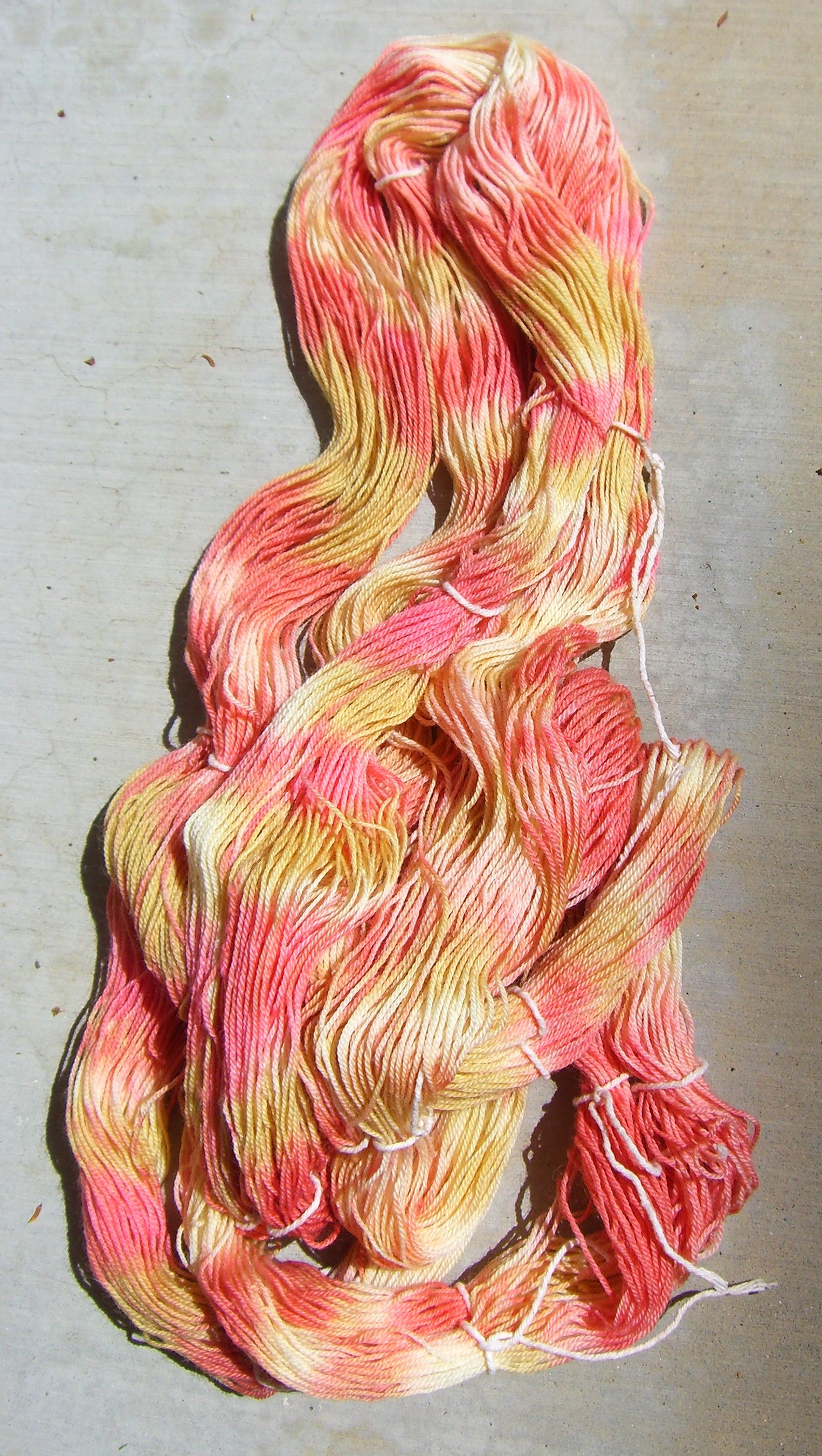
The water here in Thousand Oaks has a pH of 8. This means it has a slightly alkaline quality. The use of gypsum is to move the water closer toward pH 7, which is neutral. Ammonia is alkaline, and pushes cochineal toward the purples, and the tin in the dye bath helps to promote the red qualities of the cochineal. With the golden underdye of the quercitron, the overdye of the two exhaust baths created a color similar in tone to the gold. The result is a color variation in the yarn ranging from pale gold, to darker gold, corals and pinks.

Voila!

The final results are below. The colors are a bit lighter, but the photograph does a good job of showing the true colors. My camera pushes yellows and oranges toward the reds, and makes them far too intense at times. If you click on the photo, you should be able to see the skeins in a larger photograph, which will help you get an idea about how they look in real life. Bigger is better, here! These skeins most likely will become my own pair of flammegarn socks, either with a 2×2 rib for the ankle, or plain knitting, unless I create a little scarf with some plain knitting combined with lace.


Yikes! Stripes! and Sumi-e

Anyone who has knitted stripes in the round knows that there are problems where the two colors meet.  There are all sorts of ways written up about how to avoid that “jog” that shows the color joins.  Oddly, I couldn’t find any videos on YouTube demonstrating how to do it!

Circular Stripes

Meg Swanson and Elizabeth Zimmermann wrote about how to do a jogless jog.  Judy Gibson has a very good demonstration on how to accomplish it, including pictures with different colored yarns.  I thought I was doing it correctly when I made the Fish Hat, but didn’t – the stripes were more than obvious.

Here, then, is my take of the Jogless Jog:

  • Knit one complete round of new color.
  • Before knitting the first stitch of the next round, use the tip of your right needle to reach into down into the stitch below the first stitch of the next round, and pull the right side of that stitch up, and place it on the left hand needle.  This means (as far as I can tell) is that you pull up the stitch one row below the next stitch, and slide it onto the left hand needle.  You then knit these two stitches together.

Something to note is that a diagonal will occur, according to Judy’s site.  Take the time to read it in detail, and look at the pictures.  It’s a very nice presentation.

Yikes! Stripes! Socks

The other day in a prep class for the CBEST, I started these socks at lunch. The yarns are KnitPicks Palette in a rather tomato-soup red and a Noro sock yarn that varies from hot pink and orange to brownish stripes. I am alternating five rows of Noro with two rows of the Palette. It is because of the stripes that I researched a bit more into how to avoid the jog.

As always, TechKnitting comes up with an excellent and detailed description of avoiding that stripey jog.   Knitting-and.com has a bunch of other ways to avoid that jog.  I decided to try this method for my sock:

In circular knitting:  when adding a new color or stripe, prevent a jog at the joining point by lifting the right side of the stitch below onto the left needle and knit it together with the stitch.

Right now, the jog is not obvious in the color shifts, and is really badly photographed, but as the colors begin to shift, the stripe change will be more obvious, and I hope, more hidden.

Striped Sock Gusset

I am also at the gusset of my Thockies (for want of a better name).  I am not pleased with the way the stripes are proceeding, and so am debating about what to do.  I think what I will do is rip it out to the point of picking up the gusset stitches.  I picked them up in alternating colors, but what I think I need to do is to pick them up in a solid color, even if this means making a bit of a mess with attaching and / or breaking yarn.  Then, on the second round, I will begin the alternating colors for the stripes, and decrease using the same color all along the gusset.  I am also considering using the Dutch heel – as I know it – so I will not need any gusset decreases whatsoever, but can simply knit in stripes without a problem.

Sumi-e

I have not had the time to do any painting at all! It really bugs me. I planned to do some during the holiday season, but unfortunately, so much got in the way! And again, my weekends are devoted to credentialling. I am soooooo tired of school and work! I’ve had to drop my Japanese class, I cannot find a time slot big enough to paint and relax, and on and on and on. No Chinese painting class, either. Well, given that, once I take the CBEST, I will PAINT and make some more videos . . .

Wah!

94 Days Until Christmas

The Buttoned Cardigan is at a point where I have to focus and pick up stitches for the sleeves.  I like to do this when it is quiet, when there is good daylight, and I can listen to music that soothes the nerves.  Calmness.  Once I’m there, I will be able to work on the sleeves and watch a movie, but until that point comes, it is time to work on more mindless projects, or at least the sections which I deem mindless.  And, with only a few days left for Christmas, I felt it was a good time to begin work on projects for family members.

The two projects I have going on right now are Anemoon, by Lucy Sweetland, and Ishbel, by Ysolda Teague.

Lucy Sweetland is a very talented designer and photographer, with an eye for clean design combined with beautiful touches. Anemoon is an example (see below). Her Emerald Mitts are also another example.   Check out her blog, A Black Pepper.  There is a link for her under the “blogroll” to right, as there is for Ysolda Teague of Scotland.  Ysolda is another talented designer who creates everything from little mice and mushrooms to intricate sweaters.

Anemoon

A number of years ago I attended a conference at Asilomar in Northern California where I took a dyeing class with Nancy Finn of Chasing Rainbows Dyeworks. From this workshop, I have about 300 yards of single ply mohair-wool blend that is sort of a mottled purple. Knitted up, a stitch here and there stands out, bright against the rest of the stitches. It is this yarn that I am using for the Anemoon beret by Lucy Sweetland, author of “A Black Pepper” blog.

I think the word “anemoon” is Dutch, and means “anemone” in English. The anemone is a beautiful flower, elegantly simple.

This beret is like the flower – very elegant, simple, with a sophisticated design. Cables emerge from the body of the beret, not out of the ribbing as most cables do.  A number of plain, purled rounds are done, and then the cables begin, like a stem, to emerge and twine, with bobbles like flowers to add interest.

Straight out, cables annoy me! I really don’t like the idea of doing an Aran sweater at all. In a beret or hat, cables don’t go on and on and on. Much more fun!

Anemoon is intriguing because the cables weave in and out, yet are held within four panels which repeat themselves.  I’ve separated out the panels by containing them with different colored stitch markers setting up their boundaries, and a different one to mark the beginning of each round.  For someone like me who doesn’t like doing a lot of cables, Anemoon is the perfect project.  What you see here was accomplished, once the ribbing was done, in a few hours of a lazy afternoon. I’ve totally enjoyed the rhythm of the cables and watching them grow along with the hat.

This yarn makes me think of storm clouds as they fly across the sky. Colors shift and puddle, and then change in the blink of an eye.

Ishbel

I began Ishbel just a few days ago, and am in the process of doing the stockinette that leads into the lace. Pleasant, easy knitting – perfect for doing in front of the television. The color is a lovely turquoise merino-bamboo blend single-ply. I’ve got about 400 yards, so the small Ishbel may be the one I end up making. As a shawl, or neck scarf, the yarn will be very pleasant against the skin as it is not scratchy at all. I am making Ishbel for a family member who walks to work; she can wear it on those chilly mornings approaching so soon.

Who Gets Anemoon??

While I’ve got definite plans for Ishbel, I must admit, this Anemoon may end up on my head! I’ve got the ribbing of another started in a white tweed for another family member . . .

And for More Distraction   . . .

Look what came in today’s mail!  I’m in trouble now! I still have my Selbuvotter mittens to finish!