Mas Schmincke Pan Paints

I took some time to rummage around the studio and found my pad of paper I had set aside – an inexpensive, 100% cotton paper. This paper does not work well with really wet washes, but does well with lighter ones.

I always enjoy the combination of ink and watercolor. Drawing in ink without a pencil drawing beneath seems to me to be far easier to do, and more logical (if that makes sense) than working with a pencil for a value study and then inking over it, erasing the pencil, and then painting. I guess the amount of lines makes more sense to me than the pressure of the pencil? Anyway, I decided to see what I could do with ink and watercolor.

Nothing fantastic, but it does have a nice composition and sense of value to a point. I think the details – or lack – makes an ink drawing express itself. From there, I began to lay in some light washes, referring to the color sheet from my new set of 48 Schmincke Horadam half pan set I mentioned a couple of posts ago. Already I can see my heading toward specific colors, but looking at the painted color sampler, I tried different ones, like English Venetian Red. That color has never made it into my palette, so this was fun!

It took awhile to get comfortable using the pans as I usually paint with tubes. I am experimenting with things to decide what I want for plein air painting and drawing. Thus, pan paints make sense as does pen and ink. I like to travel light, and don’t like lugging this and that around. Having a lot of colors also allows for less need for water, I think, when sketching and painting, as mixing colors can be a bit of a job. At the same time, I do mix, such as blues and yellows to make greens, and having a lot of choices makes for some new and interesting result.

So, here is the finished ink and watercolor sketch. 9×12 on 100% cotton student grade watercolor paper. Light washes were used for most places, including the darker areas. For the darks, though, I did need to work on making my paint thicker and heavier. And I got to mix a lot of greens in addition to using the 4 or 5 available in the pans themselves. Altogether, I was pleased with the results and the experience.

Testing, Testing

I bought a set of Schmincke Horadam pan paints, and went a bit nuts with them. I decided to try a set of 48 colors – economical way to enjoy excess colors! I have an older set which has done me well over the past several years, and thought it was time to buy some more. I cannot say I am disappointed as they are really lovely.

I have some poor quality watercolor paper – great for gouache – but not for watercolor. This particular bit is poorly sized, as you can see by the mottled appearance of the blue-greens at the bottom and left of the flower pot. Still, I was not using this paper to test out the paper, but instead to just play a bit with some colors I haven’t used before. I did a few other sketches, but they were all rather poor – not that these pansies are anything great – but I have had fun!

One of the nice things that comes with the Schmincke paints is a sheet of paper which has a bit of texture and can be used to put samples of the paint on them. The sheet itself has room for the number, but I also wrote down the name on the wrapped-up half pans, as I think, “oh, Payne’s grey” not “good old number 789”!

So, more play in the near future, but not with crap paper. I think then the real colors of the Schmincke paints will really show.

Winter at Great Dunes

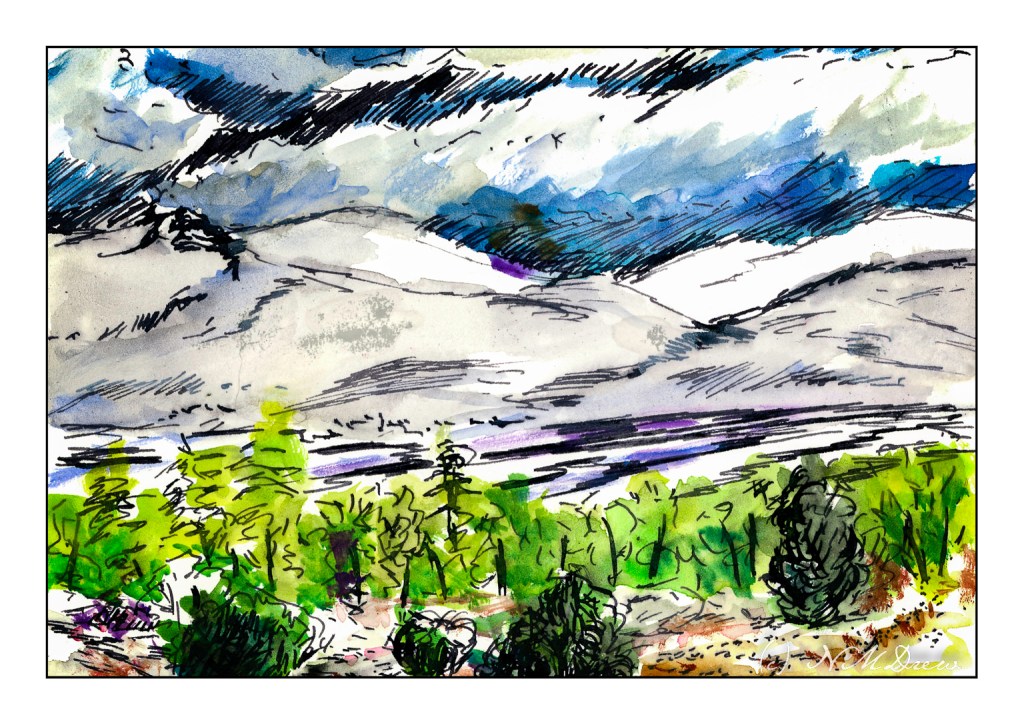
More iron gall ink and opaque watercolor. The watercolor is a small set of 24 “Angora” pan paints, probably meant for children as the colors are nontoxic and bright. Sets come in groups of 14 colors to 36. When I was a kid, I had a set of pan paints my mother bought for me – my sister had the same – and I just loved them. The set my mother bought was transparent watercolor, but diluted enough, these are equally transparent. There is something that I always love about paints in a pan – I think it is because it is more play than serious.

I have become enamored with the Great Sand Dunes National Park – so much to see, so many seasonal variations. Here, winter and snow on the dunes with clouds dropping down between the dunes and distant mountains. The river is cold, and there is a dusting of snow in the high desert plants. Winter is at hand.

Lopso-Eared Ground Hog’s Day

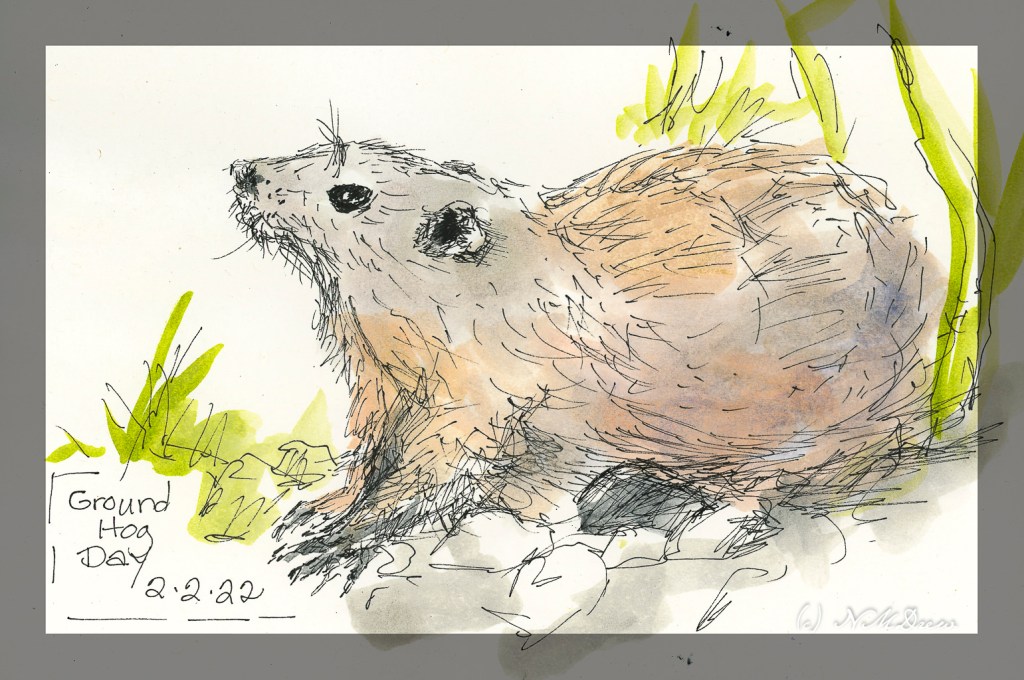
One of the beauties of drawing is you can create anything you want. This is a ground hog, but one I invented. I invented him when I realized his ear is all cockamamy. So, new subspecies: the Lopso-Eared Ground Hog.

Ground Hog Day has always been a favorite of mine. First, I like ground hogs. They are cute. Second, the entire idea of a day devoted to such a cute animal is rather delightful. According to the website history.com:

On February 2, 1887, Groundhog Day, featuring a rodent meteorologist, is celebrated for the first time at Gobbler’s Knob in Punxsutawney, Pennsylvania. According to tradition, if a groundhog comes out of its hole on this day and sees its shadow, it gets scared and runs back into its burrow, predicting six more weeks of winter weather; no shadow means an early spring.

Groundhog Day has its roots in the ancient Christian tradition of Candlemas, when clergy would bless and distribute candles needed for winter. The candles represented how long and cold the winter would be. Germans expanded on this concept by selecting an animal—the hedgehog—as a means of predicting weather. Once they came to America, German settlers in Pennsylvania continued the tradition, although they switched from hedgehogs to groundhogs, which were plentiful in the Keystone State.

Groundhogs, also called woodchucks and whose scientific name is Marmota monax, typically weigh 12 to 15 pounds and live six to eight years. They eat vegetables and fruits, whistle when they’re frightened or looking for a mate (they’re sometimes called whistle pigs) and can climb trees and swim.

They go into hibernation in the late fall; during this time, their body temperatures drop significantly, their heartbeats slow from 80 to five beats per minute and they can lose 30 percent of their body fat. In February, male groundhogs emerge from their burrows to look for a mate (not to predict the weather) before going underground again. They come out of hibernation for good in March.

In 1887, a newspaper editor belonging to a group of groundhog hunters from Punxsutawney called the Punxsutawney Groundhog Club declared that Phil, the Punxsutawney groundhog, was America’s only true weather-forecasting groundhog. The line of groundhogs that have since been known as Phil might be America’s most famous groundhogs, but other towns across North America now have their own weather-predicting rodents, from Birmingham Bill to Staten Island Chuck to Shubenacadie Sam in Canada.

In 1993, the movie Groundhog Day starring Bill Murray popularized the usage of “groundhog day” to mean something that is repeated over and over. Today, tens of thousands of people converge on Gobbler’s Knob in Punxsutawney each February 2 to witness Phil’s prediction. The Punxsutawney Groundhog Club hosts a three-day celebration featuring entertainment and activities.

Let’s hear it for monata monax!