
Oot and aboot, 50mm macro and the Nikon Z6ii, sometime ago. I liked the shadow on the leaf. 50mm macro lenses are some of the best walk-around lenses, I think.

Oot and aboot, 50mm macro and the Nikon Z6ii, sometime ago. I liked the shadow on the leaf. 50mm macro lenses are some of the best walk-around lenses, I think.
There is a lot more “ink” these days than beer or yarn, but as far as those go, there is a lot going on in the background. I guess I will need to post some of my knitting projects or sewing projects (“yarn”). Cooking, too (the “beer” part). Paint (“ink”) takes up most of my time, though.
I am continuing with the oil paints and just love the sensuality of mooshing it around on a canvas! I also like being able to work on my sense of contrast – lights and darks – as I have done with a few pears.
When I am finished with a painting, even though I use low odor solvents, the smell lingers, more so when the house is closed up to keep it warm. Because of this smell, I have some drying shelves set up in the garage, which is pretty cold. It takes a long time for the paintings to dry unless I use Gamblin’s Galkyd Gel, and then they dry almost overnight.
Now that you know this, I painted this painting about 2 weeks ago using linseed oil as the vehicle as well as Gamblin’s solvent-free gel, but not the Galkyd. Drying time is very slow. I just got some walnut oil mixed with alkyd by M. Graham, which should speed up drying time and, I hope, give that lovely ooziness that makes oil paints a lot of fun. Maybe I will check that out later today.
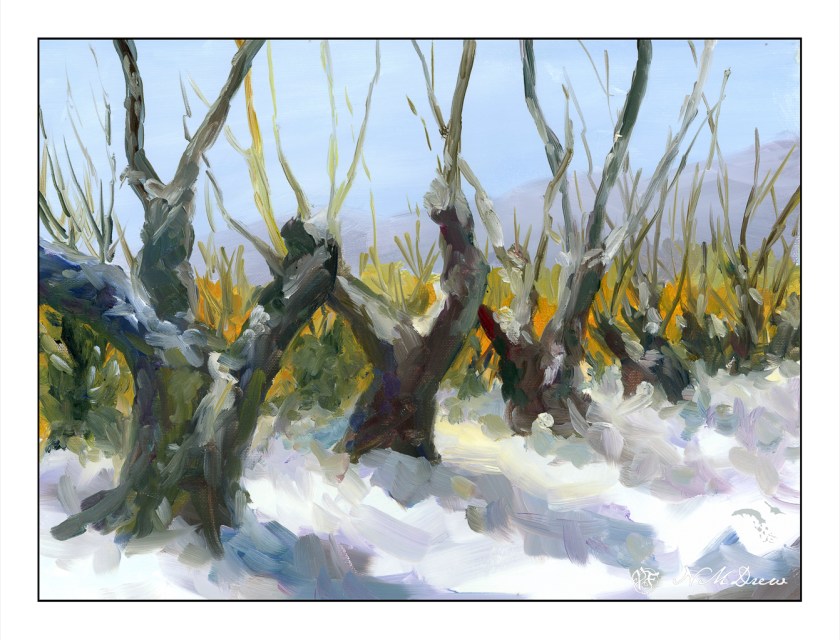
I chose this subject to work on a few things: values, color, distance, depth, contrast. Overall, I am pleased with this painting. I like the brighter yellow between the tree branches on the right as I think it leads the eye in. Someone on a forum said it was too bright and might need to be dulled down a bit. That is something to think about, but my magpie self likes that but does see what the person means. But how much should that yellow-orange be dulled, and so on. Maybe I will play with it in PS.
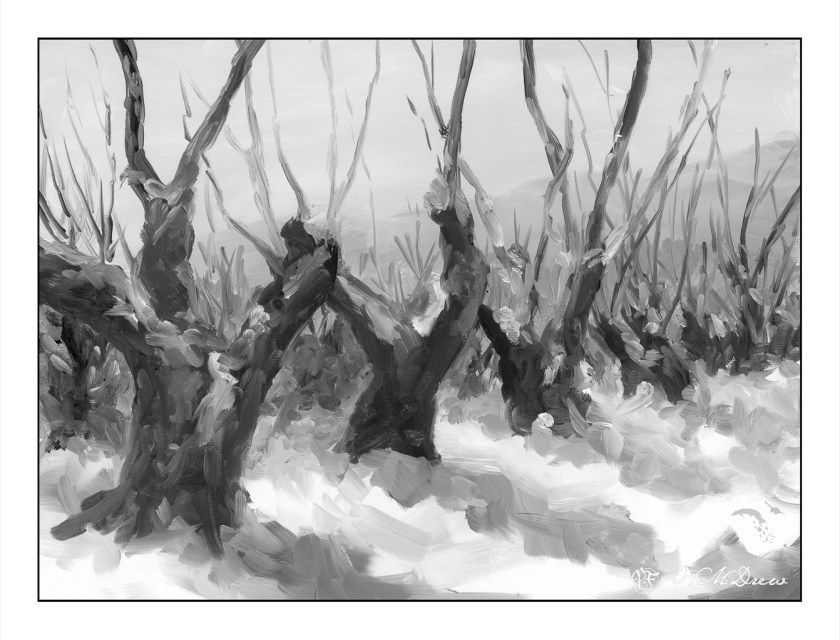
Above is the desaturated image. I do this to look at my values. Success! Isn’t it interesting to note that the bright yellow-orange becomes a middle grey when in black and white?
I have a couple of other paintings out in the garage drying. I’ll get those out in a few days. Scanning a painting is far nicer in result than photographing as there is minimal glare. The only problem with the scanner is that sometimes the software does not like to merge the sections – luckily I have a few different ones as back up and seem to work quite well.
11×14 oil painting on cotton canvas panel; scanned on Epson V600 at 600 dpi and 48 color bit depth.
We have had rain – yay! – and thunderstorms, and threats of tornadoes (which never came) – and puddles of water, and a back yard lake. More to come, perhaps, but gentle and warmer, with a promise of a relatively sunny Christmas. I love the briskness this weather brings, but am also very happy not to have to shovel snow or drive in it. In fact, I was flying through water at intersections the other day, but luckily I am in an area without low lying ground which floods, unlike other areas of the county where people woke up to flooded bedrooms.
So, winter! Winter solstice is come and gone, and in many ways I wish we marked it more with bonfires and merriment, as in the olden days. I paint winter, partly from photos, partly from memory and imagination.
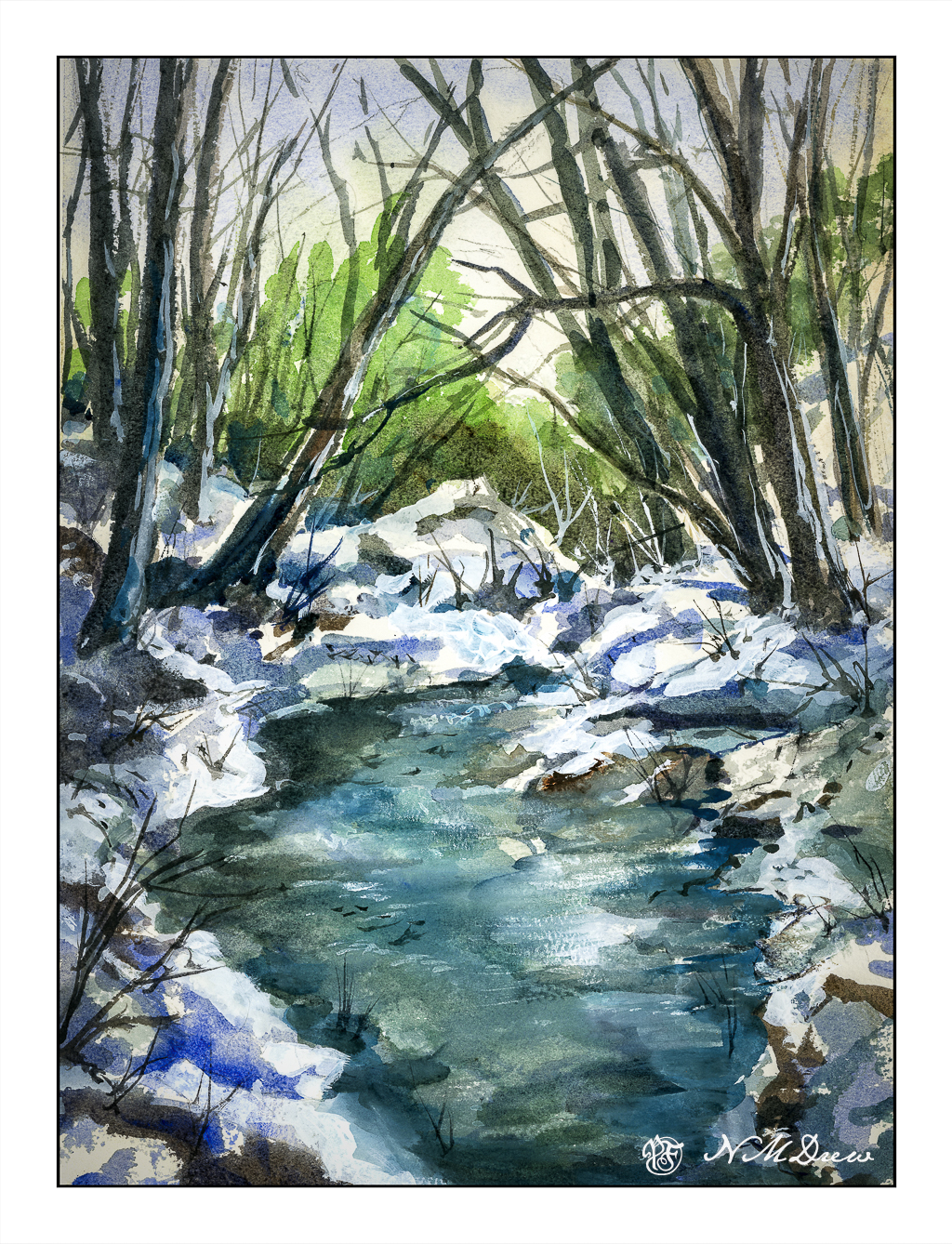
Probably most of my memories come from upstate New York. No place that I have visited does winter quite like the mixed hardwood and pine forests. Bright green, dark green, barren branches, tall trees. Skies can be sunny and fierce, dull and overcast, and everything in between. Water, whether lake or stream, takes on its own life when frozen, thawed or in between. It still amazes me that fish swim under the ice and amphibians bury themselves in the mud until spring comes.
Happy Solstice!
When I lived in upstate New York, the winters were marvelous! Hardwood forests and pine trees all worked together to create a magical land of light and shadow, rolling snow banks, and winter streams frozen and thawed and frozen again. The skies, too, were amazing in their coldness of light that could reflect so brilliantly on the snowy landscape.
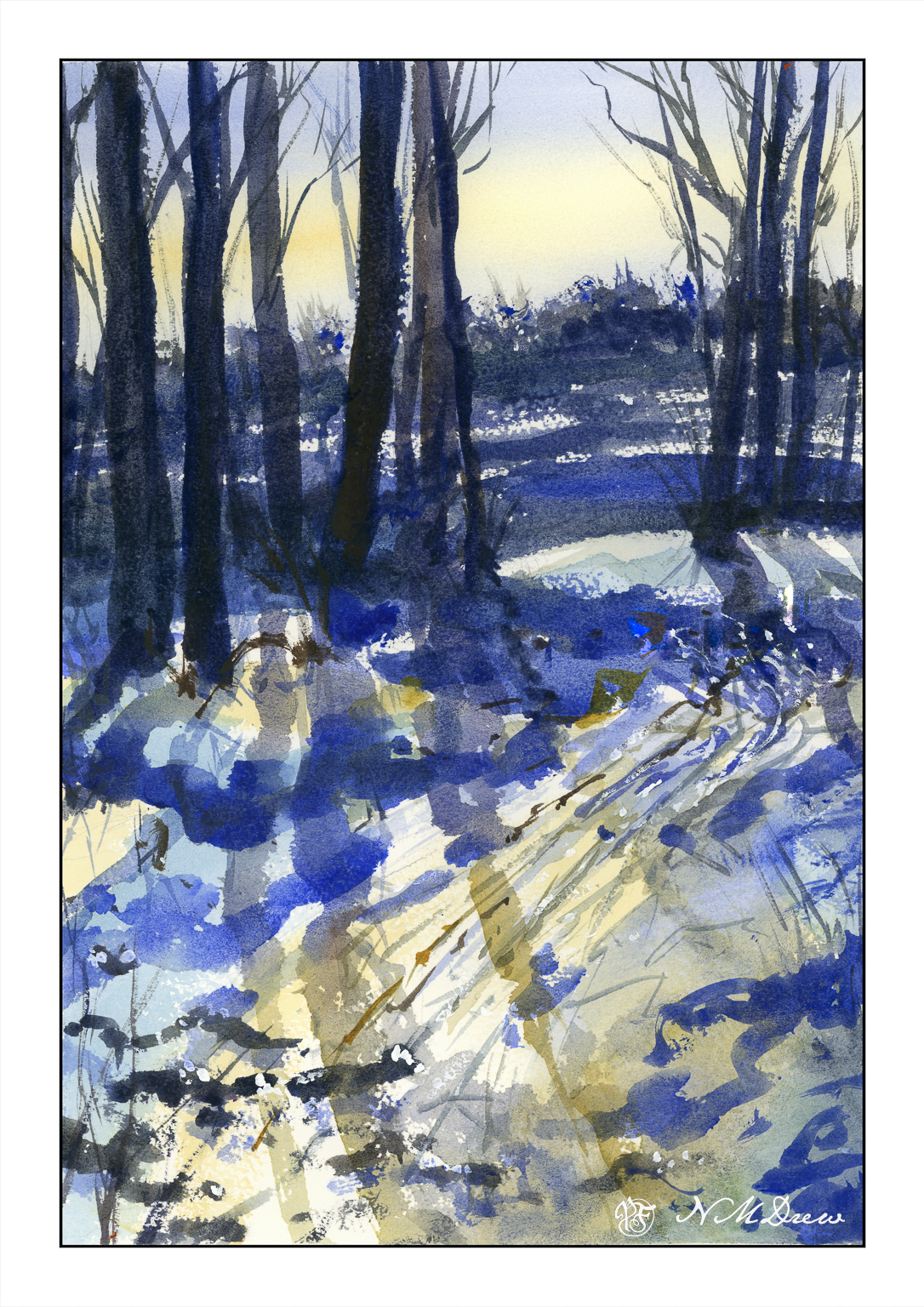
As an adult, snow as a place to live, work, and travel in no longer holds much allure – great to visit, but don’t ask me to wade through it, chisel ice off my windshield, or shovel it just to get out of my house. Still, the memories of those magical winter days in deep winter always hold a spot in my heart for their crisp and intense beauty.
10×14″ Arches Rough, watercolor limited palette of umbers, quin gold, ultramarine blue, and a touch of titanium white gouache.
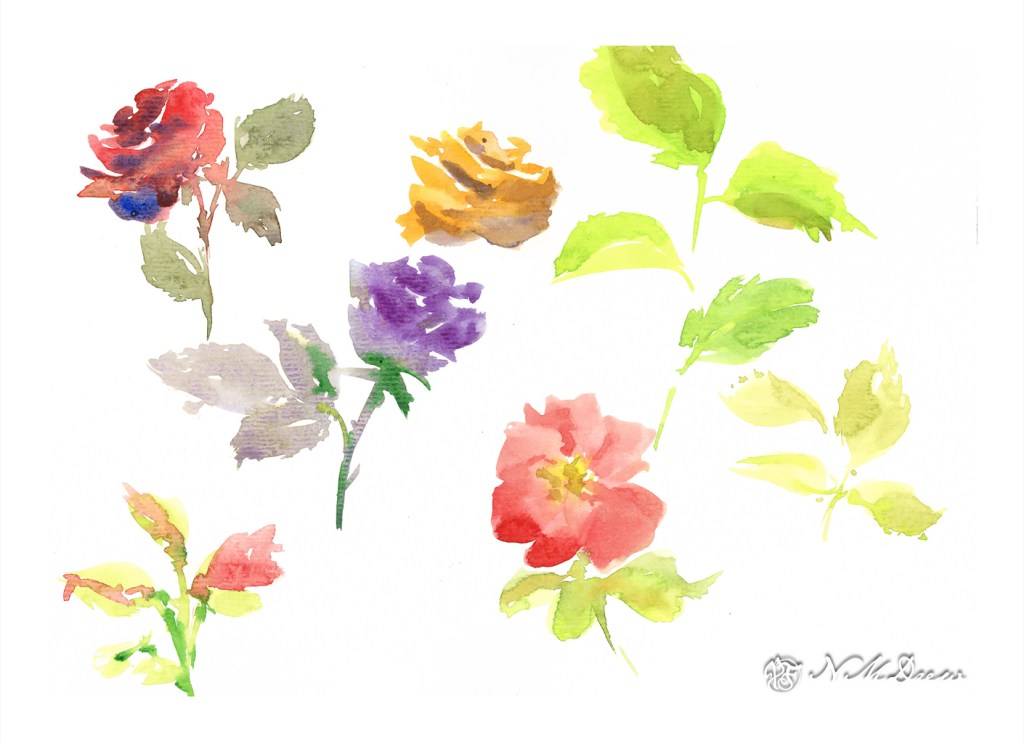
More roses – more C strokes – and then other kinds of strokes to make leaves. For the leaves, brush point on paper, squish down and move, bring brush up to another point. Just as in sumi-e! Then, while the paper and paint are still wet, take the tip of the brush and create little points around the outer edge of each leaf. Some roses have pointy leaf edges, others do not. I don’t think the Rose Police will come knocking on my door, though, so I am safe.
Roses in these kinds of sketches are easy enough to do. However, creating a successful painting of more than one sketchy rose is another story. Light, shadow, shape all begin to play together, and sometimes not very nicely.
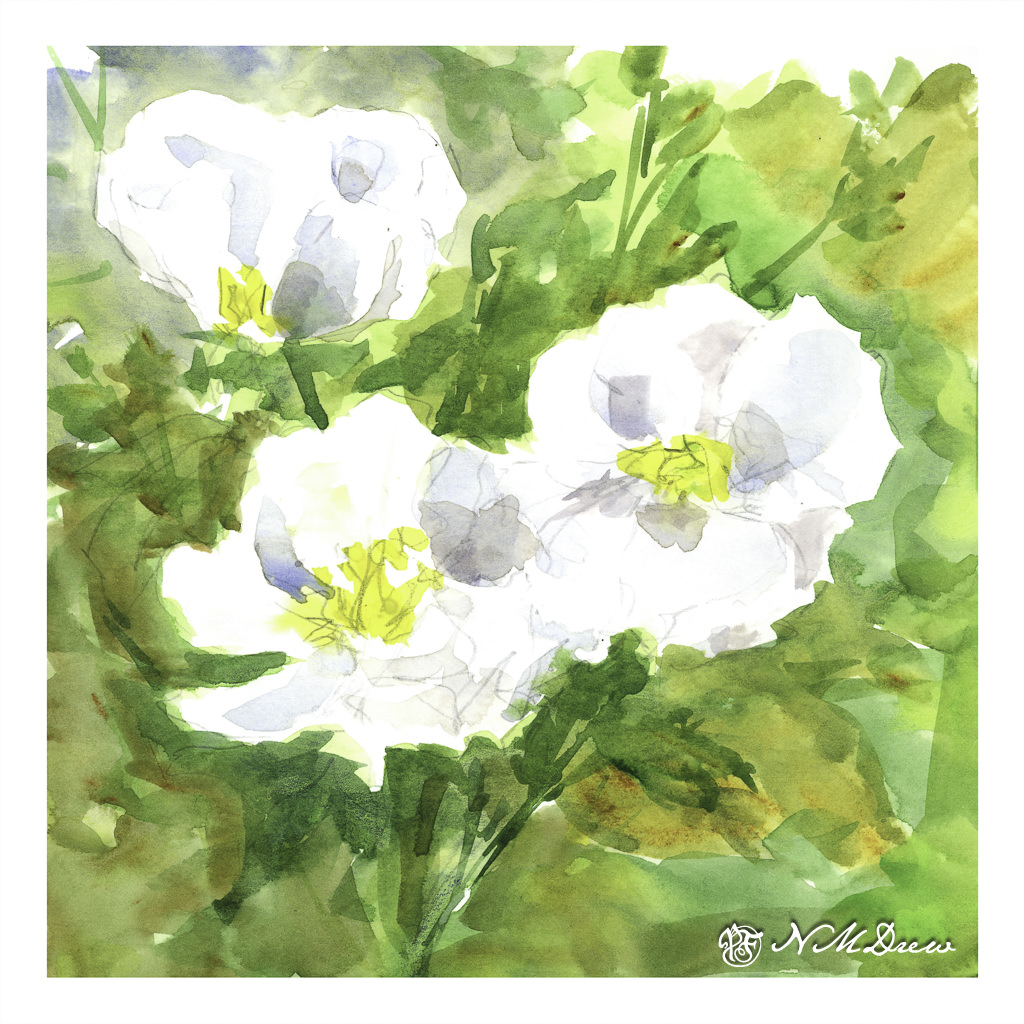
Here, a rose with a simpler petal style than the classical tea rose. As a kid in the midwest there were deep red wild roses throughout the countryside, and here in California there is a bush as above along a local trail. There are about 5 petals around a yellow center, and the wild roses are messy things that are such a pleasure and delight to encounter.
Painting a white rose is not easy because white is influenced by light and shadow and shade. Instead, you have to look at the colors in the white – light? dark? cool? warm?
The above little painting was a success, but it is only a sketch. A bouquet of roses will be far more challenging and I really doubt my ability to succeed there.
 Ink, Yarn & Beer