Orange Slices

Today, an ink study of orange slices on a bit of peel.

I am / was trying to do a bit of watercolor painting every day, but I find that such commitments, while good, can be stifling.  Drawing is integral to painting, and it is a pleasure to do in and of itself.

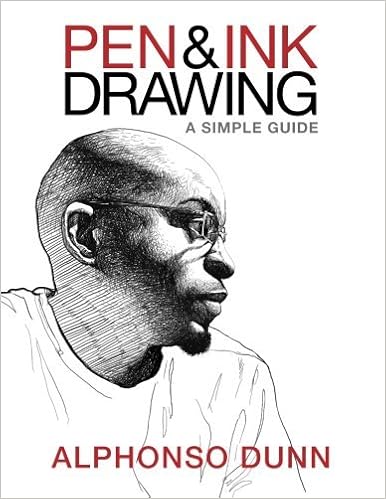
I’ve been working on the exercises in Alphonso Dunn’s Book Pen & Ink Drawing Workbook, so an ink drawing after exercises seems like a good thing to do!  I know I certainly enjoy drawing after the practice.  It’s also relaxing and, I find, a good way to loosen up for a painting session.

In addition to using Dunn’s book, I am also working through Tom Hoffmann’s Watercolor Painting:  A Comprehensive Approach to Mastering the Medium.  Right now I am working on simplifying forms and determining the 5 shades of grey – the lights and the darks – in pictures.  I am not very good at that, so combining his exercises along with ink drawing, I think it may sink in.  Then, let’s see if it can be applied to paint.

Thus, a dose of vitamin C for painting health!

Style

Definition search result for STYLE (straight from Google search “definition style”):  1.  a manner of doing something.  2.  a distinctive appearance, typically determined by the principles according to which something is designed. 

I’ve been thinking a lot about style of late, as in style of music, clothing, politics, painting, drawing, writing.  Since we are all individuals, we all have ways of doing things that earmark them as our own.

I don’t particularly care for what I might consider my native way of drawing and painting.  I have a vision in my mind’s eye about how I want things to look as a finished product.  That doesn’t mean no happy accidents, but it does mean I have a certain vision of clarity with watercolor paints in particular.  I think a lot of what I paint seems labored – and maybe that is because I did the laboring?  My paints seem heavy and more opaque rather than utilizing the transparency of the medium.

Copying

Copying a master’s work is a time-honored tradition for art students, whether sitting in the Louvre and copying a Rembrandt (if they still let people do that, like they did in the 1800s), or a sumi-e student in training.

Today there seems to be a shunning of such, with more of an emphasis on “originality” coupled with a fear of lawsuits for copyright infringement.  If you think about it, nothing is really “original” but derivations of other’s works or our own creative minds, but someone before you or me probably had the same idea.  Forgers can make a bit of money by copying masters, and passing them off as the master’s, but with today’s technology, I expect that becomes a bit more difficult.  By the same token, can using a photograph as a springboard to a painting can be considered under some circumstances as copying – even if you have taken the same picture yourself?  It’s my understanding you cannot take pictures of the Eiffel Tower lit up at night because those photographs are copyrighted by the lighting of the tower!  That is how crazy this world can be.

Learning from Copying

What do you learn when you copy someone else’s work?  What do you have to do to “get” there?  You have to look, think, analyze, plan, and then look, think, analyze, and plan again.  After you do that, where do you go?  How can you apply what you have learned to make your newfound knowledge your own?  I struggle with this as there are artists I admire, whose work inspires me – how do I make what I have learned in the process of copying my own?  I am still trying to figure this out.

One thing I do not want to do is pass something off as original if I have copied it as a learning experience.  That is completely unethical.  I find it interesting that certain art instructors make it well known that, if you have taken a workshop with them, any work derived from learning in that workshop cannot be sold as “original.”  Does that mean their “style” is copyrighted?  Does this mean if you develop a style with your own subject matter which is similar to what you have learned that you can be sued for copyright infringement?  If such is the case, none of us can produce anything – this building is copyrighted, that tree is copyrighted, that person is subject to privacy laws, that color is copyrighted, that song sound is copyrighted, that rhythm is copyrighted.  If you do DNA testing, you may be signing away your rights to your own body’s chemical makeup.

So, What Happens Now?

Well, I know what I want to accomplish in my painting.  To list it:

  • clarity of color
  • economy of composition (meaning not overworking something) and simplicity
  • mastery

I prefer landscapes to portraits or animals.  I can do skies fairly well.  Trees, sometimes; mountains, sometimes.  Cityscapes?  Seascapes?  Challenges for sure.  What about painting cars – part of cityscapes!  Waves – part of seascapes.  Water?  Omigod!  It’s overwhelming.

Enough whining and pontificating – time to get out the brushes and color!

 

Lines

Every now and then an outstanding artist and instructor shows up on the scene.  When they write books that are accessible and practical, it’s even better.  Alphonso Dunn is one such person!  He has a personal website, a YouTube channel full of information and wonderful tutorials, and two fantastic books.

The workbook was published after the simple guide, but is used in tandem with the exercises found in the workbook.  Besides using the two together, head over to YouTube for a really great set of instructions.

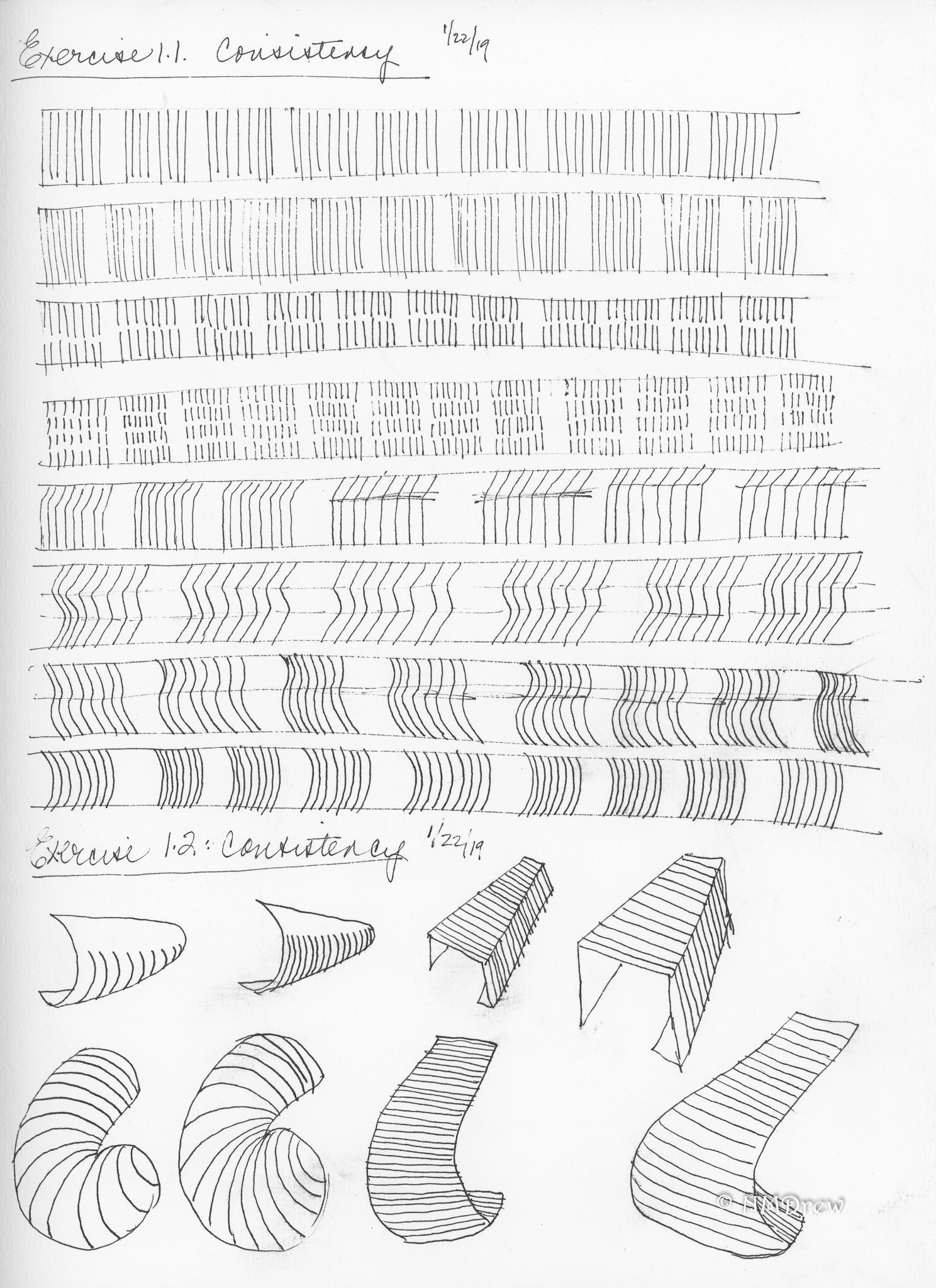
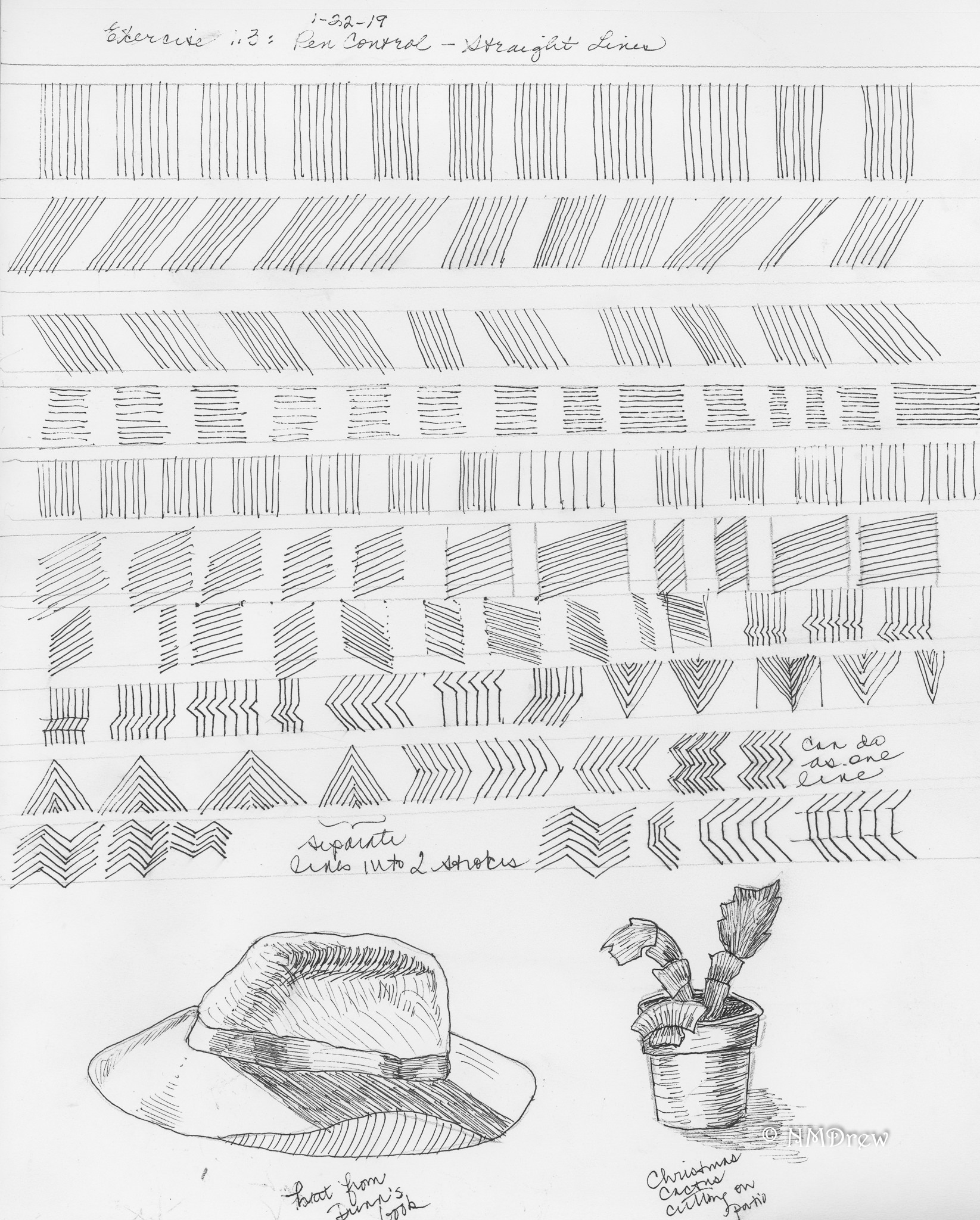
Today, rather than paint, I finally sat down and did some exercises from Dunn’s books.  The exercises were on lines – direction, shape, shift.  It takes a bit of patience and time to understand what may be going on.  I had to think about how I had my pad of paper, how far up or down my fingers were on the pen, whether to use my fingers, my wrist, or more of an arm movement.  In many ways, doing these exercises made me think of learning printing and cursive back when I was a sweet young thing.  Lines, repetition, thinking about how to do things, and doing them over and over.

Skill is bought with repetition – but repetition of itself is rather dull.  Rewards sure help!  Thus, a few drawings – one of a hat from Dunn’s book, and one of a Christmas cactus on my patio.  In each, I used straight lines, or slightly curved ones.  I thought about light and dark, repetition and straight or curved lines, or placing more lines over ones already laid down.  

To aid with the line studies, I ruled pencil lines onto my sketch paper.  It helped.  Sometimes I also drew vertical lines, or extra horizontal lines, either in pencil or pen.

Nothing like a pen in hand to make me happy!  Altogether a pleasant way to while away an afternoon.  I shall continue!

Sky and Water

More practice using wet-in-wet in varying degrees of paper dampness.  Again, this is Canson XL watercolor paper.  In my opinion, as a student paper, it is one of the better ones, having a pleasant texture as well as a responsiveness to water and color that other student papers lack.  Here, the final picture is not the point, but the laying in of washes, lifting colors, and other techniques – the practice, not the product.

As I said yesterday, I have not really taken time to learn about the paper.  This is important when you paint in watercolor – each paper has its own personality.  Once you are familiar with it, it becomes intuitive.  In my crazy life, I finally have the time to get acquainted with my paper.

Yay!

Rick & Me

About a year ago I found the YouTube channel of Rick Surowicz, and artist of considerable talent, and a formidably talented teacher.  In the space of just over a year, he has garnered 25K followers, and I am one of them.  Check him out if you don’t know who he is!

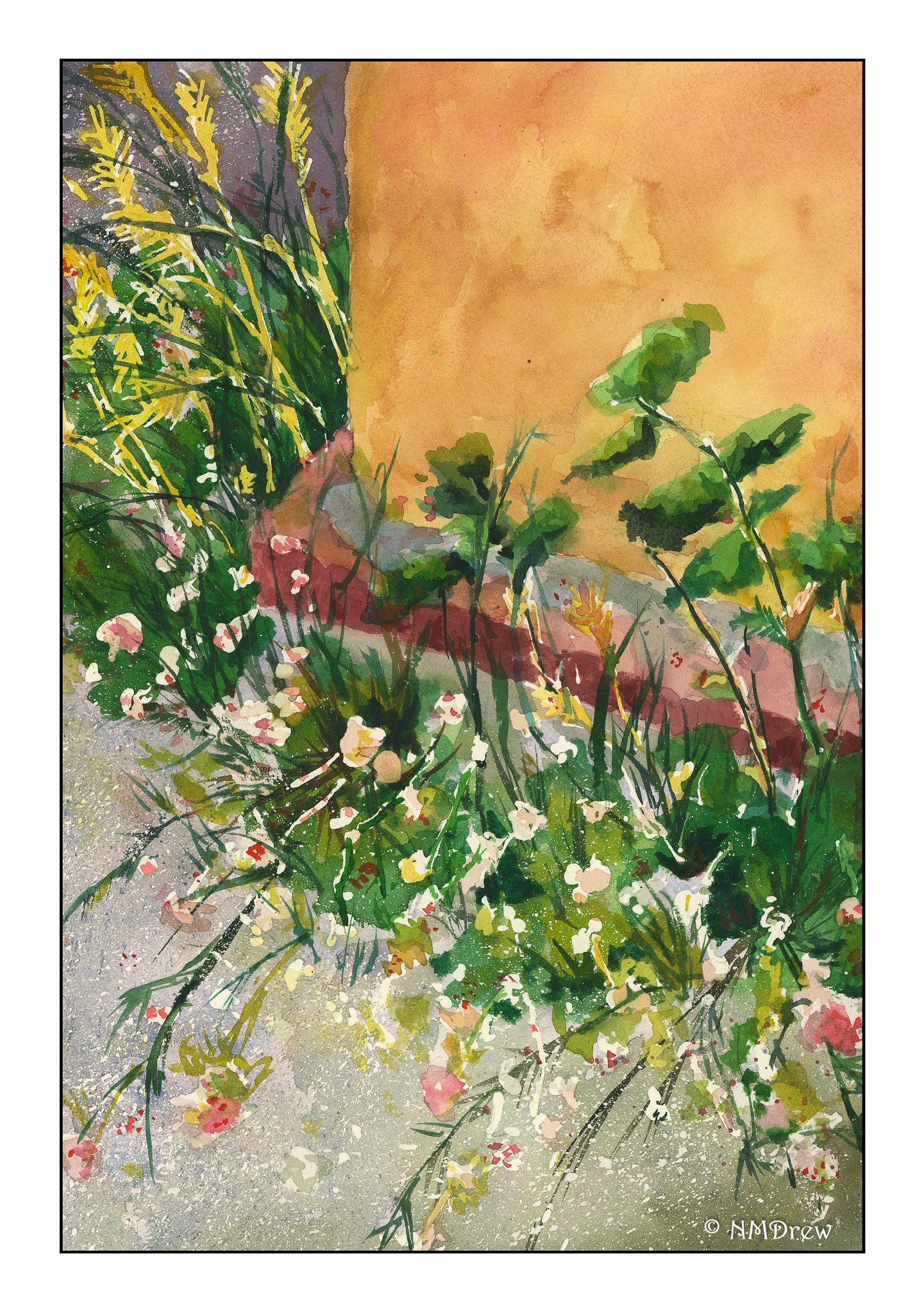
Anyway, I did two of his videos, both of which make use of frisket.  In general, I like to “travel light” – meaning, I like the idea of spontaneity for success, not thoughtful pre-planning.  The result for me is usually disaster and disappointment.  Rick’s videos are clear.  He explains what he does and why.  The results speak for themselves.  I decided to get off my don’t-panic-I’m-organic high horse and follow along.  These next two paintings are from his lessons, which I followed.  I can honestly say I enjoyed doing them, even in the moments of terror – that frisket!  those colors!  

Each one of these paintings required the usage of liquid frisket. I applied it, let it dry, and got to work. The beauty of the liquid frisket is that it allows the application of broad washes across the paper without the loss of white paper, or having to do in painting or negative painting. This actually gives a bit more ability to be spontaneous and splashy than not using it! (Surprise lesson here.) I did each of these paintings over a two or three hour period, watching the steps in each video a number of times.

At some point, we all have to try our wings. I took a photo of a weed patch behind La Purisima Mission in Lompoc, California, last summer during a visit. There were white flowers – perfect for frisket – and yellowish grasses – also good for painted-over frisket after it was removed. This painting held a lot of terror, let me tell you! However, I am fairly pleased with the end result – simplification coupled with detail.

This morning, I did this painting, derived from a public-domain photo of an aspen grove. In the photo, light was shining from the right, and in looking at the picture carefully, the trunks of the aspens, which are a brilliant white, much as birch trunks are, were actually darker than the brilliant yellow-green foliage in the distance. I used frisket for the white areas on the right of the trees, and then, as I laid down layers of color, added more frisket here and there to protect areas of color. I did this for three or four layers until I finally removed it all, and then painted in areas needing more detail or contrast.

By following Rick Surowicz’s tutorials, I finally learned something. Frisket is not scary and can be an aid to a spontaneous or splashy wash as it helps preserve white paper. In the process of copying Rick’s process, I learned a bit about color, reworking areas, contrast, and whatever. I was also able to paint a representative of a bush or leaves rather than hankering to paint the details and losing the overall effect. I am thinking about redoing the last two paintings without frisket, just to work at white space without an aid. That will be more of a challenge I think than not using frisket!