Memories of Spring, Thoughts of Summer

For me, lilies of the valley are spring flowers – late spring, for sure, but spring nonetheless. They are not native to California and certainly cannot survive the heat we get, but you can grow them in cool areas. Short-lived, they add a bit of beauty and mark the transition into summer.
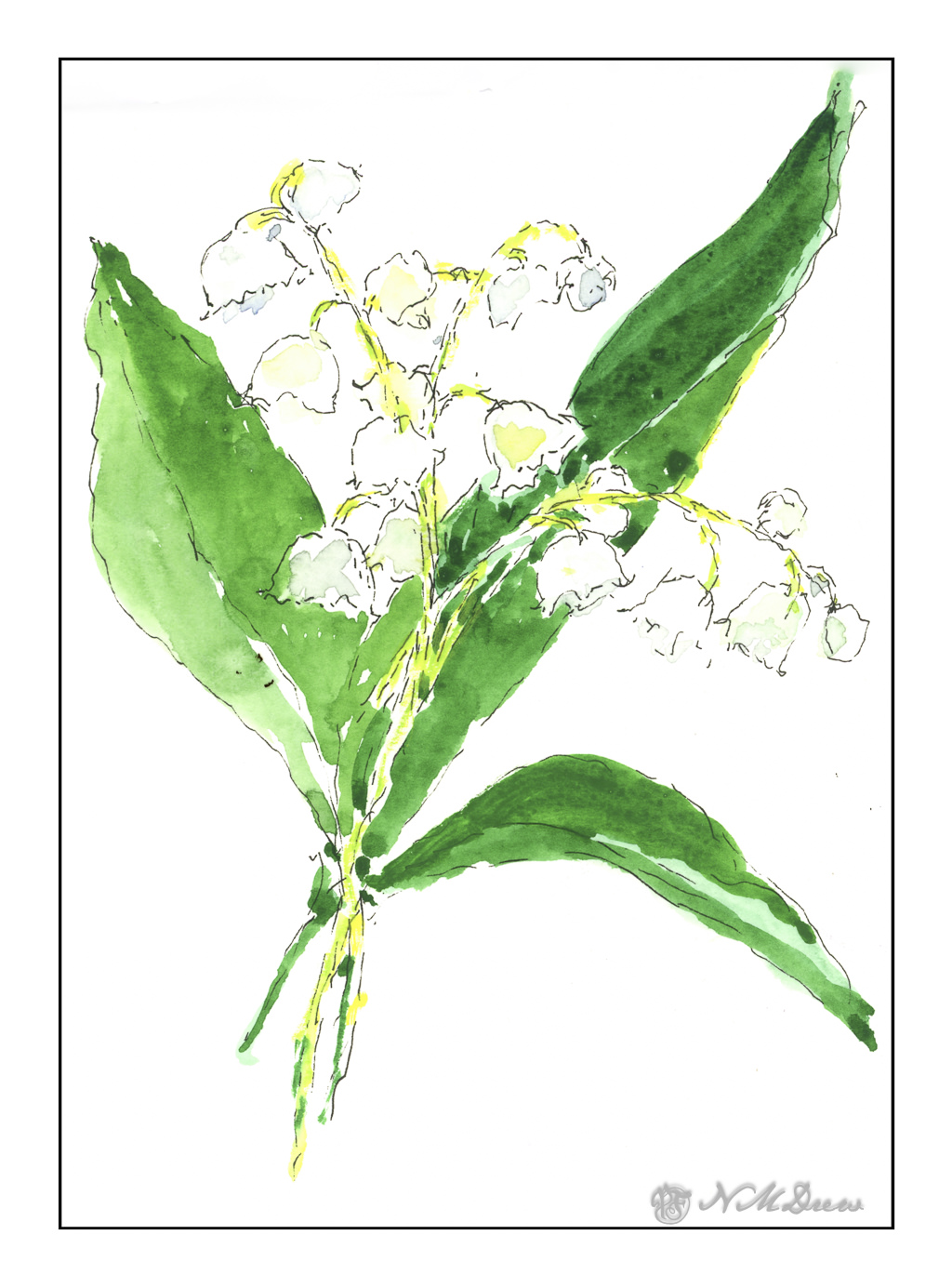
Today is cool and grey – May Grey for California! – but it will warm up later on. The sun will come out inland – we live one valley in from the Pacific – but may not show itself along the coastline. Our spring has been wet and gloomy with bits of sunshine in between, but as we move toward summer, heat and watermelon and cold drinks come to mind. (Meanwhile, I am enjoying my hot morning coffee!)
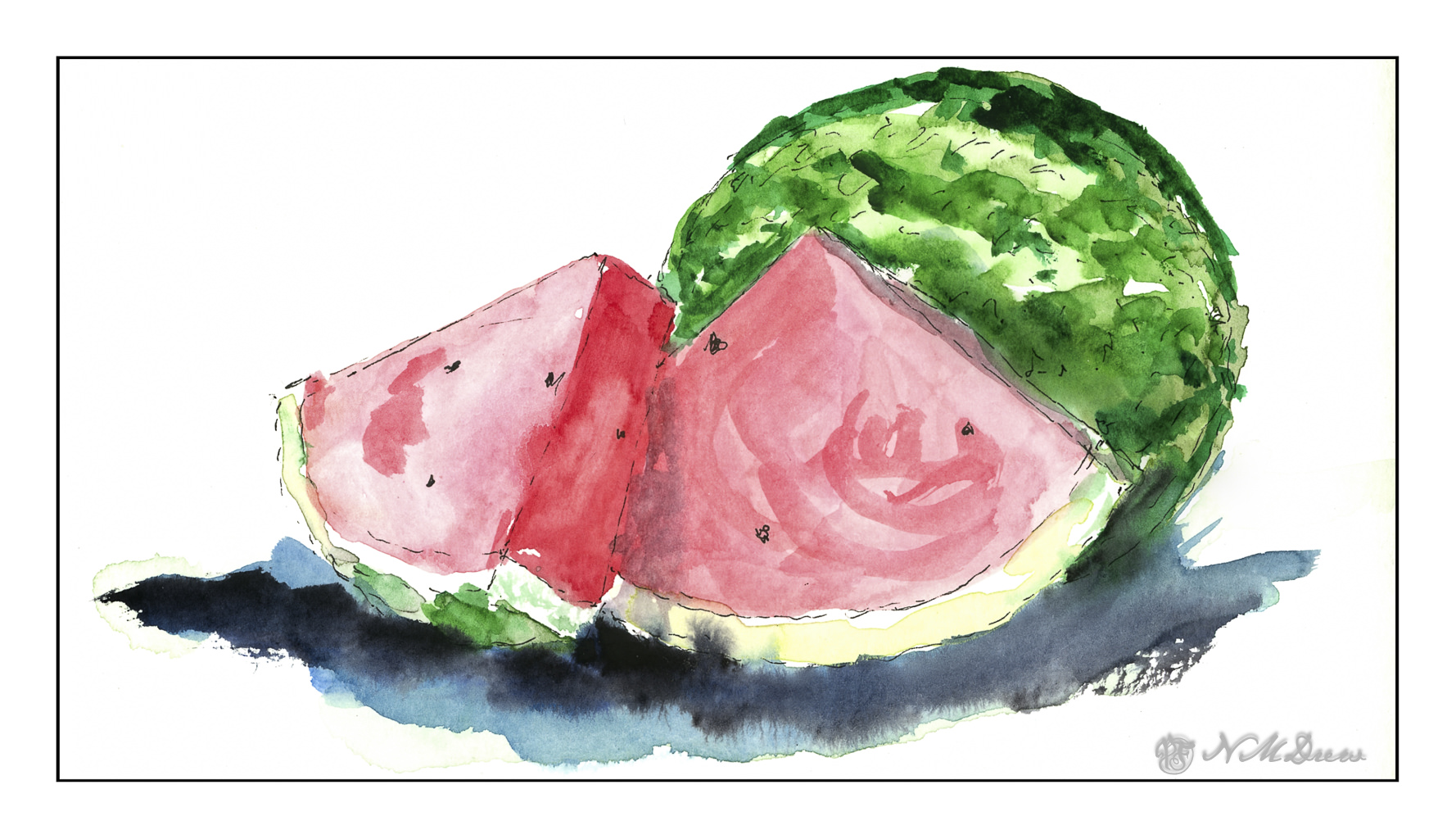
Seasonal transitions – things to say goodbye to, things to welcome. I myself have been in a phase of transition, too. I am learning to play the ukulele, working on oil painting sewing, gardening. All of these take time away from blogging, which is rather nice, really. Still, the fact is that ink and watercolor, individually or together, always beckon, so before I even started the day, my sketchbook came out, colors and ink. It all makes for a good way to start the day, beating dishes and laundry and other housework by a good ten miles!
Last Day of April – Morning Sketches

The last few days have been the quintessential spring days in Southern California – and I have been outside, but never enough. I planted some tomatoes and cleaned up some plants in the patio garden, basked in the sun, and have done very little. Today, though, pen and watercolor beckoned with the morning coffee, and the colors of spring and the outdoors called.

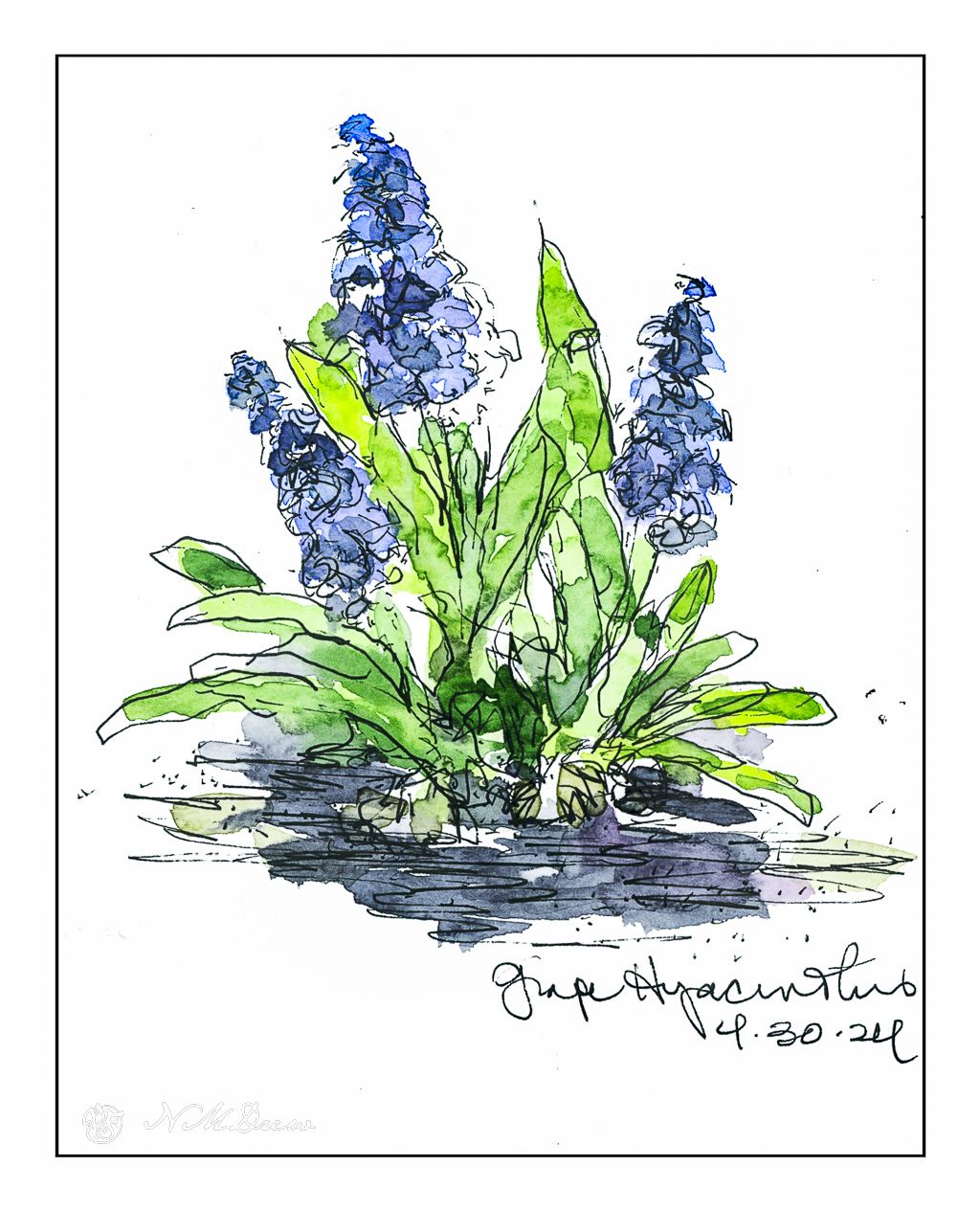
Grape hyacinths are so odd to me! I am used to the big ones, in pinks and blues and flower petals which curl outward. Grape hyacinths make me think of little bells. This is the first year I have ever grown them, and short-lived as they were, they were so much fun to see. Bulbs always make me happy, and I have a variety of them, such as iris, ixia, daffodils. Bulbs need to be hybridized for our warm California winters, so they are not so rare as they used to be, but never seem as exciting as they do when they flower in a patch of snow.

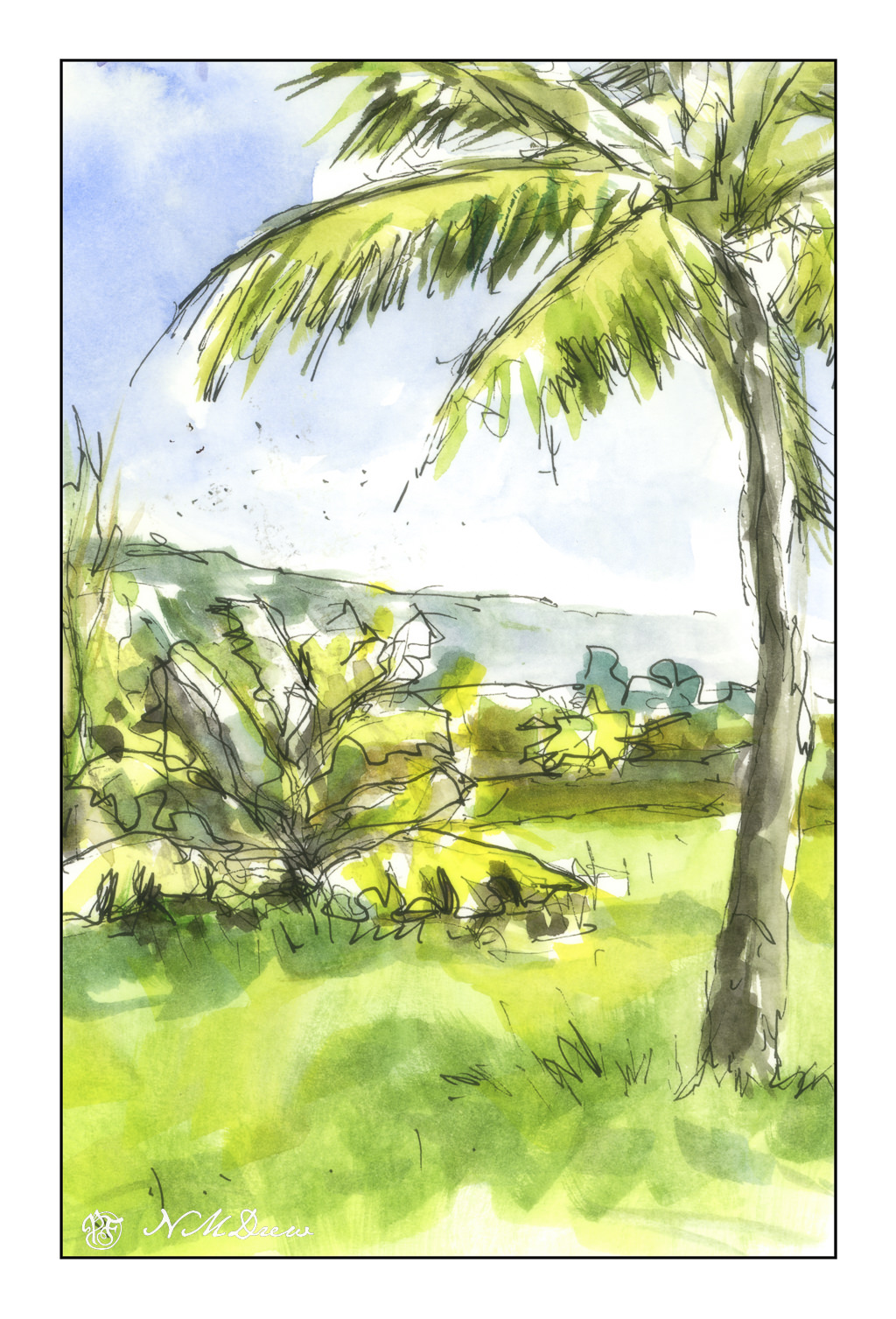
I was poring over some photos I have, taken by me or collected through Pixabay and other free online royalty sources. Palm trees and banana plants. I did this to practice dry brush on a wedge brush – nothing great but it accomplished what I wanted – a soft bit of blending, such as in the foreground.

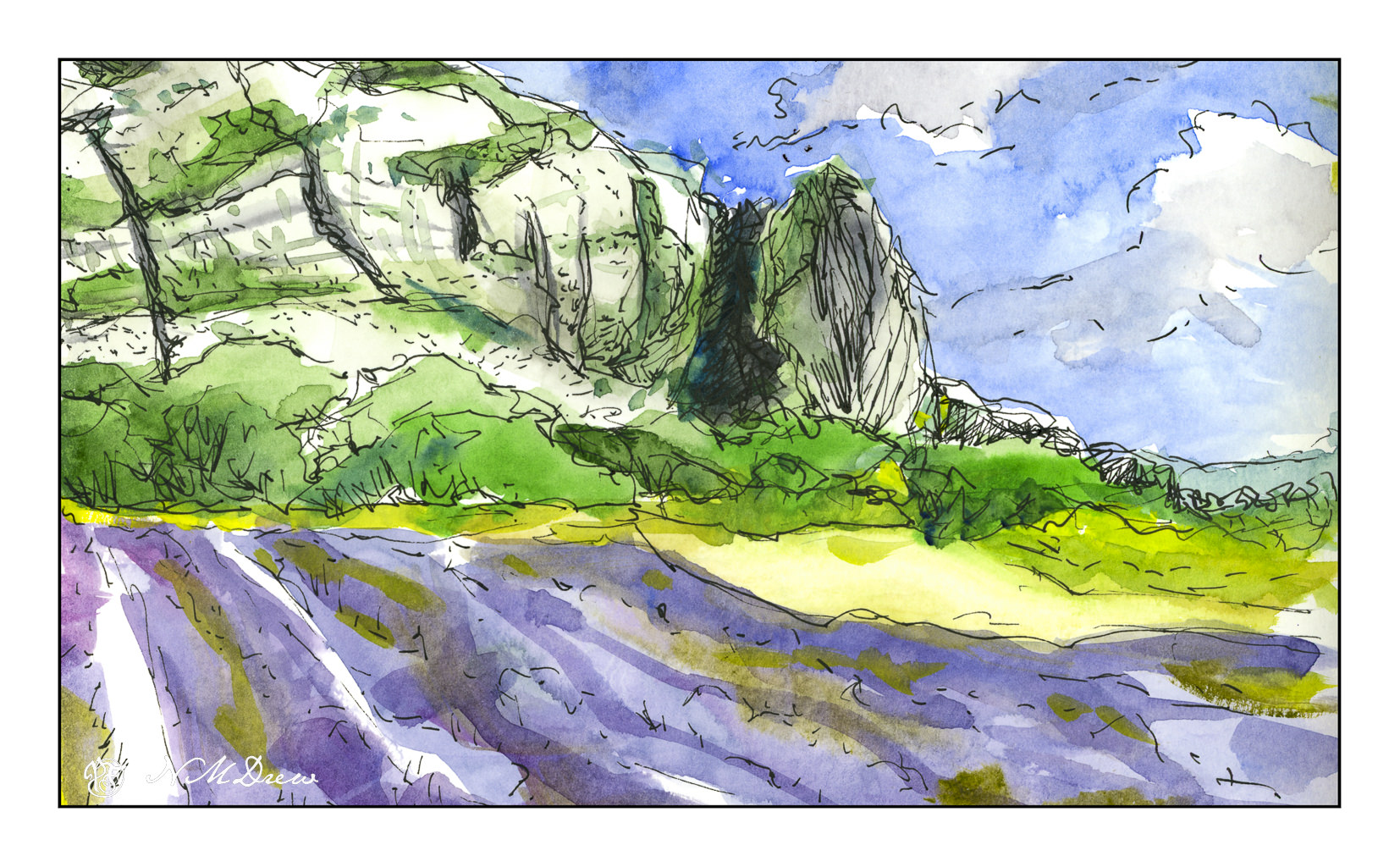
Once more lavender fields in Provence and other areas of southern France. In particular, mixing lavender that is bluish is a challenge; here, in watercolor, I diluted my purples with some blue and rose, as well as some greenish colors to suggest the lavender’s foliage. The scan didn’t do a great job. Additionally, I wanted to capture the texture in the rocky faces of the mountain, cracks vertically and horizontally in the bare stone.

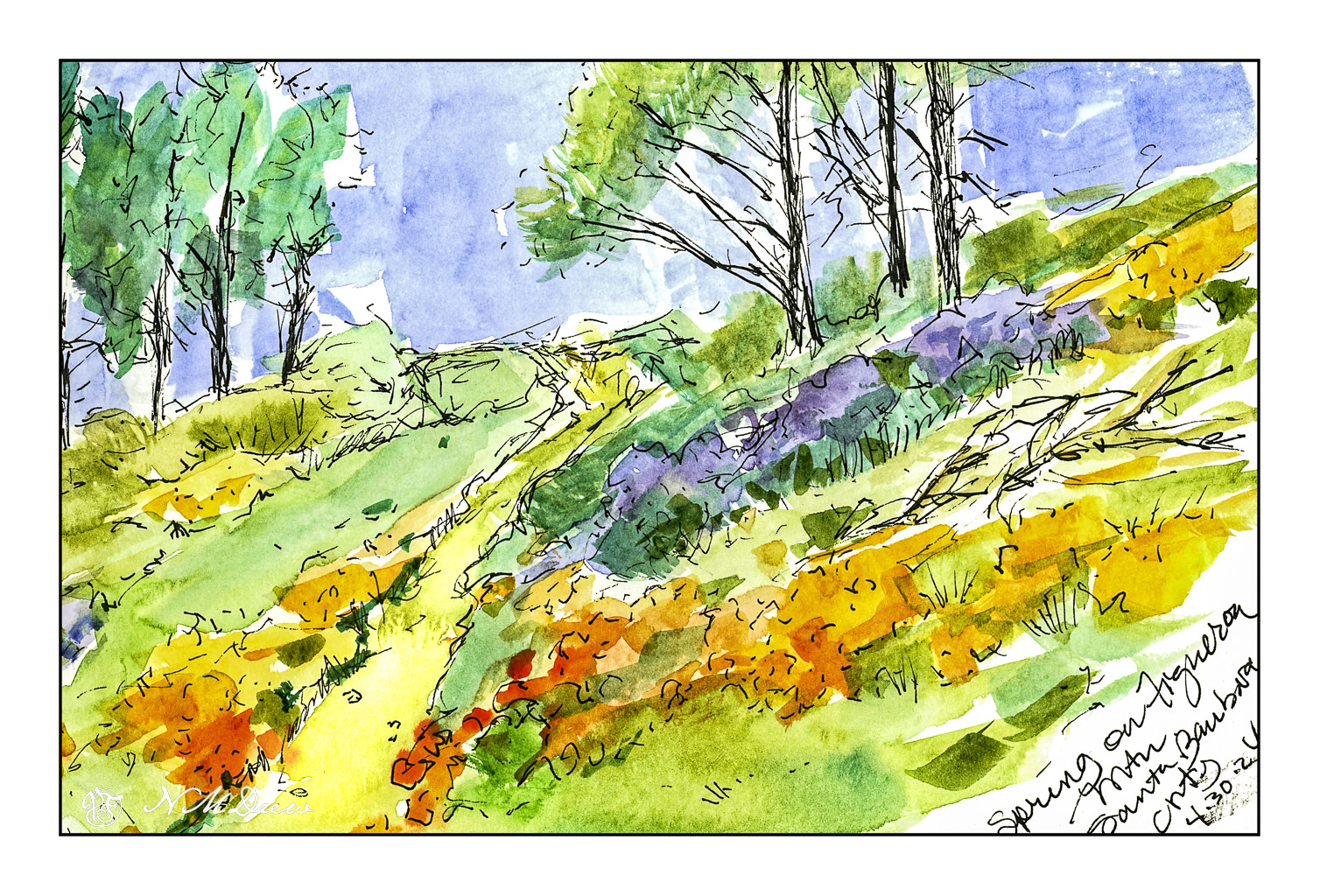
Finally, a favorite place of mine – Figueroa Mountain in Santa Barbara County. In the spring, lupines and poppies bloom, and the view across the Santa Ynez Valley extends for miles. To me, this is the epitome of a wonderful time of year in California. It is when the rains turn the hills from brown and dull to an intense display of yellow, gold, and purple.

Drawing with ink and watercolor is pleasant and relaxing, and doing it in a sketchbook takes away the desire to create a masterpiece. Here, exploration, play, practice.

Carbon ink on watercolor paper; Rosa pan watercolors.

Before Class

Every Monday afternoon I meet up with a class in oil painting. I paint oils at home, too, and they take far longer to dry than ink or watercolor. Hmmm. I really do miss those two quite a bit, so today, before class, I decided to do two quick sketches and use a bit of watercolor.

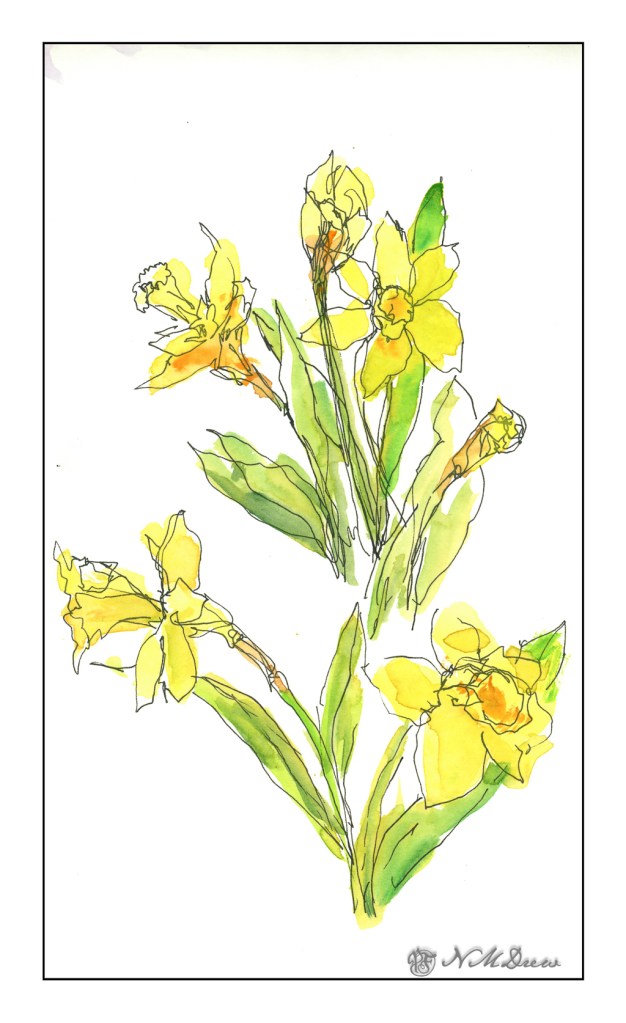
The first was daffodils – obviously! I have several in pots, some blooming and fading already, and others sending up leaves and stems and buds. Spring flowers for sure. I have some freesias which are just beginning to bloom, so perhaps some of those later on.

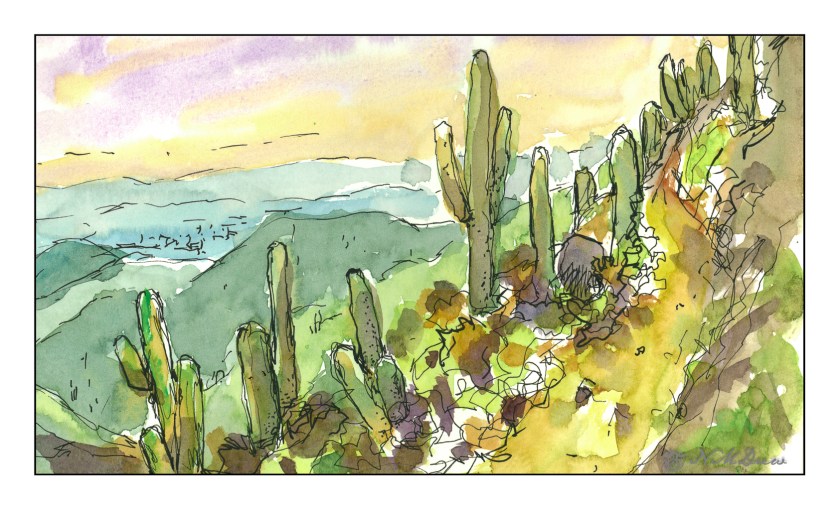
And then some saguaros from the Sonoran Desert. Sunset is always fabulous in Arizona, and here we are overlooking the metroplex that is Tucson / Phoenix in the distance. I am still amazed by these wonderful cacti – so tall and elegant, and silhouetted against the sky they are even more amazing.

Okay – time to pack it up and head out to class!

The Not Taken Vacation: Ronda, Spain

Located in the province of Malaga in southern Spain, Ronda is about 65 miles northwest of Malaga, Spain. It is a “white village” located in Andalusia – a vast region along the Mediterranean and inland – but it is more than just a “white village” as it is home to what I think is one of the most fascinating bits of architecture, the Puente Nuevo. We will explore that famous bridge later on, but for now, let us just enjoy the magnificent scenery of this lovely place.

Ronda has been settled since neolithic times, but the 6th century seems to be when itself became a more settled area. It is marked by cliffs and canyons, as you can see below, but it is also built up on either side of the Guadalevin river. As the countryside is steep, getting from one side of the river to the other is a bit problematic.

These buildings are on one side of the Puente Nuevo. They stand on steep cliffs. As someone without a head for heights, I am not so sure I would want to stand on a balcony and look down – but I think looking across would show some marvelous scenery. Also, coming from earthquake country with unstable soil, my thoughts are, oops! – why did they build there? However, I expect things are far more stable than they are in my neck of the woods as this is an area where a bridge spanning a canyon 400 feet deep and completed in 1793 still stands.

So much to see in the south of Spain! To be continued!

The Not Taken Vacation: Tram Ride in Lisbon

Lisbon is a very hilly city! Can you imagine huffing and puffing your way home, to the market, to the sea, to the museum, to the doctor, to the park, to your mother’s Sunday dinner, to anywhere?

No?

Me neither. (My days of training for the Olympics are long gone.)

Enter the tram. To learn about the history of the tram in Lisbon, Portugal, Wikipedia has an interesting and fascinating article. Some of them are two-way, meaning one on the left and right of a main street, and others, such as this one, go one way up and down narrow, winding roads.

I am sure that there are many things which typify Lisbon, but for me, a tram ride would be my first thought. This way you can see the streets of the city, look at houses and architecture, see people away from tourist spots. A single track – such as here – chugging through they neighborhood – with very narrow sidewalks on either side makes, in my imagination, for a rather scary experience. And cars in front of such a tram? A child chasing a ball? How fast do these trams go?

My mother recalled the electric buses which ran throughout Chicago and its environs as a kid. It was often the only way to get anywhere for most people. Horse-drawn ice wagons, too, are part of her childhood memories, as were the Cossacks on horseback in Poland those of her parents. I have driven since 16, and have used public transportation very little. Cars are my way of scooting around. However, the cable cars in San Francisco are world-famous and first class fun – I would take those any day. But, for now, I must suffice myself with an imaginary ride on a tram up and down the hills of Lisbon.