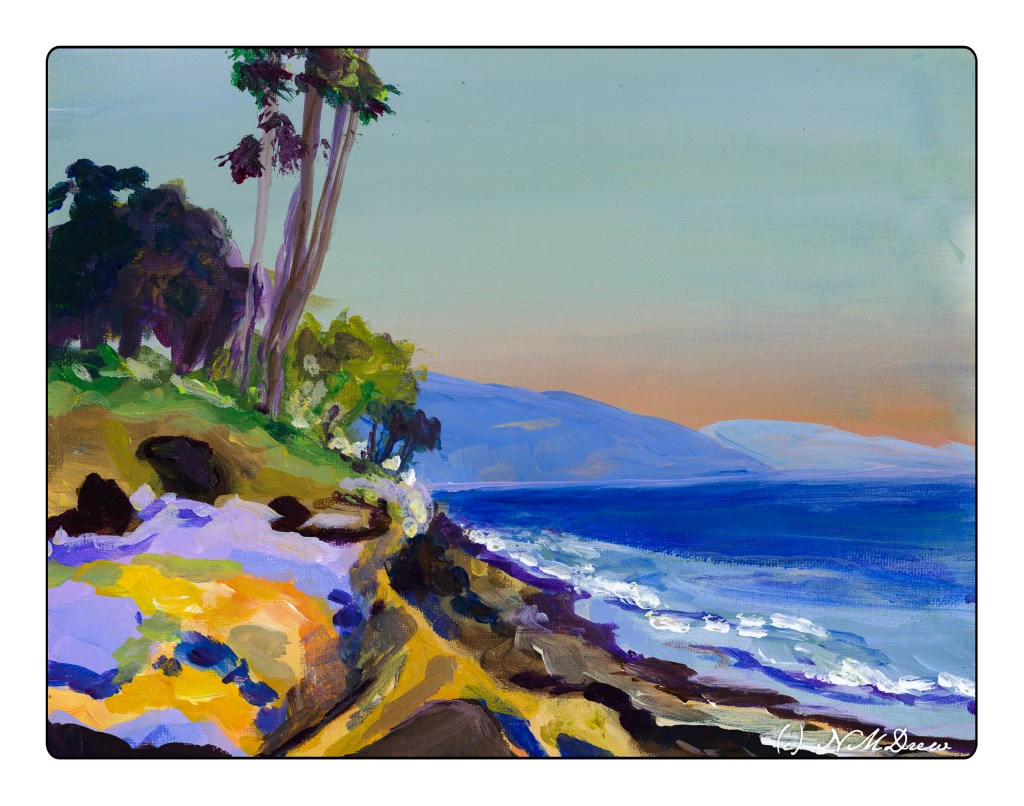
Lavender Field

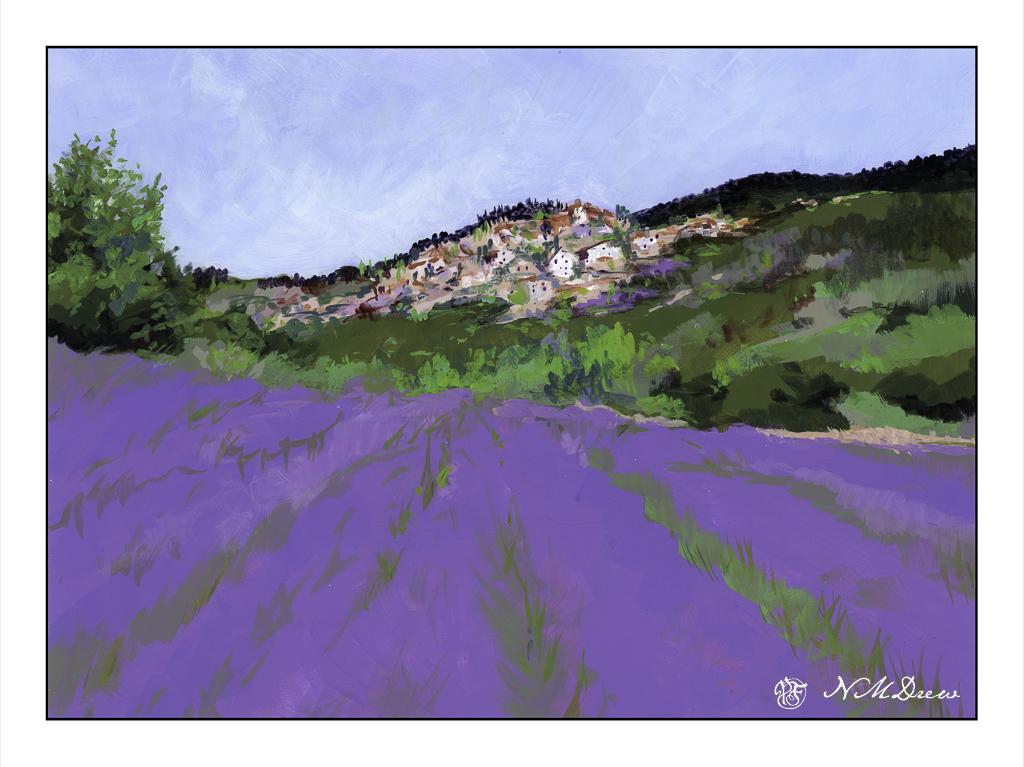
Pixabay provides such a wonderful range of photos for free! This is based on one, a lavender below a village in France, which I think may be Bonnieux.

Yesterday I bought a number of fresh bottles of Golden Fluid Acrylic Paints. These are thinner than traditional heavy body acrylics, and unfortunately their color range is not equal to that of the tube paints. However, I have a number of small bottles, but my fresh ones are 4 oz. in size, and that will give me a lot of paint for some time. After playing a bit yesterday with the colors, mixing some, and then finding the ones I had did not meet my color needs, I ordered a few more from Amazon. This allowed me to get brighter spring greens and a good color for the lavender.
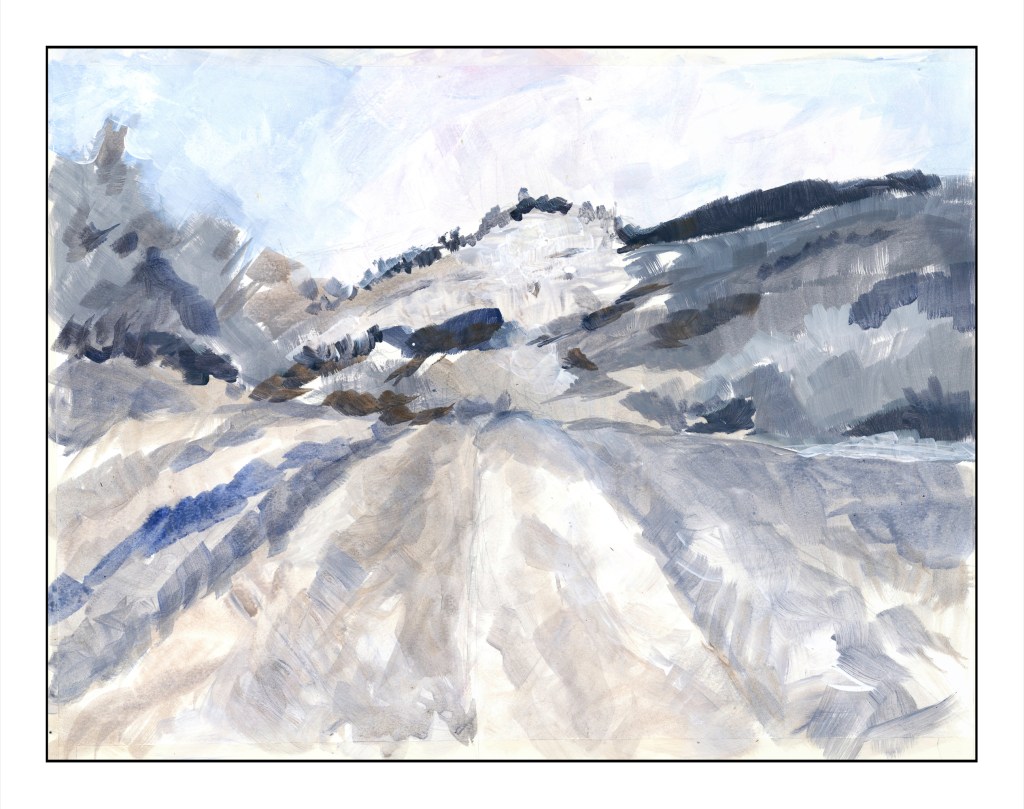
Yesterday I taped 1″ wide tape along the borders of a pieces of Canson XL watercolor paper in block format – 16×20 I believe. Then, I sketched in with pencil and laid down a foundation of values which gave me a sort of road map as to what I was going to do.
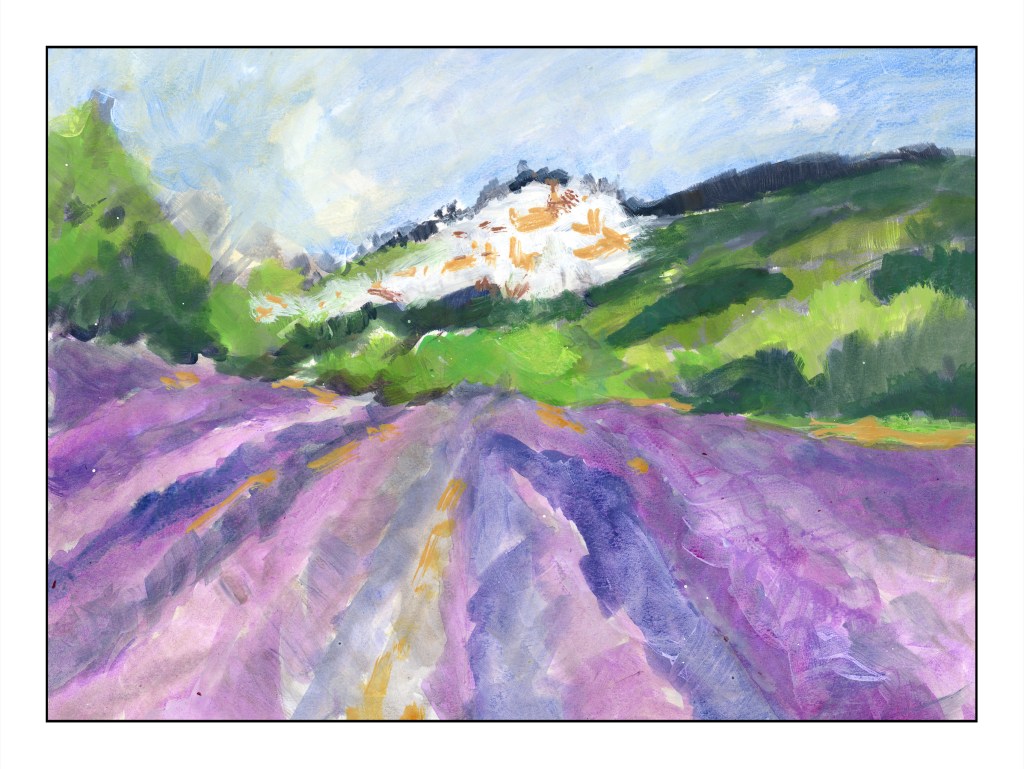
This is my second layer – colors this time with some values. The idea I had when I started out is I did not want to do a bunch of dabbing, which is my normal style, but instead make large swaths of flat color in the foreground lavender with some detail, and lead the eye to the village on the hill. To do this I used the lines of the lavender to lead the eye to the middle ground, but then chose brighter and warmer greens to sort of point to the village – lookie here!

I am not too sure how successful this is as a painting per se, but I am quite pleased with it. This is my first attempt at a big painting with the fluid acrylic paints, and as with all acrylics, I had to work with the quick drying time of the medium. The fluid acrylics were easier to use in a lot of ways than were the regular tube paints just because I didn’t need to work at diluting them. Straight out of the bottle, they work quite well. Shaking them a bit before use is a good idea, too. I will be ordering more titanium white as I have used a lot of it to just make this painting.

I hope you like this! More to come!

Apple, Anyone?

I was feeling rather depressed by my rather poor watercolors of the other day – so, time for a break. What to do? Well, how about a bit of serious cleaning up of stuff that this gal has accumulated? What I am talking about is my bill and finance drawer. Need I tell you what was in it – nay! But let us say I shredded up about 4-5 fifteen gallon trash bags worth. Now there is a lot of room in the drawer, it is organized, and I have made the resolution to shred unnecessary items about every other month.

Okay, stop laughing. There is a definite pack-rat gene in the family, specifically on the paternal side (sorry, Dad!). De-pack-ratting requires a break, and a break from watercolors means using something else. Enter revisiting pastels. I did an apple.

I was doing pastels a few years ago and really enjoyed the medium. It is a combination of painting and drawing, both of which I like. Apples are rather generic and very recognizable, and cheerful, too, if you like bright red. I do like bright red, and so here we are.

I think I am going to be doing pastels for awhile. I need a bit of a break and a change from watercolor, even though I am really trying to work hard at it. The only drawback to pastels is the dust, but I wear an N95 mask and clean up the dust with a damp cloth afterwards. Here, Nupastels and Rembrandt soft pastels, and a touch here or there with a pastel pencil. I have some fixative arriving tomorrow which supposedly will not darken the pastel painting much. The paper is Mi-Teintes, reverse surface, painted upright.

Monochrome

For the past few months I have been taking a number of classes in watercolor and painting. Throw in an occasional Pencil Portraits in the Park classes, and you can see I get a bit busy.

Magpies like bright things, and I am convinced I am a magpie reincarnated. Hawaiian shirts are a particular delight. Color in any form, the brighter is usually the better, even if it borders on poor taste. Oddly, I do enjoy black and white photography – it can be quite beautiful and dramatic – but painting value studies, monochrome, has eluded me as something to enjoy – until now!

I have been taking an online class from Ian Roberts for the past few months. It began with value studies in pencils. Now we are doing value studies in paint. Some people are painting in watercolor, others in acrylic or pastels; I decided to try out oil paints for the first time in years – nay, decades – and am pleased with the results. It is a hell of a lot of fun to moosh around paint and be able to moosh it around the next day, unlike acrylics. (You can also use gouache to pretty much the same effect.) With our weekly Zoom meetings on Saturday mornings, Roberts is providing great feedback and a personal, technical, and esoteric touch to what are foundational elements in art.

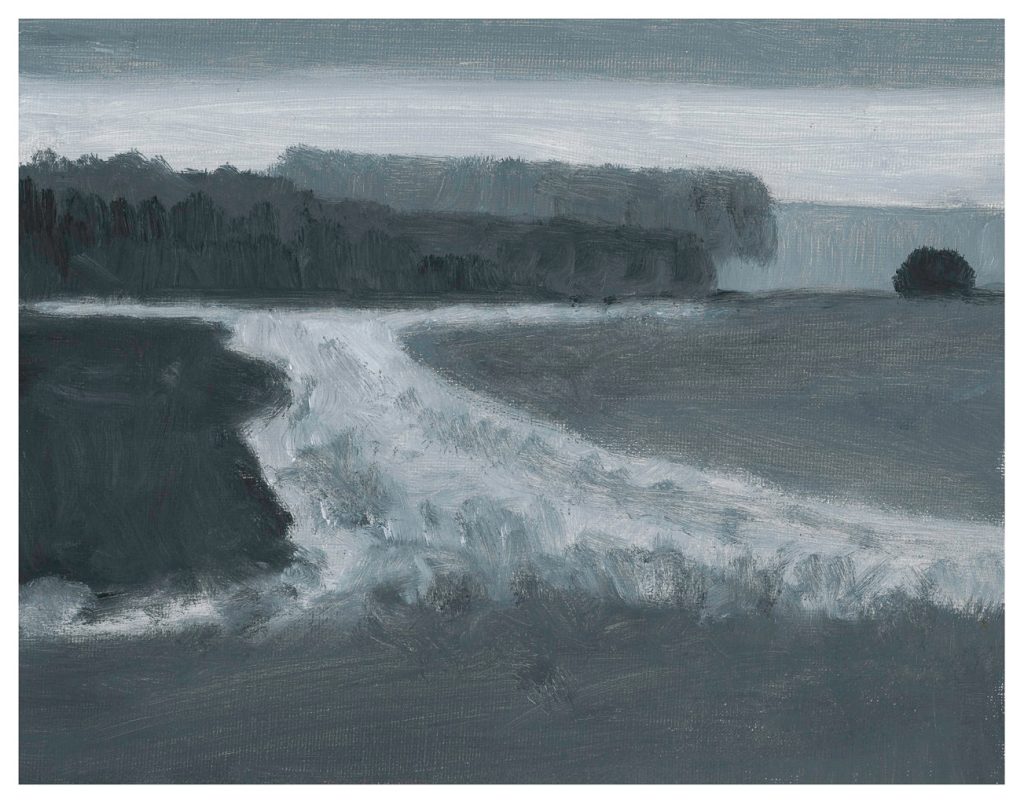
Above is my first oil monochrome. I didn’t do a great job of replicating the picture, but I did get reacquainted with how to use a brush with oils. I am using hog bristle filberts if you want to know. While we are working on values, we are also working on leading the eye. Here, not a lot of success as the road or white area in the mid left is too bright – the eye is to be led to the right.

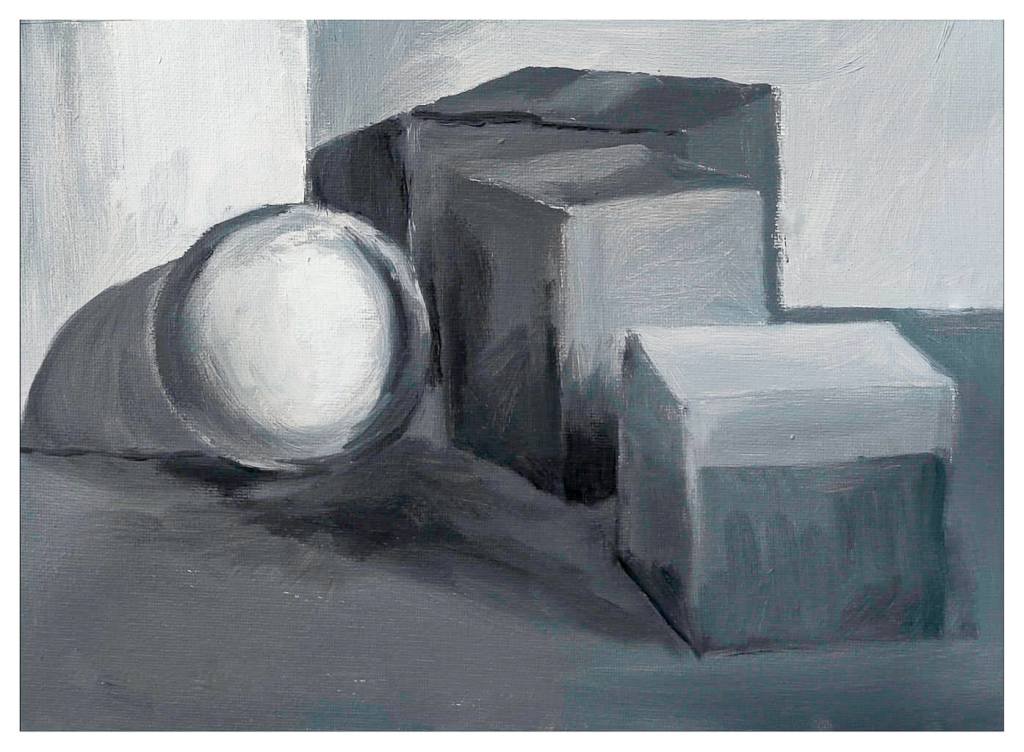
This is from the second week. Focus is on values and edges, the latter being hard or soft or vanishing. I enjoyed this a lot, even though my sphere needs a bit of anchoring! It really helped me to see a bit more sharply.

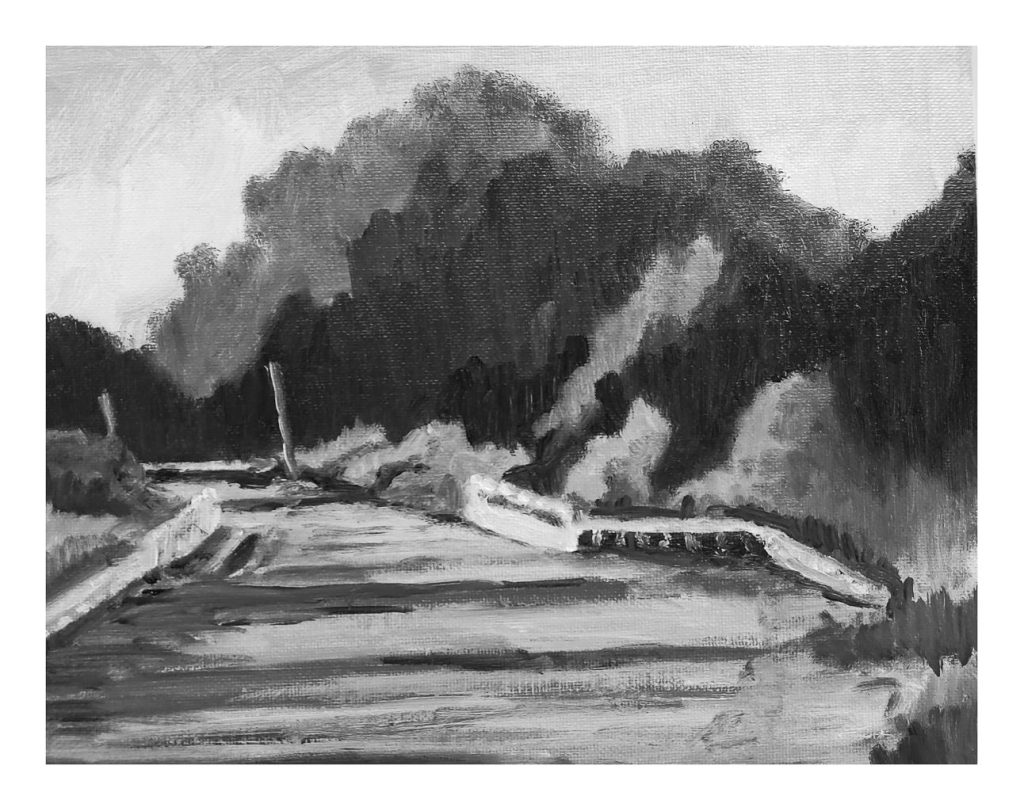
Roberts did a demo version of the still life, and then left us to find our own way with the landscape. Oils are a bit of a challenge to use because of their long drying time if you want to paint over something. As a result, I cannot scan them, but have to take a photo while they dry. Wet surfaces are a bit shiny, and the texture of the paint and canvas are more challenges to creating a digital image. This study made me see things differently, and one element I had to do was to edit the photo – simplifying it – to work a bit on the painting to make it work. Not great, but values are getting easier to produce.

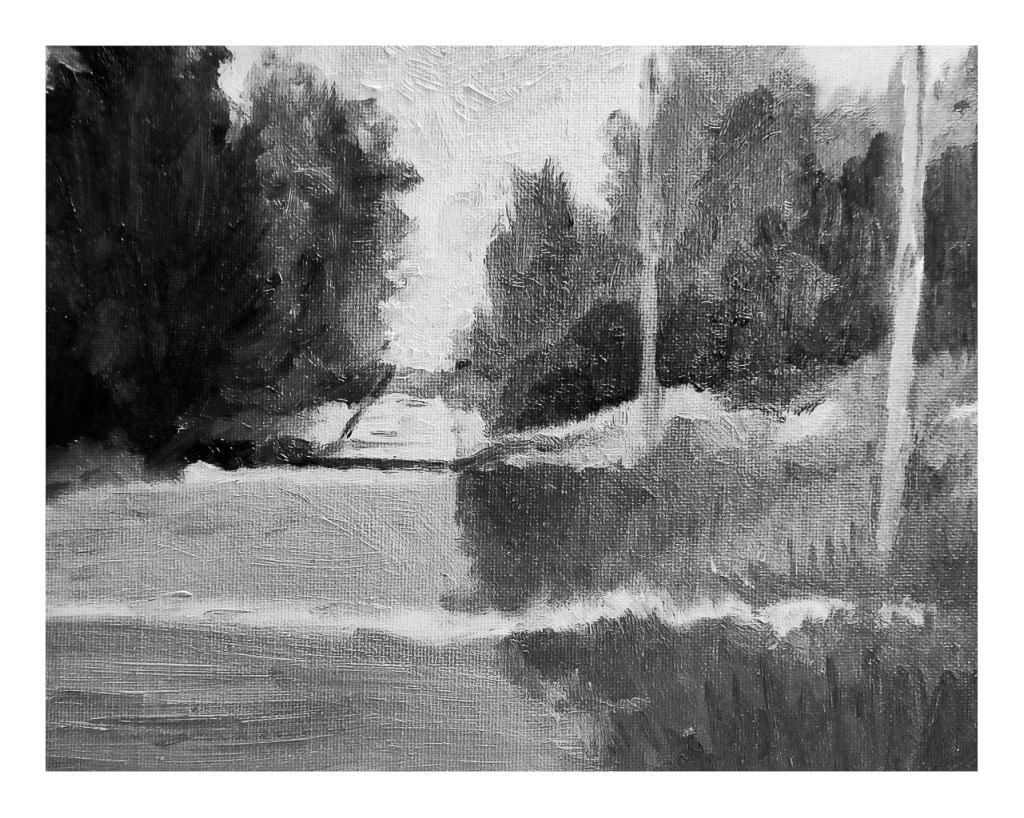
Here is one of the two studies for the third week. I did this yesterday, outdoors on the patio. I lugged out this and that, found I forgot something, ran back to get it, and it was a Big Production. But a fun one! I still need to work on this one a bit – the 2nd pole on the right needs some sharpening and the road in the distance needs a bit of work. Once more, the photo is lacking, but what can you do?

So, my painting world is suddenly black and white, and I am enjoying it. I’ve decided to do “daily painting” when possible, on other subjects as well. It will be interesting to see where all these monochrome studies take me, and when Roberts lets us to add yellow ochre to our titanium white and ivory black to learn more about warm and cool values, I think the world will change even more . . .

Across the Dunes

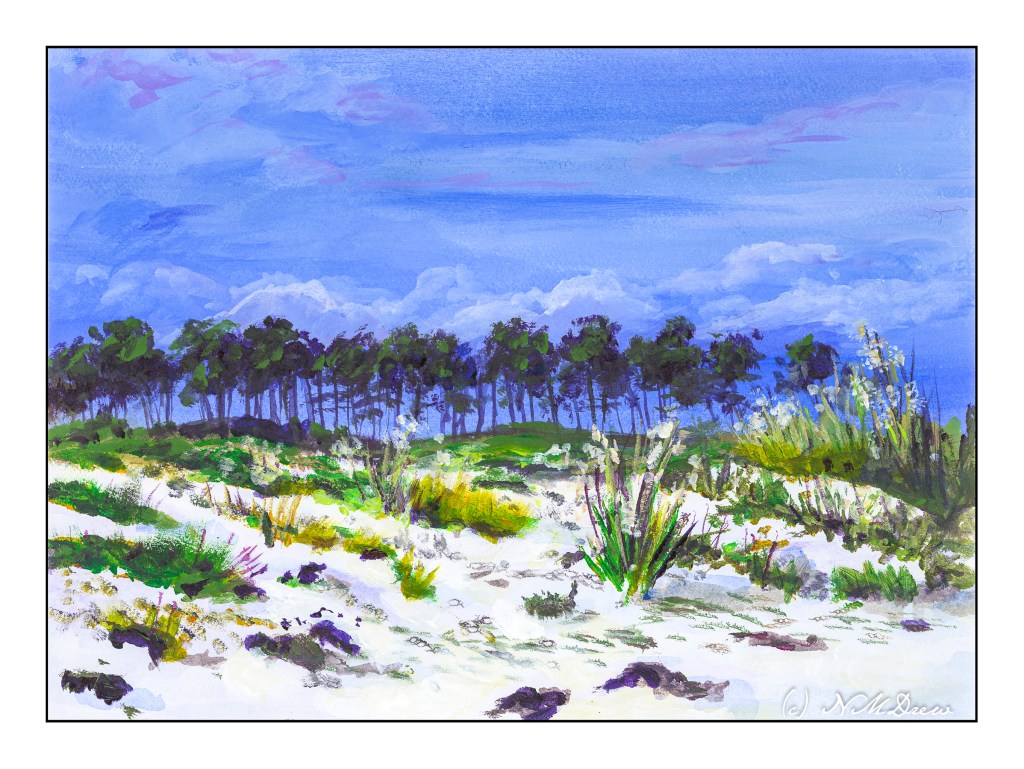
I enjoy gouache a lot because you can rework places and easily blur edges to soften them. That is a lot harder in acrylics. I decided to give it a shot. It worked rather well for the sky, but like gouache, the whites in the clouds darkened more than I thought they would. On the other hand, I did work on the sand a bit, using very thin water glazes for the shadows. That worked out pretty well.

I realize the key to “getting” acrylic painting is to just keep doing it, experimenting, trying. Each painting, successful or not, is a lesson.

Acrylic paint on unprimed Arches 140# CP. 9×12.