Somewhere in Ventura County

I have been taking classes from a local teacher and artist, Harvey Cusworth, through a seminar and adult ed classes in oil painting. He is an experienced teacher and one who pays attention to each student, gives good suggestions and advice. Additionally, he is an experienced teacher which, in my opinion, adds a lot of value to a class as he is very aware of how a classroom of unruly kids or adults can act!

In the seminar we started landscapes, but because of getting sick, I missed two of the classes along with a number of adult ed classes. I decided to continue into the adult ed class the landscape I had started in the seminar just because I thought it challenging but also something I wanted to paint – a landscape from the back country here in Ventura County.

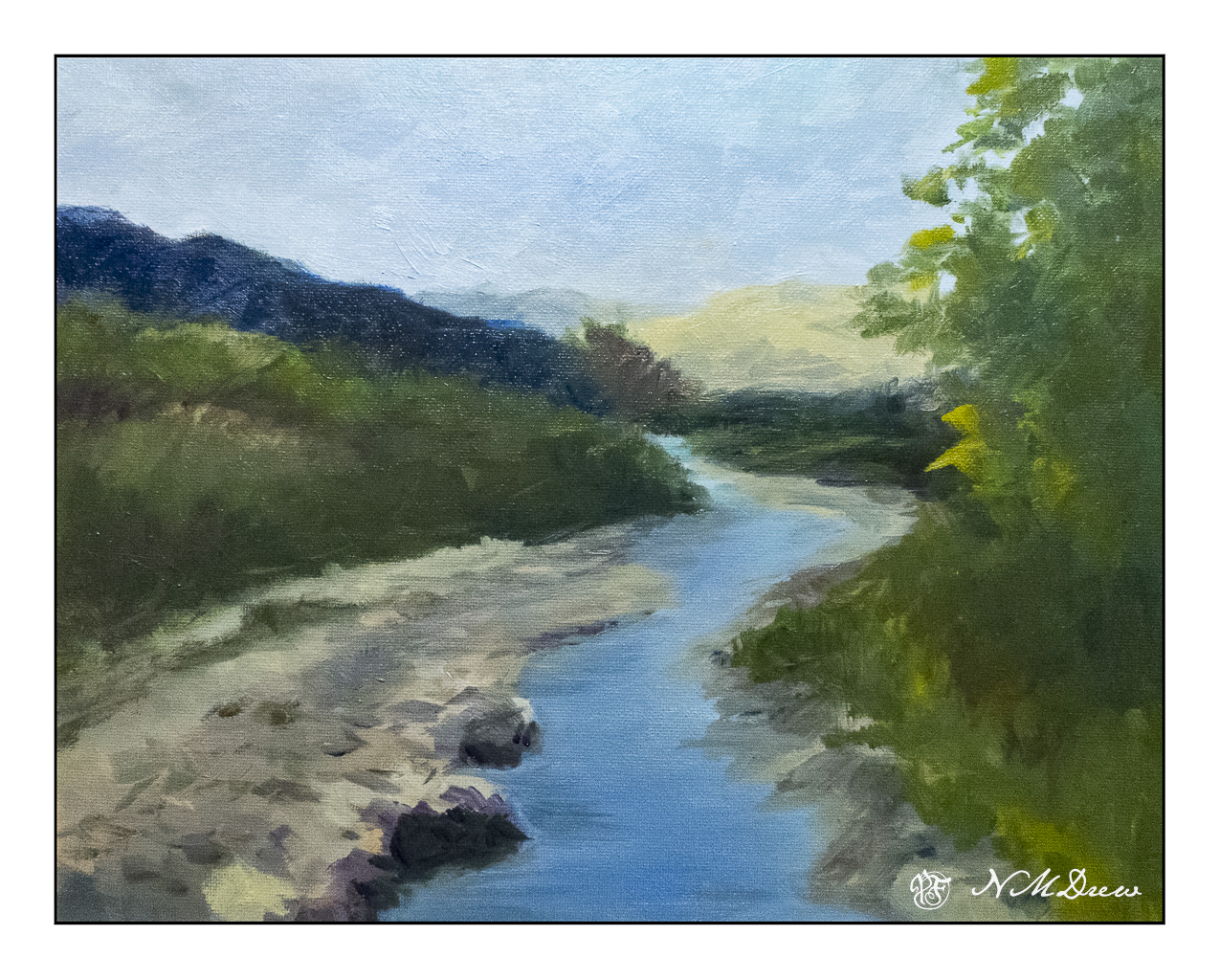
First: my final (as of this writing) version of the painting.

And now, it’s evolution. First, Harvey’s photo which was the subject matter – in color and then reduced to black and white to get a sense of values.

Photograph by Harvey Cusworth

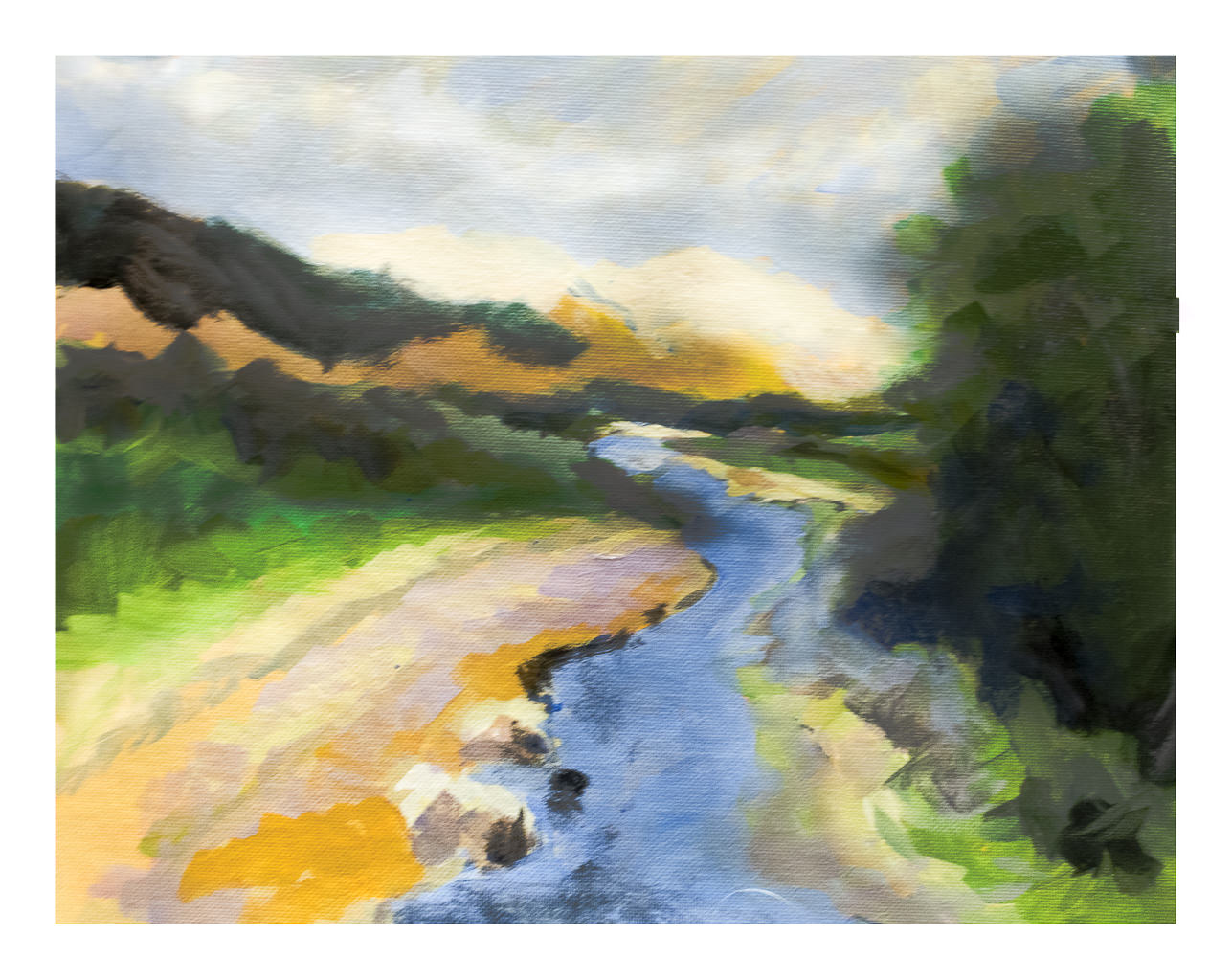
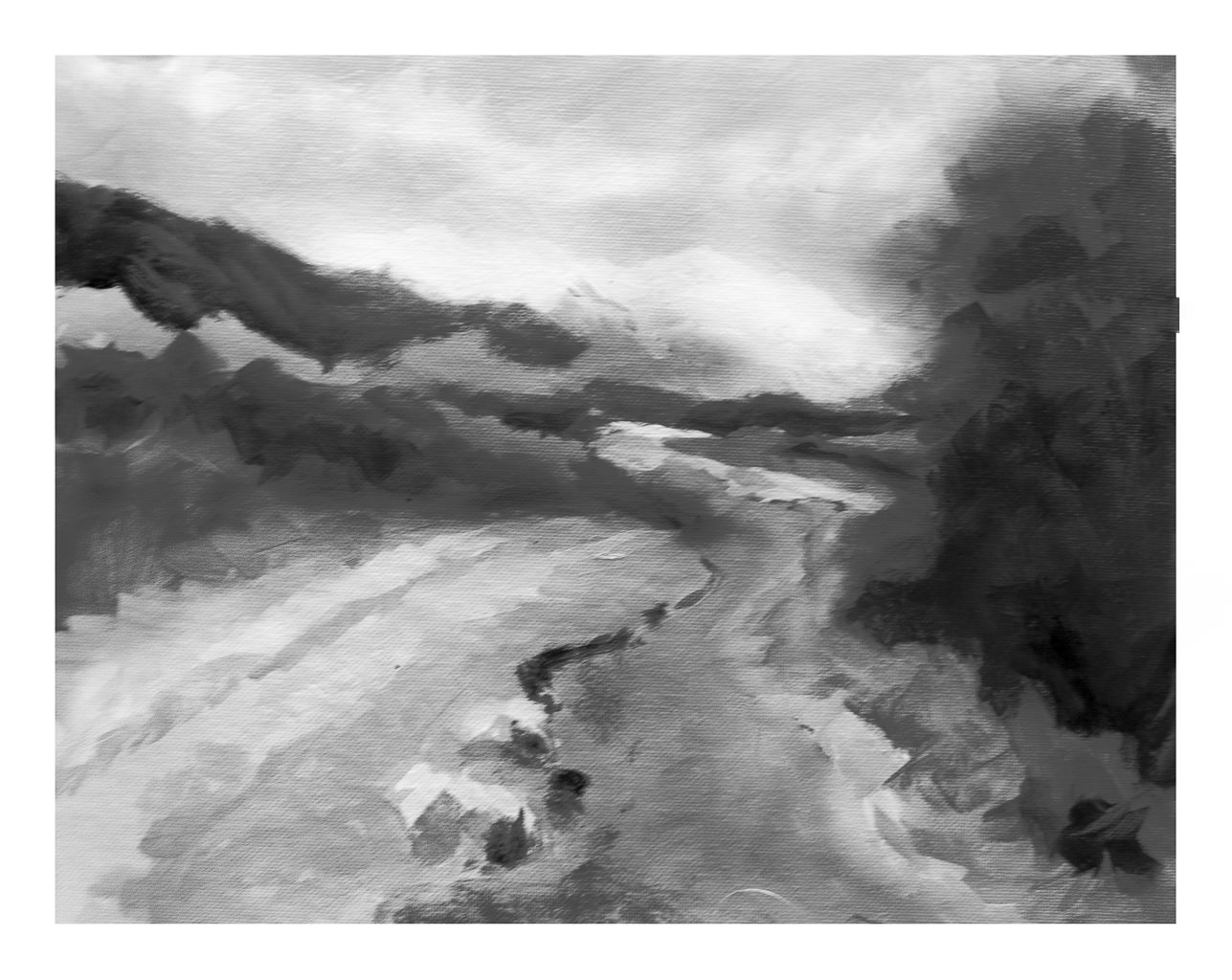
Next, my own rather goofy value study, painted in color and then reduced into black and white.

Underpainting

This painting is done in oils, and has taken me several hours over several days to complete it. Even now, I have to let it sit and dry and regard it a bit more carefully to see what I think of it. As it is still wet I took a photo of it, and in places there is some glare, seen more clearly when enlarged. 11×14 on a cotton canvas panel.

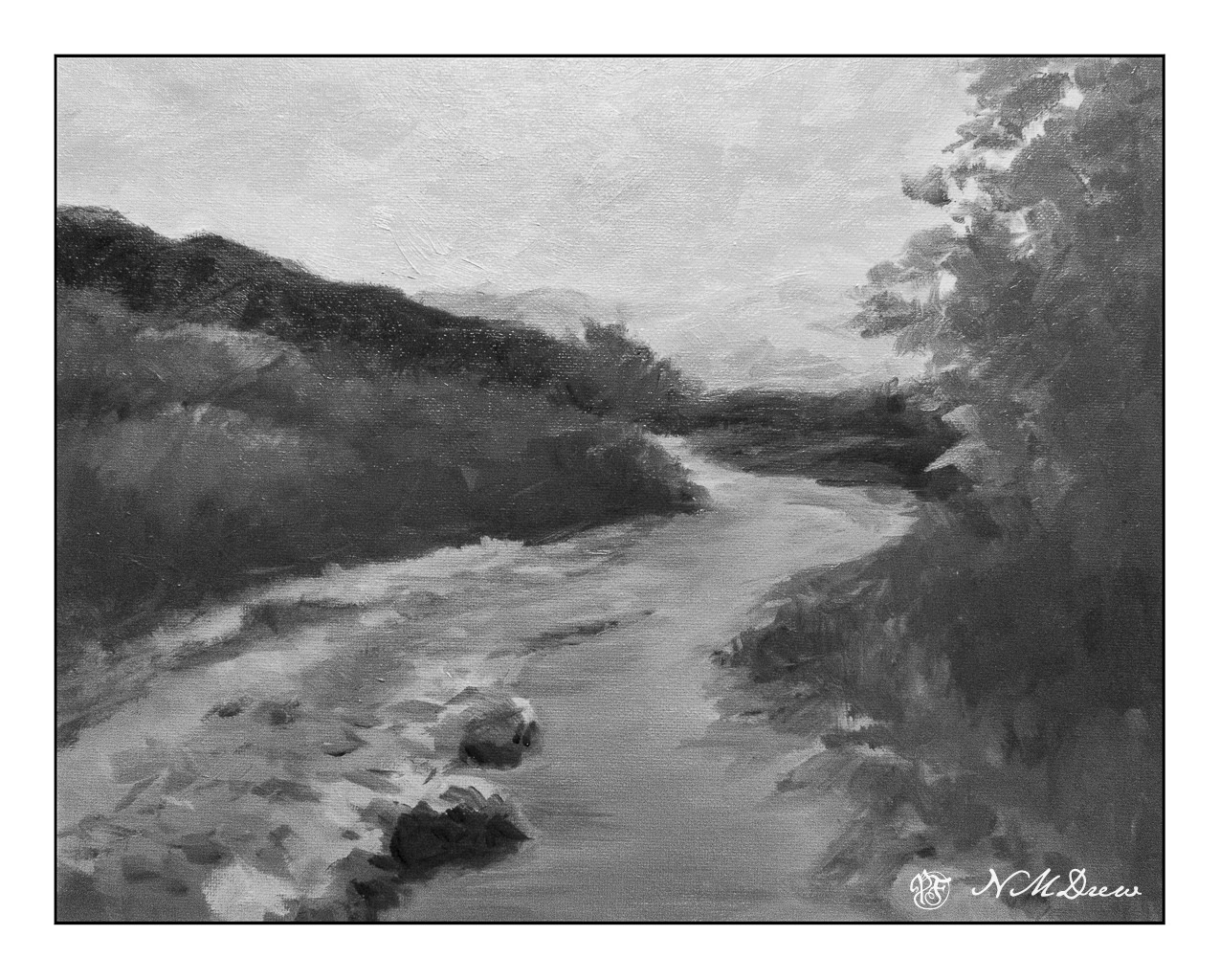
As above, I like to see what my work looks like when turned to black and white – for values. Also, it is just fun to do! I just use the sliders in LR to reduce vibrancy and saturation reduced to -100. Doing this is really a good way fro me to evaluate contrast and such.

Final painting in color and black and white

So, there we are. In general, I am pretty pleased with this painting. The goal is to lead the eye along the creek to the small stand of tree at the top of the creek. I wanted to show the brightness of the barren mountains in the distance, but did not want them to become overwhelming. The BW image of the final painting shows that the mountains are very similar in value as the sky. Is this an issue? Not sure. Things like this are to be considered in a few days when it is no longer in front of me.

Now, on to other things, like cleaning my brushes . . .

Winter Creek

First, I am not at all sure where I found the photograph upon which this painting is based – public domain? If not, and it is yours, I am sorry I cannot give you credit. Let me know, ok?

Oil paints on Canson Oil/Acrylic paper.

Initially I started out with a brush and soon realized that whatever I tried to paint was just not working. The grasses were not clear and sharp and the clouds were blobby. In the end, and out of frustration, I took a palette knife and used it to smear color into the painting – and all of a sudden I found out what painting in oils with a palette knife is capable of doing.

I am prejudiced against heavy impasto just because I don’t find it interesting to look at. First in my mind is how much dust it could collect and what a pain heavy impasto paintings could be to clean. Much impasto is done with a knife – though brushes also do the job, as seen in the work of van Gogh. So, I have avoided it to date.

Smearing paint around with a knife gives some dimension (3D) on a flat surface, but the way the paint moves is so interesting! I also used the knife tip to scratch away in the colors for the grasses, and that was both doing what I wanted to do, as well as somehow felt deliciously rebellious against my conformist self.

The snow, though, and the river, are done with brush. Brushwork was laid down first pretty much throughout the painting, and my aggravation then brought out the knife. Learning experience. And, I don’t think I could have rendered either sky or grasses anywhere to my liking with a brush of any size.

Live and learn.

11×14, knife and brush, on paper.

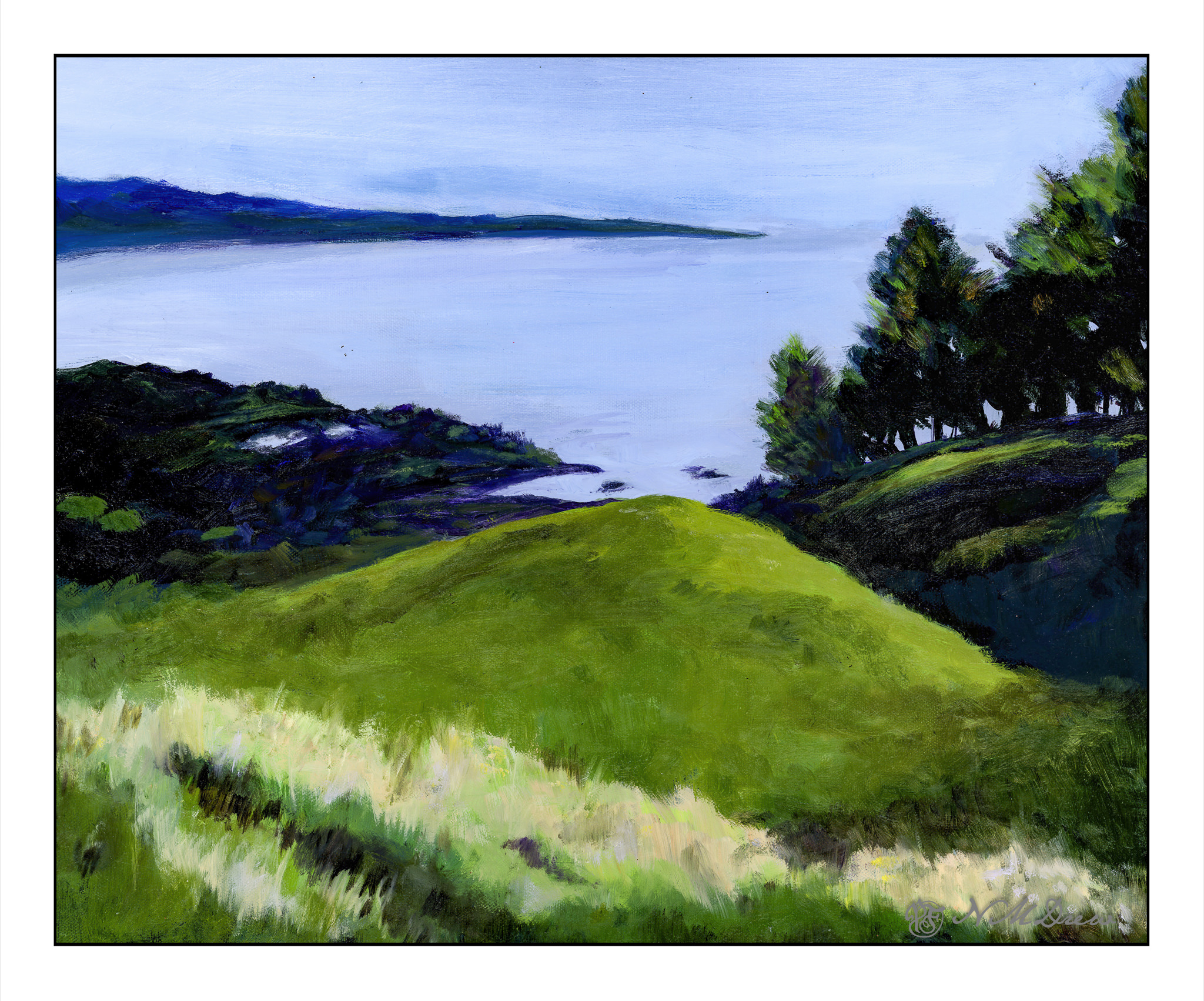
Big Sur, Looking South

Big Sur along the California coast is an incredibly beautiful bit of the state – at once wildly beautiful, in many ways easily accessible along Hwy 1, but delicate, too, as it is easily destroyed by heavy rains creating mudslides. Parts of it are rugged with mountains rising up and coming down into the Pacific Ocean. Hwy 1 skirts along, and it is always best to be the passenger so you can enjoy the wonderful views.

From where I live, you drive north, past Santa Barbara and then veer off on the 101 in an area marked on the map as Las Cruces. You could continue up the 101 up to San Luis Obispo, cutting west toward Morro Bay and then along the coast. Before you get deep into Big Sur, the mountains are toward the east, and there is a coastal plain. Slowly the landscape changes as the flatter areas disappear and the mountains move ever closer.

The entire drive is a delight. Coastal fog may drift in and out, and no matter where you look, the beauty is breathtaking. I have tried to catch this in the distance and along the horizon. The Canson XL paper is nice to paint on, and I used Gamblin Galkyd gel to speed up the drying time, but it sat in the garage this past week so I could ignore it and look at life away from the studio. Getting some time away from a painting is always a good thing as eyes are fresh upon the return. I was pleased with what I saw, and so scanned it, and present it to you for your viewing.

Painted on 11×14 Canson XL Acrylic / Oil Paper, about 10×10.

A Brush with Brushes

As someone who has used water-based media for years – watercolor, acrylic, gouache – I am used to using just one brush for the most part, or two if I need a different quality. A round, a flat. That’s about it for watercolor or acrylic or gouache. Of course, different sizes matter as far as what I am painting, but with a couple of good brushes, much can be accomplished. I just take my brush, swish it around in water, and then on to the next color.

Oil painting does not allow this. To clean a brush means to work at getting it clean, and that work is best done at the end of a session when all is ready to be set aside. This means cleaning the brushes in mineral spirits to get rid of the oil. This is done after wiping excess paint off and discarding the rags or towels. After the mineral spirits comes a bar of soap and hot water. Squish and swish the brush in the soap, rinse. Repeat if necessary. Set aside to dry after reshaping the brush, and you are ready for the next session.

I have done a bit of observation and a bit of reading about brushes. Some oil painters say you never need to wash your brushes, just clean them off by wiping and using some mineral spirits. For me, this is a disaster in the making. My habits are to use the same brush with rinses in between, and oil painting does not allow for this – at least, not the way I paint.

The classic picture of an artist is with his handheld palette, beret on head, easel in front of him / her, and multiple brushes being held in the hand holding the palette. It makes sense! Brushes with different colors, different values, different shapes to create different strokes. I watched a lot of oil painters, and some do hold multiple brushes. Some even go so far as to have the same brush in 3 editions – one for light, one for medium, and one for dark values, with other brushes exclusively used for blending. Recommendations for brushes are also as varied as how and what to do with brushes – what shape, what size, what material, how much to spend.

Well, for now, I need to focus on clean brushes. Mud was a very common byproduct of my earlier days in watercolor, and now I have to fight the same problem with oil painting. I need to retrain how I use brushes altogether. I have also found I need to determine what kind of brush I like. Watercolor works with both soft and stiff brushes, depending on desired effect. Soft brushes are the best, IMHO, for gouache. Acrylic, like watercolor, can vary with the need of the painter – hard, soft, round, flat, filbert, fan. Right now, I prefer softer brushes for oils, but I know that this will change as I become more comfortable with the medium.

Meanwhile, I think cheap brushes for 3 values will be my default for now – and it won’t be easy!

Offshore Fog

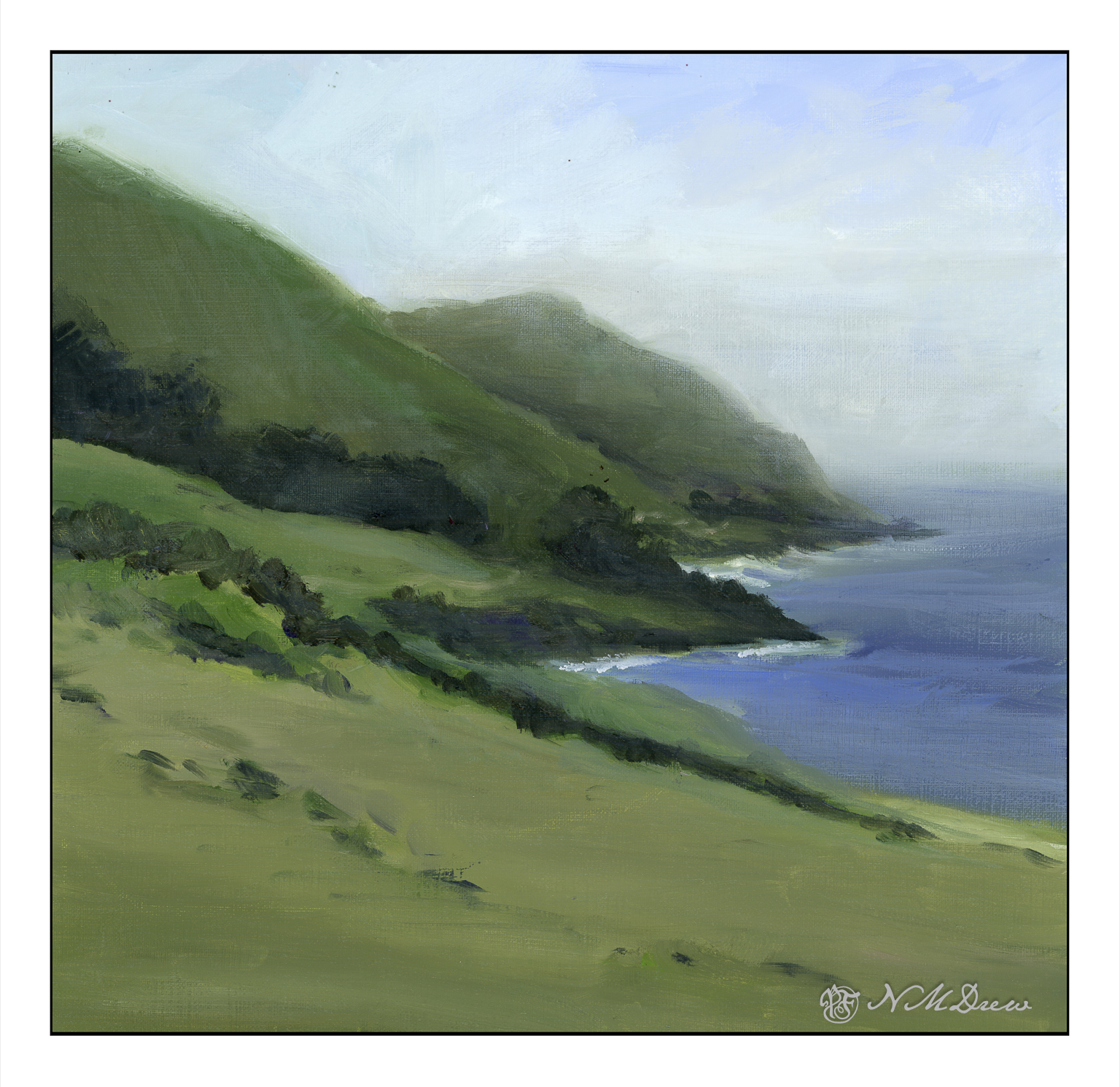
Living along the coast, fog is a part of the landscape. Coastal fog in particular is fascinating in California as in many areas the plant life depends on it for water. The beauty of fog is its ability to soften a landscape and create a mysterious effect. Inland, we don’t have much fog where I live, but in coastal areas, just a block can move you from gloomy and depressing by the beach to sunny and shiny and cheery inland. As a result, I prefer to live inland a bit so I don’t get socked in by fog.

There were two goals here. First, experiment with using only linseed oil as a vehicle to smoosh around paint, creating in the process soft gradations. The second was to experiment with using the Canson XL Oil / Acrylic paper. This paper has gotten some of the best reviews, in part because of its linen finish texture. I agree, the paper and the texture are very nice to work on! The rather grainy effect of white on the still water is done by dragging a wide brush across the underlying blue paint with dryish paint. It makes me think of fog resting above the water, but you can choose what it means to you if you are so inclined!

Because I am using linseed oil, the oil paint takes forever and ever to dry; after scanning this, I had to clean off the glass plate on the Epson V600 even after its drying for 2 weeks. So, it is back in the garage to continue drying.

Oil paint, 9×12 Canson XL Oil-Acrylic paper, linseed oil only.