Morning Walk

I don’t know if I have published this image before . . . . I have a feeling I did, but cannot find it. Of course, with all the stuff I have here on IY&B, it makes sense.

I painted this a few years ago. I worked really hard to get soft tones and paints. I had been working mostly in acrylics when I picked up the oils and was used to the hardness I seem to produce with acrylics. So, with the blendability of oils, that was my focus of the exercise.

The results here have been sitting around for ages with the thought the painting could use a bit of work. Looking at it now, it seems finished enough. I am pleased with the moodiness and sense of a damp woodland as well as how you can tell it is a misty day by the colors of the sky through the trees.

Oils, 10×14 canvas panel.

Foggy Morning with Birds

Foggy Morning with Birds

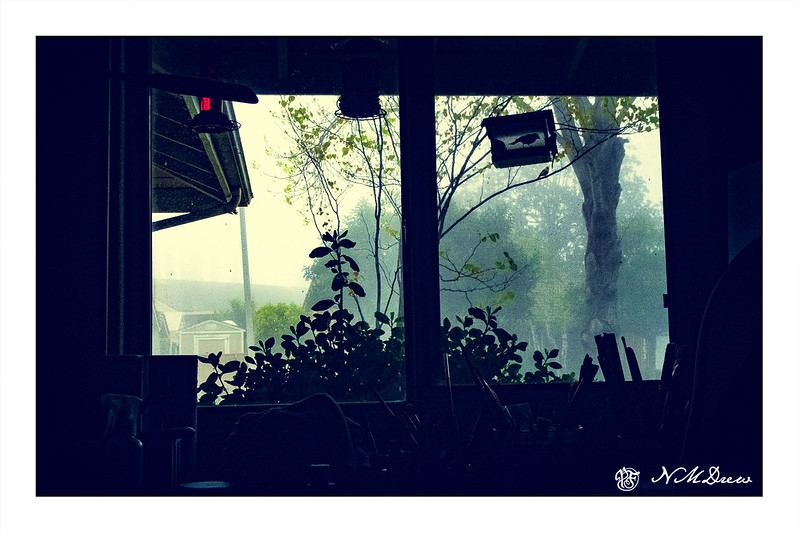
Before I finished yesterday’s painting, I took some time to take pictures of the painting itself, and out the window. We don’t get a lot of fog out here, so the pea souper we got was fascinating to watch as it lifted. From thick and dense, it slowly dissipated – I was cold from the damp, but the view was great.

Winter Farm on Christmas Eve

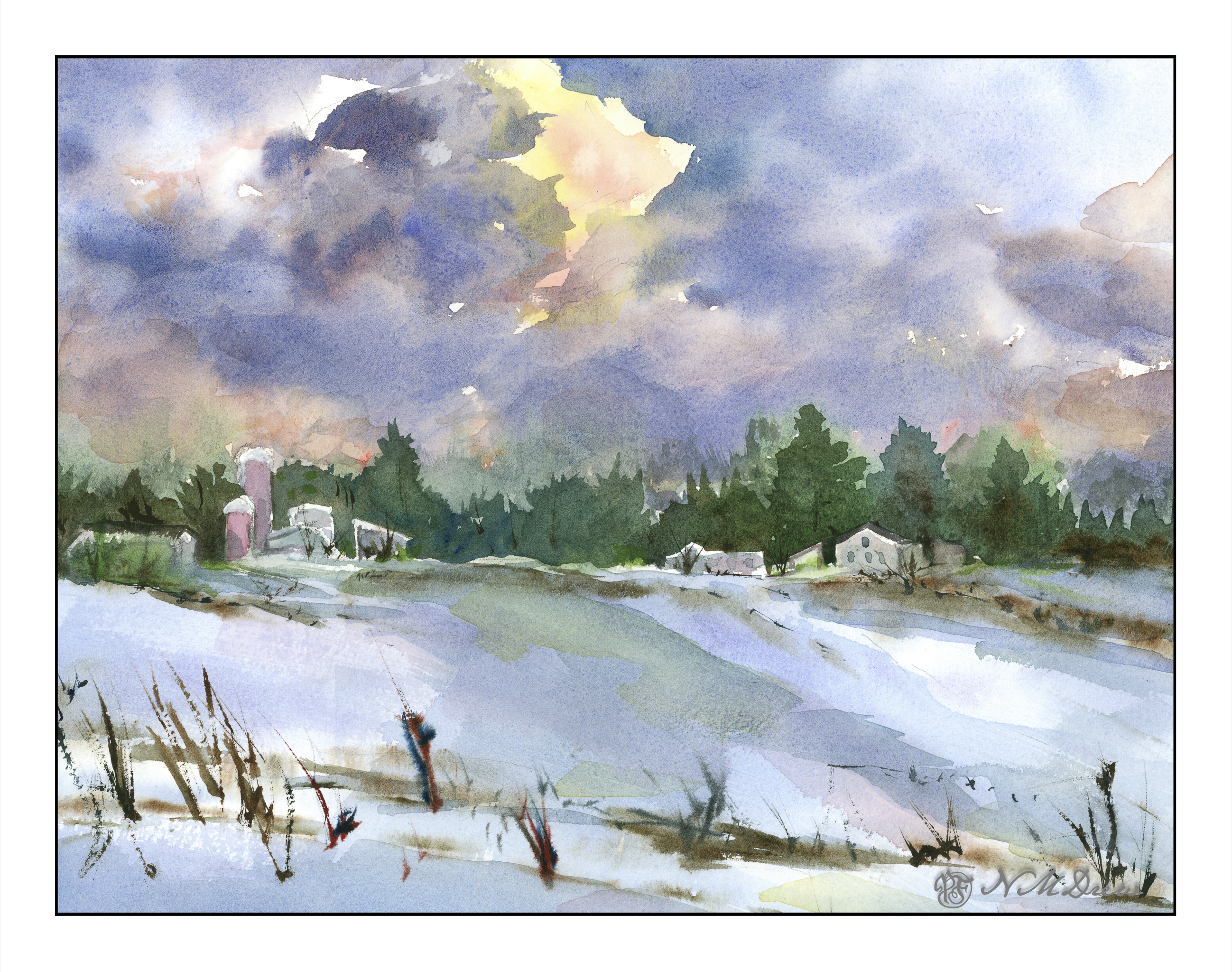
Now to the northern part of the continent . . . somewhere in North America for winter on the a prairie farm, snow covering field stubble, early evening or morning. Cold, desolate, and heartbreakingly beautiful.

I spent the morning painting this on rough 300# natural white Kilimanjaro. I did it in stages. The sketch was light, with suggestions of shapes. Then the sky was wet and yellow, quin gold, and permanent alizarin crimson used to create the rosy golds. Once down, cobalt blue and ultramarine were placed to simulate sky being careful not to merge into the rose gold of the central cloud. As the sky dried, purple and alizarin were mixed with ultramarine to create the darker clouds. 

After the clouds were laid in, I did the dark trees, blurring some green into the still damp sky, as well as waiting for the sky and soft trees to dry. This was done to create the hard edges needed for the buildings against the tree line. The buildings themselves were left white as the trees dried.

From there, the snowy field was laid in with cobalt and ultramarine in a very light wash and using a 2″ soft brush. Again, drying. At one point, the 2″ brush was dried and dipped into lightly damp burnt umber and applied to make the streaks of brown for field stubble near and far. Then the buildings were done, and once the snow dried, more thin washes as glazes applied to the foreground snow, culminating in a streak of quin gold and then permanent alizarin to the middle of the painting, hoping to show a sense of light reflected in the still dark snow from the breaking clouds above.

After that, details such as dried grasses, windows, tree trunks and whatever were added as deemed necessary.

I am pleased with this painting quite a bit! It achieves what I set out to do – a winter scene, snow, clouds, and patience to wait and think about a painting before just diving in with brush and color. The 300# rough Kilimanjaro is 11×14 and a wonderful paper to paint on. More is needed in the future for sure.

A Touch of Morning Light

Most of my watercolors tend to have intense colors that are rather bright. With the underwater rocks and floating leaves of the other day, to get the effects I did, I used a lot of thin layers of colors – glazes – to create the desired effects. I was pretty happy with the results, so today I decided to work at creating a painting with good contrast but with many delicate ares of color.

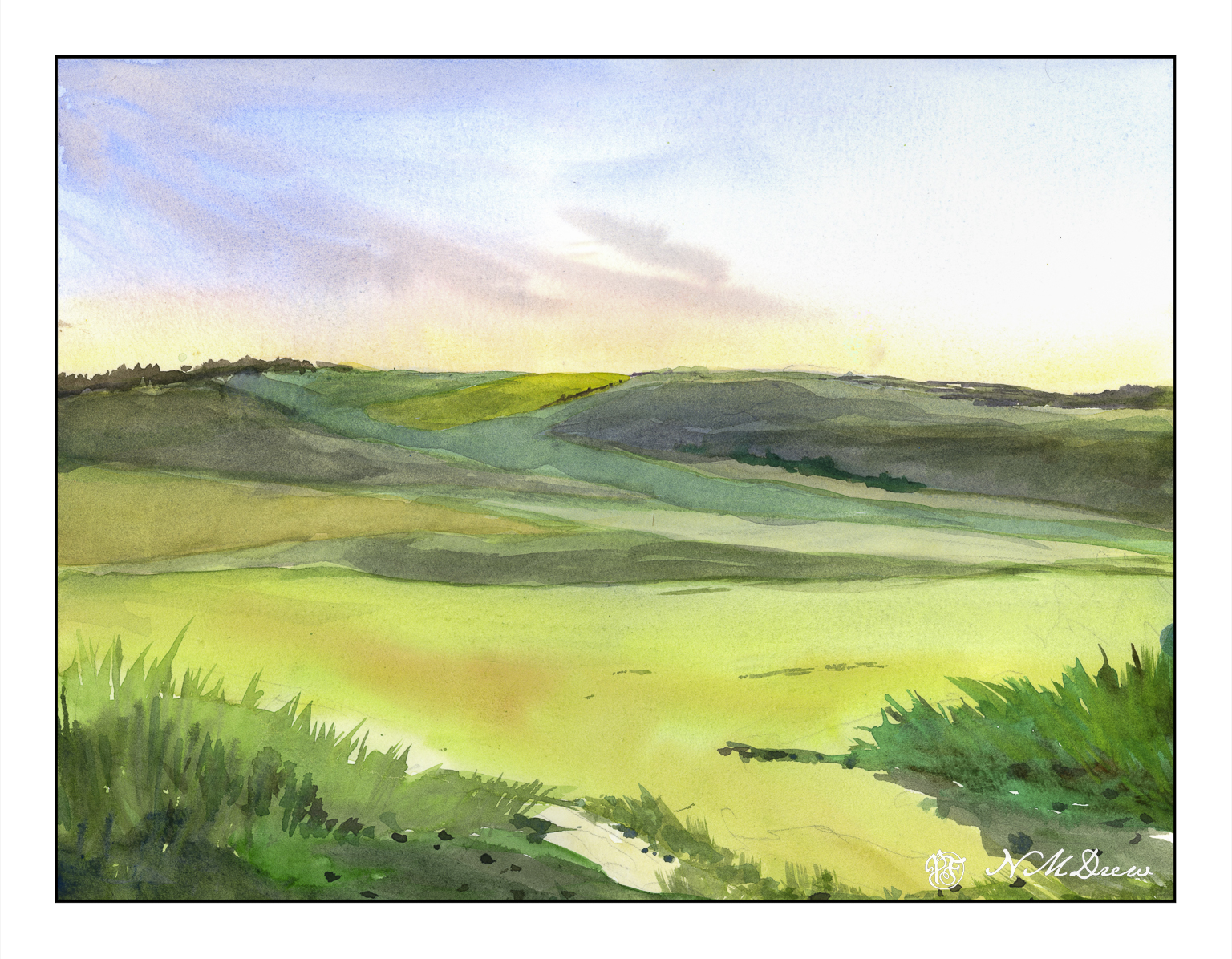
My intention here is to create the effects of early morning with sun just beginning to brighten the landscape. This needs a delicate sky. I had drawn in my sketch first and from there began with thin washes of cobalt, quin rose, and Naples yellow. The wispy clouds were painted wet-in-wet using cobalt and umber. Pleased, I again used pale washes to create the fields in mid and foreground.

Looking at the picture, I realized that the lower 2/3 of the painting were essentially all the same value even though different in color. A scan of the painting and a desaturation of color showed my assumptions were correct.

Sooooo??

A bit of thought. In the end I applied thin glazes of quin gold along the hilltop horizon and a number of layered glazes on thew lower hills in cobalt and umber. This gave depth and distance.

Another painting done slowly and with more deliberation. And I am pleased with the results as well as even learned a few things!

Watercolor, 9×12, Fluid 100% cotton CP paper.