
Edward Seago: The Hill Copse

As I mentioned the other day, I have been thinking about the bold washes as done by the British artist Edward Seago. He grew to adulthood in rather interesting historical times and while living contributed to society as well as the art world in many different capacities. As a watercolorist, he creates complex scenes with a broad swaths of paint. While not a great reproduction, at least in my opinion, here is Seago’s watercolor “The Hill Copse”.
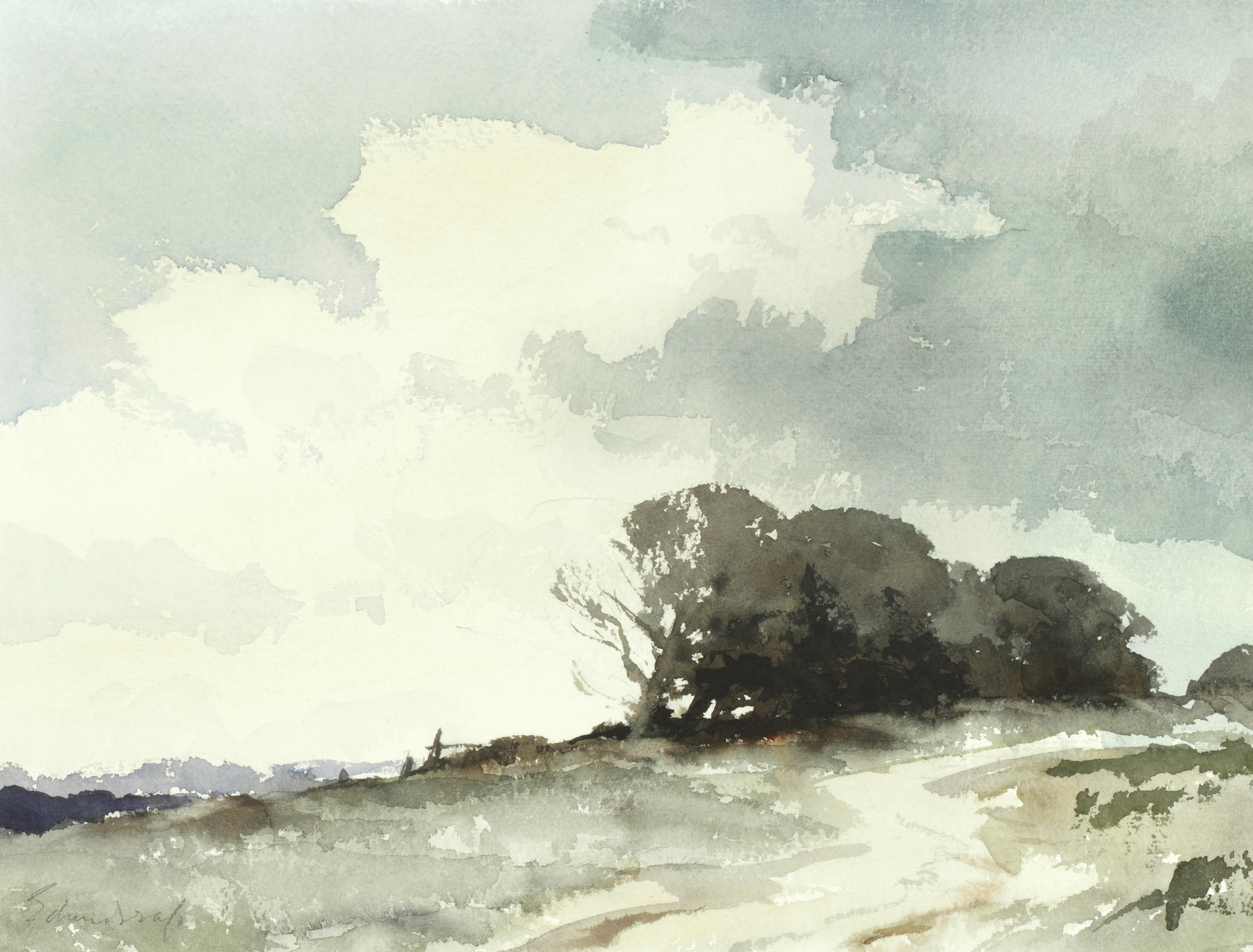
You can read a bit about it at Bonham’s, which is where the above image is located.

This is a very monochromatic painting, but I expect the original was more rich in color than is shown. During Seago’s time, many colors used fugitive pigments, meaning they fade with time. Today’s watercolor manufacturers still produce colors which can fade, but many employ chemistry that is labeled as “permanent” and so do not use the original pigment formulae.

Two good examples of fugitive colors are rose madder genuine (made by Winsor Newton) and alizarin crimson. The rose madder genuine is still available, but it is important to know it can fade to a dullish brown. Many old colors are like this, and while lovely, makes one pause to consider when painting. I have this paint, and it is one of the prettiest pinks – and have dyed yarn and fabric with rose madder that I have grown – but fading is also part of its characteristics.

But I digress. I chose this painting because of the elegant simplicity of the washes to capture complex shapes. The sky is dramatic, the sandy track uphill to the copse, the sense of distance to the left – evident to the eye, and painted with amazing simplicity – suggestions of reality rather than a more complicated syntactically correct visual statement (hahahaha).

I interpreted the colors I thought would work here for my own “master copy” and chose ultramarine blue, cobalt blue, burnt sienna, burnt umber, yellow ochre, cadmium yellow, and Hooker’s green.

Obviously, there are differences in Seago’s painting and my own, but I do think I managed the overall simplicity of the washes and colors. As with all watercolors, white paper is left for brightness and interest, and wet-into-wet was done along with wet-onto-dry. To keep things simple and think about the shapes prior to plopping down color was foremost in my mind, but at the same time I considered the original painting an pondered the techniques used by Seago while painting.

This is quite the challenge for someone like me! But, fun was had, and I think I will continue to both reproduce some of Seago’s work as well as reconsider how I paint new subject matter.

Master copy, watercolor, Hahnemuhle 140# / 300 gsm CP paper, 9×12.

Autumn Trees, with Apologies to Wolf Kahn

Color always fascinates me, and two modern painters, Richard Mayhew and Wolf Kahn, are masters of it. They pay tribute to the natural world with their colors and whether or not the landscape is based on reality doesn’t matter. The subject matter and the colors are the point, just as the squares and rectangles of color are of such importance in the work of Mark Rothko.

For this study, I looked at several of Kahn’s pastels of trees and woodlands. His color choices range from contrasting and bright to subdued. Sometimes the trees are distinct from the background, other times almost camouflaged into the surrounding foliage. I decided to continue using linseed oil here and soft colors to see what I could do with blending and creating lines for tree trunks within the the woodland while keeping the visuals of Kahn’s woodlands in mind.

This was painted in one sitting, and as the paint was damp and pliable, it was fun to move it around, wipe some off, add more, and then use the brush to create lines and dots to suggest trees and leaves and open field before entering the woodland. As I painted, I realized that I could place lighter colors in vertical strokes between darker areas to create tree trunks. I used short horizontal strokes to suggest foliage.

Again, I painted on the linen-textured Canson XL Oil-Acrylic paper. Linseed oil allowed for easy movement of the paint. And, again, this painting has been taking forever to dry out in my chilly garage, but I scanned it anyway, and cleaned up the glass afterward.

I really like Kahn’s work, especially in his later years. I also want to explore color as Mayhew and Rothko have used it. Besides exploring colors, exploring the subtleties of one color and its variants within a given area will be fun. Mayhew and Rothko will be fun to emulate, as has Kahn, because the experience of copying is a form of exploration that adds to knowledge by doing, and that, to me, is the best part of all.

Color Planes

As I mentioned a few days ago, I am experimenting with swaths of color. Not simple planes of one color, but variations of color within that plane is the goal. A number of artists do this beautifully, and the graphic quality is elegant to my way of thinking, with the simplification being the subject and the goal and the voice of the artist. As I am a dabber, this is a big challenge for me.

To begin this, I decided to try my hand at exploring a painting by Wolf Kahn. The one I copied is called Ground Fog, and it is a simple study of grey, white, yellow, green, and variations of each within each area of color. Below is my attempt.

This was a challenge to try as he painted this in oil and I am using Golden fluid acrylics. Blending the colors was hard and required a lot of thought and movement rather rapidly since acrylics dry quickly, and the fluid acrylics even more so than heavy bodied acrylics. I got frustrated, let me tell you! Despite that, I did learn a bit about color – not quite sure what, perhaps just that subtlety is hard to achieve.

From there, once more a foray into fields of lavender and other crops, such as perhaps alfafa or wheat – no idea! I just know I see tawny colors and greens when I look at photos of lavender country.

While not especially low key or subtle, I was pretty pleased with the planes of color with the variations therein. The green and lavender are not too heinous when juxtaposed. I like the mountains and sky in the distance, as well as the trees. Sometimes nature is not subtle, and while bright, I think I did a decent job of catching a sunny day in a Mediterranean clime.

The lavender field with the green foreground was done with both large and smaller brushes. This one was done, for the most part, with a rather scraggly 2.5 inch bristle brush with a lot of scrubbing. In particular, you can see this in the sky. I applied varying layers of blue and white, painting up and down to use the brushwork to express the clouds in the sky. The same with the lavender field below. I used a smaller brush for the dried field area with trees, but worked to keep the brush strokes and colors to convey light and depth. I think it worked fairly well.

The study I did on Kahn’s painting gave me ideas on how to create the color planes, but of course I am not Wolf Kahn, and therefore have my own whatever method in creating such things. Acrylics, too, have qualities which oils do not, and blend differently. I am still learning them, and while I get annoyed and frustrated, each painting helps me gain skill and learn the language of the paints. These are invaluable lessons in technique and composition and methods.