Flat

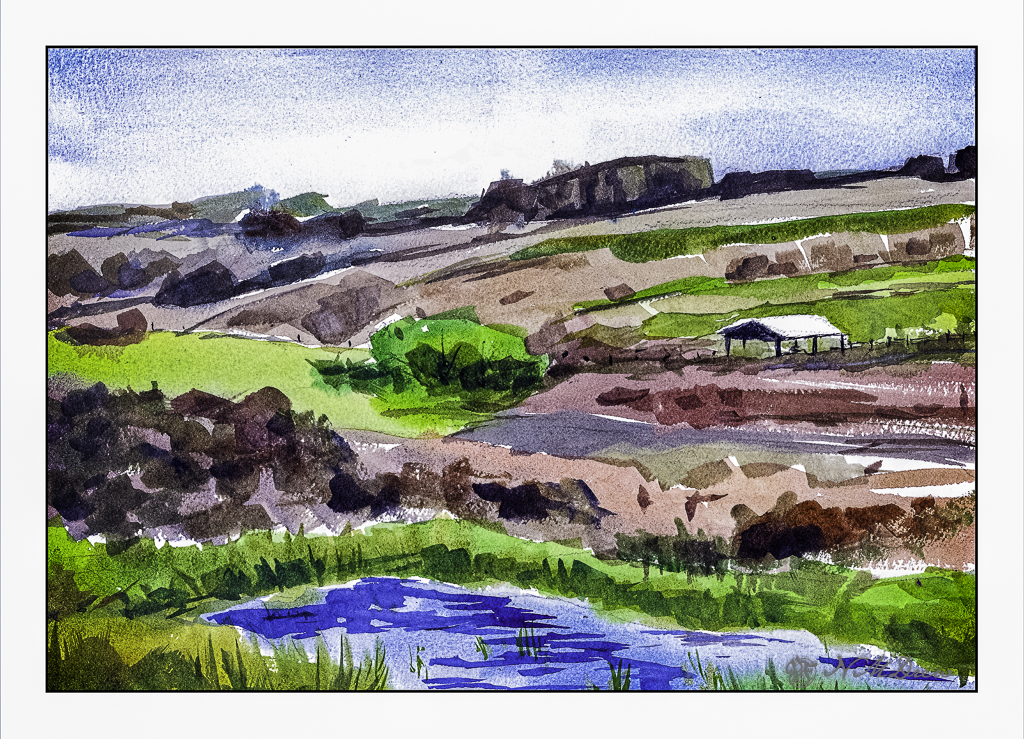
I normally tend to use pointed round brushes for watercolors, but every now and then I pick up a flat brush and use it throughout a painting. The other day I noticed some inexpensive flats on sale in a variety of sizes, so I picked up a couple to add to my collection. Now I have .25, .5, .75, and 1.0 inch flats, some firm, some soft. And tested them out.

Epson Scan used here – too lazy to putz around. The blue in the sky is granulated and light in color, but the blue in the water is too blue. The rest of the colors seem to be okay.

A flat brush is rather versatile. The longer edge makes for wider strokes, obviously. You can also load your brush with one color on one side and another color on the other side, and when you paint on wet paper, the results can be interesting. I didn’t do that here, but am writing this to remind myself I need to do it a bit more! The narrow side of the brush can give very nice straight lines, as you can see in the hay canopy in the mid-ground. Sharp edges, like in rocks can be easily expressed. Squiggly lines can also be achieved as seen in the too-blue-to-be-true water.

Watercolors, flat brushes, limited palette.

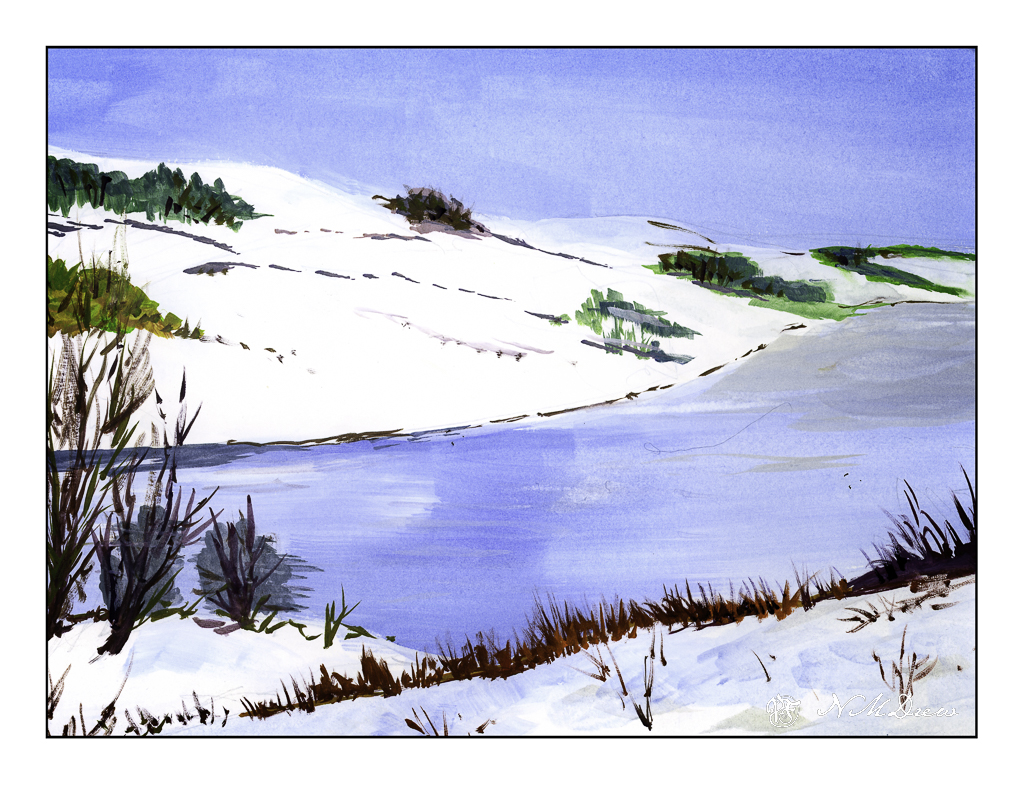
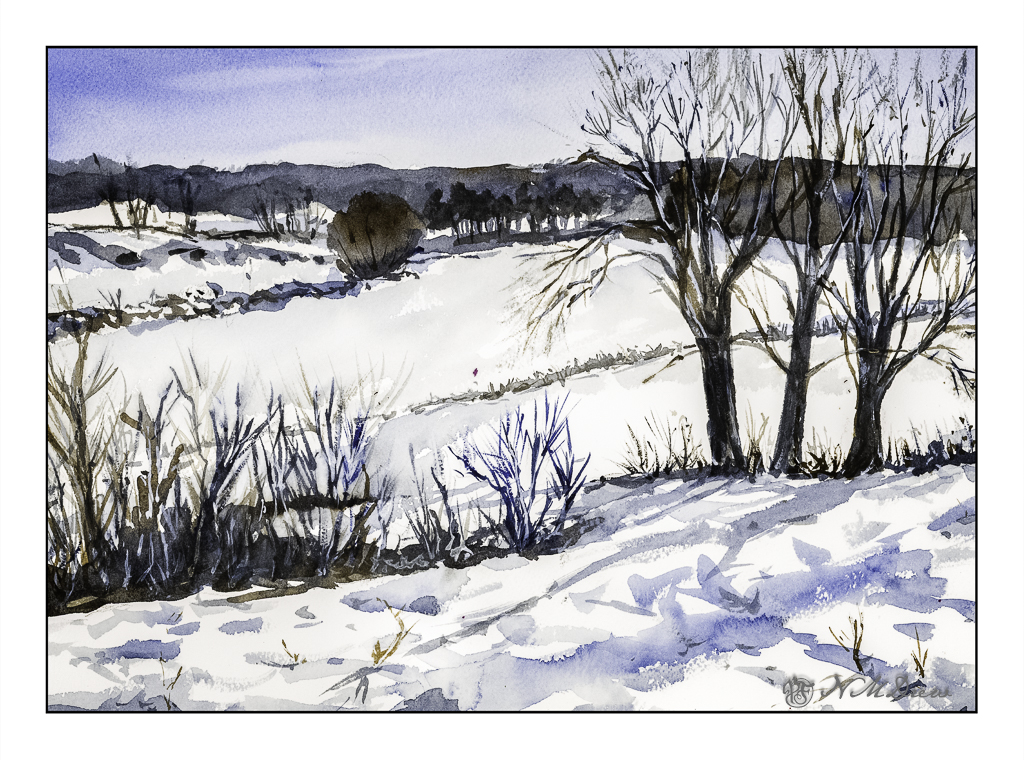
Winter Valley

Today I thought I would be a bit self-disciplined and work with only two colors to create a winter landscape. I used MaimeriBlu’s “Faience Blue” and somebody’s artist quality Burnt Umber. Add to that, as needed, some white gouache.

I have never used MaimeriBlu paints, much less Faience Blue. This blue seems a bit of a cold one, which is perfect for a winter day. The Burnt Umber, mixed with the blue, produces a nice dark as well as plays into the coldness I am trying to express.

The first part of the painting was done with the sky – start at the top and work down. This is pure color, diluted, to create a sky. First the paper in the area of the sky was wet, and then the blue brushed in. Before the paper dried I lifted out the color.

Next I painted the distant hills and background area, solid in color, but varying the intensity of the colors and mixes of brown and blue. I painted through where the trees in the mid-ground would be as I knew the tree branches would be a bit darker once painted. Next came the trees in the foreground right and shrubs and grasses on the left as well as under the trees. All dried with the hair dryer. The middles areas were done after these dried.

Finally, the snow was tinted with blue in varying strength, bits of grasses, and final details. The snow on the trees was done with white gouache, as in the front left shrubs. Once the gouache dried, a mix of blue and brown was glazed over it to tone it down. Finally, a light wash was put into give a sense of dimension to the snow.

In the end, I am rather pleased with this painting. Using triads made me recall some other watercolor exercises I have done with limited palettes of color. The cold is much to my liking as is the complexity of the foreground giving way to simpler forms in the distance.

Arches 140# CP paper, MaimeriBlu “Faience Blue” and Burnt Umber. 10×14 inches.

Old Trees in Winter

If you have been reading this blog awhile, you know I live where there is fire and not snow. Still, winter does come to my warm (ish) part of the world, and with it memories of tromping through the snow under spreading trees along a lake shore.

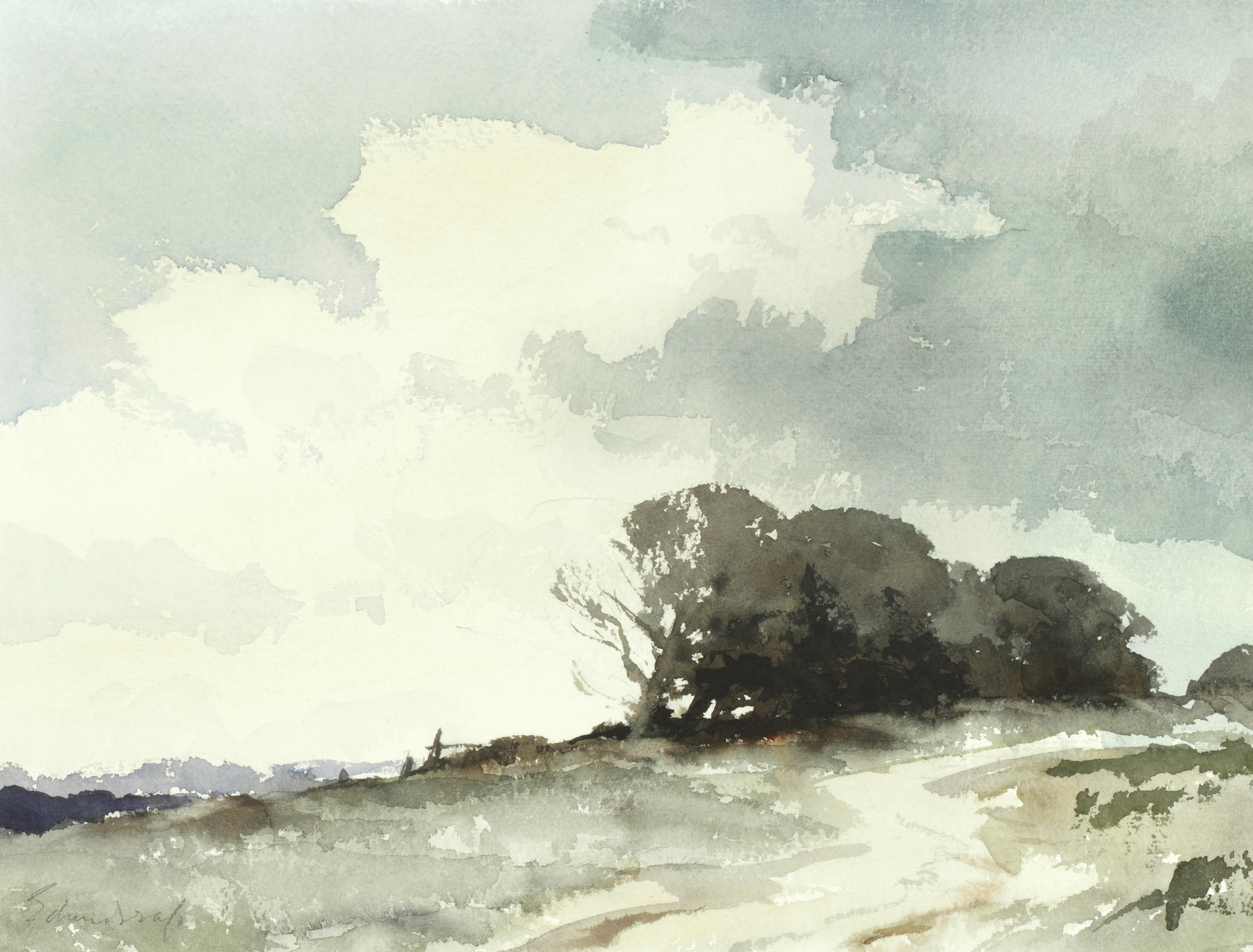
I use two software programs these days to scan my paintings – and I rather like the way they end up, similar but different. Above is the one using VueScan. Below is the one using Epson V600 and its software.

Epson software is more inclined to push colors, but in this case it does a decent job and pulls out more of the colors I put into the tree. Both scans are pretty much straight out of the scanner. Your choice as to preference!

Watercolor, Arches Rough 140#. Colors primarily burnt umber, ultramarine blue, Hooker’s green. 10×14.

Sand Dunes in Death Valley

Death Valley is up and off Hwy 395 along the Eastern Sierra Mountains in California. It’s a strange and eerily beautiful place with a lot of surprises and history. It is preserved as Death Valley National Park. The website is filled with great information and it is one of the best places to visit – in the right season, and in the right weather. People die in the desert because they do not understand it, so if you go, be careful!

Sand dunes always amaze me. I am still stuck in my child’s view of the world that sand dunes exist only in the Sahara, and can only be found by riding a camel. Silly, yes!

There are sand dunes everywhere – beaches and deserts mostly, but sometimes in places you least expect. Their shifting shape in the wind and blowing away foot prints or burying ancient cities all lead to a fascination as they make everything seem so temporal.

Anyway . . . . this is an oil painting using a limited palette. Some of the goals in doing this painting included smooth, smooth brushwork for the dunes. I tried to catch the gradual gradations and color changes I saw. In the distance is the flat valley before the towering mountains. For each I used directional brushwork and a deliberate vagueness to create a surreal effect. The mountains, when I look at them afresh, can also be visualized as swirling clouds. Interpretation I will leave to your eye.

Oil on canvas panel; 16 x 20 inches.

A Frisket, A Frasket . . . .

I’ve been taking a basic watercolor course at the local adult school with one of my favorite teachers. I decided to do this as it never hurts to return to basics as it can be eye-opening. Here, one of our studies. This one made me rethink using frisket as a resist quite a bit, and while I may never really embrace this – using frisket to maintain white paper – I really learned a lot from this little study.

First, the teacher provided us with a template to use – namely the rose. We transferred it to our watercolor paper by using graphite on the reverse of the template. We were to outline the white areas and then, using the liquid frisket, paint out the white areas. This way we could apply very wet washes to the paper without losing our hard edges and white paper.

Once the frisket dried, we wet our paper around the rose. Colors were dropped in using viridian, quin rose, and phthalo blue. We kept our paper flat and worked relatively quickly. Once the outside colors dried, we moved into painting the rose. Wetting the rose, the colors were then applied using cad red light and quin rose. The violet was a mixture of blue and rose, but I also used carbazole violet as it is a very clean purple. Once more, paper kept flat as the colors dried.

From there, little details were added, such as leaves, extra contrast, and so on, all using various tricks common to watercolor. In the end, once all was dried, the frisket was removed and little bits of color added here and there over the white areas. Lines, bits of color.

And this is the result! It is an abstract and very watercolory and painterly rose. Techniques were wet-in-wet, masking with frisket, and some dry brush. I also splattered a bit of quin rose and carbazole violet onto the surface to make it a bit more interesting to my eye.

Watercolor, frisket, 10×10 Canson XL watercolor paper, wet-in-wet and splatters. Colors were limited to carbazole violet, viridian, phthalo blue, cad red light, quin rose, and a smidgen each of burnt sienna and cad yellow.