Too Dark

I just realized that if I want to do good – in my eyes, of course – or better ink and watercolor drawings, I need to work a bit more on my colors. For many years my colors were anemic and paintings ended up pale and wan. To compensate, I made my colors more intense – more pigment, less water. However, I think if I really want to do ink and wash, I need to learn to moderate the color intensity a lot. Next painting I do will have color swatches on another piece of paper before applying them to the paper.
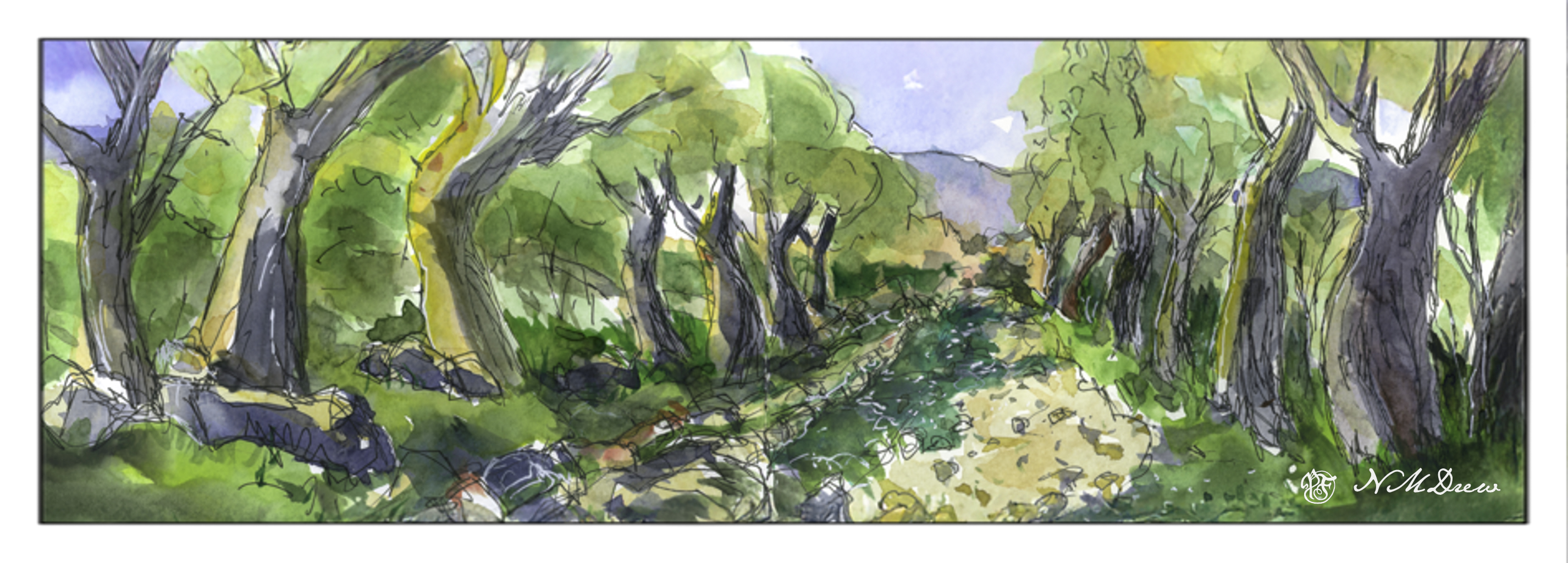
This is a very contrasty painting – and it doesn’t really play well with the eye. The shadow along the dirt road, on the left, is too green. The darks between the trees, from shadow and overgrowth, are not well done. I liked the ink drawing but think I could have made better color choices. Unfortunately, when you use a limited palette of only 10 basic colors, color mixing becomes a bit of a challenge. That is not to say these were not good quality paints – they are Schminke pan paints which are very intense – but I need to work more with moderating the colors.

Well, I didn’t paint anything yesterday, but I am beginning to work on cleaning up and getting rid of stuff. Yesterday I worked in the garden, straightening things up, getting rid of debris, and taking apart the drip system. With fewer plants it is unnecessary. This morning, sorting through clothes and mish mash in the in the garage.

However, painting continues!

Sketchbook across 2 pages, about 6×16 inches; ink and watercolor.
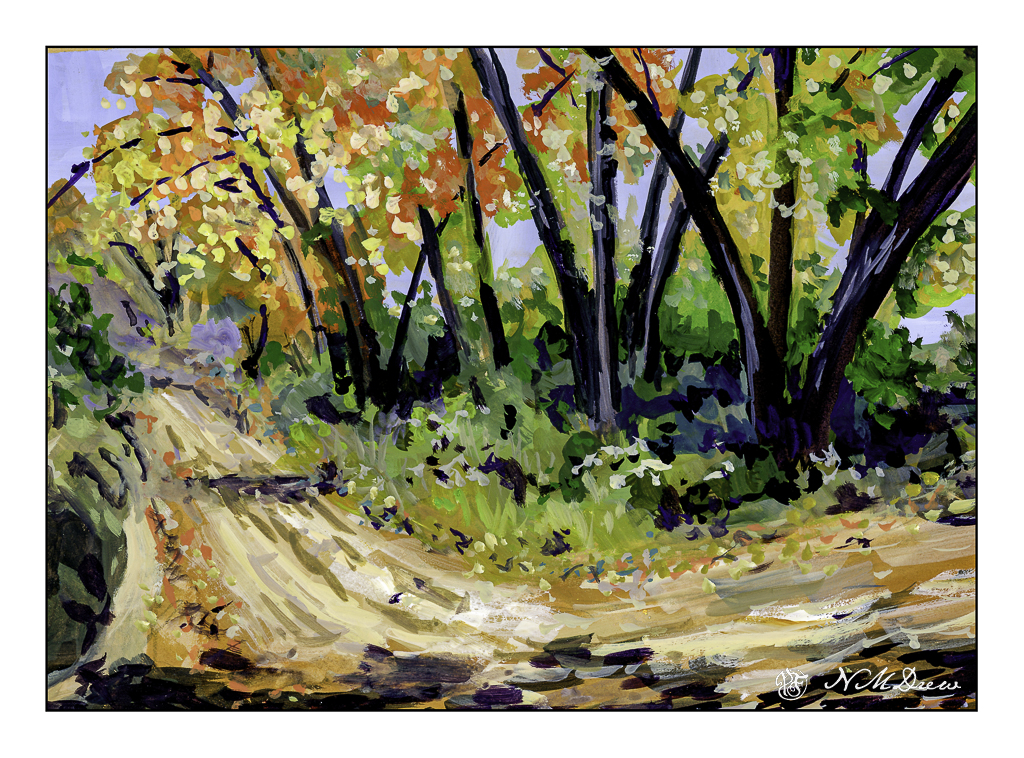
Under the Cottonwoods

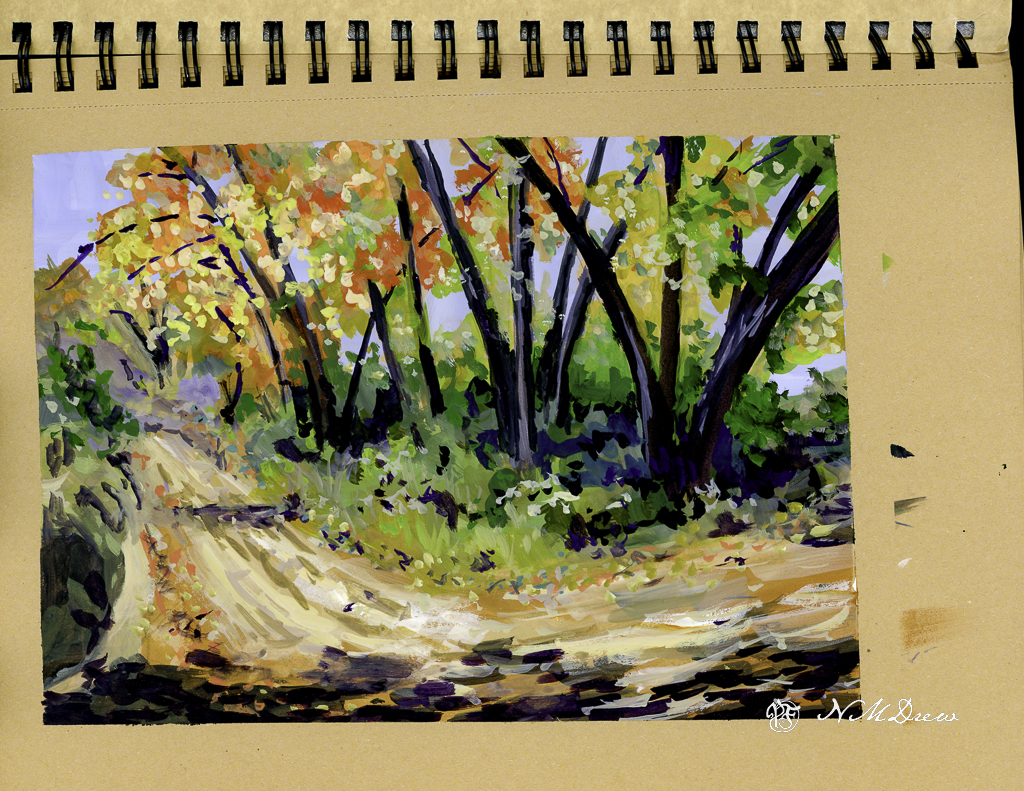
Cottonwood trees make bright yellow splashes of color in autumn. The dark trunks and limbs curve in between and the drama of these trees cannot be underestimated in the muted colors of the desert. For me, they epitomize the southwest in fall, and to see them in full color is really wonderful.

Here, another painting in gouache, and this time one that was difficult to do. Somehow I don’t think it has the crispness of the day I was trying to express. The drama of the light – dark contrast is there, but perhaps because the leaves of the cottonwoods are always more detailed in my eye than is shown here. At first I thought my scanner was a bit soft, but I really don’t know. Oh, well!

I did this painting on tan toned paper. Perhaps that adds to my sense of it not being quite what I wanted. Below is the original painting in my sketchbook.

Whatever – it is certainly something for me to think about. Gouache is opaque unless really diluted, so I am not too sure how much the toned paper is affecting my color perception.

Gouache, 9×12 toned paper, painting about 7×10.

Winter Water

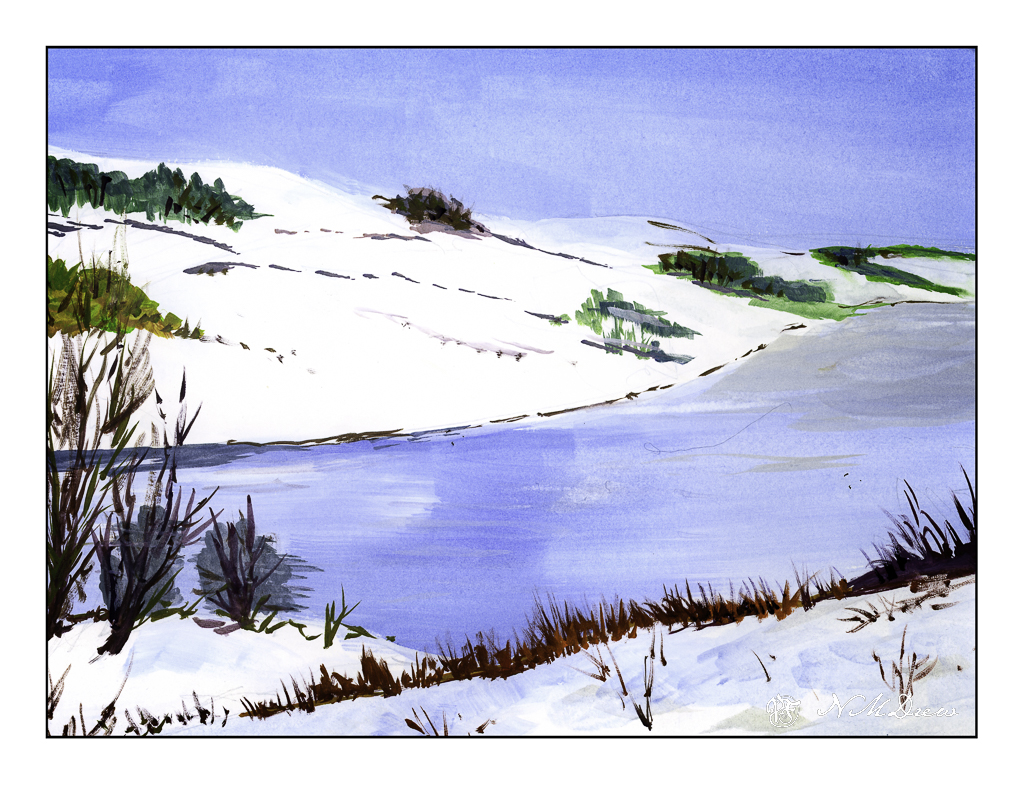
Having used a lot of gouache colors in my palette, this is a deliberate effort to see how I can make a primarily white painting. Snow, of course, is the best subject.

The two whites available for gouache are zinc white and titanium white. Zinc white is more transparent and works very well with colors to lighten them. It is not as bright as titanium white. Titanium white is more dense and opaque, and works very well for areas you want to be very white – such as white caps on waves and here very bright areas of snow.

Besides the two whites, I kept my palette limited to most ultramarine blue, burnt sienna, yellow ochre. A touch here and there included some orange, yellow, and umber to mix colors I needed.

Strathmore Vision CP 140# watercolor paper; gouache; 9×12.

Back Country, Amargosa River

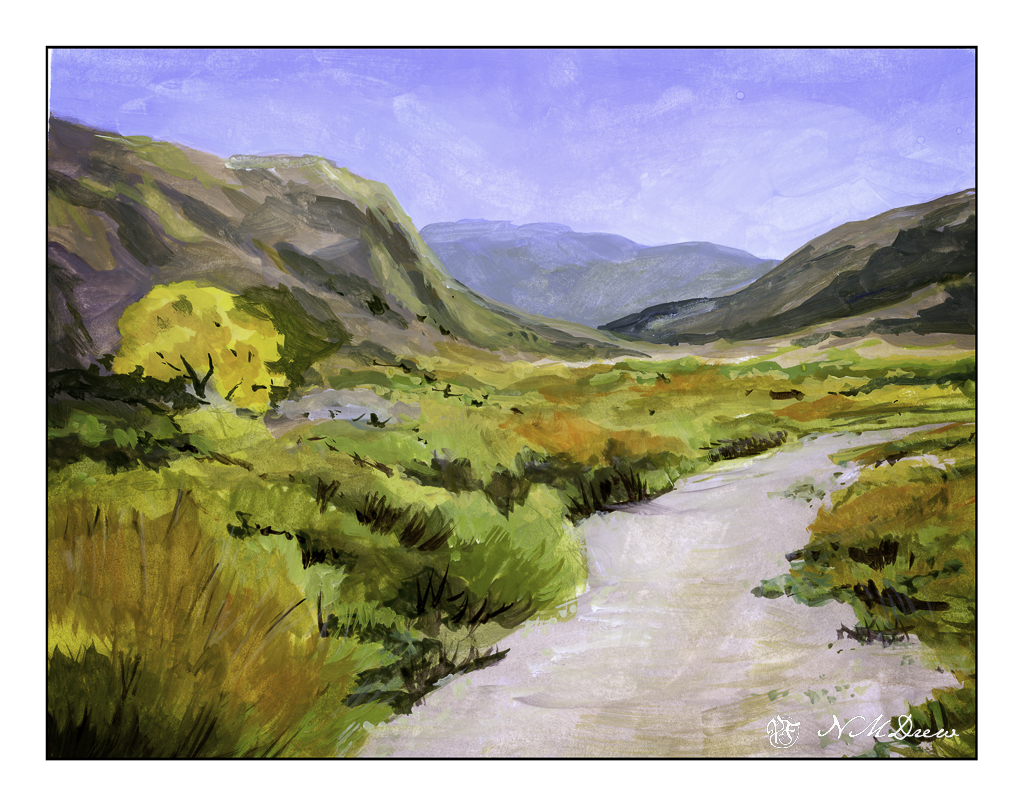
The Amargosa River is located in Nevada and California, moving into Death Valley National Park of the Mojave Desert. As a river, it flows freely both above and below ground, providing much needed water in an otherwise dry climate. Because of it, there are many rare and unusual plants and animals, some found nowhere else in the world. It is managed by the Bureau of Land Management (BLM) to conserve it . . .

This is another gouache painting. I wanted to capture the contrast of the river basin to the mountains it runs through, as well as illustrate the wonderful colors you can see in a desert or riparian area. Dry, rocky mountains, flat areas from flash floods and trails, the occasional tree, low-growing plants adapted to a dry environment. Plant colors are generally pale – sage green being a dominant one as well as bright yellow flowers. Dry air lets you see for miles into the distance and at times you wonder if you will ever see a cloud in the endless blue sky.

Gouache, Strathmore Vision 9×10 140# CP paper.

A Bow to Loiseau

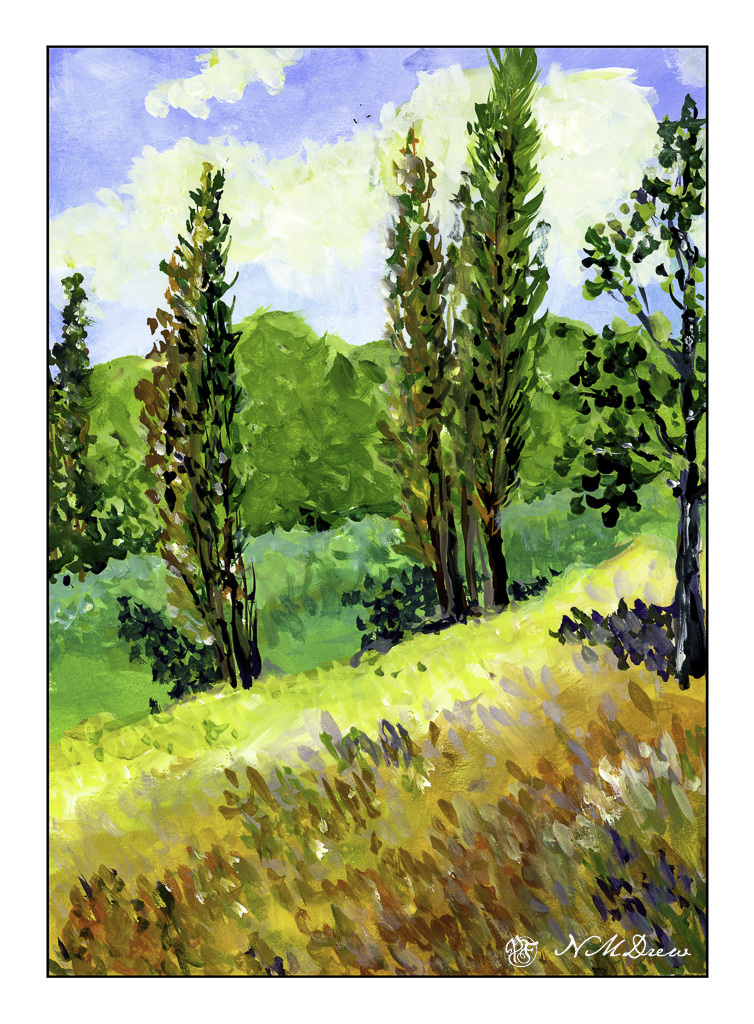
Not too long ago a painting done by Gustave Loiseau called Les Peupliers (The Poplars), ca 1898, caught my eye. I really liked the composition, colors, and overall atmosphere – a bright, sunny, breezy day in the countryside. I will leave it to find it based on my rendition of Loiseau’s lovely painting.

As with yesterday’s painting, this is done in gouache on Strathmore Vision paper. I painted in the underlying colors with an angle brush and then used a finely pointed round to do the remainder of the work.

Gouache is, to me, a rather strange paint, but one which I really enjoy using. The colors always strike me as a bit unreal, but not necessarily in a bad way. They always seem to end up rather cheery, even when I use them to create a rather monochrome or dull scene. It can be used really thin, as a wash, as well as thicker – it all depends on the amount of water you add to it. It is designed to be opaque, but its opacity depends on how much water you add. I think I am on a bit of a gouache streak as I have at least another painting to show you . . . .

Strathmore Vision 140# CP watercolor paper, gouache, 9×12.