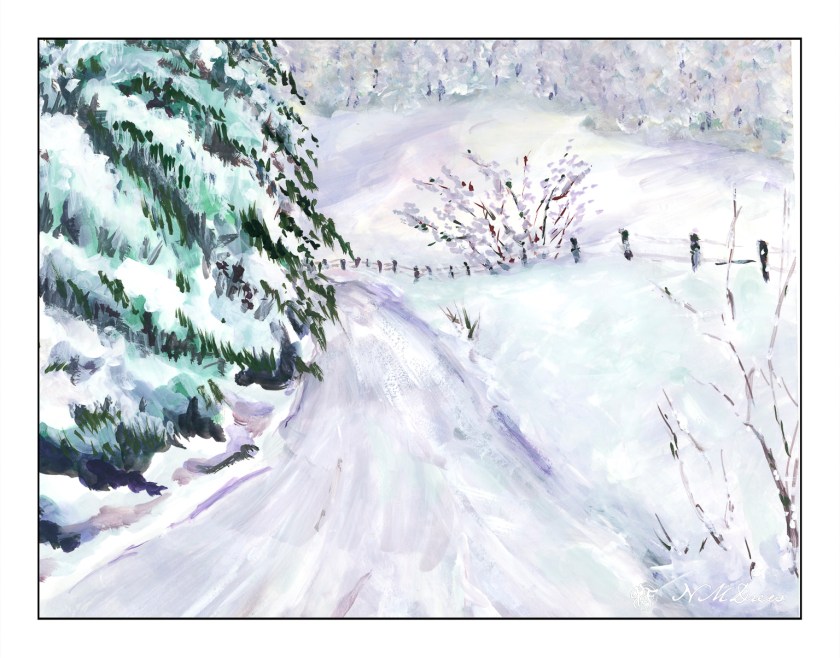
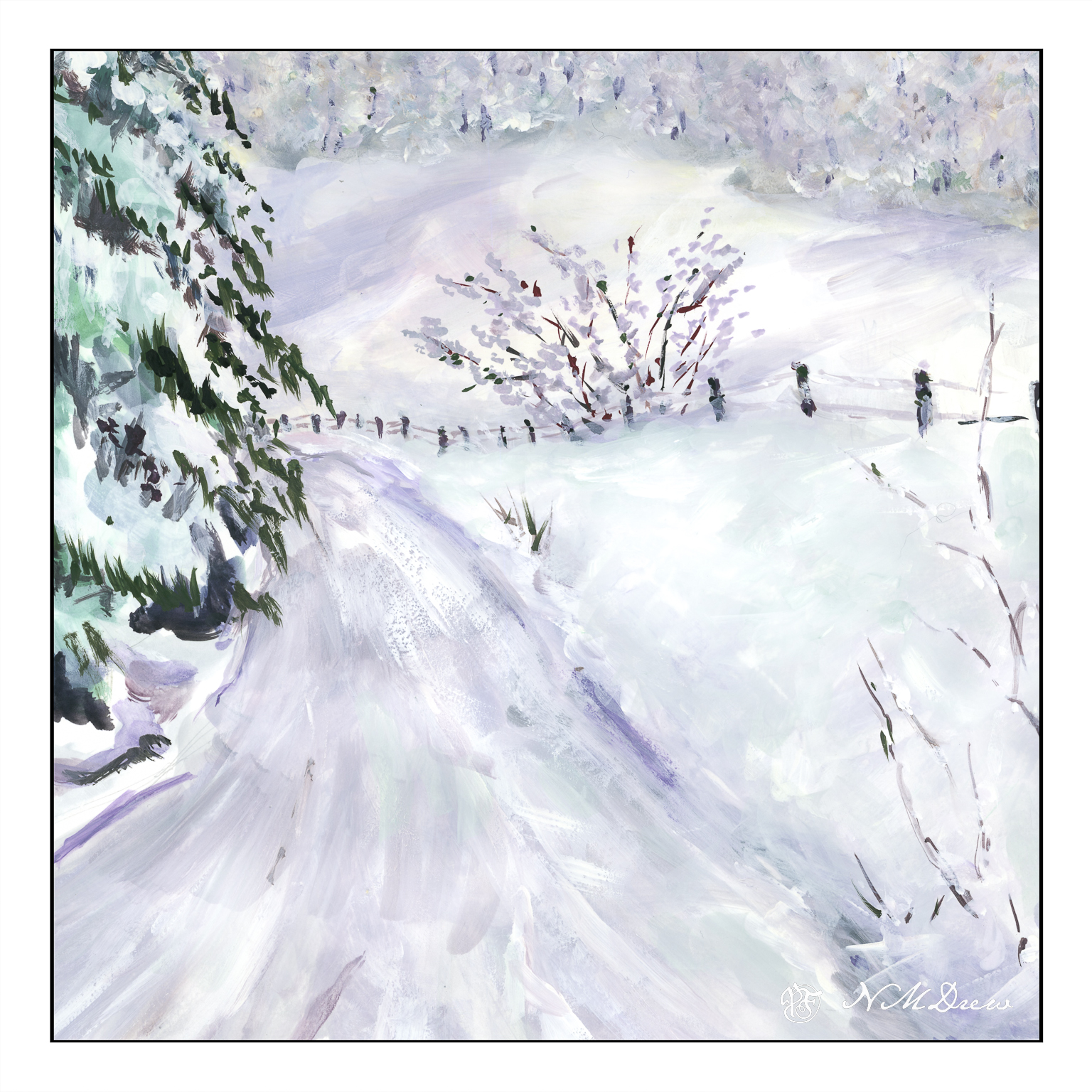
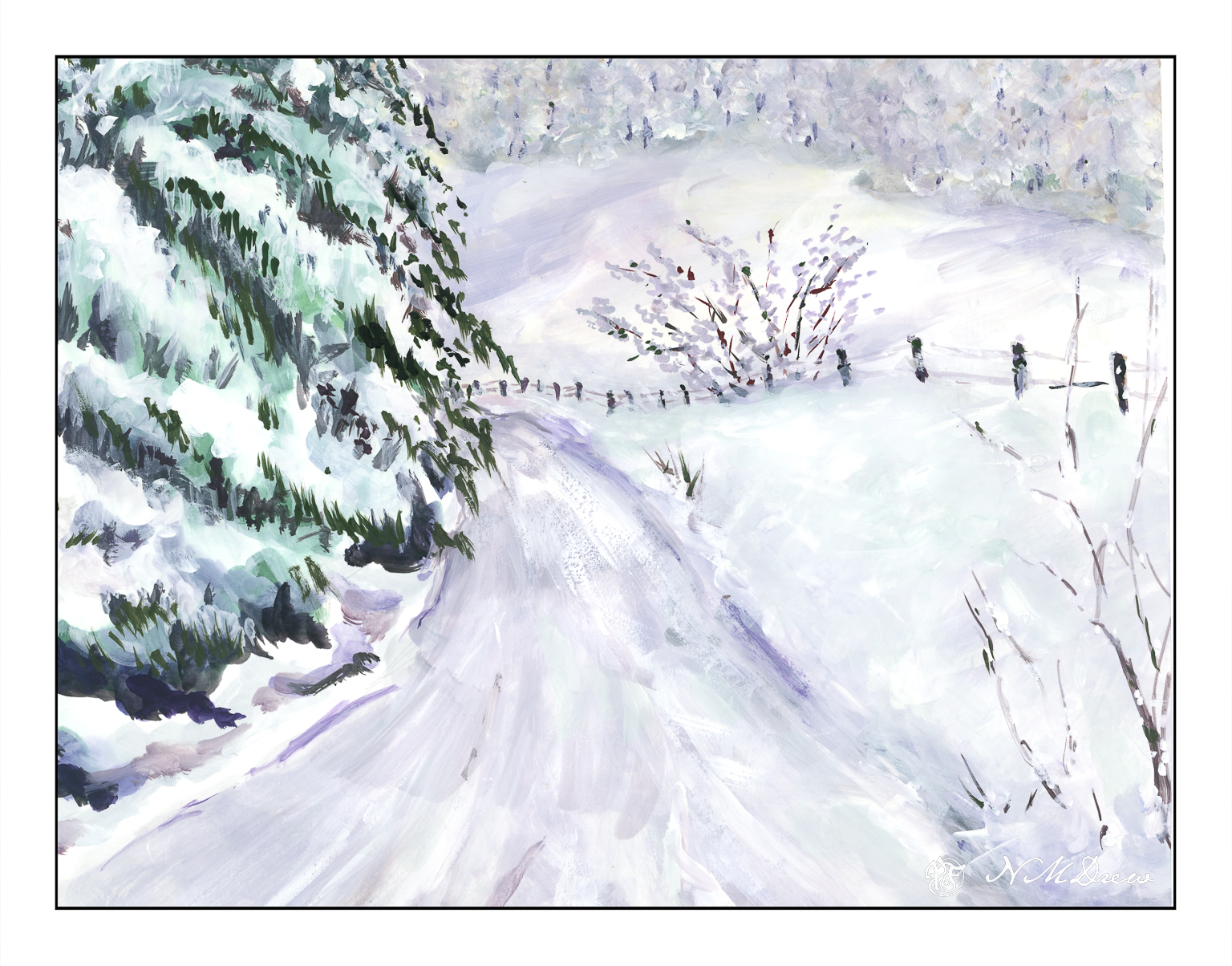
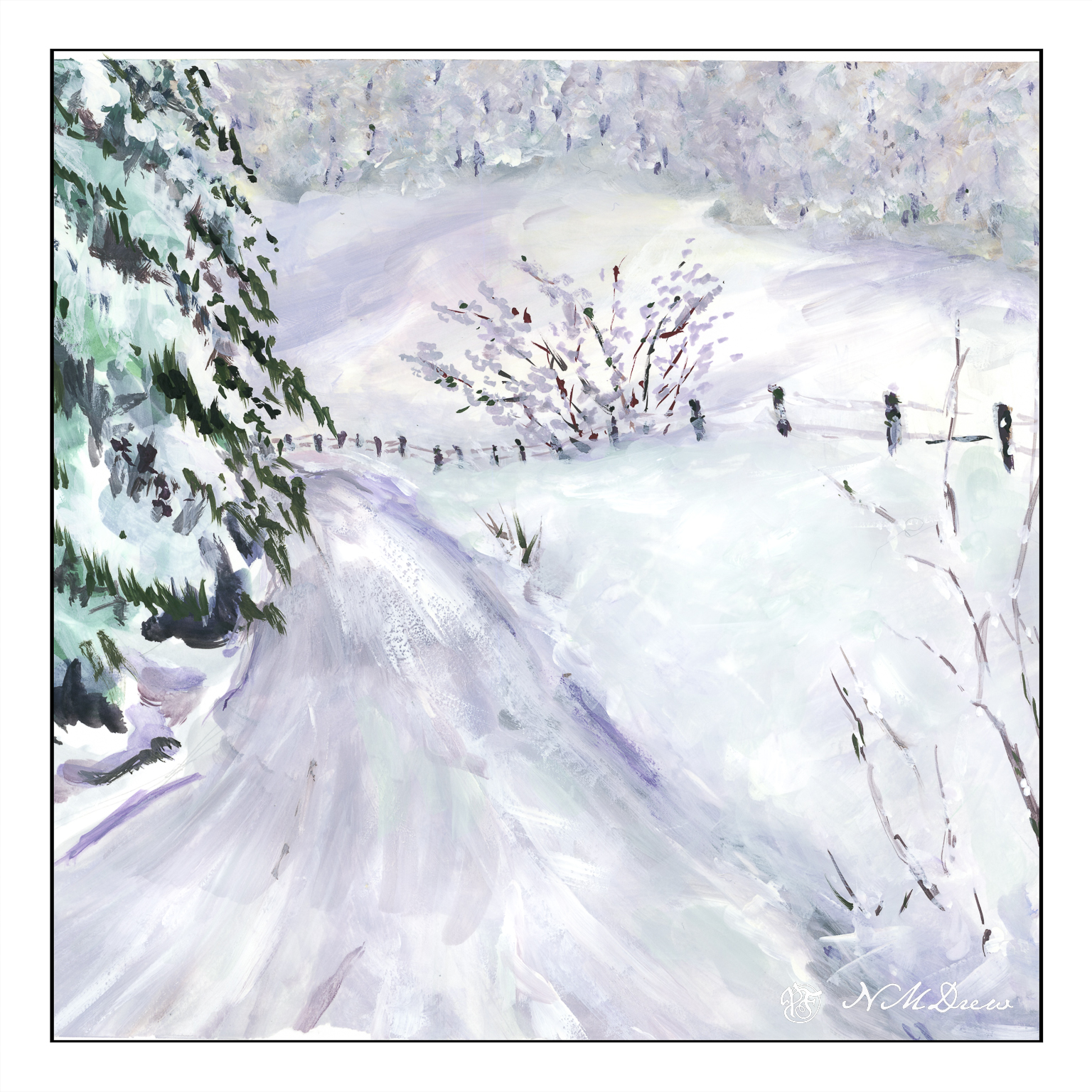
Snowy Pines Road – Rectangular or Square?

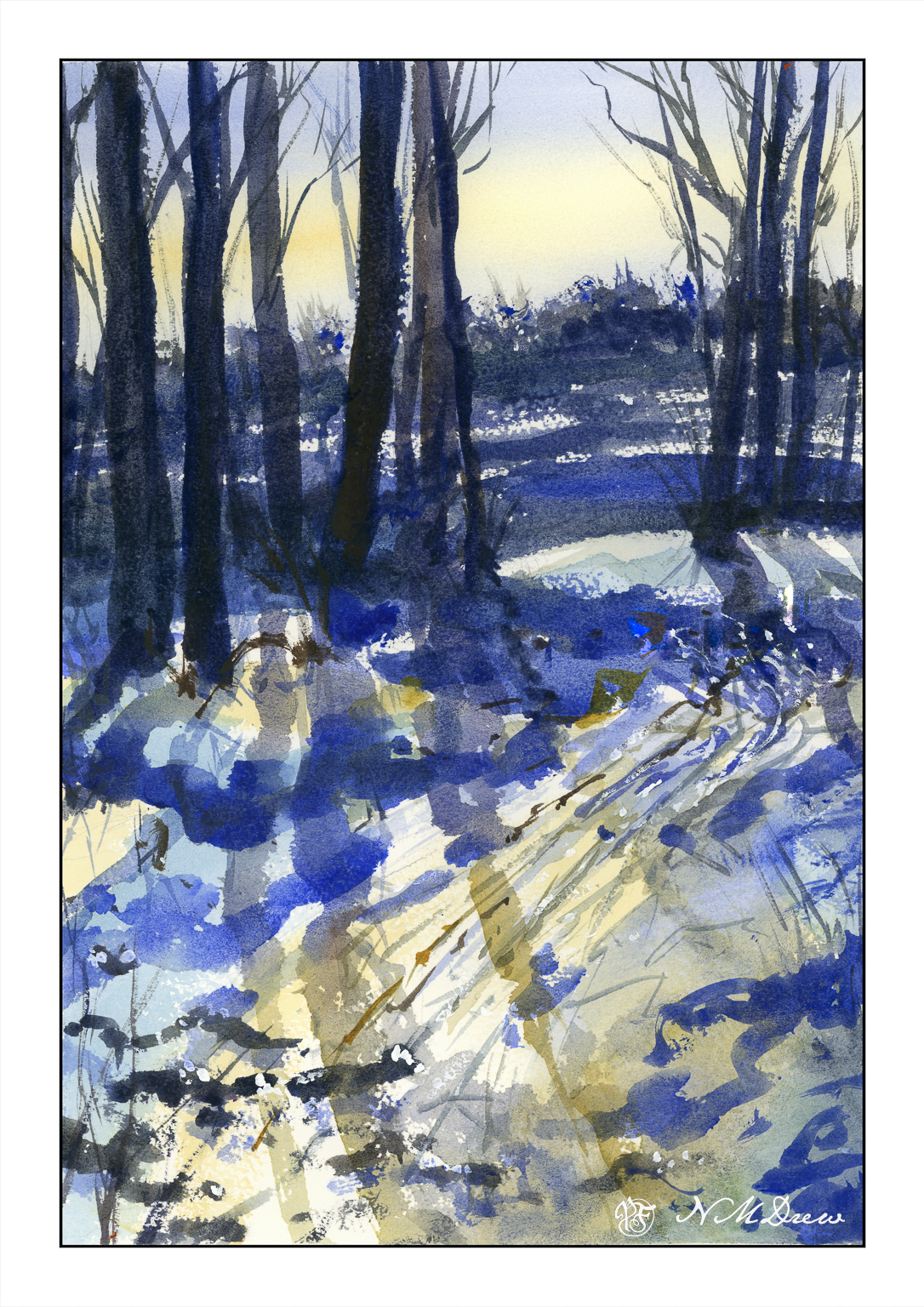
Another afternoon, another bit of time, another gouache. Today, since we are in December, it is time to visit mythological scenes of snow and cold as today we had 70+ F, and tomorrow more of the same with the possibility of fires because of the winds.

I am also in a bit of a dilemma – are the trees too heavy on the left hand side of the painting, or should they be reduced a bit in volume? The only way to do this is to crop the picture, so I did it in Lightroom.

Or is the square one a better painting?

I am rather torn. So, a slide show to compare them side by side. Drag the <> as far as you can left to right if you want to see them . . .

Your thoughts??

Sunflower Field

Yesterday I posted some of my paintings and a master copy of Khan’s Ground Fog to practice using large, simplified swaths of color to create abstractions of landscapes.

I like abstraction and simplification of things in paintings, but pure abstraction seldom attracts me. Recognition of whatever a painting is trying to depict seems to be essential for me to want to look at a painting, but as I study colorism / colorfield / abstract expressionism more, I find that sometimes pure color by itself can be enticing. I used to detest Rothko’s work, but now I am finding it quite entrancing as I appreciate the subtle qualities of color, and colors adjacent to one another, a lot more.

With this in mind, along with observing the work of Wolf Kahn, Richard Mayhew, Hashim Akib, and Andrew Faulkner, I painted this field of sunflowers.

I started out with big color fields for the sky, trees, and sunflower field using the basic colors of blue (sky), dark green (trees), and yellow and green (sunflower field). From there, I really worked to keep the foreground simple enough as the treeline, mountains, and sky do not beg for detail.

Initially I wanted to paint dots to represent the center of the sunflowers, but in the mindset of color planes, I didn’t. It paid off, but I was still not happy with how the sunflowers and foreground areas looked. Thus, some dabs – but bigger ones, brush strokes instead of dabs to be more accurate. Negative painting, too, and straight lines to represent the sunflower stalks. The buildings and poles were added at the end to add interest to a very horizontally oriented painting.

I am quite pleased with this painting. Goals were accomplished and my own style emerged here. I also did a lot of thinking about colors, how to paint a straight telephone pole (put a card down and run the paint brush along the edge), atmospheric perspective. Simplifying was difficult, but the broad swaths of color with variations within worked. In short, I have a bit of an abstract landscape in which the subject matter is recognizable, but not realistic. If I want a photographic rendition of something, I’ll just take a picture with my camera!

Color Planes

As I mentioned a few days ago, I am experimenting with swaths of color. Not simple planes of one color, but variations of color within that plane is the goal. A number of artists do this beautifully, and the graphic quality is elegant to my way of thinking, with the simplification being the subject and the goal and the voice of the artist. As I am a dabber, this is a big challenge for me.

To begin this, I decided to try my hand at exploring a painting by Wolf Kahn. The one I copied is called Ground Fog, and it is a simple study of grey, white, yellow, green, and variations of each within each area of color. Below is my attempt.

This was a challenge to try as he painted this in oil and I am using Golden fluid acrylics. Blending the colors was hard and required a lot of thought and movement rather rapidly since acrylics dry quickly, and the fluid acrylics even more so than heavy bodied acrylics. I got frustrated, let me tell you! Despite that, I did learn a bit about color – not quite sure what, perhaps just that subtlety is hard to achieve.

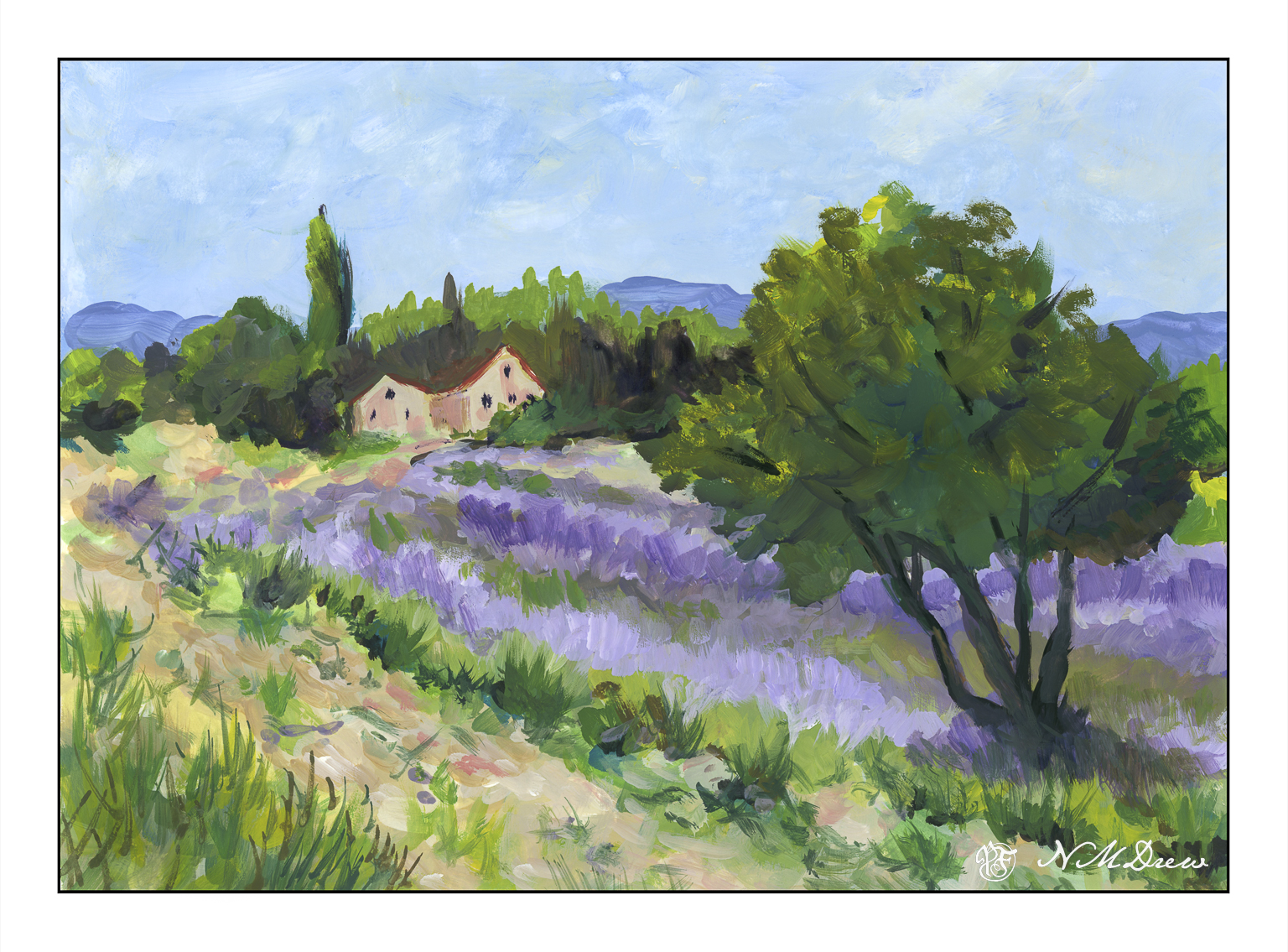
From there, once more a foray into fields of lavender and other crops, such as perhaps alfafa or wheat – no idea! I just know I see tawny colors and greens when I look at photos of lavender country.

While not especially low key or subtle, I was pretty pleased with the planes of color with the variations therein. The green and lavender are not too heinous when juxtaposed. I like the mountains and sky in the distance, as well as the trees. Sometimes nature is not subtle, and while bright, I think I did a decent job of catching a sunny day in a Mediterranean clime.

The lavender field with the green foreground was done with both large and smaller brushes. This one was done, for the most part, with a rather scraggly 2.5 inch bristle brush with a lot of scrubbing. In particular, you can see this in the sky. I applied varying layers of blue and white, painting up and down to use the brushwork to express the clouds in the sky. The same with the lavender field below. I used a smaller brush for the dried field area with trees, but worked to keep the brush strokes and colors to convey light and depth. I think it worked fairly well.

The study I did on Kahn’s painting gave me ideas on how to create the color planes, but of course I am not Wolf Kahn, and therefore have my own whatever method in creating such things. Acrylics, too, have qualities which oils do not, and blend differently. I am still learning them, and while I get annoyed and frustrated, each painting helps me gain skill and learn the language of the paints. These are invaluable lessons in technique and composition and methods.

The Not Taken Vacation: Ronda, Spain

Located in the province of Malaga in southern Spain, Ronda is about 65 miles northwest of Malaga, Spain. It is a “white village” located in Andalusia – a vast region along the Mediterranean and inland – but it is more than just a “white village” as it is home to what I think is one of the most fascinating bits of architecture, the Puente Nuevo. We will explore that famous bridge later on, but for now, let us just enjoy the magnificent scenery of this lovely place.

Ronda has been settled since neolithic times, but the 6th century seems to be when itself became a more settled area. It is marked by cliffs and canyons, as you can see below, but it is also built up on either side of the Guadalevin river. As the countryside is steep, getting from one side of the river to the other is a bit problematic.

These buildings are on one side of the Puente Nuevo. They stand on steep cliffs. As someone without a head for heights, I am not so sure I would want to stand on a balcony and look down – but I think looking across would show some marvelous scenery. Also, coming from earthquake country with unstable soil, my thoughts are, oops! – why did they build there? However, I expect things are far more stable than they are in my neck of the woods as this is an area where a bridge spanning a canyon 400 feet deep and completed in 1793 still stands.

So much to see in the south of Spain! To be continued!

Upward to the Beyond

What is the “right” way to hang an abstract? Is it the artist’s choice – the viewer’s choice – the hanger’s choice? The painting “Into the Blazing Hills” is one thing – the title telling you what I see. Inverted, I see “Upward to the Beyond” – moving toward the other side. What is the other side?

Putting my digital signature on this one gives it a different sort of reality – the signature grounds the painting and says “this is the bottom so upward is the top.” What is the top? What is the bottom?

Sideways, the painting does nothing for me, with the yellows on the left or right, but yellows on the top or bottom create a totally different feeling, but somehow the feeling is right. I will say, the yellows on the bottoms are more disconcerting and unsettling to me than when it is on the top. So, upset or comfort?

If I were to critique this at all, I would find this painting bottom-heavy in yellow, and moving upward it seems as if there are trees silhouetted against the sky. However, there is all this stuff in between, and it lacks the harmony, I think, that “Into the Blazing Hills” has. Perhaps it is the ability for me to recognize my surroundings – the hills of California – with either a sky and brilliant, blazing sunset – or a wildfire encroaching a bit of paradise, destruction being moments away.

This is going to take time – maybe both are “right” – and perhaps the middle chaos in this painting is okay but needs a path of some kind to lead the eye upward.