I have lived in Ventura County for a long, long time, and have watched changes come about, as is inevitable. Mostly it is the loss of open space and farm lands, with houses replacing fields. Traffic congestion has gotten considerably worse. Certainly we all see this. However, there are some things which do change for the better.
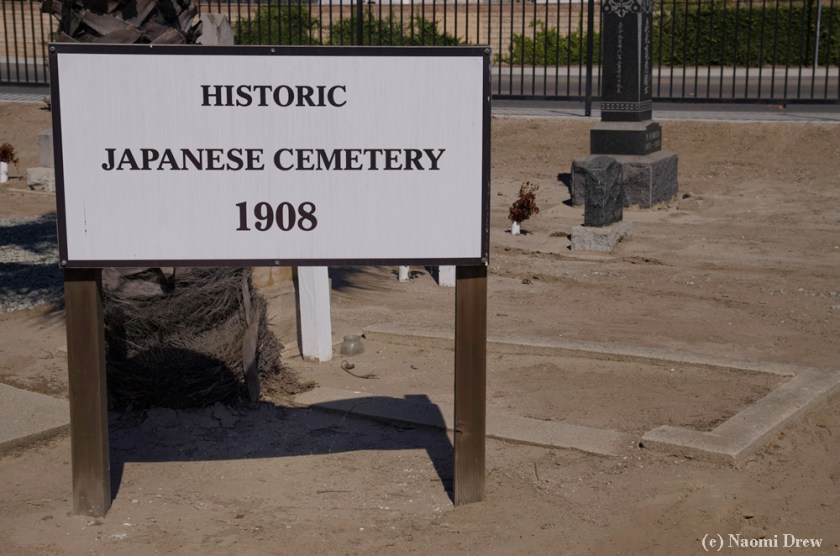
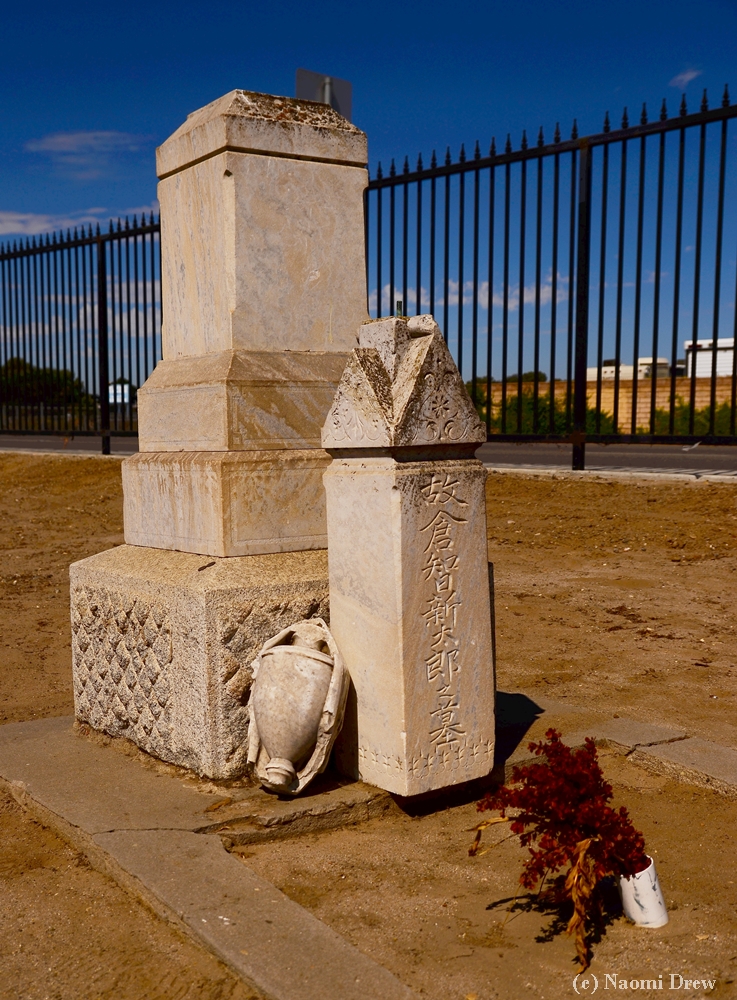
One thing which has changed is our level of discrimination. Overall, we recognize it as wrong. Years ago, people of different races and religions were buried in sections of cemeteries reserved just for them; other times, the dead amongst given ethnic groups were refused the right to buried at all. In Ventura County, and throughout much of California, Asians were denied access to cemeteries, public or private, and as a result, were forced to create their own.
The Japanese community was one group, and so they had a small one for their own community. In 1908, out in the middle of nowhere, they laid their dead to rest. Some were Christian, some probably Buddhist or Shinto. Only a few years ago did the historical recognition come, and some funding to help rebuild the cemetery. Throughout the past century, the Japanese community has maintained it, but over the years, vandalism and age have taken its toll.
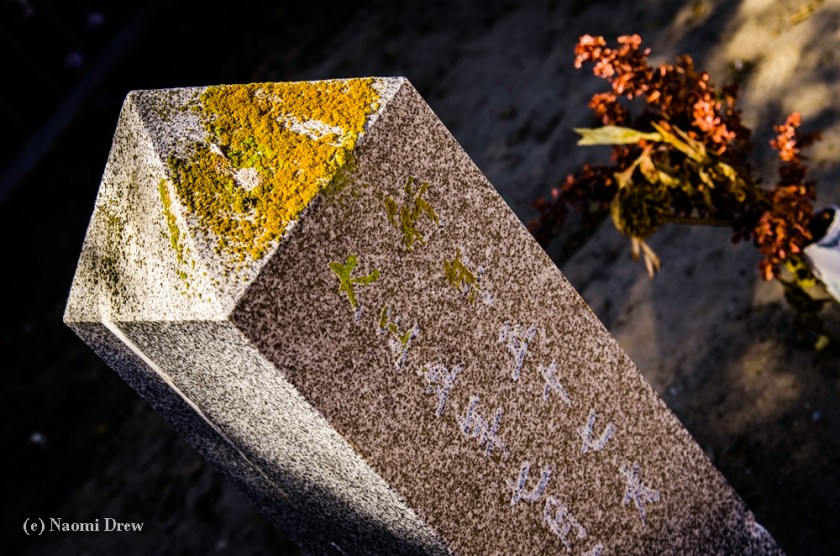
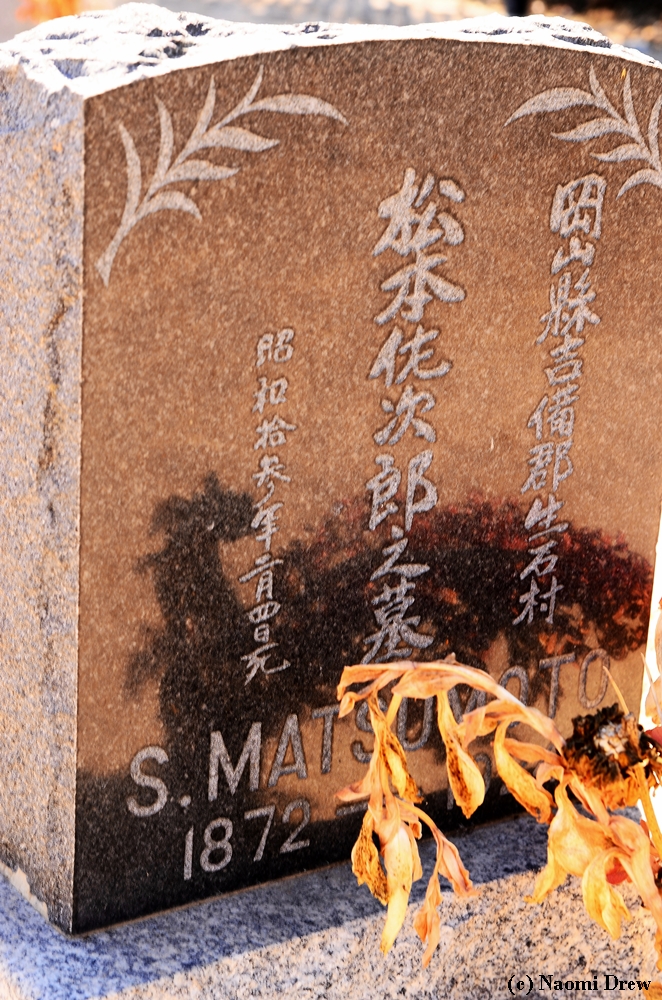
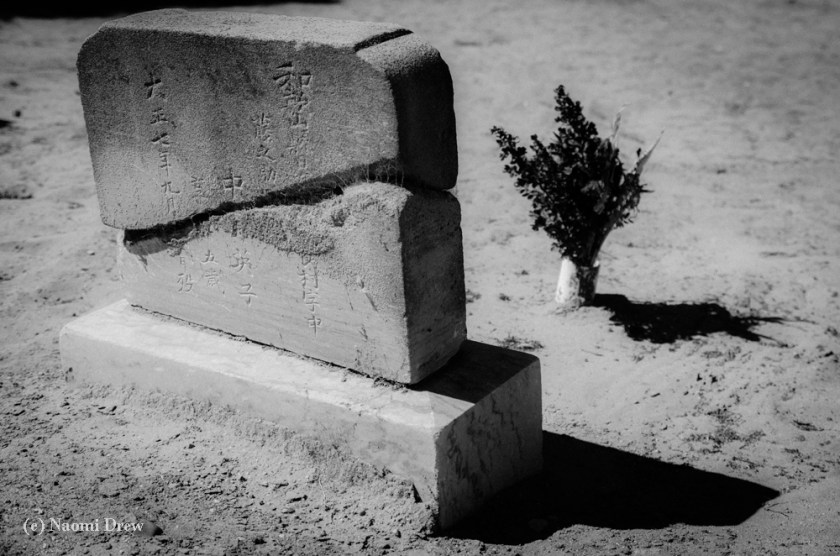
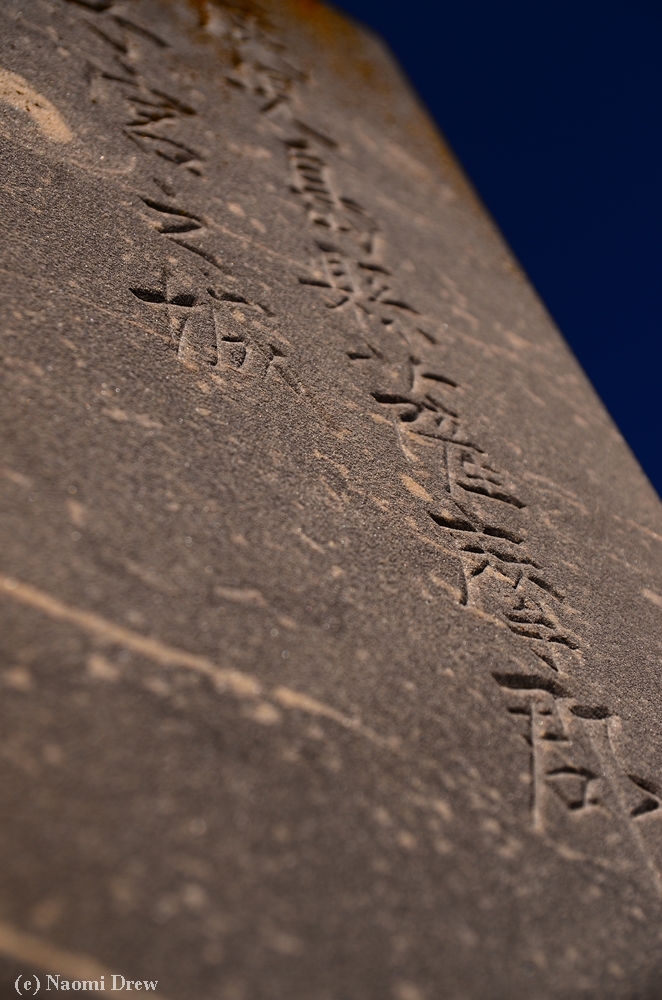
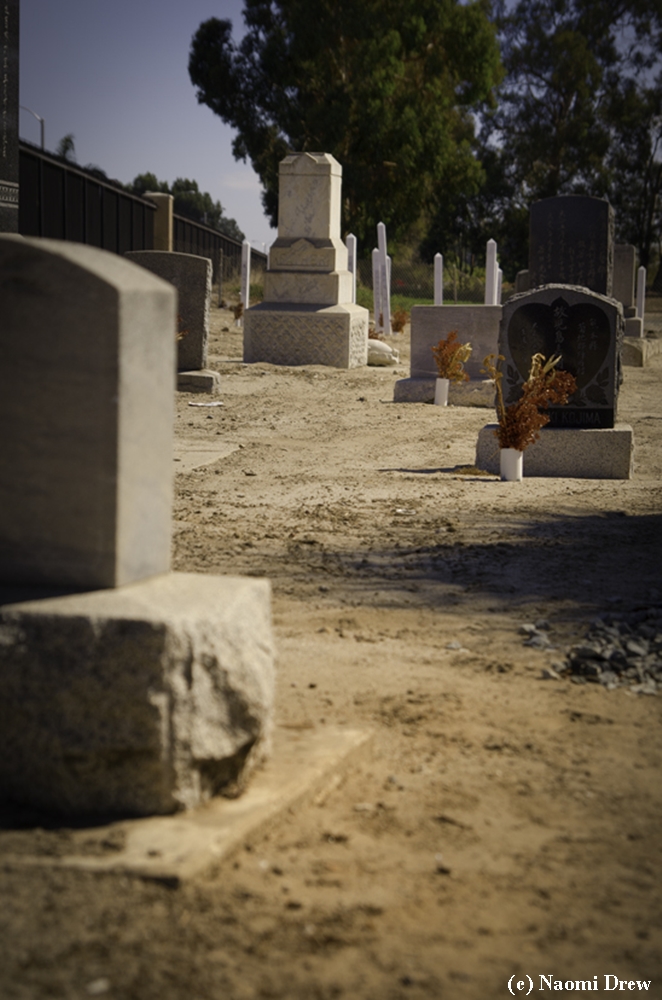
I have long been coming to this cemetery. It is small and mysterious, with stones with kanji only, others in English, and others with both. Years ago, photographs were attached to some of the more grand stones, but these have disappeared with time. Other markers were simple white posts with faded writing.
There is another cemetery nearby, only a few hundred feet up the road, and probably dating from the same time. It, too, has fallen into disrepair, but nothing has been done to renovate it. More than obviously, it was once a going concern, probably well maintained. The layout shows this, with clearly marked concrete borders for family plots. There are more fancy headstones, yet none except one has any flowers in front of it. Instead, there is litter and debris.
Interesting how differently two communities remember their members.
Every region has its artistic styles, as well as every time period. The same may be said for production of the suzuri, with a classical shape and style modified according to era and taste. The most common suzuri is a rectangular stone with a deep well on one end, and a flat surface sloping into it This makes sense, as it is practical and probably fairly easy to accomplish. Decorative elements and embellishments in the non-working areas are certainly possible, and I would be inclined to say almost inevitable for the expression of the carver’s creative force.
Besides the impact of regional and time preferences, the economics behind the stone’s production itself may be seen. Stones for the masses – the daily stone – are probably more plain than those for the aficionado, simply because of their utilitarian role. These can be made quickly, with or without attention to quality or aesthetics. Today, stones for tourists may be pretty but worthless as far as usability; other stones may be far better in quality and less ornate. A good stone is absolutely necessary, whether for calligraphy or painting, if you are using an ink stick.
Kiri Wood Box
Today’s stone is from Japan. It does not have a rosewood box, but it is very nicely encased in a kiri wood box. Unfortunately, I cannot read the label! (If anyone can translate for me, please let me know.) This is the only stone in my collection I have not yet used, and I am still deciding on whether or not I should – it is so beautiful as it is! Knowing me, though, I will at some point when I am not rushing around – I want to take the time to enjoy it.
I am under the impression this stone is carved from nachiguro, a lustrous black slate or river shale unique to Japan, and has been used since the Nara period (710 – 794 CE) for carving practical and ornamental items, such as suzuri, go stones, and suiseki, This stone is a sedimentary shale which originates in the upper side of the Kumano river in Japan’s Mie prefecture, and is characteristically very dark and shiny.
Suzuri Lid with Carving
Many traditional Japanese themes and symbols may be considered by a master craftsman in creating a high-end suzuri, but this artist has taken a considerably more modern approach. The abstract elements of the lid are suggestive of many things, and certainly some traditional themes as well. Just in a glance, I can envision falling leaves or swimming koi. The carving is very subtle and pleasing, working very well within the smooth borders of the circle. To the touch, the different textures are smooth and rough at the same time, without any sharp edges.
Inside Well of Suzuri
The smooth elegance of the polished stone is a bit more rough on the grinding surface and the well, having the necessary tooth to create sumi ink. The borders of the well are polished and shiny, in keeping with the rest of the stone. The contrast of these two areas repeats the circular motif of the suzuri’s shape, as well as the framing of the lid’s pattern. The underside of the lid is as smooth and reflective as the underside of the lower portion of the stone. Even the underside of the suzuri well is smoothly finished, and follows the circular motifs of lid surface and underside, and the well. This stone is not especially old, probably produced in last quarter of the twentieth century. It is a large, heavy stone, measuring more than 8 inches (20 cm) in diameter.
Suzuri Well on Left; Underside of Suzuri Lid on RightUnderside of Suzuri Well
I expect this stone could be considered something of a luxury item, for oneself or as a special gift. Given this, I cannot help but wonder if the beauty of the stone is all it has – can it be used to produce good ink? Even if it does not, there is something to be said for simply beautiful objects. The suzuri’s circular shape is pleasing, the lid’s carved surface intriguing, and the soft, candescent glow of the stone subtly elegant. Aesthetically, this suzuri is a sculpture to be appreciated in its own right.
Kaishu / Kaisho – standard or regular script, with some variations over time, is what most of us are familiar with as Chinese characters or Japanese kanji. It fits nicely into squares, but it goes far, far beyond that. There are a lot of dynamics at work in this script! Dots and lines, hooks, and so on. It is amazingly complicated in some ways, but not in others. But doing it right is another story.
This is an example of regular script, from a long, long time ago.
If you look closely, you will find some long, horizontal lines, which are wider at either end and narrow toward the middle. These are called “bone strokes.” Here is one below – and the path the brush should follow as you create it.
The work of the day. 4 hours. Horizontal accomplished, but initial brush stroke and ending brush strokes are far from attractive.
I’ll use the excuse that I am warming up – so to speak – to my August project of copying the Heart Sutra. After giving it some thought, I am still thinking about it.
I decided, as I thought, to simply dig out some ink and some brushes, and play a bit, loosen up. Once I did so, I realized how stressed out about everything I’ve become. Even this project, because perfection is what was on my mind, not enjoying a process.
I also was considering the reality that using the seal script might not work for me. I did a bit of research on the seal script, and realized it would be possibly more frustrating than I wanted to handle. The reason is that the lines are uniform, with none of the thick-and-thin and technical details, such as bone lines and dots, that kaisho would require. So, for now, I have decided I will probably do it in the latter.
Playtime
In the process of playing, I started with lines. Straight lines, horizontal, vertical, criss-crossed. Circles and spirals. Bone lines. Dots. I used bottled ink, and cheap, poorer quality ink sticks, and sheets of paper. The results are like photography – lotsa photos, lotsa paintings – and only a few which are particularly pleasing.
Lines
In the line category, I wonder if it is just me, or if other people from the West experience the incredible difficulty I have with doing straight lines. Both horizontal and vertical, parallel to the edge of the paper, are very difficult to produce. My theory is that as someone who was taught the Palmer method of script, everything – but everything! – has a slant on it, except the t-bar. Horizontal and vertical lines are very foreign.
In one book, one on the meditative approach to sumi, the author wrote about the importance of focusing on each line individually, not on the group of lines. This proved to be the case. As I began to paint grid after grid, the understanding of this concept became quite clear. Becoming the line as I was painting it is the simplest way I can explain the experience.
Circles / Enso
On the other hand, circles were a bit more easy, but doing them from the bottom of the` page and moving in a clockwise manner was a bit of a challenge. My penmanship training was always start the number zero at the top, and create it by moving counterclockwise. On a few pages, the paperweights did not hold, and so the paper got pulled along in the brush movement.
From circles and spirals, came a series of circles – some of which developed an incredible dynamic quality for me.
Bone Lines
Bone lines, used in kaisho, were especially difficult. I watched videos from YouTube, simply to watch how the brush was manipulated. Reading directions also created confusion. Instructions in videos and in text books emphasize that the brush is held vertical to the paper. To me, this means a 90 degree angle, perpendicular, not a tilt at all. Then, watching, of course there is a tilt to the brush, but it is done through wrist manipulation. Books say to keep the brush vertical, and then say “push the brush to the right” – well! What does that mean?? I think I figured it out – some of my bone lines began to look like bone lines.
Dots
Finally, I could not just practice lines and circles. I had to do something a bit different. Yesterday I did dots – such as would be found with grapes – and various techniques with the brush. Dots can be made by simply allowing the ink to be absorbed by the paper and spread, or by twirling the brush, to create a circle.
Brush Loading
Another technique is loading the brush in different ways. In the picture below, you can see different methods.
In the picture above, there are three ways of loading the brush demonstrated. The top one is the traditional light ink with the brush tipped in dark, and pulled at an angle across the paper. The second one was an attempt to add dark ink to the top of the brush, near the handle, along with dipping it – this did not work out too well as I was stingy with the ink. The third line, I was more generous, with both ink and water – the light middle line is visible to show the result. Finally, the fourth line is the result of using a light wash for the brush, and then adding dark ink to the middle of the brush. A rather nice effect.
Bouncing the Brush
I also practiced bouncing the brush, sort of tapping it and moving it along the paper. The picture below demonstrates what can be done with this technique.
Copying the Master
Thoroughly warmed up now, I decided to see about copying a painting, using a video to copy and learn from techniques. I admire the work of Kazu Shimura (see link to the right), who has over 70 videos on YouTube about sumi-e painting. One I really enjoyed was his demonstration painting of hydrangeas.
Two totally different approaches to the same subject. I went for the first one, and to do it with some rain. These are my first attempts. I did them from recall on what I saw, but I was not too pleased with my results. Something was missing.
I did about 5 paintings altogether, but none of them worked. So, I watched his first video again. This time, my painting was far more pleasing than any of my other attempts. Knowing full well I would fail at frogs, I did a snail.
And now?
It’s Friday, early evening. I read a book today from the library – a rare treat – and then went out shopping for a computer desk. I think tomorrow I am ready to begin the Heart Sutra. It will be slow, maybe only one character, maybe a few more than that. I think I will go page by page, as broken down on van Ghelue’s web page or from her book. This past week I have spent about 20 hours painting in ink, and enjoying every minute!



 If you look closely, you will find some long, horizontal lines, which are wider at either end and narrow toward the middle. These are called “bone strokes.” Here is one below – and the path the brush should follow as you create it.
 The work of the day. 4 hours. Horizontal accomplished, but initial brush stroke and ending brush strokes are far from attractive.


 From circles and spirals, came a series of circles – some of which developed an incredible dynamic quality for me.


 Bone Lines


 Copying the Master

 And now?
 Ink, Yarn & Beer