
Over the past year or so I have gotten numerous requests about sumi, suzuri, brushes, paper, lessons, and where they may be bought. I would like to respond to people, but there are times when it requires a lot of work and time on my part to answer individual enquiries in depth. I have sent out a few lengthy emails in reply, but have received no acknowledgment back from the recipient. Other times, people have been quite demanding, asking me to do this, to do that, and while I generally do not mind helping people out, it can become a chore. So, given this, I hope that this posting will prove useful.
Let’s face it – there is a real challenge to finding high quality art supplies for traditional Asian art. Much of what art suppliers import is poor or student quality, simply because it is such a niche market. I would like to import items myself, but that takes time and energy I really do not have – there are too many other things I am interested in, as well as am obligated to do. That said, I am going to write up a bit about what I know.

Sumi Ink Sticks
Acorn Planet was a wonderful resource for good Chinese ink sticks, brushes, paper and stones. They no longer provide such items, but remain online with a wealth of information. Ink sticks from tourist shops are likely to be worthless. And, if you value your suzuri, you need to make sure you get fine quality ink. Thus, at this point, the only places I would recommend for sumi would be John Neal Books (JNB) for Japanese ink – I own many that they carry, so can vouch for the quality of the sumi by manufacturer. I have never ordered from them, but will when I want more ink! The other resource is Oriental Art Supply (OAS), which carries Chinese ink sticks, none of which I have used, but am inclined to think should be good given how great their other supplies are. Both are listed to the side as direct links.
Brushes
I think good ones are the most difficult to find. Cheap ones may be found everywhere. My preference is for Japanese brushes, but the high labor costs make them expensive. Still, as any art student is told, buy good supplies when you begin; this same adage holds here. Poor quality supplies can be very frustrating, and the fact is, the Asian brush can be an extremely difficult brush to master, especially the soft one. Western brushes are, in general, much stiffer in character, and are not as flexible as Asian ones, and do not hold on to water or paint as tenaciously.
 For the beginner, mixed hair brushes are probably the best, as there is resilience from an inner core of harder hairs, which helps the Western painter, combined with an outer layer of softer hairs, which retain liquids. Because both hardness and softness are combined in this type of brush, a beginning student will be more comfortable with the brush, as well as learn about the challenges of the Asian brush.
OAS carries these in various sizes and prices. At this point, OAS is likely to be the only supplier from whom I would buy a brush sight unseen, partly because of their service, partly because I have been to their storefront, and partly because I have boughten a number of their harder brushes, and have been really pleased with them. This is not to disparage other vendors, this is simply based on personal experience.
If you are a beginner, buy a medium-sized mixed brush, but also get yourself a hard brush. These are incredible for texture and expression. Additionally, they do not retain water as much as the mixed brush, but can be so hard that you feel you are painting with a bunch of sticks! My favorite ones from OAS include the Happy Dot and Orchid Bamboo for smaller ones; and the Dragon Brush for a larger one, and the Mountain Horse for expressive lines. The Biff Brush is a kick to use and is unlike anything you will find elsewhere. Expressive calligraphy is nicely accomplished using the Cao brush, which is available in hard and soft.
 Suzuri / Ink Stone
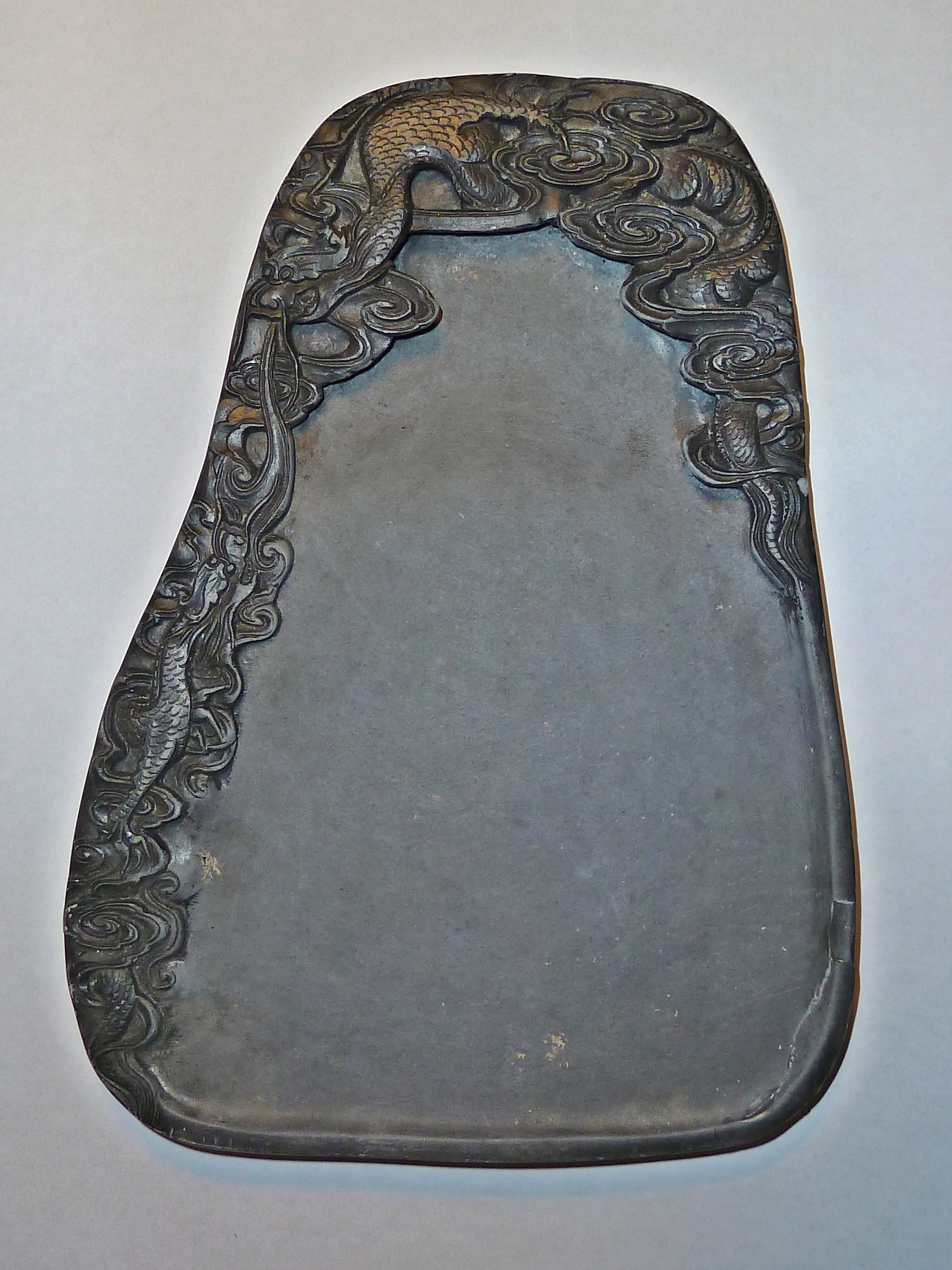
These remain the most elusive item. The last I checked, John Neal Books carried only one inkstone, the Shakyo-Ken, which I wrote about here. This stone is wonderful, and in a pinch would work well for painting, but it is quite small. Ebay is a good resource for stones; I have picked up some there which were worthwhile, and have been rooked on others. OAS has a few; I have one similar to their large round one, which I have enjoyed. Its round shape will hold a lot of ink, but lacks the flat surface and deep well a suzuri has.
Buying a stone on Ebay is risky. Some are “stones” which are really just a plaster mold, antiqued to look interesting. If you are going to buy a stone, don’t get anything too fancy, and get one with a slope and well. This is the best stone if you plan on grinding ink as you have the smooth area to grind on, and the well to collect the ink. Never buy a kit containing a stone, brushes, and inks, all prettily packaged – these are basically worthless. Sometimes the best ones to buy are used. You may need to clean them up a bit to remove old ink, and you may need to sand them down, but the quality may be had for a small price and a bit of elbow grease. If you want antique stones, check out various Asian antique sites, but beware as they may be very overpriced.
 Paper
Paper
I love paper! Asian paper is quite different than Western art paper, in structure and manufacture. A major difference is the amount of sizing and thickness of the sheet.
My favorite Chinese paper I have used comes from OAS. It is their Premium Double Shuen. Expensive? Yes, compared to other papers, but I have found it has the best response to my way of painting. Chinese paper is “raw” if it is not sized, and extremely absorbent. It will make you crazy. Even the Premium Double Shuen is very absorbent, not quite as much as raw. Specialty papers for calligraphy may also be found at OAS.
Japanese paper is also different than Western paper. It may be sized, it may not be. It is also constructed with different materials. Handmade paper may be very expensive. An excellent resource for Asian papers is Hiromi Paper in Los Angeles. Their online store is quite good, and their brick-and-mortar store is a delight to wander through.
When it comes to buying paper, of course it is always best to go in and see and touch it. When you cannot physically try out a paper or touch it, if the company offers a sample packet, it can be worthwhile, as long as the papers are clearly labeled. When I buy sample packets, I usually use permanent ink to write the name on the paper – most places use pencil – but this lets me remember what it was, and if I would want it again. I consider this as “tasting” a paper – you can get really overwhelmed by too many at one time!
Color / Paints
Color pigments and paints must, of necessity, be waterproof in Asian painting. Western watercolors will not substitute as they are less intense and not manufactured to become waterproof when dry.
Tube paints are a Western invention of the 1800s (I think!). And, they are a major convenience! However, colors may also be had in the form of chips and sticks.
 Colored “ink” sticks are very convenient, and can be a wonderful experience, but the drawback is grinding the pigment. You do not use your suzuri for this! Rather, a gaken (gakken?) is used. This is a ceramic dish, which may be had from JNB. I clean these after each use, so they are rather intensive to use. A separate one is best for each color. JNB carries the color pigment sticks.
Chips may be dissolved in baby food jars and stored. Chips may be purchased from OAS. Japanese companies also manufacture color chips, but I have never found them for sale in the U.S. Daniel Smith offers dry pigments, but I have no idea if they can be used for Asian painting.
Tube paints I have used for Chinese painting are manufactured by Marie’s and are very inexpensive, and can be found at many different retailers. (Just do a google search!) The tubes are sealed, and the paints have a rather awful smell, but are essential if you do Chinese painting. The palette is also limited, but good watercolorists do not tend to 50 different colors, either. The reason Marie’s are de rigueur is because, once dried on the paper, they are waterproof. The same may be said for the paint chips and sticks. Bone glue is used to bind the pigments, and it is this, from my understanding, that creates the final impermeable paint. Ink sticks are also bound with bone glue, which is why ink does not run after it has dried. Holbein manufactures the Irodori line of opaque watercolors, based on antique pigments. These colors are lovely, but I do not recall if they are waterproof or not once dried! (Think I should do some painting??)
Lessons
Unless you live in an area with an established Asian population, or artistic community, individual and group instruction may be difficult to come by. Here where I live, there is a wonderful group for Chinese painting. The instructor comes monthly. Harris Ha is very talented. OAS maintains a list of instructors you may search. Silver Dragon Studio has another list. These may be worthwhile checking out. Ning Yeh of OAS offers classes through a local community college, and sometimes through UCLA extension. In the links to the side, you will also find some artists I admire who may offer classes.
Truthfully, hands-on instruction can be the best experience, but the cost may be out of the range of your finances. Books, then, when coupled with good supplies, dedication, and time, are also very good ways to learn the art of ink painting. The internet provides us with many resources, from old books to videos. I’ve watched Kazu Shimura over and over! Making videos of my own painting has been fun, and re-watching them, educational and surprising.
Other Supplies
Asian painting must be done on a felt panel. Wool ones are the best, and can be found in varying sizes. In a pinch, flannel from the fabric store is fine to use.
A brush rest is useful as it holds the brush tip above the surface on which you are painting, keeping your work surface clean and organized.

A water source, from which small drops of water may be used to wet the ink stone, is another necessity. I use a “sucky cup” – a Rubbermaid cup with a straw that folds down – or a fancy antique suiteki, which is a water dropper. There are cheap ones available, and can be delightful additions to your studio. Water containers are also necessary, and it is best to have at least two to use – one to rinse out a brush, and a second for fresh water. This helps keep your paints bright, and your ink gradations unpolluted.
A palette is necessary for colors, and small white porcelain dishes are useful for ink gradations.
Paper towels for blotting wet paper are other useful utensils – I always keep a roll on my desk. Old, absorbent towels are also important, particularly for blotting excess water or ink from brushes before touching them to raw paper.
Some artists recommend using a blow dryer if your paper is too wet. This may be good for a beginner, but ultimately, it should not be used. The heat could change the chemicals of the pigments, I’ve been told, but the real reason for not using a blow dryer is that dependence on it is not a good thing. As an artist, mastery of your craft includes learning the quirks of the media.
Because Asian paper is very thin, paperweights are essential for holding the paper in place. Also, long sheets need to be moved along if they are on a table, rather than the floor, and paperweights help keep large sheets from blowing around in a breeze. Long ones are great for the top and bottom of a sheet, or along the length. Smaller ones are good for corners, and can range from the whimsical to elegant. Rocks are also useful as paperweights, and if you walk along the beach or river, some very lovely ones can be found. Do not disregard the value of paperweights – the first time your paper pulls up and sticks to your brush, ruining your stroke or painting, you will understand their importance!

Finally, brush holders are a necessity. There are some beautiful hangers for Asian brushes. These are excellent for use when drying your brushes after use because the water will not drip into the handle and dissolve glues holding the bristles in place, nor cause the wood or horn to rot, weaken or disintegrate. Personally, I do not have one, but rest my brushes on their sides after rinsing and drying with towelling. I have a piece of wood and screw-in cup hooks I keep meaning to put together for the same purpose. Storing dried brushes is easy enough – just put them in a jar, tip up.
Summary
I hope that this helps out all you inkophiles out there! If you have any resources which you would like to share, please let me know. I’m always looking for good, reliable resources.
 Some time ago,




 Ink, Yarn & Beer