
Dragon Stone

We are still moving things around since my brother moved out last year.  Needless to say, we are slow!  In that process of making room for him, a lot of stuff was shifted, stored, and forgotten.  Now that the studio is being revamped, I am refinding things, namely, two ink stones, one Chinese, one Japanese. Today I will write a bit about the dragon stone.  Clicking on the image below will take you to a larger image which will allow you to see the in greater detail.
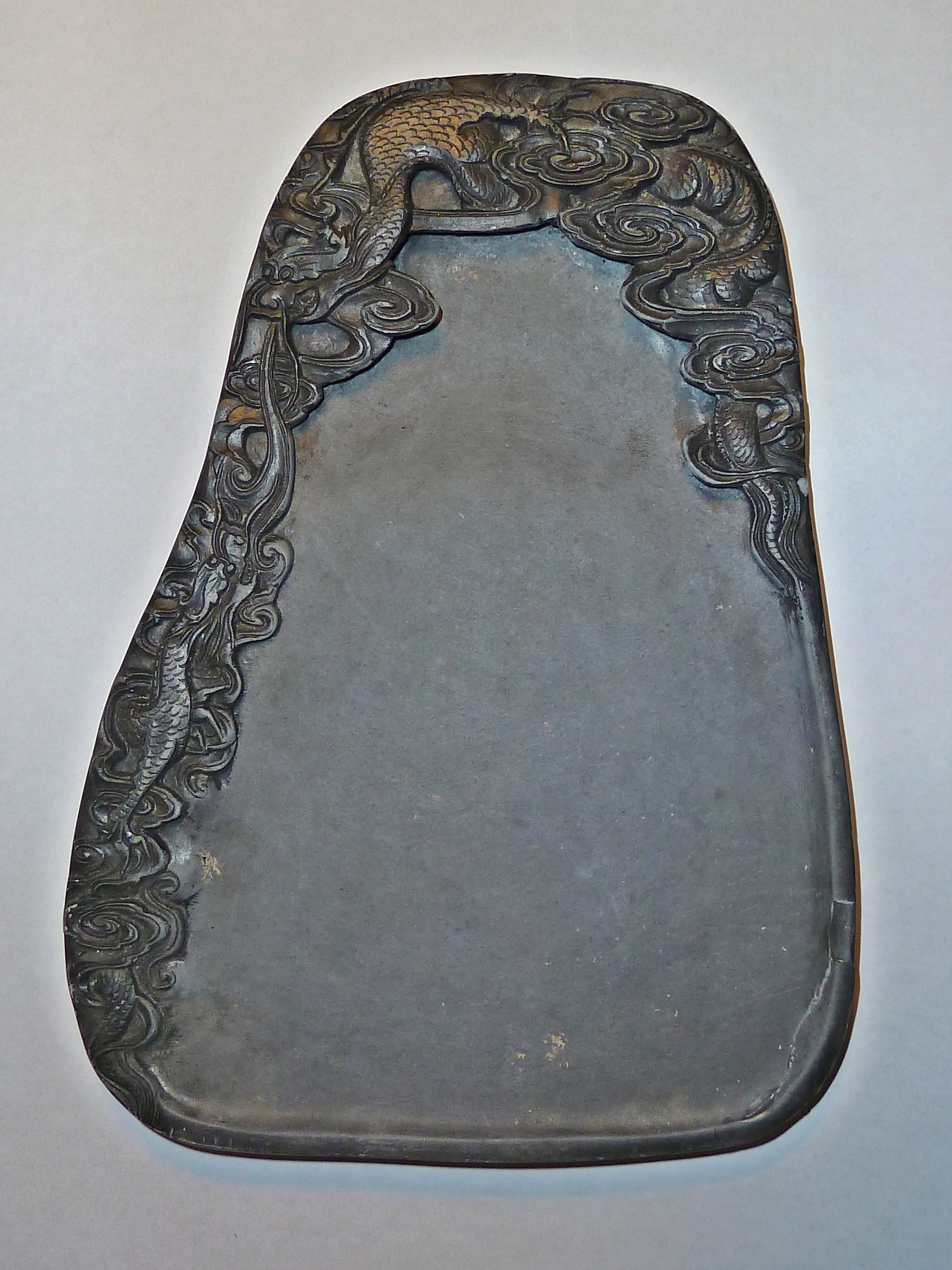
Dragon Stone - Dragon on Upper Left, Clouds and Tail on Upper Right - Smaller Dragon Along Left Edge

The above stone is Chinese and measures about 8.5 x 6 inches (22 x 15 cm). What kind of stone it is – most likely a slate – I cannot tell you for sure, but I will say the design is more Chinese, from what I know, than Japanese. The stone has a rather bell-like sound to it when tapped. Breathing on the stone shows little retention of surface moisture, as do some other stones, but a thin layer of water holds to the surface, then vanishes. I have not ground any ink on the stone as of this writing. Also, I have no idea where or when I purchased this stone! I expect I bought the stone because I like the carvings of the dragon in the clouds more than anything else – I’m a water dragon myself.

Repairing Chips on Lower Right Side of Dragon Stone

Unfortunately, when I unpacked the stone, a number of chips were in the box. I managed to salvage a few, and, not knowing what type of glue to use, decided to just try white glue. As the stone is porous, and white glue works well on porcelain, I decided to give it a shot. Admittedly, it doesn’t look great, especially in large pictures, but the mending is not too noticeable in the large picture of the stone itself.  The stone seems rather soft, which may account for the issue of low moisture retention on its surface, so it may be rather porous as well.  However, until I use it to make ink, I really cannot assess its grinding qualities.

Top of Stone - Dragon

I love the energy of the carving!  You can just imagine wild, stormy weather, and a fearsome dragon flying through the clouds.

Dragon Tail - Upper Right

The carving on this stone is quite fine, with thin lines being well expressed in the undulating lines of the dragon’s body as he flies through the clouds. Scales are small and subtle; the whorling clouds undulate gracefully over the carved surfaces.

Left Side Carving - Smaller Dragon and Clouds

There are also small, light inclusions in the stone, which probably to the knowledgeable will give a lot more information about the type of stone this is, and its origins.

This stone is enjoyable for its carving and size. I’ll ink it up in the next few days and tell you what I think. And, hey, maybe I’ll even do some painting (at last!).

UFOs are Landing!

Yarn Balls Rolling!

What was supposed to be a two-week interim stay by my brother turned into five months.  We moved the guest bed in my husband’s office into my studio so that Josh, who telecommutes, would not be kicking my brother out at 5:30 a.m.  All the stuff in my studio, where the bed landed, migrated to the former bed space in my husband’s office.

Last night I dove into the knitting projects which had begun piling up there.  Some people live out a suitcase quite tidily – I admit, I do not – and using borrowed space is sort of the same.  The result was a treasure trove of lost needles (more than few, and lots more than several), projects, yarn.   In the mix I found two sweaters which need finishing up, like weaving in ends, that I had neatly folded into a bag and promptly lost.  Also, a beret or two or three or four in various stages of design and failure.  The list grows.

Paint Brushes Ready to Escape!

The remaining items include the tansu which stores my suzuri and varied painting supplies, rolls of paper, and a box full of ink-painting supplies (mostly sumi and hake brushes) which I have been hoping to sell here on Ink, Yarn & Beer, to see if anyone might be interested in a few specialty items. My light table is also in there and who knows what else!

Photoscaping is Happening!

And while I am at it, a wonderful, easy-to-use, free program to edit digital images just released an upgrade.  Photoscape is a fantastic product.  I use it for quick editing of jpg files (it does not support raw files, as far as I know), especially those with color issues, such as being too red.  For those red ones, I decolor the image to -3 or -4, depending.

Now it has frames!  I used one of the gradated ones for these.  Check it out – there is a bit of learning curve, but I have found it quite easy.

And?

It takes time to re-organize after such a disruption. Available space is different than it used to be as the bed is staying in the studio.  The best part – hooray – is I can paint with far easier access to supplies.

Ciao!

Persimmons, ii

With this entire week off for Thanksgiving, I have free time.  No rush like at Christmas.  Other family members will be serving up dinner, which means I don’t have anything to do, other than show up and be charming!  Josh is making tiramisu for dessert – off the hook there.  So easy.

Not really.  I’ve brought work home to do, such as contracts and letters of recommendation, but in that mix I certainly plan to do some fun things.  The latest Harry Potter movie is slated for the next couple of days, as is time to knit and paint and work out and walk and take some photos and read and learn some software.  Maybe a day trip to Santa Monica, too.

And paint I have – with disastrous results.  Persimmons are far harder to do than I was thinking – and I can see what not painting has done as well:  I’ve lost the knack.  Sure, I know I will get it back, but it is not a lot of fun to be frustrated!  More importantly, though, is realizing that, although I enjoy photography, I also love having things in my hands to manipulate – a brush, a knitting needle, a trowel, a mixing spoon.  Photography is a bit more intellectual even though I like the gut approach, too, of thinking of something, and trying it out.  It also can be cumbersome, and I really like to travel light.  Lugging around a dog and a camera is not fun, especially if the dog sees a squirrel!

Here are my persimmon paintings.  Yuck.

I certainly plan on working on the subject matter a lot.  The part where the fruit attaches to the tree is rather interesting – the area is square and continues that square shape into the leaves at a 45 degree angle, creating a rather interesting pattern of diamonds within diamonds.  The shape of the hachiya persimmon is longer and pointed, sort of like an acorn, while the fuyu persimmons are squat.  Luckily, both are available in the market right now.  Mine are getting moldy.

The Four Treasures: Inkstone / Suzuri, vii

Every region has its artistic styles, as well as every time period. The same may be said for production of the suzuri, with a classical shape and style modified according to era and taste.  The most common suzuri is a rectangular stone with a deep well on one end, and a flat surface sloping into it  This makes sense, as it is practical and probably fairly easy to accomplish. Decorative elements and embellishments in the non-working areas are certainly possible, and I would be inclined to say almost inevitable for the expression of the carver’s creative force.

Besides the impact of regional and time preferences, the economics behind the stone’s production itself may be seen.  Stones for the masses – the daily stone – are probably more plain than those for the aficionado, simply because of their utilitarian role. These can be made quickly, with or without attention to quality or aesthetics. Today, stones for tourists may be pretty but worthless as far as usability; other stones may be far better in quality and less ornate. A good stone is absolutely necessary, whether for calligraphy or painting, if you are using an ink stick.

Kiri Wood Box

Today’s stone is from Japan. It does not have a rosewood box, but it is very nicely encased in a kiri wood box. Unfortunately, I cannot read the label! (If anyone can translate for me, please let me know.) This is the only stone in my collection I have not yet used, and I am still deciding on whether or not I should – it is so beautiful as it is! Knowing me, though, I will at some point when I am not rushing around – I want to take the time to enjoy it.

I am under the impression this stone is carved from nachiguro, a lustrous black slate or river shale unique to Japan, and has been used since the Nara period (710 – 794 CE) for carving practical and ornamental items, such as suzuri, go stones, and suiseki, This stone is a sedimentary shale which originates in the upper side of the Kumano river in Japan’s Mie prefecture, and is characteristically very dark and shiny.

Suzuri Lid with Carving

Many traditional Japanese themes and symbols may be considered by a master craftsman in creating a high-end suzuri, but this artist has taken a considerably more modern approach.  The abstract elements of the lid are suggestive of many things, and certainly some traditional themes as well.  Just in a glance, I can envision falling leaves or swimming koi.  The carving is very subtle and pleasing, working very well within the smooth borders of the circle.  To the touch, the different textures are smooth and rough at the same time, without any sharp edges.

Inside Well of Suzuri

The smooth elegance of the polished stone is a bit more rough on the grinding surface and the well, having the necessary tooth to create sumi ink.  The borders of the well are polished and shiny, in keeping with the rest of the stone.  The contrast of these two areas repeats the circular motif of the suzuri’s shape, as well as the framing of the lid’s pattern.  The underside of the lid is as smooth and reflective as the underside of the lower portion of the stone.  Even the underside of the suzuri well is smoothly finished, and follows the circular motifs of lid surface and underside, and the well.  This stone is not especially old, probably produced in last quarter of the twentieth century.  It is a large, heavy stone, measuring more than 8 inches (20 cm) in diameter.

Suzuri Well on Left; Underside of Suzuri Lid on Right
Underside of Suzuri Well

I expect this stone could be considered something of a luxury item, for oneself or as a special gift. Given this, I cannot help but wonder if the beauty of the stone is all it has – can it be used to produce good ink? Even if it does not, there is something to be said for simply beautiful objects. The suzuri’s circular shape is pleasing, the lid’s carved surface intriguing, and the soft, candescent glow of the stone subtly elegant. Aesthetically, this suzuri is a sculpture to be appreciated in its own right.