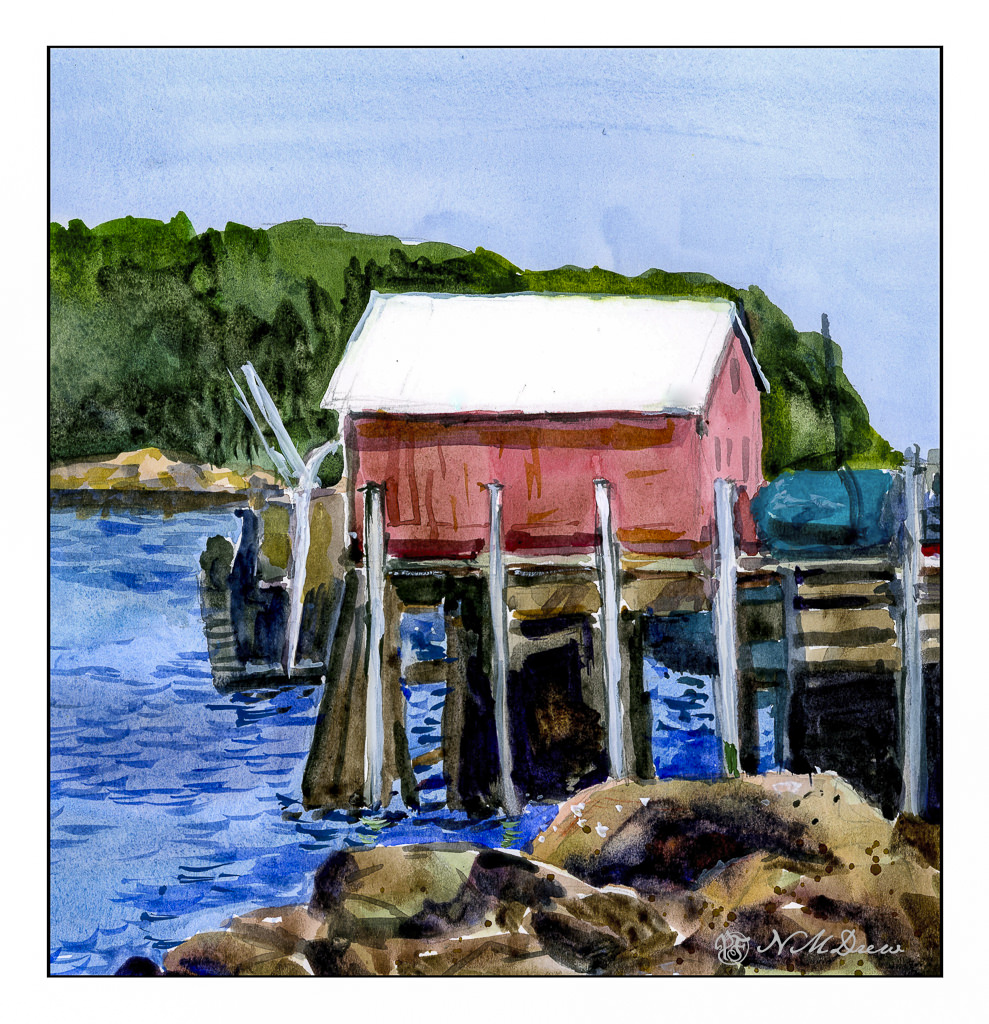
Red Building on the Pier

After playing around with the Strathmore Vision watercolor paper, I used it for today’s painting. Knowing its strength lies in painting directly on it with little to no lifting or scrubbing, I had to reset my thinking for this painting.

First, I did a pencil sketch on the paper, working to get proportions and placement of the bits and pieces in fairly good proportion to each other. From there, I worked as directly as possible to get values and colors the way I wanted them. I moved around the paper, too, laying in big washes and areas of color before adding detail.

First, the foreground rocks. The wash was laid down to get the ranges of tonality and vary the colors within them. Once dried I added the darker areas to create shadows. If you look, you will know the sun is coming from the upper right, and thus shadows will be toward the left.

Next, the sky. It is a very flat sky so I did a wash of a blue mix once I had dampened the paper, carefully working around various shapes. From there, the red of the building on the pier, working around the light uprights. Then, the green of the trees in the distance, being careful about the roof. Finally, the water.

Once all this was dried, the little things began, such as sorting out the supports and boards on the pier, some rock details, and the ripples of darker blue on the water.

This painting took me quite awhile as I tend to splish-splash and be quite impatient. This time around I worked hard to consider the colors and the paint before placing them on the paper. My mind is fried! Still, even though it is not by any means a great watercolor, I do like the way it looks – there is a bit more freshness to it than some of my other ones. I ordered some Sakura Gelly pens in white for better details for more delicate areas – I couldn’t find mine at all.

More watercolors to come, but I am going to use my 100% cotton Arches and try this same approach – more direct and thoughtful. I am curious as to how I will feel about Arches absorbency vs. the Vision. The Vision paper works rather well in this area – a good balance of absorbency without drying out. Surprisingly, even with a fair amount of water, Vision does not buckle as much as Canson XL does, and it seems quite capable of handling water when applied over the entire sheet without a problem.

Both Canson and Vision have problems with lifting color or scrubbing, and in many ways I think continuing the usage of Vision will force me to retrain my painting techniques a bit by requiring patience and forethought.
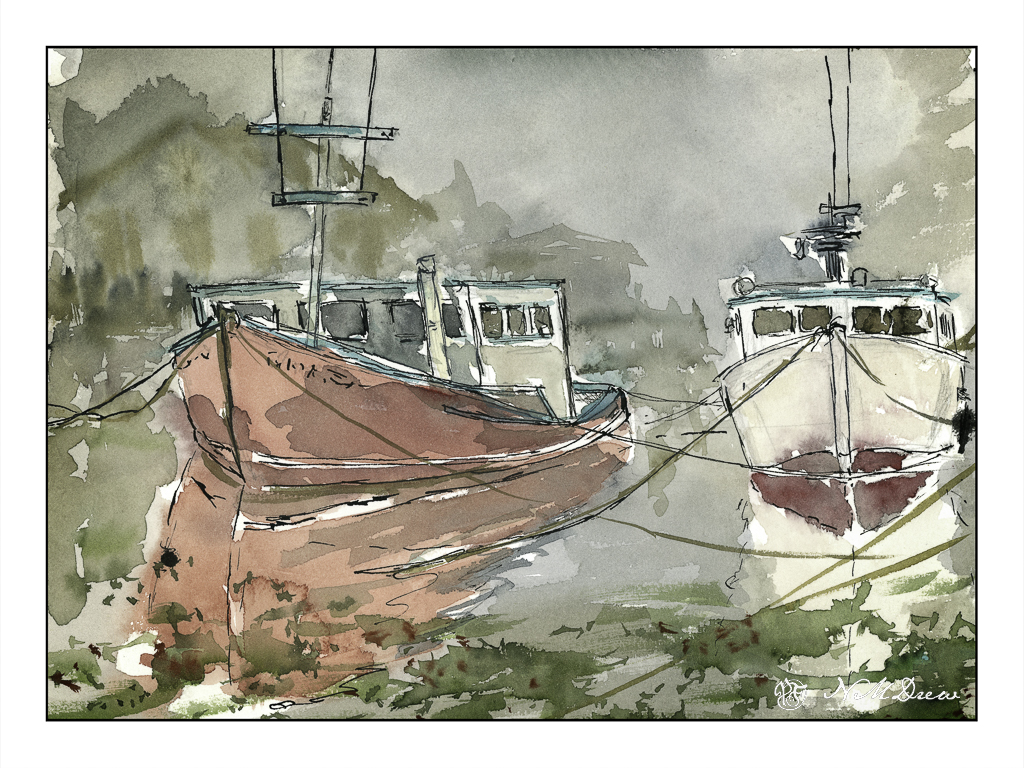
Fishing Boats in a Misty Harbor

This ink and wash painting sort of drew itself. I wanted to paint some more boats, inspired by yesterday’s fortress / citadel / rock ship! I found some photos of fishing boats, drew them first with pencil and then inked them in. From there, lines and misty buildings, and seaweed in the foreground. Now, if you are fishing boat person, you will probably laugh at what I have done – and I don’t blame you – what are some of those things on the boats?!

That said, I think the boats turned out fairly good. The swoop and curve of a boat is always a challenge as most things look like rectangles and squares, with corners rather than a bulging curve out of the water. Reflections, too, are a challenge. I think the direction of the sun influences if reflections are shorter or longer in water – maybe I read it in Ted Kautzky’s classic Ways with Watercolor.

And so I leave you to ponder the boats, the fog, and what might lurk in the distance . . .

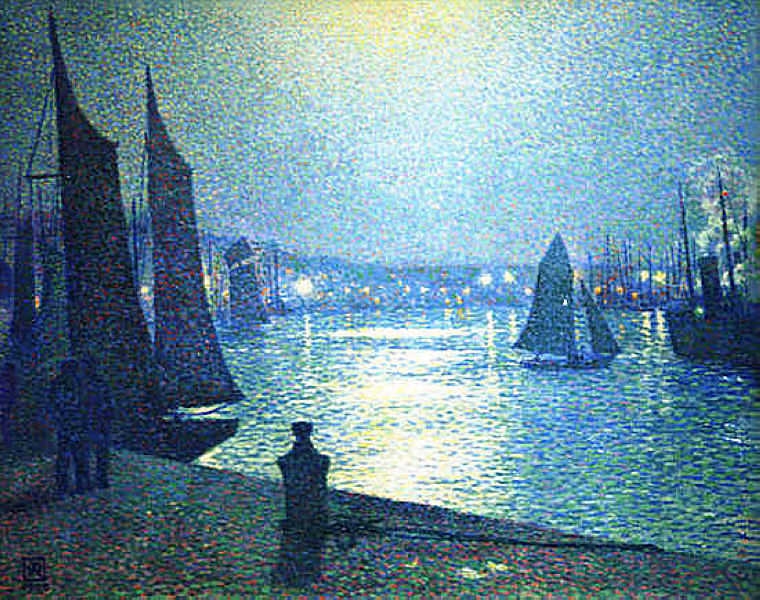
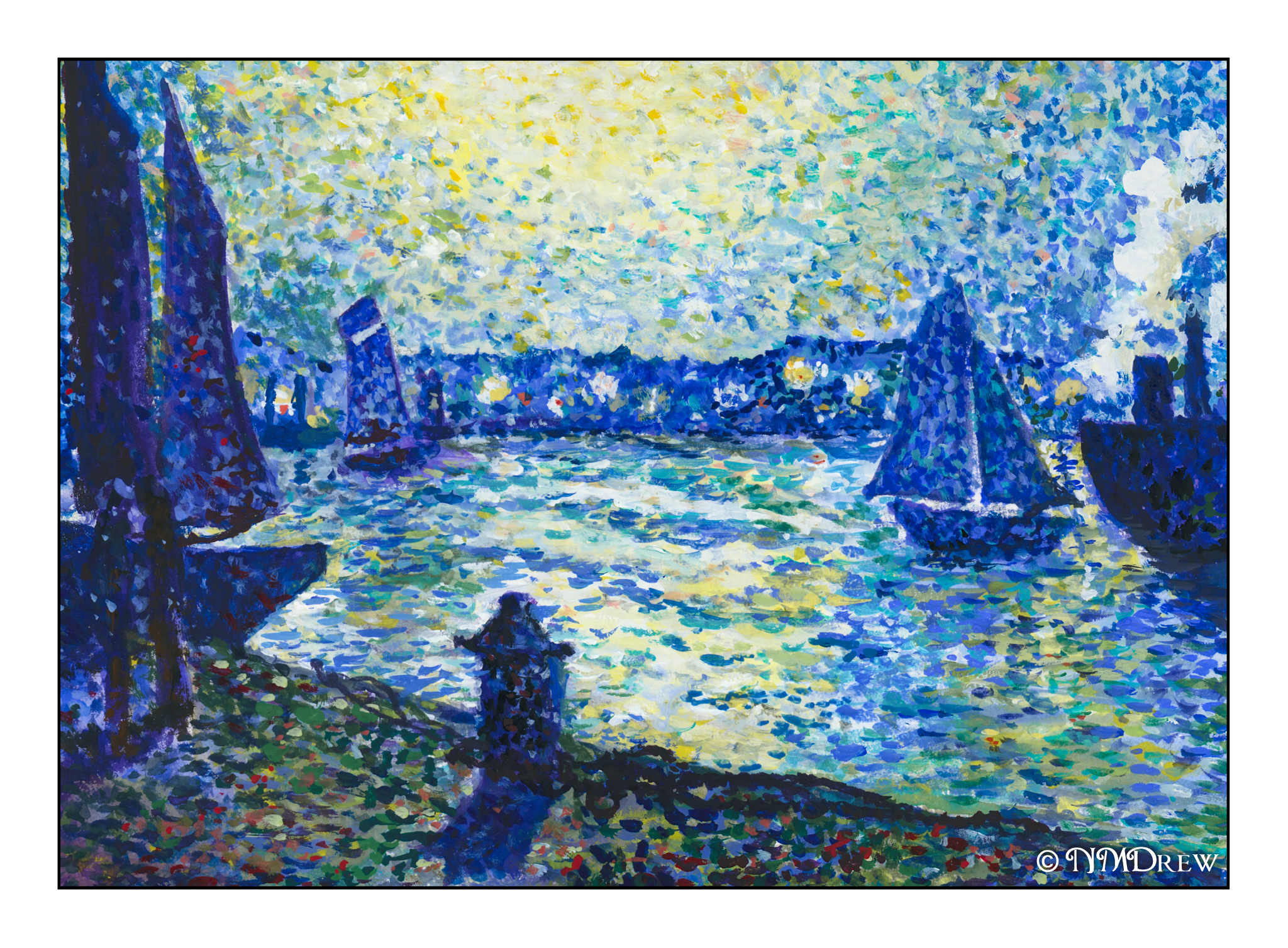
Moonlight Night in Boulogne – Gouache Study After Theo van Rysselberghe

One of the totally fun things about studying a school of painting is exploring its members! Who is this person? Oh, I like that painting! And then, off on a trail of discovery. I am finding a lot of painters I like, many from the post-Impressionist schools of Pointillism. These same painters move not only into Pointillism, but other ways, or schools, of painting that appeal to me in their composition and their colors.

Still, sticking with Pointillism, today’s study is from a painting by Theo van Rysselberghe, a Belgian painter who does lovely work. Here, a study of a moonlit night of a harbor. Boats, sails, reflections, silhouettes, lights, and even a few human beings. Van Rysselberghe’s interpretation of the night, the light of the moon, and the colors used to express the night are so interesting. The lack of light, artificial light, and moonlight all create an atmosphere at once pleasing and rather mysterious. My own agenda has learning to paint the night effectively a high priority.

My own painting is nowhere as good as van Rysselberghe’s, but that is not the point. The focus is on the colors of the night, the blues, the darks – purple? black? phthalo blue? mixtures of all kinds? There is a luminescent quality to even the darkest colors, as well as a brilliance to the lightest that is not quite white, but a pale, pale yellow.

The dots are also more than dots. Brushwork is not only circular dabs of color, but also horizontal lines that are done perhaps with the side of a round brush (mine were!). When I copy a painting, I try to see the brushwork. Gouache does a decent job for copying paintings, but the paintings I have been copying are in oil and certainly oil paintings are much larger than my 9×12 studies, and consequently more subtle.